
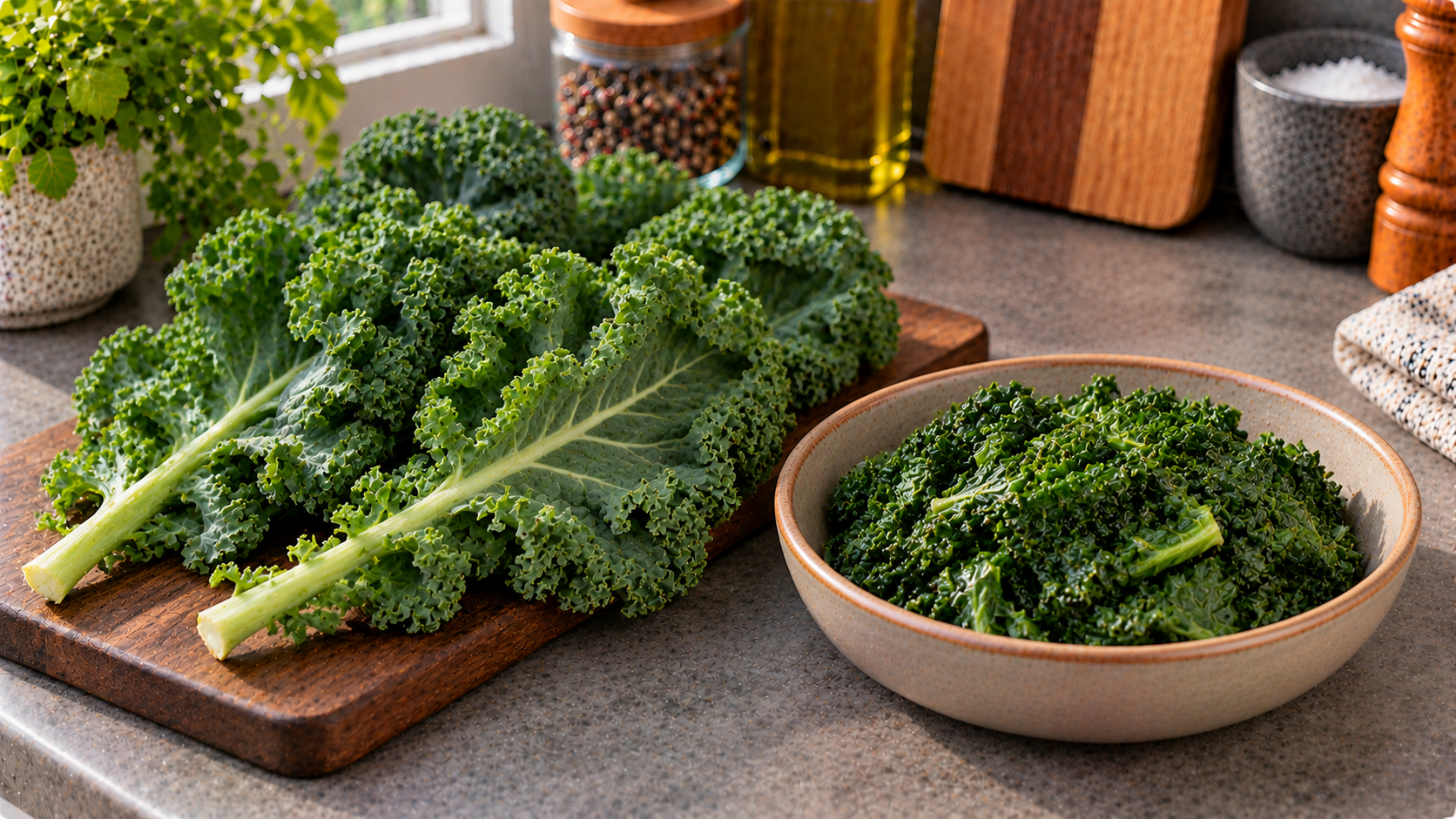
Kale contains approximately 35 calories per 100 g raw and 36 calories per 100 g boiled, drained and prepared without added salt, according to USDA FoodData Central. It is a leafy member of the cabbage family, providing fibre, vitamin C, vitamin K and several minerals.
Kale is relatively low in calories, but the energy content of a finished dish depends on how it is prepared. Raw kale salad, steamed kale, sautéed kale and crispy kale chips can have very different calorie counts.
Kale nutrition: raw versus cooked
The following table uses two USDA FoodData Central SR Legacy entries: raw kale (FDC 168421) and kale cooked, boiled, drained, without salt (FDC 169238).
| Nutrient per 100 g | Raw kale | Boiled kale |
|---|---|---|
| Calories | 35 kcal | 36 kcal |
| Protein | 2.92 g | 2.94 g |
| Carbohydrates | 4.42 g | 5.30 g |
| Dietary fibre | 4.1 g | 4.0 g |
| Fat | 1.49 g | 1.21 g |
| Calcium | 254 mg | 150 mg |
| Sodium | 53 mg | 16 mg |
Sources: USDA raw kale and USDA boiled kale.
Both entries describe edible kale without added oil or dressing. Their differences reflect food composition, moisture, preparation and sampling. Cooking does not create calories.
Different varieties, including curly kale, lacinato or Tuscan kale, may have somewhat different values. Do not assume one database entry describes every kale product exactly.
Calories in common portions
The following examples use 36 kcal and 4.0 g fibre per 100 g of boiled and drained kale.
| Cooked edible portion | Calories | Protein | Fibre |
|---|---|---|---|
| 50 g | 18 kcal | 1.5 g | 2.0 g |
| 75 g | 27 kcal | 2.2 g | 3.0 g |
| 100 g | 36 kcal | 2.9 g | 4.0 g |
| 150 g | 54 kcal | 4.4 g | 6.0 g |
| 200 g | 72 kcal | 5.9 g | 8.0 g |
| 250 g | 90 kcal | 7.4 g | 10.0 g |
These are calculations from the named USDA entry, not separate laboratory measurements.
Calories = cooked edible grams × 36 ÷ 100.
If your kale is weighed raw, use the matching raw value of 35 kcal per 100 g. Raw and cooked weights should not be mixed when tracking food.
For example, 180 g of cooked kale contains approximately 65 kcal before any additional ingredients.
How many calories are in a cup of kale?
A cup is not a universal weight. Loose raw leaves occupy more space than finely chopped or cooked kale.
Raw kale leaves may appear to make a large serving because their volume is high and their weight is relatively low. During cooking, the leaves shrink substantially.
A cup of cooked kale may therefore contain considerably more vegetable by weight than a loosely filled cup of raw leaves.
For accurate tracking, especially when preparing salads or soups, weighing edible kale in grams is more reliable than converting cups without knowing the preparation method.
Remove tough stems if they will not be eaten. The discarded weight should not be included in the consumed portion.
Raw kale, steamed kale and sautéed kale
Plain steamed or boiled kale remains relatively low in calories.
For a practical cooked-kale meal, the kale and white bean soup recipe shows how the leaves fit into a complete dish with other ingredients.
Sautéing introduces additional ingredients, usually oil or butter. Those ingredients can contribute more energy than the kale itself.
For example, 200 g boiled kale provides approximately 72 kcal. Adding 10 g olive oil that is fully consumed contributes approximately 90 kcal, bringing the combined total to around 162 kcal.
This is an example based on specified ingredient quantities, not an average for every sautéed kale recipe.
Garlic, onions and seasonings may also be included. Their amounts should be counted when calculating a complete dish.
When water evaporates during cooking, the finished food weighs less. That can change calories per 100 g even when the total energy of the original ingredients remains nearly the same.
Are kale chips low in calories?
Kale chips are made by baking or dehydrating leaves until crisp, often with oil and seasoning.
Removing water makes the finished product much lighter, so 100 g of chips can represent a much larger starting quantity of raw kale.
Added oil further increases their energy content.
Consequently, kale chips should not automatically be assigned 35 or 36 kcal per 100 g.
For homemade chips, calculate calories from the raw kale, oil and other ingredients used in the batch. Divide by the portions actually eaten.
For packaged kale chips, use the nutrition label and serving weight.
Fresh versus frozen kale
Plain frozen kale can be a convenient alternative to fresh kale.
Freezing does not itself add calories, although product moisture, preparation and the particular reference entry can affect values per 100 g.
Frozen kale containing cream, butter or sauces must be calculated using the complete product's nutrition information.
Check whether the declared serving refers to the frozen contents or the finished, cooked food.
For cooked frozen kale that is drained before eating, a suitable cooked-and-drained entry is generally more relevant than a raw-leaf entry.
Fibre, carbohydrates and digestion
Raw kale provides approximately 4.1 g fibre per 100 g, while the boiled reference contains about 4.0 g.
Fibre can support normal bowel function and contribute to fullness as part of a balanced diet.
Kale contains plant carbohydrates and compounds that may contribute to bloating in some people, especially when large quantities of cruciferous vegetables are eaten.
Cooking until tender and introducing larger portions gradually may improve tolerance. Individual responses vary.
The USDA total-carbohydrate figures include fibre. European food labels generally report available carbohydrate separately from fibre, so the numbers may not be directly interchangeable.
Vitamin C, vitamin K and calcium
Kale can provide substantial amounts of vitamin C and vitamin K. It also contributes calcium, although the amount depends on variety and cooking method.
The specific raw USDA entry in the comparison reports 254 mg calcium per 100 g, compared with 150 mg in the boiled reference.
These values describe two food records; they do not establish the exact mineral loss caused by cooking one particular batch.
Vitamin C is involved in normal immune function and collagen formation. Vitamin K is important for normal blood clotting.
People taking anticoagulants affected by vitamin K should aim for consistent intake and follow their clinician's guidance rather than suddenly eliminating kale.
Although kale contains some protein, an ordinary vegetable serving does not replace a concentrated protein source.
Kale and weight management
Kale can add volume, texture, fibre and micronutrients to meals without providing many calories when served without substantial added fat.
It does not independently cause weight loss. Total dietary energy intake and long-term habits remain more important.
A practical meal might combine kale with potatoes, lentils or beans and an appropriate protein source.
For calorie tracking, record the edible kale weight and any oil, sauce, nuts, cheese or other toppings separately.
Sources and calculation notes
- USDA FoodData Central: kale, raw, FDC 168421.
- USDA FoodData Central: kale, cooked, boiled, drained, without salt, FDC 169238.
Portion values are mathematically derived from the listed reference data and rounded. Actual values depend on preparation, product and edible yield.