
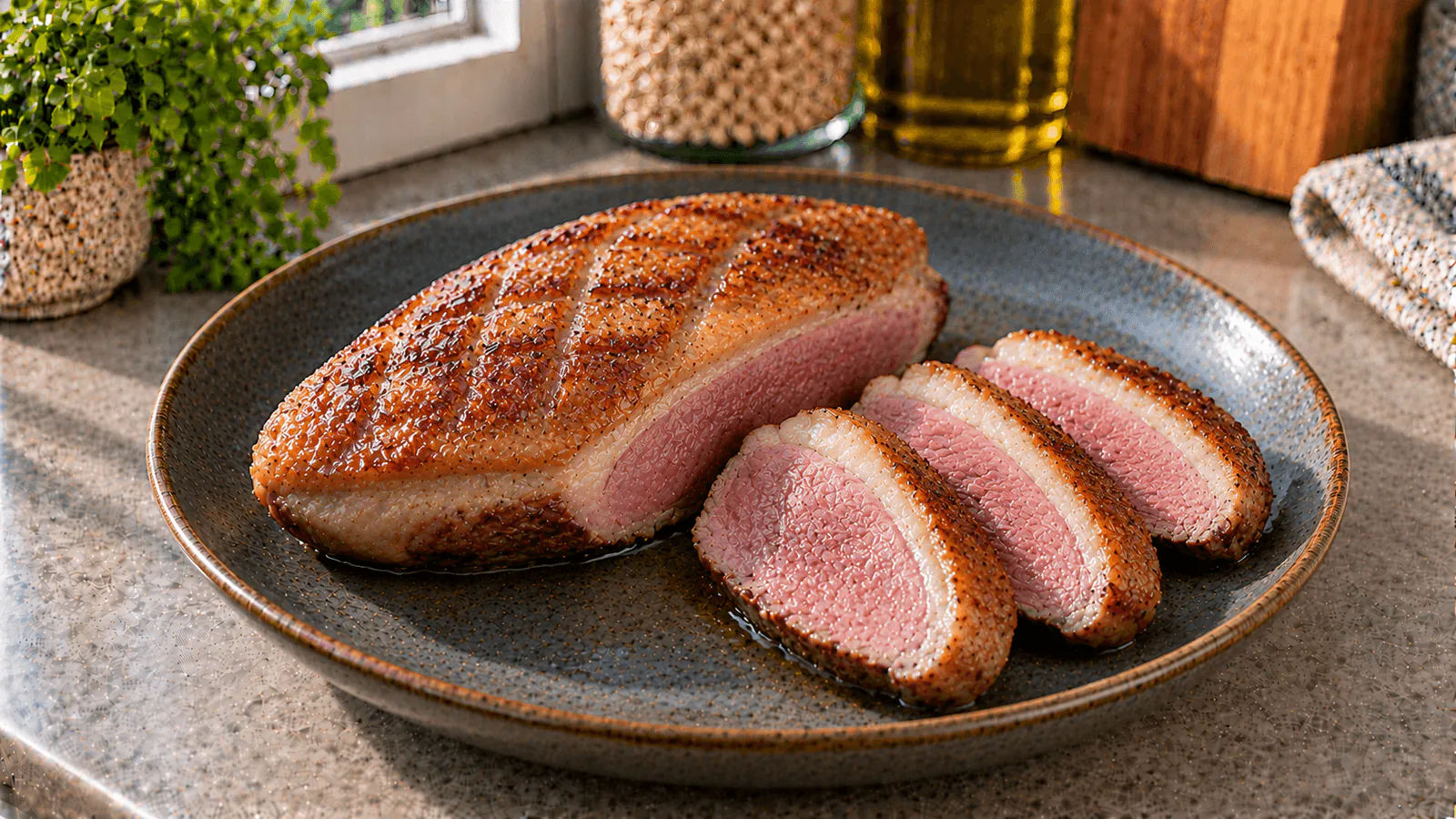
Duck breast can be a relatively lean protein or a richer centrepiece, depending on whether you eat the skin, which cut you buy and how you cook it. The difference is large enough that a single “duck breast calories” number can mislead. For a useful food-diary entry, first choose the correct state of the meat, then weigh the edible amount on the same raw-or-cooked basis used by the nutrition reference.
Quick answer: USDA SR Legacy reports 140 kcal per 100 g for broiled, boneless White Pekin duck breast without skin and 202 kcal per 100 g for roasted, boneless White Pekin duck breast with skin. These are separate cooked-food records, not two outcomes for an identical raw piece. A third USDA record, raw wild duck breast without skin, has 123 kcal per 100 g. Specific supermarket breasts can differ, so use their labels when available.
Duck breast nutrition per 100 g: match the product first
The reference values below describe the edible portion, without bones. The two domesticated-duck rows are cooked products prepared differently. The wild-duck row is raw. Comparing them illustrates why “per 100 g” alone does not tell the whole story.
| USDA duck breast description | Calories | Protein | Fat | Carbohydrates | Sodium |
|---|---|---|---|---|---|
| White Pekin breast, cooked without skin, broiled | 140 kcal | 27.6 g | 2.5 g | 0 g | 105 mg |
| White Pekin breast, meat and skin, roasted | 202 kcal | 24.5 g | 10.85 g | 0 g | 84 mg |
| Wild duck breast, meat only, raw | 123 kcal | 19.8 g | 4.25 g | 0 g | 57 mg |
Sources: USDA skinless cooked breast, FDC 171511, USDA cooked breast with skin, FDC 171510 and USDA raw wild breast, FDC 174469. These are reference profiles, not lab measurements of every breast sold in a shop.
The contrast is mostly a fat issue. The cooked skin-on reference contains about four times as much fat per 100 g as the cooked skinless reference. It is not accurate, however, to subtract exactly 62 kcal from every skin-on serving simply by peeling the skin off after cooking. The final edible weight, fat rendered into the pan and portion of skin actually eaten all matter.
The 123-kcal raw wild-duck figure is included to make a separate point: a raw number should not be applied to a cooked portion. It is not an estimate for a raw domestic White Pekin breast. Species and farming conditions matter alongside cooking state.
How many calories are in a portion of cooked duck breast?
The table scales the two cooked USDA White Pekin profiles above. All weights refer to edible cooked food, not the initial weight in the package, the weight of a bone-in joint or the combined weight of meat and sauce. Numbers are rounded to the nearest whole calorie.
| Cooked edible portion | Cooked, skin removed | Cooked, skin included |
|---|---|---|
| 50 g | 70 kcal | 101 kcal |
| 75 g | 105 kcal | 152 kcal |
| 85 g | 119 kcal | 172 kcal |
| 100 g | 140 kcal | 202 kcal |
| 120 g | 168 kcal | 242 kcal |
| 125 g | 175 kcal | 253 kcal |
| 150 g | 210 kcal | 303 kcal |
| 175 g | 245 kcal | 354 kcal |
| 200 g | 280 kcal | 404 kcal |
A 150 g cooked skinless portion is about 210 kcal in this reference. The same cooked weight with skin is approximately 303 kcal. That difference refers to different reference products, not to the precise energy saved by trimming an individual breast.
A smaller 120 g skinless cooked portion contains about 168 kcal. If you also eat approximately 10 g of added cooking oil, count another 90 kcal: 258 kcal for the meat and oil combined, before sides or sauce. Only include oil you actually consume; fat left in the pan is not part of the plate.
For more on the difference between what you put on a plate and a package's stated serving, read portion size versus serving size.
Raw versus cooked weight: why it changes the answer
An uncooked breast loses some water during heating and may release fat from the skin. A cooked piece usually weighs less than it did raw. Energy is not magically created in the oven, but when water leaves, a fixed 100 g of cooked food can contain more concentrated nutrients than a fixed 100 g of its raw starting material.
Suppose you buy a 200 g raw skin-on breast and the cooked edible piece weighs 150 g. You must not multiply the 200 g raw weight by 202 kcal per 100 g, because 202 is a cooked reference. Nor should you treat the entire original 200 g as if it were cooked edible tissue. If you weigh the final meat and eat its skin, the skin-on cooked reference gives 150 × 202 ÷ 100 = 303 kcal as an estimate. A product-specific nutrition label or recipe measurement may provide a better figure.
This is particularly important when entering duck into a tracker from a photograph. The camera may see a browned skin surface but cannot accurately infer how much fat was rendered away, whether the skin was eaten or what the cut weighed before cooking. Use a kitchen scale once when precision matters, and keep the chosen reference consistent across similar meals.
Does removing the skin make duck breast lean?
The cooked skinless White Pekin entry contains 27.6 g protein and 2.5 g fat per 100 g. On that reference, it is a lean, high-protein choice. Cooked breast with skin has 24.5 g protein and 10.85 g fat per 100 g. Both provide protein; neither automatically determines whether a meal fits your energy target.
An easy approach is to choose the version you actually ate. If you roasted a breast skin-on but left the entire skin on the plate, logging the skin-on reference may overestimate the food consumed. On the other hand, if you ate crisp skin and pan sauce made from rendered fat, logging only the skinless breast will underestimate the plate. If the package has nutrition information for a defined state, that may be more representative of the specific product.
For context, compare the different baselines used in chicken breast nutrition and turkey breast nutrition. A chicken or turkey number should not be substituted directly for duck simply because all three are poultry.
Pan-searing, roasting, sauces and rendered duck fat
Duck breast is often started skin-side down in a pan to render fat. This cooking method does not imply that all fat remains in the meat; some may collect in the pan. But a dish may then include that fat again in a sauce or used to roast potatoes. In calorie tracking, account for where the fat ends up rather than automatically adding the full amount rendered plus the full amount originally in the breast.
Three situations illustrate the difference:
- Dry-roasted and skin eaten: select an entry for cooked duck with skin, then add the sauce and sides actually eaten.
- Skin removed before eating: choose a skinless cooked reference when it represents the edible portion reasonably well; measure the meat after trimming.
- Breast sautéed in extra oil or butter: use an appropriate duck entry and add the amount of cooking fat retained in the meal, not automatically everything poured into the pan.
For different ways cooking fats influence a recipe, see butter versus olive oil. The choice of fat affects flavour and fat composition, but its calories still count when the fat is eaten.
A glossy orange glaze, honey sauce or sweet restaurant reduction can shift the total further. Without a recipe or nutrition label, any exact figure for a glazed duck breast is only an estimate. The same applies to cured, smoked or pre-marinated duck, where added ingredients and sodium can change the nutritional picture.
A practical method for recording duck breast
First, decide whether you want to record the raw packaged food or the cooked food. If you can access the package label, note whether its figures describe raw or cooked product. Weigh the meat at the matching stage. If you use a cooked-food database value, weigh the cooked edible portion after excluding bones and any skin you did not eat.
Second, record cooking additions separately when possible. A tablespoon measured before cooking is not necessarily a tablespoon eaten: some may remain in the pan. If the oil is incorporated into a sauce served over the duck, include it. If fat drains off and is discarded, do not count it a second time.
Third, log side dishes independently: potatoes, rice, vegetables, bread and sauce can easily make the total meal substantially different from the duck alone. At a restaurant, using a reasonable portion estimate is better than presenting a highly precise number based on a photo without knowing the recipe.
Lastly, compare entries by their wording. “Duck meat only, raw,” “duck breast, cooked without skin” and “duck breast, cooked with skin” are not interchangeable. A change of only one phrase can be responsible for a large difference in the reported calories.
Food safety: check the temperature, not the colour
Duck breast is sometimes served pink. Colour alone does not prove that it is safe. USDA Food Safety and Inspection Service recommends cooking duck and other poultry to an internal temperature of 74°C (165°F), checked with a food thermometer in the thickest part of the breast. The USDA also notes that safely cooked duck can retain a pink colour. See the official USDA guidance for duck and goose. Keep raw poultry separate from foods that will be eaten without further cooking and clean tools and surfaces after handling it.
How to use the source numbers correctly
For transparency, the key references are the USDA cooked skinless Pekin breast, cooked skin-on Pekin breast and raw wild duck breast. Each gives nutrients per 100 g of the named edible food. Values are not an instruction to treat all duck breasts as identical.
For most meals, the useful answer is therefore not one universal calorie count. Choose the right type of duck, identify whether skin was eaten, select raw or cooked weight consistently, weigh the portion you actually consume and add sauces or cooking fat separately. Those choices will usually improve the estimate much more than rounding a nutrition database entry to another decimal place.