
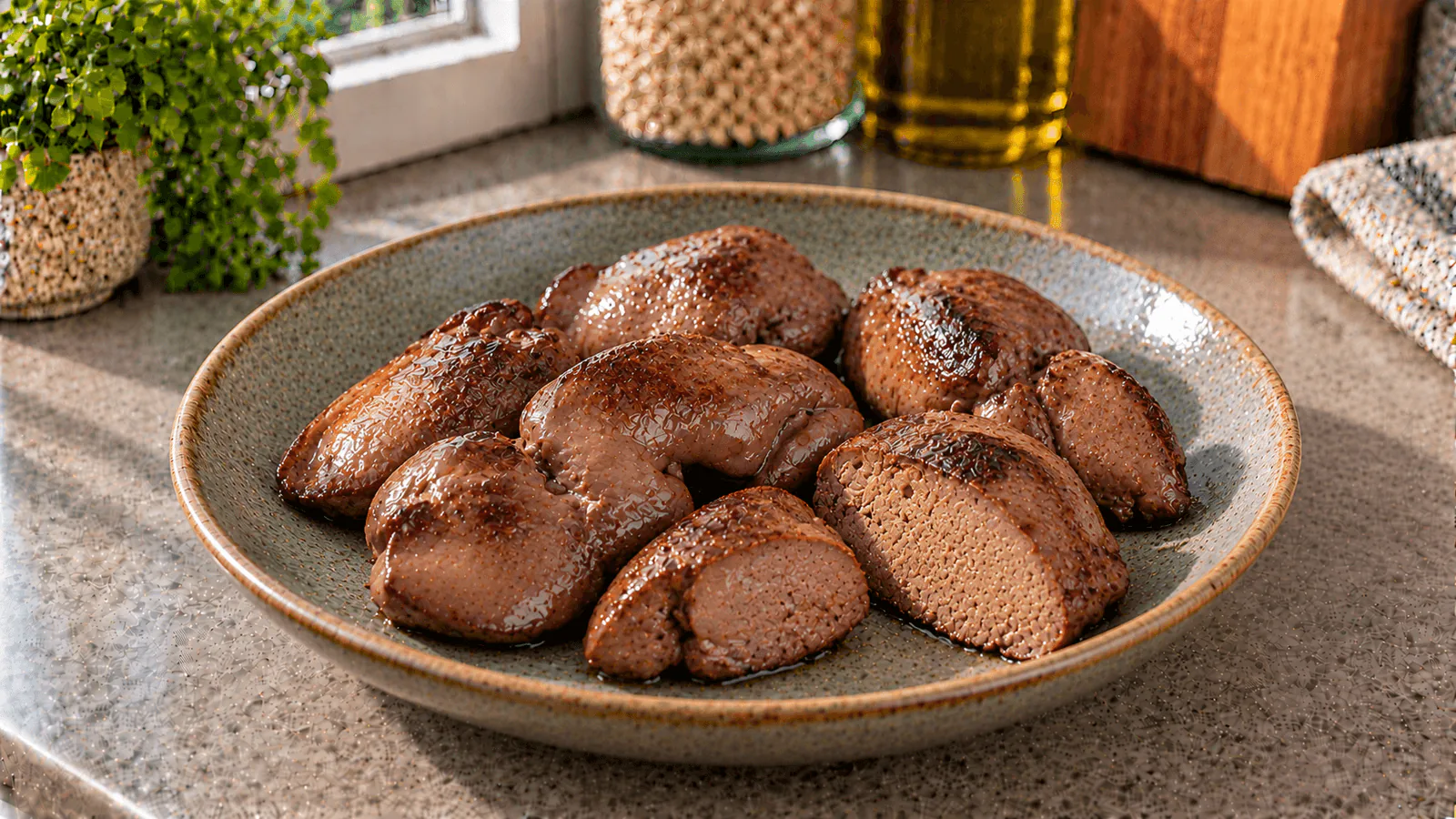
Chicken liver provides about 119 calories per 100 g when raw, compared with 167 kcal per 100 g when simmered and 172 kcal per 100 g when pan-fried, according to three distinct USDA FoodData Central SR Legacy records. These figures describe different food states. They are not interchangeable, and the higher cooked values per 100 g do not mean that heat creates energy.
This guide shows how to log chicken liver by edible weight, how to choose between raw and cooked database entries, and how to account for oil, onion, pâté and sauces. It also explains why chicken liver's unusually high preformed vitamin A content and safe cooking temperature deserve more attention than a simple calorie number.
Chicken liver nutrition: raw, simmered and pan-fried
All numbers in this first table describe 100 g of the named form, not one whole liver or one portion of an assembled dish. Values are rounded from the USDA records for chicken liver, all classes. The pan-fried entry represents the food analysed in that preparation state; it is not a recipe for every restaurant or household frying method.
| Chicken liver state | kcal per 100 g | Protein | Fat | Carbohydrates | Sodium |
|---|---|---|---|---|---|
| Raw | 119 kcal | 16.90 g | 4.83 g | 0.73 g | 71 mg |
| Cooked, simmered | 167 kcal | 24.50 g | 6.51 g | 0.87 g | 76 mg |
| Cooked, pan-fried | 172 kcal | 25.80 g | 6.43 g | 1.11 g | 92 mg |
Primary records: USDA — raw chicken liver, FDC 171060, USDA — simmered chicken liver, FDC 171061, and USDA — pan-fried chicken liver, FDC 174491.
Chicken liver supplies complete animal protein, relatively little carbohydrate and substantial amounts of several micronutrients. However, the sodium figure above is intrinsic sodium in the reference food, not a prediction for a salted restaurant dish. Fat, flavourings and cooking liquid can change the numbers you log. Meat from the chicken breast or thigh has a different nutrient profile even though all three foods come from chicken.
How many calories in 50, 75, 100 or 150 g?
Use the weight you actually ate, after cooking if you select a cooked reference. For these two preparation states, the table is calculated directly from 167 and 172 kcal per 100 g. Portions are illustrative weights, not a recommendation to consume chicken liver frequently.
| Cooked edible weight | Simmered liver | Pan-fried liver |
|---|---|---|
| 50 g | 84 kcal | 86 kcal |
| 75 g | 125 kcal | 129 kcal |
| 85 g | 142 kcal | 146 kcal |
| 100 g | 167 kcal | 172 kcal |
| 125 g | 209 kcal | 215 kcal |
| 150 g | 251 kcal | 258 kcal |
| 200 g | 334 kcal | 344 kcal |
For example, 125 g of simmered chicken liver is about 209 kcal, before butter, oil, gravy or side dishes. 150 g of pan-fried liver is about 258 kcal using the cited USDA record. If a ready-to-eat product specifies a different calorie figure, its label is the more appropriate reference for that specific product.
A kitchen scale is much more useful than counting individual livers. The USDA household measure sometimes uses a single liver, but actual pieces vary markedly in size and trimming. For more on the distinction between a reference serving and the food on your plate, see Mealisa's guide to portion size versus serving size.
Raw weight and cooked weight are different quantities
Chicken liver loses water during cooking. For that reason the cooked values are more concentrated per 100 g. Someone starting with 300 g of raw liver should not automatically log 300 g of cooked liver afterward. Nor should they take the raw calories and add the cooked calories: the two entries describe alternative ways to estimate the same ingredient.
Imagine a batch weighing 300 g raw. It contains approximately 357 kcal according to the raw reference before added ingredients. If the cooked, drained batch weighs 225 g, that doesn't mean its total food energy increased merely because its mass fell. Real cooking can also move nutrients into discarded juices, so the raw-batch and cooked-database approaches may not match exactly. Choose one approach and apply it consistently.
For a weighed cooked portion, select a cooked database entry that resembles the preparation. For a home recipe logged from raw ingredients, record raw liver and every other edible ingredient once, then divide by the finished servings. Do not combine raw-liver calories with a second full entry for cooked liver.
What changes when you fry chicken liver?
The USDA pan-fried reference is 172 kcal per 100 g. That does not cover every possible amount of cooking oil. Extra fat that stays in the pan should not automatically be charged to the plate, while fat absorbed by the liver or present in a sauce needs consideration.
The most defensible method for a homemade pan is to weigh the oil put in, estimate or measure what remains, and avoid adding oil twice if you are using a prepared-food database entry that already incorporates the relevant frying fat. A different cooking method, breading or butter-based sauce warrants its own ingredient calculation.
Here is an illustrative meal calculation using the simmered reference as a clear starting point and assuming all explicitly listed added fat is consumed:
| Scenario | Calculation | Estimated energy |
|---|---|---|
| 150 g simmered chicken liver | 150 × 167 ÷ 100 | 251 kcal |
| 10 g oil consumed with the dish | 10 × 9 kcal | 90 kcal |
| Combined liver and oil | 251 + 90 | 341 kcal |
The 341 kcal total excludes onions, flour, vegetables and side dishes. The assumed 9 kcal per gram is a useful approximation for culinary oil; a product label may give a slightly different value. If only part of the oil was eaten, use that quantity rather than the whole amount poured into the pan.
Chicken liver pâté, gravy and prepared products
Pâté and liver spreads often contain butter, cream, oil or other energy-dense ingredients. They cannot be estimated accurately from the raw, simmered or pan-fried liver tables alone. Read the manufacturer's nutrition label per 100 g and multiply by the amount actually eaten, including the spread on bread or crackers.
A liver-and-onion dish is another distinct recipe. Weigh the liver, oil and onions separately and count any flour, sugar or stock concentrate. The energy in a cream sauce can be much greater than the difference between 167 and 172 kcal per 100 g liver. When eating out, the portion and cooking method are usually more uncertain than the laboratory reference value.
For comparison with a more familiar cut, see calories in chicken breast. Our guide to chicken thigh calories covers another distinct cut; neither page's numbers should be copied onto liver. A similar principle applies to turkey breast, which has its own raw and cooked references.
Protein, iron, B12 and vitamin A
Chicken liver is rich in protein and contains iron, vitamin B12, folate and preformed vitamin A (retinol). The USDA raw record reports about 9 mg iron, 16.6 µg vitamin B12 and 3,296 µg vitamin A RAE per 100 g. The simmered record reports about 11.6 mg iron and 3,981 µg vitamin A RAE per 100 g cooked. These are reference measurements for different water contents, not a promise that every individual liver has the identical level.
Its high iron and B12 content does not justify eating large portions daily or using liver as a substitute for clinical assessment of deficiencies. Iron status depends on many factors and is not determined by the nutrient value of one meal.
Vitamin A is the important caution. Unlike carotenoids in many vegetables, liver supplies concentrated preformed vitamin A. The UK's NHS advises people not to eat liver or liver products more than once a week because too much vitamin A can be harmful; people eating liver regularly should pay attention to supplements containing vitamin A as well. See the NHS vitamin A guidance.
During pregnancy, avoid liver and liver products, according to the NHS foods-to-avoid guidance. This applies even when liver is cooked safely; it is a vitamin A concern separate from the bacterial risks of undercooked poultry. If you have a medical reason to manage vitamin A or iron intake, seek individual professional advice rather than using a generic portion table as a prescription.
Cooking chicken liver safely: 74 °C, not a pink-centre guess
The USDA Food Safety and Inspection Service warns that chicken liver can carry Campylobacter or Salmonella internally as well as on its surface. It specifically advises cooking chicken liver throughout to 165 °F (73.9 °C, approximately 74 °C), checked with a food thermometer. Browning the outside or preparing a pink-centred pâté does not establish safety. Read USDA FSIS chicken liver safety guidance and the safe-temperature chart.
Keep raw liver and its juices away from foods that will be eaten without cooking; wash hands, tools and surfaces after handling. Refrigerate perishables promptly. Texture or colour alone is not a reliable substitute for a thermometer. Never taste raw liver to check seasoning.
A practical method for logging a chicken-liver meal
First decide whether you know the raw or cooked weight, and choose the corresponding chicken-liver entry. Second, log the edible liver, excluding discarded connective tissue or packaging. Third, account separately for absorbed oil, butter, flour, sauce and sides, without duplicating fat already included in a prepared-food entry. Finally, divide a batch recipe by the actual portions eaten rather than by an assumed number of individual livers.
For nutrient tracking, remember that even a small calorie portion can provide a large amount of preformed vitamin A. The most useful calorie result therefore includes both the food state and a realistic portion weight, with safety and frequency considered separately.
Sources and calculation basis: USDA raw chicken liver (FDC 171060); USDA simmered chicken liver (FDC 171061); USDA pan-fried chicken liver (FDC 174491). Serving calories are rounded calculations from these 100 g references; they are not separate laboratory tests.