
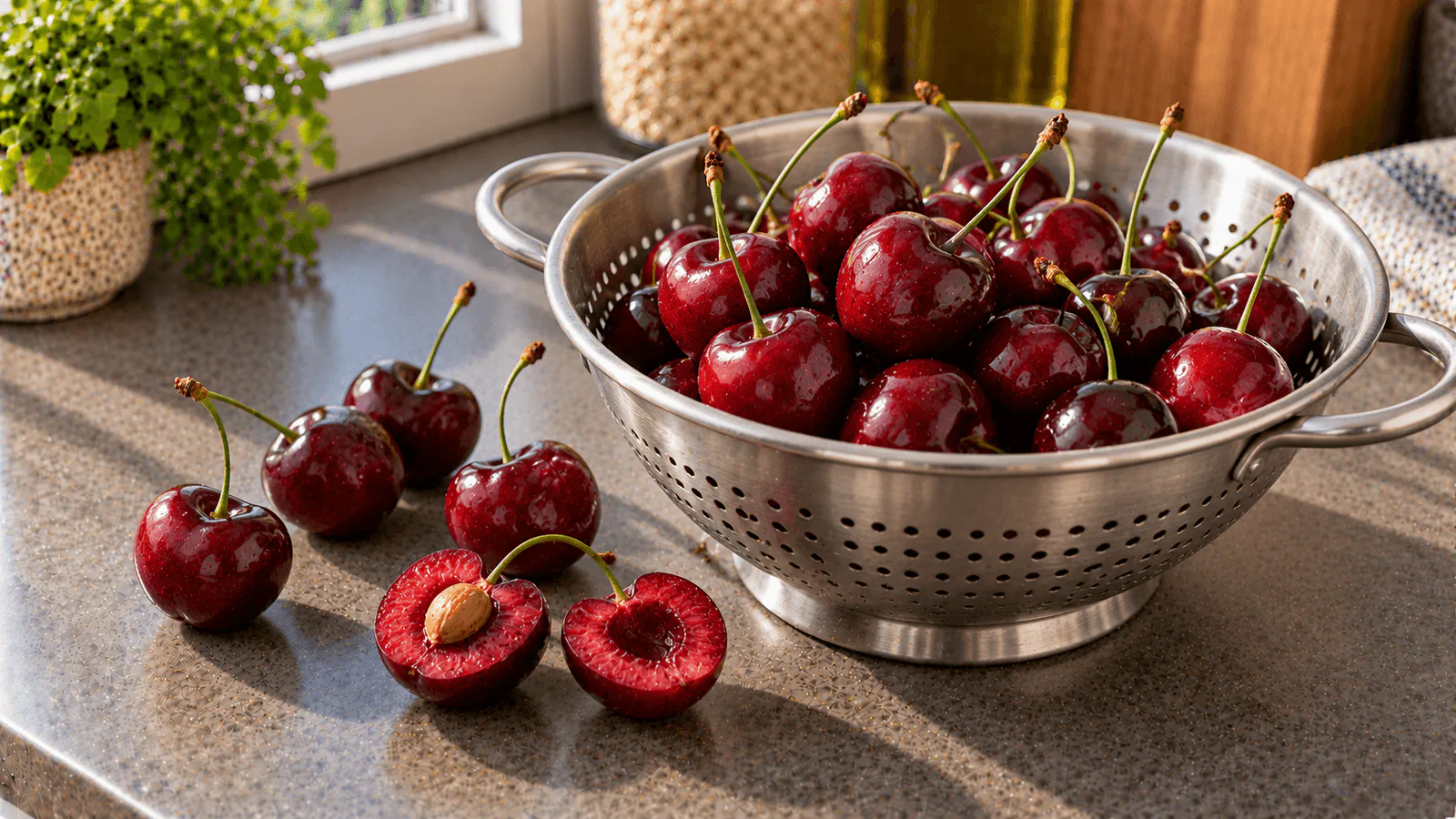
Raw sweet cherries contain about 63 calories per 100 g of edible fruit, according to USDA FoodData Central. Sour red cherries have a separate reference value of about 50 kcal per 100 g. These values refer to the fruit flesh, not stems or stones, and do not describe cherry jam, pie filling, dried cherries or a glass of juice.
A few cherries are easy to count, but their size and edible weight vary. The most useful way to track calories is to distinguish the fruit you actually ate from the total weight purchased with pits.
Cherry nutrition: sweet and sour fruit
Two USDA SR Legacy entries describe fresh cherries. The sweet-cherry record is Cherries, sweet, raw, FDC 171719; the sour-cherry record is Cherries, sour, red, raw, FDC 173954.
| Nutrient, per 100 g edible fruit | Sweet cherries, raw | Sour red cherries, raw |
|---|---|---|
| Energy | 63 kcal | 50 kcal |
| Protein | 1.06 g | 1.00 g |
| Total carbohydrate (USDA) | 16.01 g | 12.18 g |
| Total natural sugars | 12.82 g | 8.49 g |
| Dietary fibre | 2.10 g | 1.60 g |
| Fat | 0.20 g | 0.30 g |
| Water | 82.25 g | 86.13 g |
Sources: USDA sweet cherries, raw and USDA sour red cherries, raw. Reference averages are not guaranteed values for any particular cultivar, ripeness or harvest.
Sweet and sour are culinary categories, not a way to measure sugar from the fruit's taste. Differences between the two entries are meaningful for tracking, but individual cherries still vary.
USDA's total carbohydrate includes fibre; European packaged-food labels generally report available carbohydrate separately from fibre. Do not compare numbers from the two systems as if they used identical definitions.
Calories in a handful, cup or bowl of cherries
Using 63 kcal, 12.82 g sugars and 2.1 g fibre per 100 g of sweet, pitted edible cherries gives these rounded portion estimates:
| Edible sweet cherries | Calories | Natural sugars | Fibre |
|---|---|---|---|
| 50 g | 32 kcal | 6.4 g | 1.1 g |
| 80 g | 50 kcal | 10.3 g | 1.7 g |
| 100 g | 63 kcal | 12.8 g | 2.1 g |
| 138 g | 87 kcal | 17.7 g | 2.9 g |
| 154 g | 97 kcal | 19.7 g | 3.2 g |
| 200 g | 126 kcal | 25.6 g | 4.2 g |
Formula: edible grams × 63 ÷ 100 = approximate sweet-cherry calories. For example, 150 g of pitted sweet cherries contains 94.5 kcal, normally rounded to 95 kcal.
The USDA reference includes household measures such as a cup of cherries weighed after accounting for pits, but cups are not perfectly reproducible. A 138 g edible yield and a 154 g pitted cup are different measured amounts; neither is a mandatory serving size.
If you track a snack by volume or by handful, use a scale occasionally to learn your own usual portion. A guide to portion size versus serving size explains why a database reference serving and a personal portion can differ.
How many calories are in one cherry or ten cherries?
A sample cherry weighing 8 g after removing the pit contains approximately 5 kcal. Ten such edible cherry portions weigh 80 g and contain about 50 kcal. Larger cherries can contribute more than that, while small ones contribute less.
The pit is not edible and can represent a noticeable part of the purchased weight. It is therefore misleading to take the weight of ten intact cherries and treat all of it as edible flesh.
For a reasonably accurate estimate, weigh the fruit before eating and then weigh the stems and pits you discarded; subtract the discarded weight. Alternatively, pit the cherries first and weigh the actual edible fruit.
Use exactly the same approach with cherries in a recipe: the amount entering the bowl after pitting determines the appropriate raw-fruit calculation.
Cherries with pits: avoiding an easy tracking error
If 250 g of cherries were purchased with stones, the edible amount is less than 250 g. There is no single stone-to-fruit ratio suitable for every cherry variety or batch.
If your measured edible yield is 225 g, the sweet-cherry calculation is 142 kcal after rounding (225 × 0.63 = 141.75). The 250 g purchase weight would instead give 158 kcal and overstate the edible portion in this example.
When serving cherries to young children, remove the pits and prepare the fruit to reduce choking risk. The hard pits must not be treated as part of a normal edible portion.
Sweet cherries, sour cherries and cooking cherries
Sweet cherries are commonly eaten fresh. Sour cherries are often used for baking, compotes, sauces and preserves. Their USDA raw values are 63 versus 50 kcal per 100 g, respectively.
However, sour cherry products often contain sugar because the fruit tastes tart. A sour-cherry filling with added sugar can contain more calories per 100 g than plain sweet cherries despite starting with a lower-calorie raw fruit.
Use the actual product label or the weighed ingredients of the recipe rather than inferring calories from the word “sour.” If a dish combines varieties, calculate each fruit separately where practical.
Fresh cherries versus frozen, canned or dried cherries
Freezing plain cherries does not add energy. But frozen sweetened cherries, cherry syrup and concentrated dried fruit may have very different calories per 100 g.
| Form | What changes | Best way to record it |
|---|---|---|
| Fresh sweet cherries | Flesh and natural juice, no added ingredients | Raw sweet-cherry value by edible grams |
| Frozen unsweetened cherries | Usually similar ingredients, variable pack processing | Package values or suitable unsweetened entry |
| Sour cherries canned in water | Added liquid changes total package weight | Label, drained amount and liquid consumed |
| Cherries in syrup or pie filling | May contain added sugar and starch | Product label or complete recipe |
| Dried cherries | Most water removed; sugar may be added | Exact brand label and edible grams |
| Cherry juice | Fibre and pulp may differ from whole fruit | Drink label and millilitres consumed |
For further context, see Mealisa's dried versus fresh fruit comparison. It explains why reducing water changes the amount of fruit represented by 100 g, even when the underlying fruit is similar.
What about natural sugars and fibre?
For sweet cherries, the reference lists 12.82 g naturally present sugar and 2.10 g fibre per 100 g. This does not mean sugar has been added to the fresh fruit. A product such as cherry jam may contain both fruit sugars and added sugar.
The difference matters when reading labels. Natural sugars are included in total sugars; added sugars are a separate concept where separately declared.
A 200 g portion of sweet cherries contributes about 4.2 g fibre by calculation. That can help overall fibre intake, but cherries are not a complete source of protein or a substitute for a varied diet.
Comparing cherries with other fresh fruit
Nutrition comparisons work best per 100 g of edible fruit, not per whole fruit or shopping packet. Strawberries and cherries differ in their reference energy density and naturally occurring sugars. The Mealisa strawberry calorie guide provides a separate reference if you are choosing fruit for a snack.
The same applies when comparing grapes: a grape portion guide can help you avoid assumptions based on handfuls or bunch size.
No single fruit needs to be labelled inherently “better.” Variety, taste, budget, convenience and the rest of your meal also matter.
Cherries in yogurt, desserts and smoothies
A practical calculation can show why the toppings frequently matter. Suppose a bowl contains 150 g pitted sweet cherries (95 kcal after rounding), 170 g plain yogurt labelled 60 kcal/100 g (102 kcal), and 15 g nuts labelled 600 kcal/100 g (90 kcal).
The illustrative bowl totals 287 kcal: 95 + 102 + 90. The yogurt and nut figures are explicit example-label assumptions; replace them with the brands you actually use.
Cherry pie, ice cream, compote and syrup are recipes, not raw cherries. Count flour, fat, sugar and any other ingredients separately, and divide the finished batch by the number or weight of portions consumed.
How to enter cherries into a food diary
Select sweet cherries, raw for fresh sweet cherries and sour red cherries, raw for sour fruit. Enter the actual edible weight without pits and stems. If you cannot weigh the fruit, use a clearly marked approximate portion instead of implying exact precision.
For frozen or packaged preparations use the matching product entry. If you ate a dessert, enter the whole recipe rather than only the cherries. This produces a more realistic calorie estimate without unnecessary restrictions on enjoying fruit.
Source notes
- USDA FoodData Central — Cherries, sweet, raw, FDC 171719
- USDA FoodData Central — Cherries, sour, red, raw, FDC 173954
All portion figures are rounded calculations based on reference composition. Individual fruit and finished products may vary.