
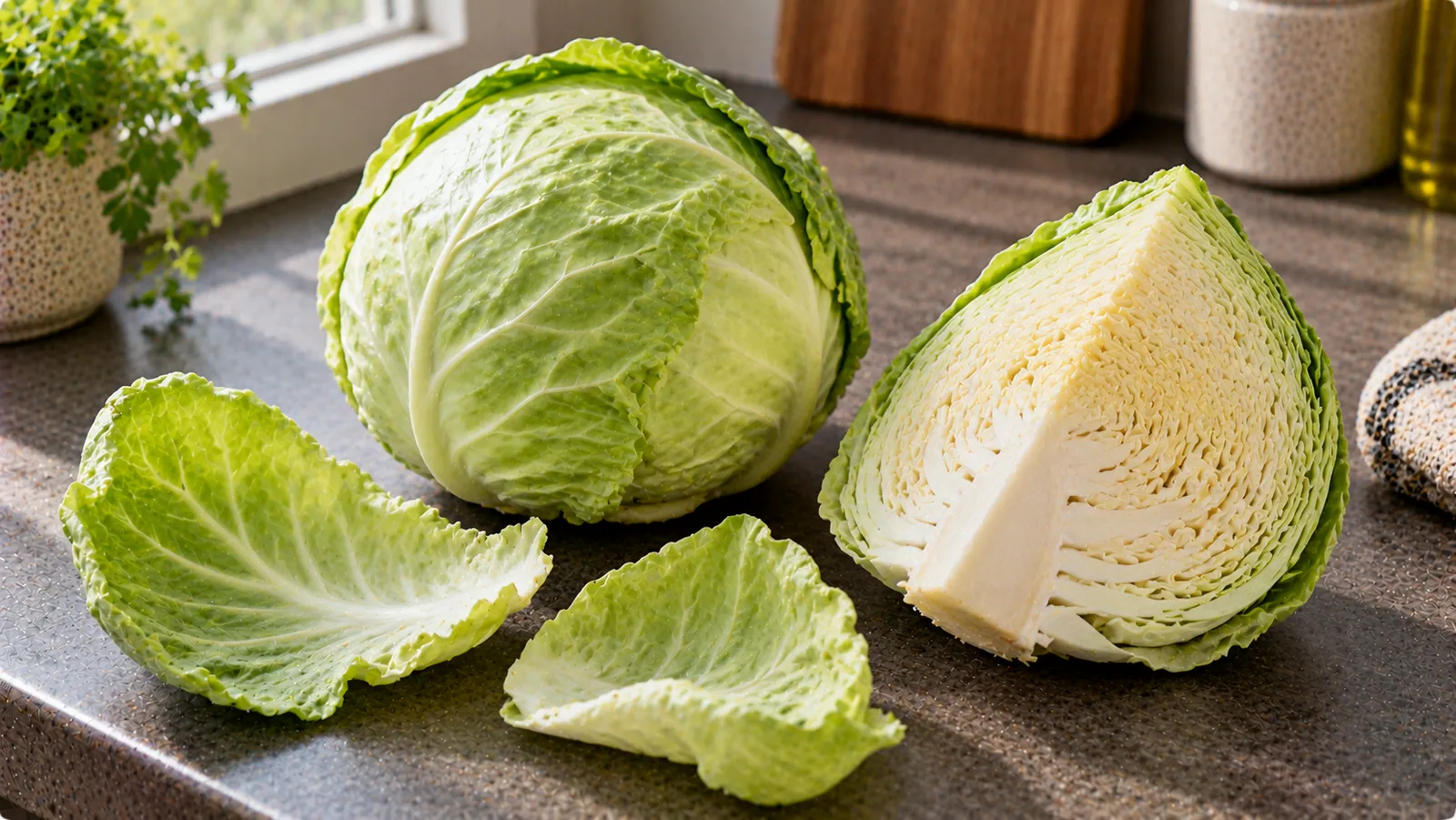
Cabbage is used in salads, soups, stews, stir-fries, roasted vegetable dishes and fermented foods. Its calorie content is relatively low, but the energy in a prepared cabbage dish depends on the variety, portion size and ingredients added during cooking.
Raw green cabbage contains approximately 25 kcal per 100 g, based on a commonly used USDA food composition reference.
A 200 g portion therefore provides about 50 kcal before adding oil, butter, meat, dressing or other ingredients.
Cabbage calories by weight
The following calculations use 25 kcal per 100 g of raw green cabbage.
| Raw green cabbage | Approximate calories |
|---|---|
| 50 g | 13 kcal |
| 75 g | 19 kcal |
| 100 g | 25 kcal |
| 150 g | 38 kcal |
| 200 g | 50 kcal |
| 250 g | 63 kcal |
| 300 g | 75 kcal |
| 400 g | 100 kcal |
| 500 g | 125 kcal |
Values are rounded.
To calculate another amount:
Calories = weight in grams × 25 ÷ 100
For example, 350 g of raw green cabbage provides approximately 88 kcal.
These values describe the edible raw vegetable, not a finished recipe.
Source: USDA FoodData Central.
Cabbage nutrition per 100 g
A commonly cited USDA reference for raw green cabbage provides approximately:
| Nutrient | Per 100 g |
|---|---|
| Energy | 25 kcal |
| Protein | 1.28 g |
| Fat | 0.10 g |
| Total carbohydrate, US definition | 5.80 g |
| Dietary fiber | 2.5 g |
| Total sugars | 3.20 g |
| Water | 92.2 g |
| Vitamin C | 36.6 mg |
| Vitamin K | 76 µg |
| Potassium | 170 mg |
| Folate | 43 µg |
Actual values vary with variety, growing conditions, storage and analytical methods.
Why carbohydrate figures may differ
US food composition data generally include fiber within total carbohydrate. European nutrition labels report available carbohydrate separately from fiber.
Using the figures above, a simplified estimate is:
5.80 g total carbohydrate − 2.5 g fiber = approximately 3.3 g available carbohydrate per 100 g.
This subtraction is an illustration, not a guaranteed conversion between analytical methods.
Check the definitions used by your nutrition database before comparing carbohydrate values.
References: USDA FoodData Central and Regulation (EU) No 1169/2011.
How many calories are in one cup of cabbage?
Cup measurements depend on how finely the cabbage is chopped and how tightly it is packed.
One commonly used reference for a cup of chopped raw cabbage is approximately 89 g.
At 25 kcal per 100 g, that provides about 22 kcal.
| Chopped raw cabbage | Approximate weight | Calories |
|---|---|---|
| Half cup | 45 g | 11 kcal |
| One cup | 89 g | 22 kcal |
| Two cups | 178 g | 45 kcal |
| Three cups | 267 g | 67 kcal |
These are approximate reference weights.
Shredded cabbage, large leaves and cooked cabbage can occupy the same volume at different weights.
A kitchen scale is more reliable when tracking food intake.
Calories in a whole cabbage
A whole cabbage includes outer leaves and a central core. The edible amount depends on trimming and preparation.
The purchase weight is therefore not always the same as the weight eaten.
| Edible raw cabbage | Approximate calories |
|---|---|
| 300 g | 75 kcal |
| 500 g | 125 kcal |
| 700 g | 175 kcal |
| 1,000 g | 250 kcal |
| 1,500 g | 375 kcal |
These are illustrative edible weights, not official classifications of cabbage size.
If you prepare a whole cabbage, weigh the edible portion after removing anything you will discard.
Green cabbage versus red cabbage
Green and red cabbage have broadly similar energy densities, although their nutrient profiles are not identical.
A commonly used USDA reference places raw red cabbage at approximately 31 kcal per 100 g, compared with approximately 25 kcal per 100 g for raw green cabbage.
| Raw cabbage | Calories per 100 g | Calories per 200 g |
|---|---|---|
| Green cabbage | 25 kcal | 50 kcal |
| Red cabbage | 31 kcal | 62 kcal |
Red cabbage contains anthocyanin pigments responsible for its purple-red color.
Differences in vitamin and mineral content also exist.
Neither variety is inherently better for every diet. Preparation and total meal composition matter more than the small calorie difference.
Savoy cabbage and napa cabbage
Other cabbage varieties have different reference compositions.
Savoy cabbage has crinkled leaves and is frequently used in soups and cooked dishes.
Napa cabbage, also called Chinese cabbage, has a milder texture and is commonly used in stir-fries and fermented preparations.
Their energy values may differ from those of ordinary green cabbage.
Do not automatically apply the 25 kcal figure to every vegetable sold under the name cabbage.
For precise tracking, select the actual variety in a food composition database.
The USDA FoodData Central database provides entries for different vegetables and preparation states.
Raw versus cooked cabbage
Cooking changes the water content and sometimes the nutrient composition of cabbage.
Boiling may introduce water and cause soluble compounds to move into the cooking liquid.
Roasting and sautéing may reduce the vegetable's water content.
Therefore, 100 g of cooked cabbage does not necessarily have the same energy concentration as 100 g raw.
Consider 300 g raw green cabbage:
300 × 25 ÷ 100 = 75 kcal.
If the cabbage is cooked without added fat and finishes at 250 g, its total energy remains close to the starting amount if losses of energy-containing material are small.
75 ÷ 250 × 100 = approximately 30 kcal per 100 g cooked.
This is a simplified mass-balance example, not a universal database value.
The vegetable has not gained calories simply because water evaporated.
Boiled cabbage calories
Boiling cabbage in plain water adds no energy.
The total calories remain largely attributable to the cabbage itself, although some nutrients and solids may be lost into the cooking water.
For example, 400 g raw green cabbage provides approximately 100 kcal before cooking.
The finished weight and precise energy content may differ.
When logging boiled cabbage, use either the raw ingredient weight with raw values or a suitable boiled-cabbage database entry with the cooked weight.
Do not combine raw weight with cooked values without adjustment.
Butter, oil, sauces and other additions must be counted separately.
Steamed cabbage calories
Steaming generally requires no additional cooking fat.
A plain steamed portion therefore remains relatively low in calories.
A starting portion of 200 g raw green cabbage provides approximately 50 kcal.
If it is steamed without additional ingredients, the finished portion will usually have a similar total energy value, allowing for normal cooking losses.
The calorie value per 100 g may still change if the weight changes.
For a consistent food diary, record how the portion was weighed.
Fried or sautéed cabbage
Oil can contribute substantially more calories than cabbage.
Using approximately 884 kcal per 100 g olive oil:
300 g cabbage without oil
- Cabbage: approximately 75 kcal.
300 g cabbage with 10 g olive oil
- Cabbage: 75 kcal.
- Olive oil: approximately 88 kcal.
- Total: 163 kcal.
300 g cabbage with 20 g olive oil
- Cabbage: 75 kcal.
- Olive oil: approximately 177 kcal.
- Total: 252 kcal.
These estimates assume that all the oil is consumed.
If some oil remains in the pan, the actual amount eaten may be lower.
The best approach is to weigh cooking oil and calculate the complete recipe.
Roasted cabbage wedges
Roasted cabbage wedges can be prepared with salt, pepper and herbs, but many recipes also include oil, butter or sauces.
Suppose a recipe contains:
| Ingredient | Quantity | Approximate calories |
|---|---|---|
| Raw green cabbage | 600 g | 150 kcal |
| Olive oil | 20 g | 177 kcal |
| Garlic | 10 g | 15 kcal |
| Lemon juice | 20 g | 4 kcal |
| Total | 346 kcal |
The non-cabbage values are rounded reference estimates.
If the recipe makes four equal servings:
346 ÷ 4 = approximately 87 kcal per serving.
If it makes two servings:
346 ÷ 2 = approximately 173 kcal per serving.
The total depends on the amount of oil and other ingredients actually consumed.
Cabbage soup calories
Cabbage soup can contain cabbage, carrots, onions, tomatoes, potatoes, beans, meat, broth or oil.
There is no universal calorie value for all cabbage soups.
A simple vegetable soup and a soup containing fatty meat or substantial oil can have very different energy contents.
To calculate homemade soup:
- Weigh each calorie-containing ingredient.
- Add its energy using appropriate food composition values.
- Calculate the total recipe calories.
- Divide by the number of servings or the fraction consumed.
Water increases volume but does not add calories.
Evaporation reduces volume without automatically increasing total energy.
If you record soup by weight, consider the finished batch weight rather than assuming every 100 g of soup has the same composition.
Coleslaw calories
Coleslaw often contains raw shredded cabbage, carrots and a dressing.
The cabbage itself is relatively low in calories, but mayonnaise, oil, sugar and other dressing ingredients can change the total substantially.
Consider an illustrative coleslaw recipe:
| Ingredient | Quantity | Approximate calories |
|---|---|---|
| Raw green cabbage | 400 g | 100 kcal |
| Carrot | 100 g | 41 kcal |
| Mayonnaise | 80 g | 544 kcal |
| Sugar | 10 g | 40 kcal |
| Total | 725 kcal |
These values are examples and vary by product.
For five equal portions, the estimate is:
725 ÷ 5 = 145 kcal per serving.
A yogurt-based dressing or smaller quantity of mayonnaise would produce a different result.
A plain cabbage entry should not be used to represent prepared coleslaw.
Sauerkraut calories
Sauerkraut is fermented cabbage, commonly prepared with salt.
Plain sauerkraut is generally relatively low in calories, but its composition differs from raw cabbage because of fermentation and preparation.
Some commercial products contain additional ingredients.
Sauerkraut cooked with bacon, sausage, oil or sugar can be much more energy-dense than plain sauerkraut.
For accurate values, check the nutrition label or choose a food database entry matching the specific product.
Also consider sodium when evaluating large portions, since salted fermented cabbage can contain substantial amounts.
Kimchi calories
Kimchi is a category of fermented vegetable dishes rather than a single standardized recipe.
Cabbage-based kimchi may contain napa cabbage, radish, garlic, chili, salt and other ingredients.
Calories vary with the recipe and the amount of sugar or other additions.
It is not accurate to assign every kimchi product the same calorie value as raw green cabbage.
Use the label for packaged kimchi or calculate the ingredients for a homemade batch.
Stuffed cabbage rolls
Cabbage rolls often contain cabbage leaves wrapped around a filling of meat, rice, grains or vegetables.
The leaves contribute relatively few calories, while the filling and sauce can provide most of the energy.
For example, cabbage rolls containing minced meat and rice cannot be calculated from the cabbage weight alone.
A recipe may also include oil, sour cream, tomato sauce or cheese.
To estimate a serving, calculate all ingredients and divide by the number of rolls or the amount consumed.
If rolls differ in size, weighing the finished portion is more reliable than counting pieces.
Protein, carbohydrates and fiber in cabbage
Raw green cabbage contains approximately 1.28 g protein and 2.5 g fiber per 100 g.
For a 250 g raw portion, that gives approximately:
- Protein: 3.2 g.
- Fat: 0.25 g.
- US total carbohydrate: 14.5 g.
- Fiber: 6.25 g.
- Energy: 63 kcal.
Cabbage contributes fiber and micronutrients, but it is not a concentrated protein source.
A balanced meal may combine cabbage with beans, lentils, tofu, eggs, fish or other protein-containing foods.
The final nutrient profile depends on the entire meal.
Is cabbage good for weight management?
Plain cabbage has a low energy density because it contains substantial water and relatively little fat.
It can add volume to soups, salads and cooked dishes without contributing many calories by itself.
However, eating cabbage does not directly cause weight loss.
Weight management depends on overall energy intake, dietary patterns, physical activity and individual circumstances.
A cabbage salad with substantial mayonnaise or cabbage cooked with a large amount of oil can be much more calorie-dense than plain cabbage.
The practical distinction is between the vegetable and the complete dish.
How to calculate cabbage calories accurately
For raw cabbage, weigh the edible portion and use a suitable raw-cabbage reference.
For cooked cabbage, choose one of two consistent methods:
Ingredient method: Weigh the raw ingredients, add their calories and calculate the portion of the finished recipe consumed.
Cooked-food method: Weigh the cooked portion and use a database entry specifically describing that preparation.
The ingredient method is particularly useful for homemade recipes with measured oil, butter, meat or dressing.
Avoid combining incompatible raw and cooked entries.
For packaged foods, the manufacturer's nutrition declaration is usually the most directly applicable reference.
Quick answers
How many calories are in 100 g of cabbage?
Raw green cabbage contains approximately 25 kcal.
How many calories are in 200 g?
Approximately 50 kcal for raw green cabbage.
How many calories are in one cup?
A reference cup of chopped raw cabbage weighing about 89 g provides approximately 22 kcal.
Is red cabbage higher in calories?
Raw red cabbage is approximately 31 kcal per 100 g in a commonly used reference, compared with 25 kcal for raw green cabbage.
Does cooking increase cabbage calories?
Cooking without calorie-containing additions does not create energy. Water changes can affect the value per 100 g.
Why is coleslaw higher in calories?
Dressings containing mayonnaise, oil or sugar can contribute substantial additional energy.
Sources
- USDA FoodData Central — cabbage composition and reference values for recipe ingredients.
- Regulation (EU) No 1169/2011 — European nutrition labeling definitions.
- USDA MyPlate — general information about vegetables and dietary patterns.
All values are approximate. Actual calories depend on cabbage variety, edible weight, cooking method and additional ingredients.