
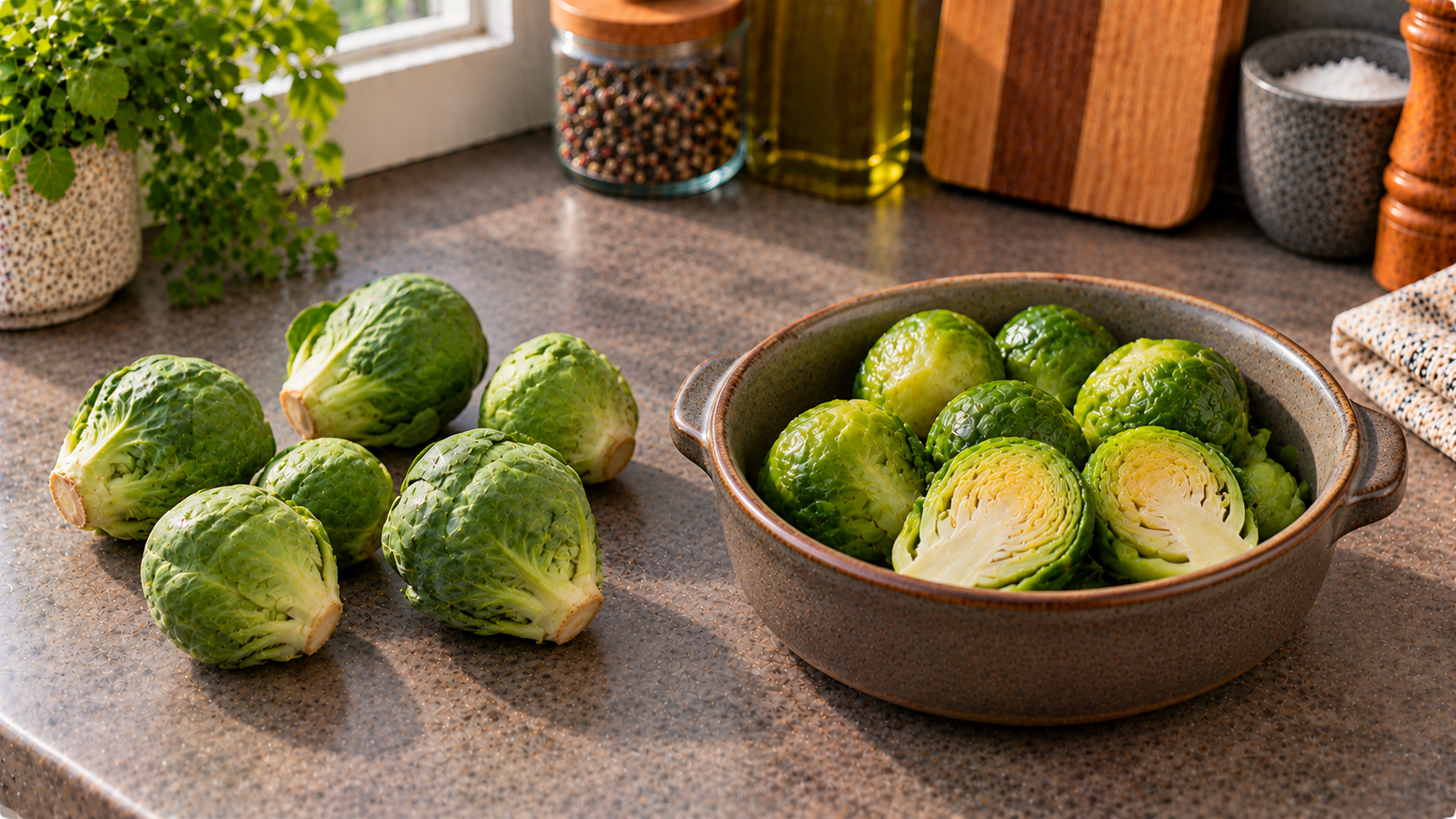
Brussels sprouts contain 43 calories per 100 g raw and 36 calories per 100 g boiled, drained and prepared without salt, according to USDA FoodData Central. These small cabbages provide fibre, vitamin C, vitamin K and folate while remaining relatively low in energy.
The calories in a real serving depend on its edible weight, cooking method and added ingredients. Plain steamed Brussels sprouts and roasted sprouts covered in oil or butter should not be assigned the same nutritional values.
Brussels sprouts nutrition: raw versus boiled
The table compares two specific USDA SR Legacy foods: raw Brussels sprouts (FDC 170383) and Brussels sprouts cooked, boiled, drained, without salt (FDC 169971).
| Nutrient per 100 g | Raw | Boiled |
|---|---|---|
| Calories | 43 kcal | 36 kcal |
| Protein | 3.38 g | 2.55 g |
| Carbohydrates | 8.95 g | 7.10 g |
| Fibre | 3.8 g | 2.6 g |
| Fat | 0.30 g | 0.50 g |
| Water | 86.0 g | 88.9 g |
Sources: USDA raw Brussels sprouts and USDA boiled Brussels sprouts.
These are measurements from different food states. Boiling does not automatically remove exactly seven calories from every 100 g of raw sprouts. Water movement, soluble-nutrient losses, sampling and changes in cooked weight explain why per-100-g records differ.
Calories by portion size
For Brussels sprouts weighed after boiling and draining, use the reference of 36 kcal per 100 g:
| Cooked edible portion | Calories | Protein | Fibre |
|---|---|---|---|
| 50 g | 18 kcal | 1.3 g | 1.3 g |
| 100 g | 36 kcal | 2.6 g | 2.6 g |
| 150 g | 54 kcal | 3.8 g | 3.9 g |
| 200 g | 72 kcal | 5.1 g | 5.2 g |
| 250 g | 90 kcal | 6.4 g | 6.5 g |
| 300 g | 108 kcal | 7.7 g | 7.8 g |
These portions are calculations from the same USDA entry, not separate laboratory measurements.
Calories = cooked edible weight in grams × 36 ÷ 100.
If weighing the vegetables raw, use 43 kcal per 100 g instead. Do not mix raw weights with cooked nutritional values.
Calories in one Brussels sprout
Sprouts vary considerably in size. A fixed calorie count per sprout is therefore only an approximation.
For example, a trimmed raw sprout weighing 20 g contains approximately 9 kcal. Five similar sprouts weighing 100 g altogether contain about 43 kcal raw.
For reliable tracking, remove inedible or damaged outer leaves and tough stem ends, weigh the usable vegetables and select the matching food state.
The weight of a supermarket package is not necessarily identical to the prepared edible weight.
Steamed, roasted and fried Brussels sprouts
Steaming and boiling without added fat normally keep Brussels sprouts low in calories.
Roasting changes the vegetable's moisture content. Consequently, 100 g of roasted sprouts may not have exactly the same nutritional concentration as 100 g raw or boiled sprouts.
The amount of oil is often the largest practical difference.
For example, 200 g boiled Brussels sprouts supply about 72 kcal. If 10 g olive oil is added and completely consumed, approximately 90 kcal are added, producing a combined total near 162 kcal.
This is an ingredient calculation, not a generic value for all roasted Brussels sprouts.
Butter, bacon, cheese, honey-based glazes and creamy sauces must also be counted.
When making a complete tray-bake, calculate the ingredients added to the tray and divide by the portions actually eaten.
Fresh versus frozen sprouts
Plain frozen Brussels sprouts can be a convenient alternative to fresh ones.
Whether fresh or frozen sprouts are better value depends on usable weight and preparation; see the fresh-versus-frozen vegetable comparison.
Freezing alone does not turn the vegetable into a calorie-dense food. However, frozen and fresh products can have different reference entries, moisture content and serving weights.
Frozen Brussels sprouts sold with butter, seasoning or sauce require their own label values.
Use the nutrition entry matching the product and whether the recorded weight is frozen, thawed or cooked.
Fibre, carbohydrates and digestion
Raw Brussels sprouts contain approximately 8.95 g carbohydrate and 3.8 g fibre per 100 g in the cited USDA entry. Boiled sprouts contain around 7.10 g carbohydrate and 2.6 g fibre.
These carbohydrate figures include fibre under the USDA reporting convention. European food labels may use a different convention for carbohydrate presentation.
Brussels sprouts contain fermentable carbohydrates and sulphur-containing compounds. Some people experience gas or bloating, especially after larger servings.
Cooking them until tender and gradually increasing portion sizes may improve tolerance. Digestive responses vary between individuals.
Vitamin C, vitamin K and folate
Brussels sprouts provide vitamin C, vitamin K and folate. Cooking method, duration and storage can affect vitamin levels, especially water-soluble nutrients.
Vitamin C contributes to normal immune function and collagen formation. Vitamin K has an established role in normal blood clotting.
People taking vitamin-K-sensitive anticoagulants should maintain consistent dietary vitamin K intake and follow their clinician's advice rather than making abrupt changes.
Brussels sprouts also contribute some protein, but a usual vegetable serving is not equivalent to a concentrated protein food.
Combine them with beans, tofu, fish, eggs or another suitable protein source to create a more balanced main meal.
Brussels sprouts and weight management
Plain Brussels sprouts provide volume, fibre and nutrients for relatively few calories. They can fit well into meals designed to manage overall energy intake.
They do not cause fat loss independently of total dietary intake.
A useful plate might contain Brussels sprouts, potatoes and a protein source, with the oil or sauce measured separately.
The most accurate approach is to calculate the entire recipe rather than assign the finished meal the calories of plain vegetables.
Sources and calculation notes
- USDA FoodData Central: Brussels sprouts, raw, FDC 170383.
- USDA FoodData Central: Brussels sprouts, cooked, boiled, drained, without salt, FDC 169971.
All portion values are calculated from the named USDA entries. Different packaging, cooking methods and added ingredients can change the actual nutritional values.