
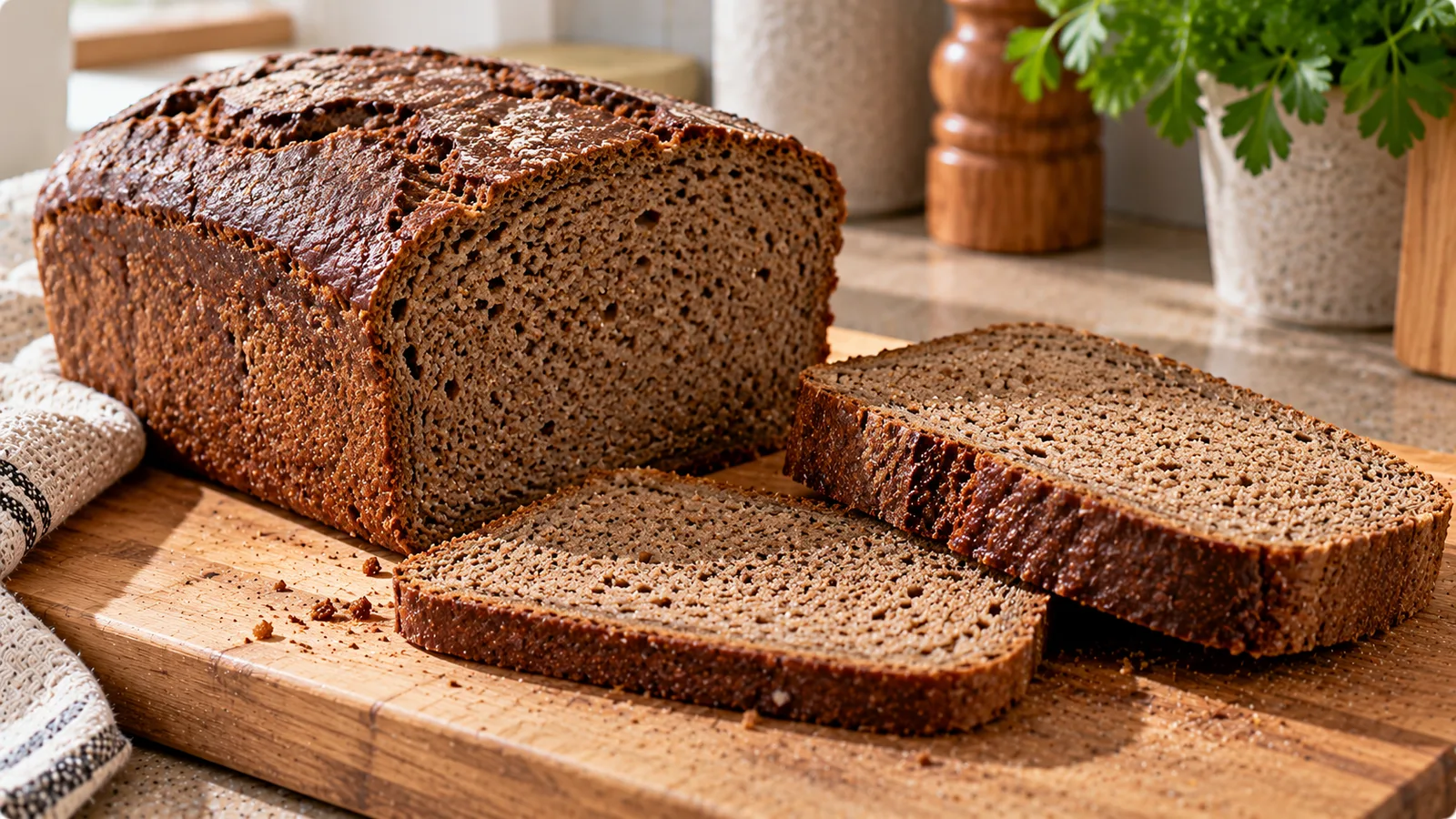
Rye bread is a staple in many European kitchens, from dense German wholegrain loaves to lighter rye-wheat sandwich breads.
But how many calories does rye bread contain?
A useful starting estimate is around 250–260 kcal per 100 g for many standard rye breads, although actual values vary substantially by recipe, moisture content and added ingredients.
A dense, moist wholegrain rye loaf may contain fewer calories per 100 g than a drier bread with added seeds or oil. The weight of each slice also matters.
If you are logging food, the nutrition label and the weight of the bread you actually eat are more reliable than a generic slice estimate.
Rye bread calories at a glance
The following values are illustrative estimates, not universal figures for every rye bread.
| Rye bread portion | Estimated calories at 259 kcal/100 g |
|---|---|
| 25 g thin slice | 65 kcal |
| 35 g slice | 91 kcal |
| 40 g slice | 104 kcal |
| 50 g thick slice | 130 kcal |
| 60 g large slice | 155 kcal |
| 80 g portion | 207 kcal |
| 100 g | 259 kcal |
| 150 g | 389 kcal |
These calculations use approximately 259 kcal per 100 g, a commonly cited reference value for rye bread in USDA-based food databases.
Your product may differ.
For example, a bread labeled 210 kcal per 100 g provides 84 kcal in a 40 g slice, while one labeled 280 kcal per 100 g provides 112 kcal for the same weight.
How many calories are in one slice of rye bread?
A slice has no standard weight.
A thin slice of packaged rye bread may weigh around 25–35 g, while a thick slice from a bakery loaf can weigh 50–70 g or more.
Using the reference value of 259 kcal per 100 g:
- 30 g slice: approximately 78 kcal.
- 40 g slice: approximately 104 kcal.
- 50 g slice: approximately 130 kcal.
- 60 g slice: approximately 155 kcal.
The difference between a thin and thick slice can be larger than the difference between two bread varieties.
If you want a reliable number, weigh one typical slice from your loaf.
Rye bread nutrition per 100 g
A commonly used USDA-style reference profile for rye bread is approximately:
| Nutrient | Per 100 g |
|---|---|
| Energy | 259 kcal |
| Protein | 8.5 g |
| Total fat | 3.3 g |
| Total carbohydrate, including fiber | 48.3 g |
| Dietary fiber | 5.8 g |
| Total sugars | 3.9 g |
These are representative database values, not a guaranteed profile for traditional German rye bread, pumpernickel or any particular brand.
An important distinction: US food databases commonly include dietary fiber within total carbohydrate, while EU nutrition labels list carbohydrate and fiber separately.
For this example, subtracting fiber from the US-style carbohydrate value gives approximately 42.5 g of carbohydrate excluding fiber.
That arithmetic is only a rough illustration of the reporting difference; exact analytical methods and regulatory definitions can differ.
For a packaged bread sold in Germany or France, use the carbohydrate and fiber values shown separately on its EU label.
How to calculate calories from the label
The formula is simple:
Calories eaten = calories per 100 g × portion weight in grams ÷ 100
Suppose your rye bread has 224 kcal per 100 g.
You eat two slices weighing 42 g and 48 g.
Total bread weight:
42 + 48 = 90 g.
Calories:
224 × 90 ÷ 100 = 201.6 kcal, or approximately 202 kcal.
If you eat the same two slices with butter, cheese or another topping, calculate those ingredients separately.
This avoids treating the calories of a complete sandwich as the calories of bread alone.
Why rye bread calories vary
Not every bread labeled “rye” has the same recipe.
Several factors affect calories per 100 g.
1. Rye flour versus mixed flour
Some breads are made primarily with rye flour.
Others contain substantial amounts of wheat flour.
The label may say rye bread, rye-wheat bread, mixed rye bread or wholegrain rye bread, depending on the recipe and local naming rules.
Different flours can change protein, fiber and texture.
However, the calorie difference is not determined by rye percentage alone.
2. Water content
Water adds weight without adding calories.
A dense, moist bread can have fewer calories per 100 g than a relatively dry loaf, even when the flour ingredients are similar.
This is one reason traditional moist pumpernickel and crisp rye bread can differ greatly in energy density.
3. Seeds, nuts and added oil
Sunflower seeds, flaxseed, pumpkin seeds and nuts add fat and energy.
That does not make the bread inherently unhealthy.
It does mean that seeded rye bread may contain more calories per 100 g than a comparable loaf without added seeds.
4. Sweeteners and other ingredients
Some recipes contain syrup, molasses, sugar or malt ingredients.
These may affect flavor, color and carbohydrate content.
Check the ingredient list and nutrition table rather than assuming dark bread contains no added sugar.
5. Slice thickness
A 60 g slice contains twice the calories of a 30 g slice from the same loaf.
For practical calorie tracking, slice weight is often the most important variable.
Rye bread versus other bread types
Bread varieties overlap considerably in calories.
The following ranges are broad illustrations rather than fixed nutritional standards.
| Bread type | Typical approximate calories per 100 g | Main reason for variation |
|---|---|---|
| Standard rye bread | 230–270 kcal | Flour blend, moisture and recipe |
| Moist wholegrain rye bread | 190–250 kcal | High moisture and dense structure |
| Rye-wheat mixed bread | 220–270 kcal | Flour proportions and water |
| Seeded rye bread | 250–330 kcal | Added seeds, nuts and oils |
| Rye crispbread | 320–380 kcal | Much lower water content |
| White wheat bread | 240–280 kcal | Recipe and moisture |
These ranges can overlap or be exceeded by individual products.
Crispbread is particularly easy to misinterpret: it can have more calories per 100 g but fewer calories per piece because each piece is light.
Always compare both per 100 g and per portion.
Is rye bread lower in calories than white bread?
Not necessarily.
A standard rye bread and white wheat bread may contain similar calories per 100 g.
Rye bread can provide more fiber, depending on whether it is wholegrain and how it is made, but a higher fiber content does not automatically mean a lower calorie content.
A dark color is also not proof that bread is wholegrain.
Color can be influenced by ingredients and baking methods.
If you want a higher-fiber bread, compare the fiber declaration and look for wholegrain ingredients.
Is rye bread good for weight management?
Rye bread can fit into a weight-management eating pattern.
The relevant factors are the total portion, toppings, overall diet and how satisfying the meal is.
Wholegrain rye products can contribute dietary fiber, which may support fullness as part of a balanced diet.
But no single bread automatically causes weight loss.
For example:
- Two 40 g slices of rye bread at 230 kcal per 100 g provide 184 kcal.
- Add 20 g butter at approximately 720 kcal per 100 g: another 144 kcal.
- Add 40 g cheese at 350 kcal per 100 g: another 140 kcal.
The resulting meal is approximately 468 kcal, before vegetables or other ingredients.
The example shows why toppings should be tracked separately.
A sandwich with rye bread, a lean protein source and vegetables can have a very different energy profile.
What about pumpernickel?
Pumpernickel is often associated with dense, dark rye bread, but the name and preparation vary by country and producer.
Traditional German pumpernickel is typically moist and made with rye-based ingredients.
Because it contains considerable moisture, its calories per 100 g may be lower than those of some drier breads.
However, not every product marketed as pumpernickel follows the same recipe.
Some packaged varieties contain additional ingredients or use different baking methods.
Check the specific label instead of assuming all pumpernickel has the same calories.
Is rye crispbread the same as rye bread?
No.
Rye crispbread contains much less water than soft rye bread.
This increases its calorie density per 100 g.
For example, a crispbread labeled 350 kcal per 100 g provides:
- 10 g piece: 35 kcal.
- 15 g piece: 53 kcal.
- 20 g portion: 70 kcal.
A soft rye slice weighing 50 g at 240 kcal per 100 g provides 120 kcal.
Comparing one piece with one slice is misleading unless you also consider weight.
Rye bread and gluten
Rye naturally contains gluten proteins and is not suitable for people with celiac disease.
A bread made from rye flour is not gluten-free simply because it contains less wheat or is marketed as traditional or sourdough.
Sourdough fermentation does not reliably make ordinary rye bread safe for celiac disease.
People who require a gluten-free diet should choose appropriately labeled gluten-free products and consider cross-contact.
Rye bread and fiber
Rye, particularly wholegrain rye, can contribute fiber to the diet.
Fiber content depends on flour extraction, grain structure and additional ingredients.
A product made mainly with refined rye flour may contain less fiber than a wholegrain rye loaf.
When comparing packaged products in the EU, look at the fiber value per 100 g.
A product containing 8 g fiber per 100 g provides 3.2 g fiber in a 40 g slice.
A product containing 4 g fiber per 100 g provides only 1.6 g in the same slice.
The difference matters more than the bread's color.
Common portion examples
Breakfast with rye bread
Two 35 g slices at 240 kcal per 100 g:
70 × 2.4 = 168 kcal from bread.
Add toppings separately.
Open-faced sandwich
One 55 g slice at 250 kcal per 100 g:
55 × 2.5 = 138 kcal from bread.
Rye bread with soup
A 75 g portion at 220 kcal per 100 g:
75 × 2.2 = 165 kcal from bread.
Three slices from a bakery loaf
Three slices weighing 45 g each:
135 g total.
At 255 kcal per 100 g:
135 × 2.55 = 344 kcal from bread.
These examples demonstrate why counting slices without weighing them can produce inaccurate totals.
How to log rye bread accurately
- Identify the exact product or bread type.
- Use its nutrition label when available.
- Weigh the bread before adding toppings.
- Calculate calories using the per-100-g value.
- Log butter, spreads, cheese, meat or other toppings separately.
- If no label is available, use a clearly identified estimate and accept some uncertainty.
For homemade rye bread, calculate the energy of all ingredients and divide by the final baked loaf weight.
Because bread loses water during baking, using the raw dough weight as the denominator can underestimate calories per 100 g of finished bread.
Frequently asked questions
How many calories are in a slice of rye bread?
A 40 g slice contains approximately 104 kcal if the bread provides 259 kcal per 100 g. Actual slices and recipes vary.
How many calories are in 100 g of rye bread?
Around 250–260 kcal is a useful reference for many standard products, but moist or seeded varieties may differ considerably.
Is dark rye bread always lower in calories?
No. Color alone does not determine calorie content.
Does rye sourdough have fewer calories?
Not automatically. Sourdough fermentation can change flavor and other characteristics, but the calorie content still depends primarily on ingredients and final moisture.
Is rye bread gluten-free?
No. Rye contains gluten and is unsuitable for people with celiac disease.
Is rye crispbread lower in calories?
Often per piece, because the pieces are light. Per 100 g, crispbread may contain more calories than soft rye bread.
Sources
- USDA FoodData Central — food composition data for rye bread and other breads.
- European Commission: Food Information to Consumers — EU nutrition labeling rules.
- NIDDK: Celiac Disease — gluten-containing grains and celiac disease.
Key takeaway
Rye bread commonly provides around 250–260 kcal per 100 g, but the exact number depends on the recipe and moisture content.
A 40 g slice may contain around 100 kcal, while a large slice can contain substantially more.
For accurate tracking, use the product's nutrition label, weigh your portion and calculate toppings separately.