
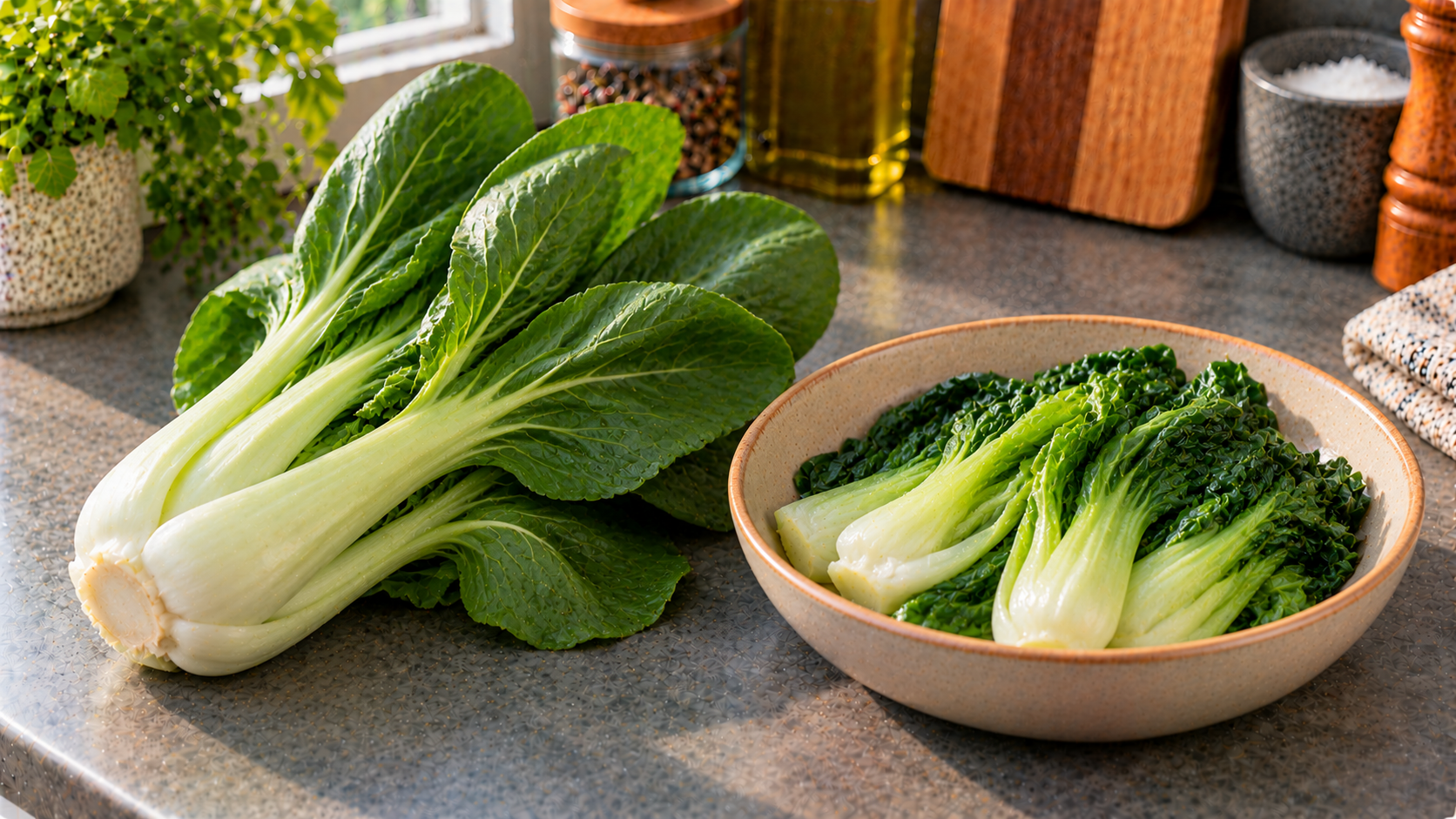
Bok choy (also spelled pak choi or pak choy) supplies 13 kcal per 100 g raw and 12 kcal per 100 g boiled, drained and prepared without added salt in the named USDA FoodData Central records. This leafy Chinese cabbage has pale, crunchy stems and tender green leaves. It is light in calories, but an entire stir-fry may not be: cooking oil, sauces, noodles and protein additions all count.
Nutrition: raw versus boiled bok choy
The values below describe the edible leaves and stalks of Chinese cabbage, pak-choi, not napa cabbage or ordinary green cabbage. Raw values come from USDA FDC 170390; boiled, drained values from FDC 170391.
| Per 100 g edible | Raw | Boiled, drained |
|---|---|---|
| Calories | 13 kcal | 12 kcal |
| Protein | 1.50 g | 1.56 g |
| Carbohydrates, USDA total | 2.18 g | 1.78 g |
| Dietary fibre | 1.0 g | 1.0 g |
| Fat | 0.20 g | 0.16 g |
| Total sugars | 1.18 g | 0.83 g |
| Water | 95.32 g | 95.55 g |
References: USDA raw pak choi and USDA boiled pak choi. Database figures are averages for described samples, not a guarantee for every individual bunch. Different cooking states and samples should not be interpreted as a controlled experiment proving exact nutrient losses.
How many calories are in one portion?
The following are calculated using 12 kcal, 1.56 g protein and 1.0 g fibre per 100 g boiled, drained bok choy. Weigh the vegetable after cooking and draining when using this table.
| Cooked edible weight | Calories | Protein | Fibre |
|---|---|---|---|
| 50 g | 6 kcal | 0.8 g | 0.5 g |
| 100 g | 12 kcal | 1.6 g | 1.0 g |
| 150 g | 18 kcal | 2.3 g | 1.5 g |
| 200 g | 24 kcal | 3.1 g | 2.0 g |
| 250 g | 30 kcal | 3.9 g | 2.5 g |
| 300 g | 36 kcal | 4.7 g | 3.0 g |
Calories from boiled bok choy = edible cooked grams × 12 ÷ 100. For raw weights use 13 instead of 12. These rounded serving examples are calculations, not separate measurements.
One cup, one stalk or one head?
A stalk or head does not have a standard weight. Baby bok choy is usually smaller than a mature head, and the number of leaves varies. A cup of loose, chopped raw leaves and stems also weighs differently from a firmly packed cup of cooked vegetables.
As a practical example rather than an official serving size, 70 g raw edible bok choy provides about 9 kcal; 200 g raw provides 26 kcal. For reliable tracking, trim discarded root ends and damaged leaves, then weigh the edible portion. If the root base and outer leaves are discarded, do not count them as eaten.
Raw, steamed, boiled and stir-fried
Raw bok choy works in salads; briefly steamed or boiled bok choy retains a mild flavour and tender-crisp texture. Stir-frying often adds oil, garlic, soy sauce or other flavourings, which change calories and sodium.
For portions measured before or after stir-frying, the raw-versus-cooked vegetables guide explains the effect of water loss and added oil.
For example, 200 g of boiled and drained bok choy contributes about 24 kcal. If the finished serving also contains 10 g cooking oil that is actually eaten, the oil contributes approximately 90 kcal. Together that is about 114 kcal, before sauce or other ingredients. This is an ingredient-based calculation, not a published average for all stir-fries.
When cooking for several people, total the ingredients and divide by the quantity actually served. Oil left in a pan is not necessarily all consumed, so adjust your estimate when you know the amount remaining. Roasting may also evaporate water: 100 g finished roasted bok choy cannot automatically use the raw record's values without considering the cooked yield.
Bok choy versus napa cabbage
Pak choi and napa cabbage are related Chinese cabbages, but they are not identical. Pak choi typically has separated spoon-shaped leaves and thick stalks; napa cabbage forms a more compact elongated head. USDA maintains distinct descriptions for pak-choi and pe-tsai (napa cabbage).
Do not apply the pak-choi calorie figure automatically to a product labelled napa cabbage, kimchi, pickled Chinese cabbage or an assembled dish. Choose the entry matching the actual vegetable and preparation.
Carbohydrates, fibre and blood sugar
Raw pak choi provides 2.18 g total carbohydrate and 1.0 g fibre per 100 g in the cited USDA record. It is a relatively low-carbohydrate vegetable. Still, the amount of carbohydrate in a meal also depends on accompanying rice, noodles, sugary sauces and other foods.
USDA's total-carbohydrate-by-difference figure incorporates fibre, whereas nutrition labels in the European Union normally list available carbohydrate and fibre separately. Avoid mixing those conventions in a tracking app.
A 200 g raw serving provides roughly 4.4 g USDA total carbohydrate. That number alone does not predict an individual's blood glucose response, which depends on the whole meal and other factors.
Vitamins, minerals and dietary role
Bok choy can contribute vitamin C, vitamin K, folate, calcium and potassium. The USDA raw entry reports approximately 45 mg vitamin C and 105 mg calcium per 100 g. Nutrient quantities can change with storage, variety and cooking, particularly when cooking liquid is discarded.
Its modest protein content means it is best viewed primarily as a vegetable, not as a protein replacement. A practical meal might include bok choy with tofu, fish, eggs or beans and a suitable grain or other side.
People taking vitamin-K-sensitive anticoagulants should seek medical guidance about keeping vitamin K consumption consistent rather than suddenly changing their intake.
Fresh versus frozen, takeaway and sauces
Plain frozen bok choy can remain low in calories, but prepared frozen mixes may contain sauce or fat. Restaurant meals can include generous amounts of oil even when vegetables dominate the plate. On a package, check whether values apply per 100 g frozen, drained or ready to eat.
Soy sauce itself can contain substantial sodium even if its calories are modest. Sweet chilli sauce, sesame oil and nut-based sauces can change the energy content considerably. Estimate each added ingredient rather than assigning a whole takeaway dish 12 or 13 kcal per 100 g.
Is bok choy helpful for weight management?
Because bok choy contains plenty of water and relatively few calories, it can add vegetable volume to meals. That can be useful when planning satisfying meals, but it does not cause weight loss on its own. Energy balance and the overall eating pattern remain decisive.
For food logging, use 13 kcal per 100 g raw or 12 kcal per 100 g boiled and drained without added salt, match the weight to the state, and count extras separately.
Sources and method
- USDA FoodData Central: Cabbage, chinese (pak-choi), raw — FDC 170390.
- USDA FoodData Central: Cabbage, chinese (pak-choi), cooked, boiled, drained, without salt — FDC 170391.
All portion values are rounded calculations from the stated food records; actual servings, recipe yields and packaged formulations vary.