
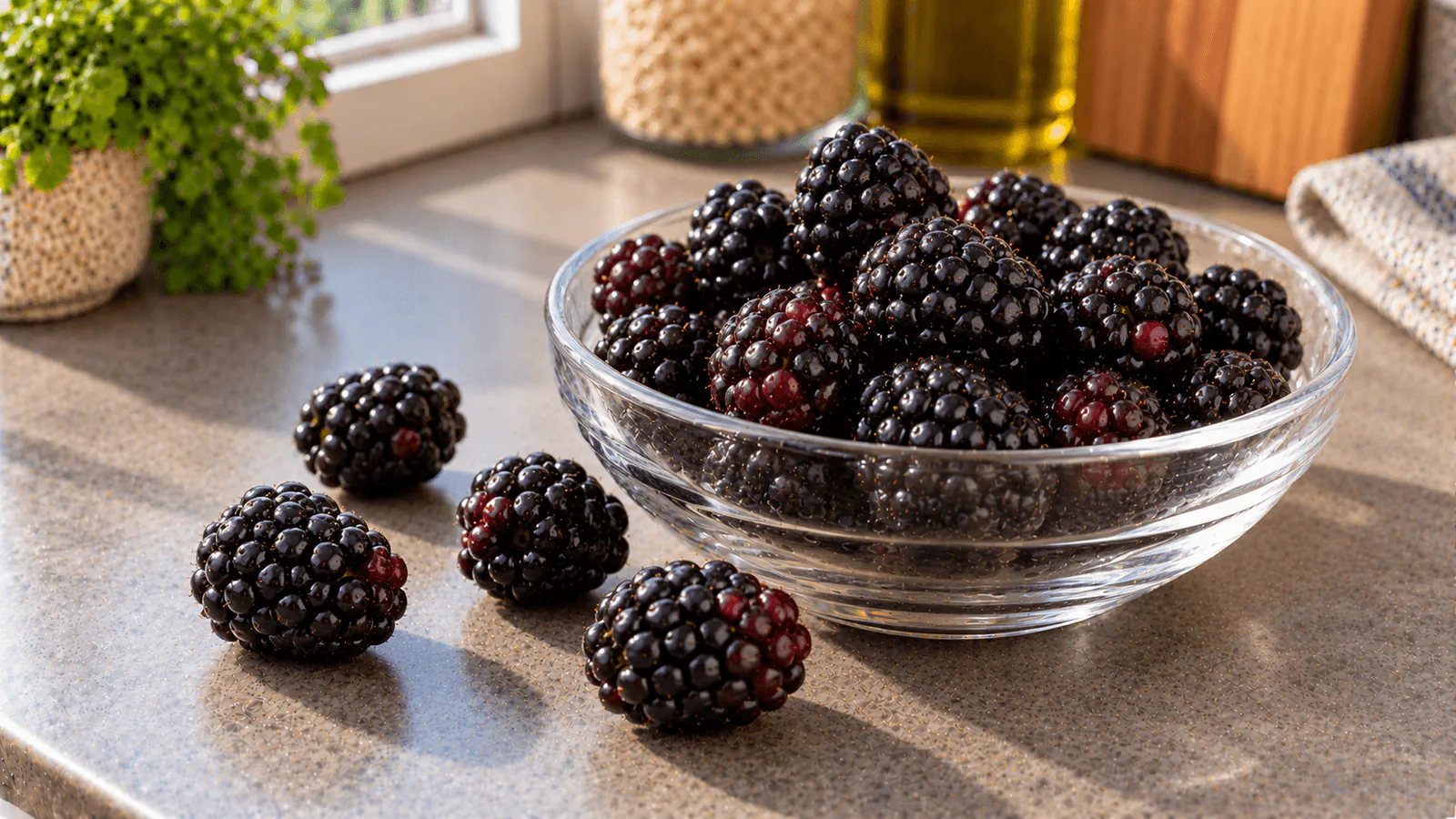
Fresh blackberries have approximately 43 calories per 100 g of edible fruit, according to USDA FoodData Central's SR Legacy entry Blackberries, raw (FDC 173946). A 144 g reference cup contributes about 62 kcal and 7.6 g of fibre. This is a useful starting point, but the portion on your plate may weigh more or less than a measuring cup.
This guide covers raw blackberries, practical serving sizes, naturally occurring sugars, fibre and the differences between fresh fruit, frozen berries, jam, juice and desserts. The numbers apply to edible berries without added ingredients, not to every blackberry-flavoured product.
Blackberry nutrition per 100 g
The values below come from the USDA entry for raw blackberries. They are reference averages, not laboratory measurements of a particular punnet of fruit.
| Nutrient | Per 100 g raw blackberries |
|---|---|
| Calories | 43 kcal |
| Protein | 1.39 g |
| Total carbohydrate, USDA method | 9.61 g |
| Naturally occurring sugars | 4.88 g |
| Dietary fibre | 5.30 g |
| Total fat | 0.49 g |
| Water | 88.15 g |
| Potassium | 162 mg |
| Vitamin C | 21.0 mg |
Source: USDA FoodData Central — Blackberries, raw, FDC 173946.
USDA's total carbohydrate includes dietary fibre under the American reporting system. On European nutrition labels, available carbohydrates and fibre are generally listed separately. Do not compare those two carbohydrate definitions as if they were the same measurement.
The fruit is mainly water. That helps explain its relatively modest energy per 100 g, but ripeness, variety and growing conditions can change the nutrient profile of a specific batch.
Calories in a handful, a bowl and a cup
The following figures use the same raw-fruit reference of 43 kcal, 4.88 g sugars and 5.3 g fibre per 100 g. The 144 g cup is a USDA reference measure; a household cup is not a precision scale.
| Edible raw blackberry portion | Calories | Natural sugars | Fibre |
|---|---|---|---|
| 40 g | 17 kcal | 2.0 g | 2.1 g |
| 60 g | 26 kcal | 2.9 g | 3.2 g |
| 100 g | 43 kcal | 4.9 g | 5.3 g |
| 125 g | 54 kcal | 6.1 g | 6.6 g |
| 1 reference cup, 144 g | 62 kcal | 7.0 g | 7.6 g |
| 150 g | 65 kcal | 7.3 g | 8.0 g |
| 200 g | 86 kcal | 9.8 g | 10.6 g |
The simple calculation is calories = edible blackberry weight in grams × 0.43. Every result is rounded, and the source itself is an estimate. For a 180 g serving, 180 × 0.43 gives 77.4 kcal, or approximately 77 kcal.
When a nutrition app offers both grams and cups, weighing the berries is generally more reliable. The distinction between the amount you actually eat and a reference measure is explained in portion size versus serving size.
How many calories are in one blackberry?
There is no trustworthy universal weight for a single blackberry. The berries differ noticeably in size, and a large cultivated berry can weigh much more than a small wild one.
For illustration only, a berry providing 5 g of edible fruit would contain about 2 kcal (5 × 0.43 = 2.15). That is not a claim that all blackberries weigh 5 g. Ten berries weighing 40 g together contain about 17 kcal, while ten larger berries weighing 70 g would contain about 30 kcal.
If you need an accurate diary entry, place the serving on a scale rather than multiplying by a fixed per-berry estimate. Remove any stems or damaged inedible parts, but the small seeds embedded in normal ripe blackberries are usually consumed with the fruit.
Are blackberries different from raspberries, blueberries and strawberries?
Each berry has its own typical balance of water, sugars and fibre. Blackberries are often notable for their fibre content, but comparing fruit by taste or colour alone cannot establish its calories.
A practical comparison must use the same edible weight and preparation. Do not compare 100 g blackberries with a full bowl of another fruit or a sweetened fruit product. If you want the individual values, see Mealisa's guides to raspberries, blueberries and strawberries.
These fruits can all be part of the same mixed-fruit dish. Weigh each ingredient separately if you want the best estimate. Calling the whole dish “berries” and using a single generic number is less accurate than identifying the mix.
Blackberries also should not be confused with mulberries, a different fruit. A database entry labelled “mulberries” is not automatically interchangeable with one labelled “blackberries”.
Fresh blackberries versus frozen blackberries
Plain blackberries frozen without sugar can be a practical substitute for fresh berries. Freezing alone does not add calories, although storage, thawing and loss of juice may affect the weight you record and some nutrient retention.
If you weigh a portion after thawing and discard some released liquid, its composition may no longer be identical to the same gram weight before thawing. For ordinary food logging, use an entry that corresponds to the product and the weight you actually eat.
A package marked sweetened, in syrup or blackberry dessert mix is different from plain frozen berries. Use the specific nutrition label. Check whether the listed values describe the berries alone or a product with sugar and other ingredients.
The colour of a frozen berry does not prove that it is lower in calories or contains more vitamins than a fresh one.
Blackberry jam, juice and sweetened products
Jam is not simply raw fruit in a jar. Added sugar, cooking and water evaporation can greatly change calories per 100 g. Blackberry juice may retain some sugars while containing less of the whole-fruit fibre. Syrup-packed fruit, coulis and fruit fillings have different recipes.
For a homemade quick sauce, start with the ingredients. Suppose you heat 300 g blackberries and 25 g table sugar. The fruit provides about 129 kcal, while sugar contributes about 100 kcal. The entire batch therefore begins with roughly 229 kcal, before any extra ingredients. Evaporation changes the finished weight, not the sum of the starting energy.
If you divide that complete batch into three equal portions, each has approximately 76 kcal. This calculation assumes the full mixture is eaten; losses left in a pan or sieve would change the consumed amount. It is not a universal value for blackberry sauce.
For bottled juice or manufactured jam, the product's declared nutrition is more relevant than the raw-blackberry USDA figure.
A blackberry yoghurt bowl: calculate the complete serving
Blackberries are not a concentrated protein source. Combining them with yoghurt may make a more substantial snack, although the finished bowl naturally contains more calories than the fruit alone.
Consider an illustrative recipe using 150 g blackberries, 170 g plain yoghurt and 10 g walnuts. The berries supply approximately 65 kcal. If the selected yoghurt label states 70 kcal per 100 g, it adds 119 kcal; at an assumed 650 kcal per 100 g, the walnuts contribute 65 kcal. The total is approximately 249 kcal.
The yoghurt and walnut figures here are clearly stated example label values, not universal nutrient data. A strained high-fat yoghurt, a low-fat version and a sweetened yoghurt can differ considerably. Use the actual packaging and weigh the toppings.
Granola, honey, nut butter and other additions may contribute more calories than the fruit; measure them instead of assigning one fixed number to every berry bowl.
Fibre, natural sugars and micronutrients
A 100 g serving of raw blackberries supplies 5.3 g fibre and 4.88 g naturally occurring sugars in the USDA reference. A 144 g reference cup supplies approximately 7.6 g fibre. Whole fruit contains fibre and water in a food matrix, whereas blackberry-flavoured syrup may provide little of either.
Vitamin C is approximately 21 mg per 100 g and potassium is approximately 162 mg per 100 g. Vitamin C has established roles in normal collagen formation and immune function, but a berry portion should not be described as preventing disease or replacing a balanced diet.
Some people notice gastrointestinal discomfort when they suddenly increase fibre intake. If your current intake is low, increasing fibre from fruit and other foods gradually can be more comfortable. Individual tolerance and dietary needs vary.
Recording blackberries accurately
Choose “blackberries, raw” for fresh unsweetened berries and log the edible amount in grams. For plain frozen fruit, use an appropriate frozen or unsweetened reference or the package label. For jam, sauces, drinks and desserts, calculate all ingredients or select the exact product.
The key reference is 43 kcal per 100 g fresh edible blackberries. The one-cup example is approximately 62 kcal for 144 g, but your own measured portion is more useful than a fixed household measure.
Sources and calculation limitations
All serving tables and recipe examples in this article are calculated from the explicitly stated reference values or illustrative ingredient-label assumptions. Values can vary by fruit, preparation, brand and edible weight.