
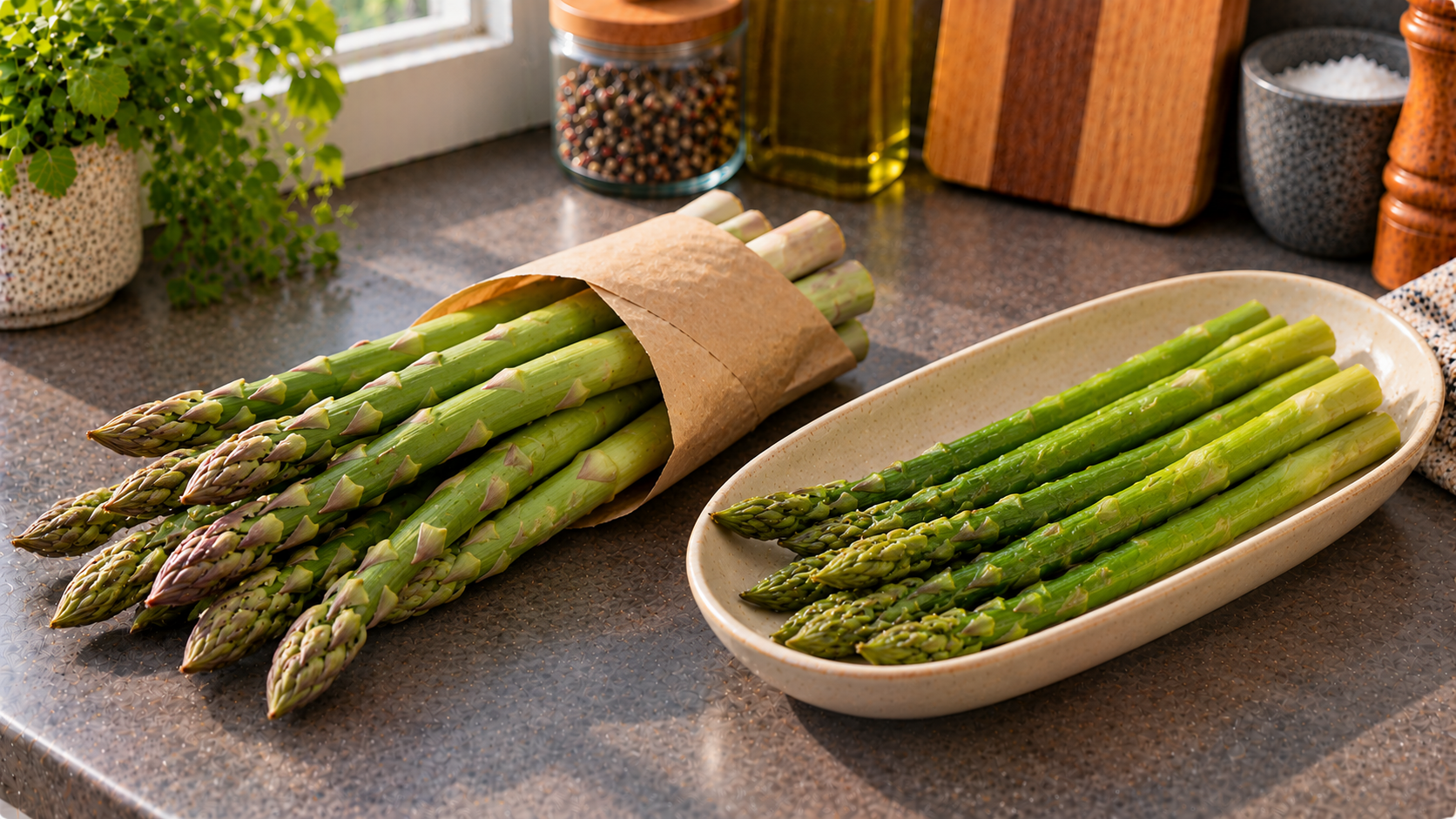
Asparagus contains about 20 calories per 100 g raw and 22 calories per 100 g boiled and drained, according to USDA FoodData Central. It is a low-energy-density vegetable with water, fibre, folate and vitamin K.
The calorie count depends on the edible weight, cooking method and added ingredients. Butter, olive oil, cheese or sauces can contribute far more energy than the asparagus itself.
Asparagus calories and nutrition per 100 g
These figures use two specific USDA SR Legacy entries for edible asparagus: raw (FDC 168389) and boiled, drained, without added salt (FDC 168390).
| Nutrient | Raw, 100 g | Boiled, 100 g |
|---|---|---|
| Calories | 20 kcal | 22 kcal |
| Protein | 2.20 g | 2.40 g |
| Total carbohydrate | 3.88 g | 4.11 g |
| Fibre | 2.1 g | 2.0 g |
| Fat | 0.12 g | 0.22 g |
| Water | 93.22 g | 92.63 g |
Sources: USDA raw asparagus and USDA boiled asparagus.
The difference between 20 and 22 kcal reflects different food states and water concentrations. Boiling does not create energy. Actual values vary with preparation, moisture and the food entry used.
Calories by portion size
Using 22 kcal and 2.0 g fibre per 100 g boiled asparagus:
| Edible cooked portion | Calories | Fibre |
|---|---|---|
| 50 g | 11 kcal | 1.0 g |
| 100 g | 22 kcal | 2.0 g |
| 120 g | 26 kcal | 2.4 g |
| 150 g | 33 kcal | 3.0 g |
| 200 g | 44 kcal | 4.0 g |
| 250 g | 55 kcal | 5.0 g |
These are calculated portions, not separate laboratory measurements.
Calories = cooked edible weight in grams × 22 ÷ 100.
If you weigh asparagus raw, use the raw nutritional entry. If you weigh it cooked, use a comparable cooked entry. Cooking changes water content, so the same spears may have different weights before and after cooking.
How many calories are in asparagus spears?
Individual spears differ considerably in thickness and length. A single spear cannot reliably be assigned a fixed calorie amount.
For example, five trimmed spears weighing 100 g raw collectively contain approximately 20 kcal before added ingredients. If another five spears weigh 180 g, their corresponding raw energy is approximately 36 kcal.
The reliable method is to trim the inedible or woody ends, weigh the edible portion and use the appropriate nutrient basis.
Do not calculate an entire retail bunch using package weight if substantial woody stems will be discarded.
Green versus white asparagus
Green and white asparagus come from the same species but grow under different light conditions. White asparagus is shielded from light during cultivation.
Their nutritional profiles can differ, but both are relatively low-calorie vegetables.
White asparagus often needs more peeling, particularly near the lower stem. The amount discarded therefore changes the edible yield.
Do not assume that the exact USDA green-asparagus figures automatically apply to every white-asparagus product. Use the package label or a matched food-composition entry where available.
Raw, steamed, roasted and grilled asparagus
Steaming or boiling without substantial added fat generally keeps asparagus low in calories.
When asparagus is weighed after boiling or roasting, the raw-and-cooked vegetable guide helps separate moisture changes from added fat.
Roasted or grilled asparagus can also be a light side dish, but the oil must be included in the recipe calculation.
For example, 200 g boiled asparagus provides approximately 44 kcal. Adding 10 g olive oil contributes approximately 90 kcal, bringing the combined total to about 134 kcal if all the oil is consumed.
This is an illustrative recipe calculation based on actual ingredient quantities, not a claim that every roasted-asparagus dish contains 134 kcal.
Butter, breadcrumbs, hollandaise sauce and grated cheese can similarly change the energy content.
Asparagus from jars and cans
Canned or jarred asparagus may be packed in water, brine or sauce. Salt content can differ from fresh asparagus.
Check whether the nutrition label refers to drained asparagus or the complete contents. Use drained weight when the liquid is discarded, together with the corresponding label values.
Pickled asparagus and asparagus with prepared sauces should not automatically receive the nutrition values of plain boiled asparagus.
Fibre, folate and vitamin K
Asparagus supplies dietary fibre and can contribute folate and vitamin K. The exact amounts depend on the product and preparation.
Fibre supports normal bowel function, while folate and vitamin K have established physiological roles. No single vegetable can replace dietary variety.
Although asparagus contains some protein, a typical serving is not a high-protein main course. Combine it with fish, eggs, tofu, beans or other appropriate protein foods for a balanced meal.
Asparagus and weight management
Because plain asparagus contains relatively few calories for its weight, it can add volume and variety to meals with limited energy.
It does not directly cause fat loss. Weight change depends on total energy intake and expenditure over time.
For a practical meal, consider asparagus with potatoes and a protein source, then count the cooking oil and sauce separately.
Sources and calculation method
- USDA FoodData Central: raw asparagus, FDC 168389.
- USDA FoodData Central: boiled asparagus, FDC 168390.
All serving values are derived from these per-100-g data. For packaged food, use the actual label and edible weight.