
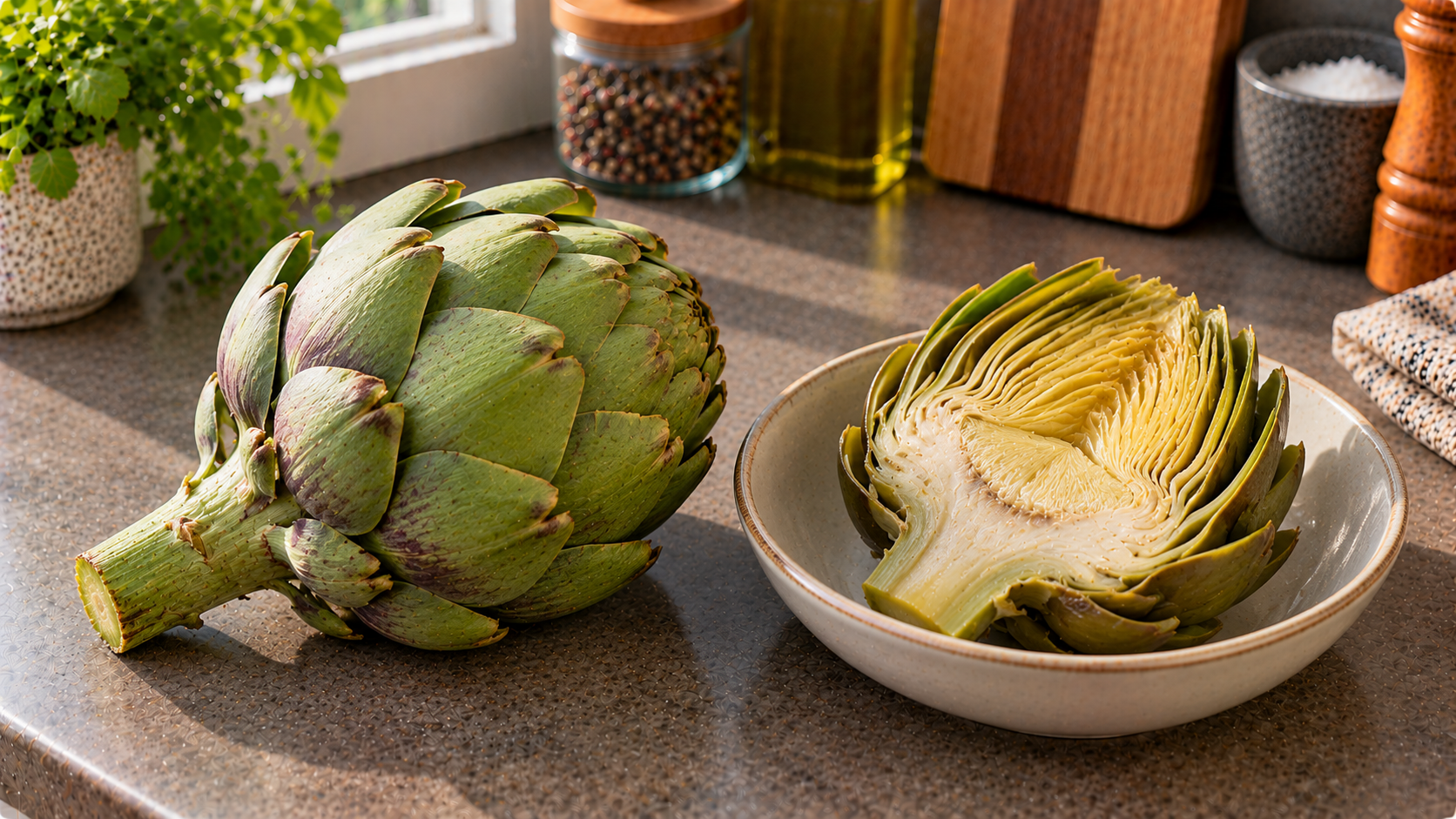
Artichokes are relatively low in calories and provide a substantial amount of dietary fibre. According to USDA FoodData Central, raw globe artichokes contain 47 kcal per 100 g of edible portion, while boiled and drained artichokes without added salt contain 53 kcal per 100 g.
The important distinction is between the weight of an entire artichoke and the part you actually eat. Tough outer leaves, the fibrous choke and parts of the stem may be discarded, so the calories of a whole purchased vegetable cannot be calculated accurately from its total weight alone.
How many calories are in artichokes?
The following values come from two specific USDA SR Legacy entries: raw globe artichokes (FDC 169205) and globe artichokes boiled, drained and prepared without salt (FDC 168386).
| Nutrient per 100 g edible | Raw artichoke | Boiled artichoke |
|---|---|---|
| Calories | 47 kcal | 53 kcal |
| Protein | 3.27 g | 2.89 g |
| Carbohydrates | 10.51 g | 11.95 g |
| Fat | 0.15 g | 0.34 g |
| Dietary fibre | 5.4 g | 5.7 g |
Sources: USDA raw artichokes and USDA boiled artichokes.
These values describe edible portions, not whole vegetables including discarded parts. Cooking changes water content and nutrient concentration per 100 g; the difference between raw and boiled entries does not mean cooking creates additional calories.
Calories by serving size
Using the USDA value of 53 kcal per 100 g of boiled, drained artichoke:
| Cooked edible portion | Calories | Fibre |
|---|---|---|
| 50 g | 27 kcal | 2.9 g |
| 100 g | 53 kcal | 5.7 g |
| 120 g | 64 kcal | 6.8 g |
| 150 g | 80 kcal | 8.6 g |
| 200 g | 106 kcal | 11.4 g |
Values are rounded calculations, not separate laboratory measurements.
Calories = edible portion in grams × 53 ÷ 100.
A medium cooked artichoke may yield roughly 120 g of edible parts in the USDA serving reference, but actual yield depends on size and preparation. Weigh the edible portion when accuracy matters.
Whole artichokes versus artichoke hearts
An artichoke heart is only one edible component of a whole globe artichoke. Tender parts of some leaves and suitable stem portions may also be eaten.
Do not count discarded leaves or the fibrous choke as consumed food. Conversely, do not assume that an entire purchased artichoke weighs the same as its edible heart.
Fresh hearts, frozen hearts and canned or marinated hearts can also have different nutrient values. Their labels or matching food-database entries are preferable to a generic whole-artichoke estimate.
Are artichokes good for weight management?
Plain boiled artichokes have low energy density and contain fibre, making them a useful vegetable choice in calorie-conscious meals.
They are not a weight-loss treatment, and their effect depends on the complete diet.
Artichokes served with olive oil, mayonnaise, butter or creamy dips may contain substantially more calories than the vegetable itself.
For example, 10 g of olive oil adds approximately 90 kcal to a recipe. If two people share the oil equally, that adds approximately 45 kcal per portion, assuming all of it is consumed.
Fibre, carbohydrates and digestion
Boiled artichokes provide approximately 5.7 g fibre per 100 g. A 150 g edible portion therefore supplies approximately 8.6 g.
USDA total carbohydrate values include dietary fibre; they should not be mistaken for digestible carbohydrate alone.
Artichokes also contain fermentable carbohydrates, including inulin-type fructans, which can cause gas or bloating in sensitive individuals.
People with sensitive digestion may prefer smaller portions and adjust intake according to tolerance.
Calories in cooked, canned and marinated artichokes
Boiling or steaming without substantial added fat keeps calories relatively low. Roasting can also be suitable, but the amount of oil matters.
A change in cooked weight does not itself mean calories were added; the raw-versus-cooked vegetables guide explains how to make fair comparisons.
Canned artichokes in water or brine should be compared using their actual labels and drained weights. Sodium may be higher in salted products.
Artichokes marinated in oil can be much more energy-dense, particularly when some of the oil is eaten.
For tracking, use the cooked edible weight and add oil, sauces, cheese and other ingredients separately. If using a packaged product, follow its stated nutrition basis.
Practical ways to use artichokes
Artichokes can be served warm with lemon, added to vegetable soups, combined with beans, incorporated into pasta dishes or used in salads.
For a more balanced main meal, pair them with an adequate protein source and other foods according to your needs.
The simplest calculation remains the most reliable: identify the preparation, weigh the edible portion and use matching nutrient data.
Sources and calculation notes
- USDA FoodData Central — raw globe artichokes, FDC 169205.
- USDA FoodData Central — boiled, drained artichokes, FDC 168386.
Portion values are calculated from USDA per-100-g figures. Packaging, cooking oil, edible yield and product formulation can change the calories in an actual meal.