
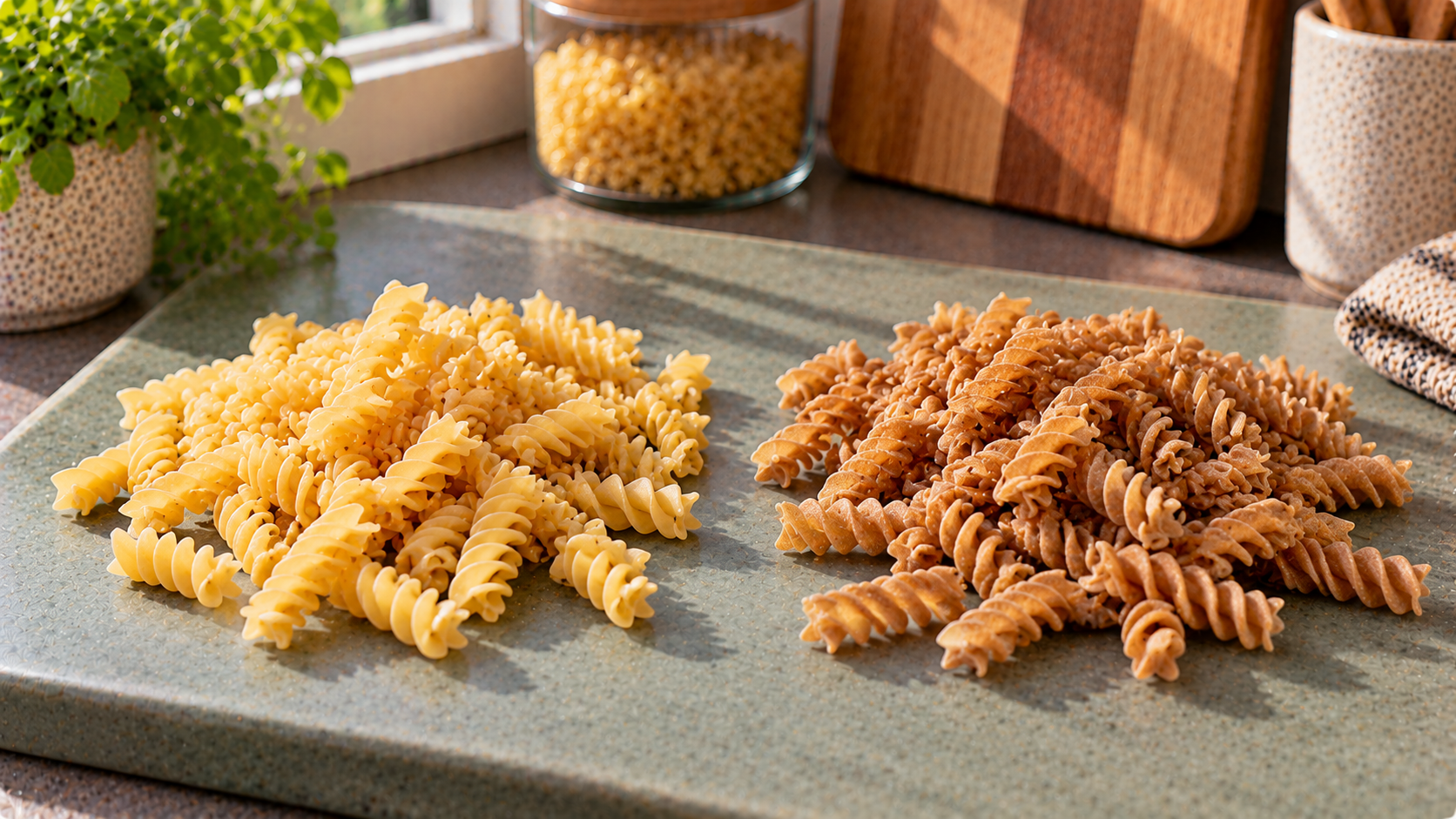
White pasta and whole-wheat pasta can both fit a balanced diet. They usually deliver similar amounts of energy from a comparable dry serving, but whole-wheat pasta generally provides more fibre and often more naturally occurring micronutrients. The useful question is not which pasta has the more impressive label. It is what changes in a meal when you switch, how much you actually eat, and whether the texture works for the dish you want to cook.
The practical difference in one table
The figures below are illustrative label-style values, not a laboratory analysis of a particular brand. They compare plain, dry wheat pasta without sauce. Enrichment, flour type, recipe and manufacturer all affect the results; check the two packages you are considering.
| Per 100 g dry pasta | White durum-wheat pasta, example | Whole-wheat pasta, example |
|---|---|---|
| Energy | 355 kcal | 350 kcal |
| Protein | 12 g | 13 g |
| Carbohydrate | 72 g | 65 g |
| Fibre | 3 g | 8 g |
| Fat | 1.5 g | 2.5 g |
The 5 g difference in fibre per 100 g in this illustration matters much more nutritionally than the 5 kcal difference. A different pair of packages may show smaller or larger gaps. Protein differences are generally modest relative to what you can add with lentils, beans, fish, tofu or a sauce containing dairy. Whole wheat does not mean carbohydrate-free or low-calorie.
What the labels mean: white, whole wheat and enriched
White pasta is normally made from refined durum-wheat semolina and water; some varieties contain egg. Milling removes much of the bran and germ. The remaining refined flour is rich in starch and still contributes energy and some protein. The refining step changes the fibre and micronutrient profile; it does not make the product nutritionally empty.
Whole-wheat pasta uses flour or semolina containing the grain's bran, germ and endosperm. Bran contributes much of the insoluble fibre; the germ and outer layers provide additional naturally occurring nutrients. Exact proportions depend on formulation and manufacturing rules. Dark colour by itself is not proof of whole grain: read the ingredient list for terms such as whole wheat, wholegrain durum wheat or equivalent local wording.
An enriched white pasta may have iron or certain B vitamins added. That can narrow or reverse the difference for individual vitamins and minerals, depending on the country. It does not recreate the complete whole-grain matrix or automatically supply an equivalent amount of fibre. To compare fairly, examine the nutrition declaration, ingredients and any meaningful enrichment information instead of assuming that one category wins every nutrient.
Fibre: the strongest reason to switch
Fibre is the clearest repeatable advantage of most whole-wheat pastas. Germany's DGE recommends adults aim for at least 30 g of fibre daily. A single pasta portion is not expected to meet that target; it can nevertheless make the rest of the day's eating easier.
Using the example table, 75 g dry pasta supplies about 2.25 g fibre if white and 6 g if whole wheat. Choosing whole wheat adds 3.75 g without changing the dry serving size. With 100 g dry, the corresponding example is 3 g versus 8 g, an extra 5 g. The arithmetic is straightforward: fibre on the label per 100 g × dry grams eaten ÷ 100.
This does not mean a bowl of white pasta without fibre is inherently a poor meal. White pasta with tomato sauce, broccoli, chickpeas and salad can deliver considerably more fibre overall than plain whole-wheat pasta. The most meaningful comparison is the complete meal, not an isolated ingredient. Still, where you already enjoy whole-wheat pasta, the substitution is an easy way to raise fibre intake without another cooking step.
Increasing fibre rapidly can cause gas or abdominal discomfort. If your usual diet is low in whole grains, try a half-and-half mix or start with one whole-grain pasta meal per week. Increase gradually and drink enough fluids. A product that you can eat comfortably and regularly is more useful than a theoretically ideal product you dislike.
Calories and carbohydrates: why the gap is often small
Both products are predominantly cereal carbohydrates. Whole-wheat pasta often has slightly fewer digestible carbohydrates because more of the grain is represented by fibre, but the difference is not equivalent to replacing pasta with vegetables. Labelled energy may be close or even overlap, and the exact ranking can differ by brand.
| Example dry serving | White: energy | Whole wheat: energy | White: fibre | Whole wheat: fibre |
|---|---|---|---|---|
| 50 g | 178 kcal | 175 kcal | 1.5 g | 4 g |
| 75 g | 266 kcal | 263 kcal | 2.25 g | 6 g |
| 100 g | 355 kcal | 350 kcal | 3 g | 8 g |
All values are calculations from the illustrative labels above, rounded where appropriate. The caloric difference in this example is not an effective weight-management strategy by itself. Portions, sauce, added oil, cheese, meat and vegetables usually influence the final plate more than swapping one plain wheat pasta for the other.
For a meal-planning app, record the actual brand and whether the entered weight is dry or cooked. A generic food entry might differ from the package you have. If you change pasta type but keep the same sauce and serving, the fibre number may change substantially while total calories barely move.
For a general reference on dry and cooked pasta portions, see the pasta calorie guide. The actual fibre content and energy of white or whole-wheat pasta should still come from the specific packet.
Dry weight is not cooked weight
Pasta absorbs water as it cooks. Its cooked mass therefore rises without the water adding calories. A common rule of thumb is that 75 g dry pasta may yield roughly 150–200 g cooked, but shape, thickness, cooking time and draining change the final weight. This range is for orientation, not a universal conversion factor.
If a packet lists 350 kcal per 100 g dry, 75 g dry represents 262.5 kcal before sauce, regardless of whether you later weigh 160 g or 190 g in the saucepan. Do not apply the dry 100-g number to 180 g of cooked pasta: doing so would substantially overstate energy. Conversely, if a verified database entry specifies cooked pasta per 100 g, do not apply it to 75 g uncooked.
The most accurate everyday method is to weigh the portion before cooking and calculate from the dry label. For a shared pot, weigh all pasta dry, divide the cooked total by the number of servings actually eaten, and assign each its corresponding fraction of the dry amount. Cooking longer changes water content and therefore calories per 100 g cooked without changing the pot's starting calories.
Protein: useful, but not the decisive difference
Standard white and whole-wheat pasta both contain wheat protein, including gluten. Depending on the product, whole-wheat pasta may contain slightly more protein, slightly less, or approximately the same as refined pasta. The example table shows 12 versus 13 g per 100 g dry: just 0.75 g additional protein in a 75-g serving.
That is too small to treat whole-wheat pasta as a substitute for a genuine protein-rich ingredient. For a higher-protein meal, add cooked lentils, beans, tuna, chicken, eggs, tofu or a suitable dairy-based sauce. The amount of protein in the final meal and the eater's overall daily pattern matter more than a one-gram difference between two pasta packets.
Neither type of conventional wheat pasta is gluten-free. Someone with coeliac disease needs appropriately labelled gluten-free pasta, not merely whole-wheat or organic wheat pasta. For a wheat allergy, both are unsuitable unless the individual receives specific clinical advice. A product made from lentils or chickpeas is a different category and should be compared on its own nutrition panel.
Minerals and B vitamins: an advantage with important exceptions
Whole-grain wheat retains more of the grain components that contain magnesium and various naturally occurring nutrients. White flour processing can reduce some amounts. Yet a whole-grain label does not guarantee higher values for every nutrient in every product: enrichment can add iron, folic acid or B vitamins to refined pasta, and manufacturers vary.
A label in the European Union must display a standard nutrition declaration, but not every mineral is listed. Absence of magnesium or iron from the panel does not mean the food contains none. Where a manufacturer claims a vitamin or mineral benefit, check the quantity and portion used. For practical nutrition, grains are only one part of mineral intake; legumes, vegetables, nuts and other foods can make substantial contributions.
Whole grains also contain phytate, which can reduce absorption of certain minerals in a meal. That complexity does not invalidate dietary recommendations to choose whole grains. It is a reminder not to equate an isolated mineral number in a database with the exact amount your body absorbs.
Blood glucose and fullness: avoid simplistic claims
Both pastas supply starch and can raise blood glucose. Fibre, pasta structure and cooking method may affect digestion, but there is no fixed rule that every whole-wheat product produces a particular glucose response. Portion size, the sauce, added protein and fat, cooking firmness, and individual physiology all matter. Processing and recipe also differ between brands.
Whole-wheat pasta can support a more filling eating pattern because it often contains more fibre and has a denser texture. But satiety is personal and depends heavily on the meal. A modest pasta portion with vegetables and protein can feel more satisfying than a huge bowl of either pasta by itself. For people managing diabetes, measuring portions and considering the full carbohydrate content remain important; fibre is not permission to disregard carbohydrates.
Cooked, cooled and reheated starch foods are sometimes described as having more resistant starch. The amount formed is variable, and the claim should not be used to deduct a specific number of calories from a meal. Handle leftovers safely; food safety is a separate issue from speculative glucose benefits.
Taste, texture and which dishes suit each type
White pasta generally has a milder flavour and a smooth, familiar bite. It works well with delicate sauces, light seafood dishes and recipes where the pasta's neutral profile lets other flavours dominate. Whole-wheat pasta often tastes nuttier and has a more pronounced grain texture. It can be especially good with tomato, mushrooms, roasted vegetables, lentils, robust greens and olive-oil-based sauces.
Shape matters. A thin whole-wheat spaghetti will not behave exactly like a thick whole-wheat penne, just as two white pastas do not cook identically. Use the package's recommended cooking time as a starting point and taste before draining. Overcooking can weaken texture, particularly in some whole-grain formulations.
Try this easy transition: cook 50 g whole-wheat and 50 g white pasta for two people who would otherwise eat 100 g dry pasta in total. Use shapes with similar cooking times, or cook them separately if necessary. You gain some whole-grain content without changing the flavour of the whole plate dramatically. Over several meals, increase the whole-wheat share if you enjoy it. There is no need to eliminate white pasta to obtain a useful improvement.
A complete meal matters more than a pasta label
Consider two dishes. Dish A is 90 g dry whole-wheat pasta with butter and a little grated cheese, without vegetables. Dish B is 75 g dry white pasta with chickpeas, tomatoes, spinach and an olive-oil-based sauce. Dish A has more whole-grain pasta, but Dish B could provide more vegetables, legumes, total fibre and a more substantial protein contribution. You cannot decide which is nutritionally stronger based on the pasta name alone.
A convenient way to build a meal is to choose a pasta portion appropriate to appetite and energy needs, add one generous vegetable component, include a protein source, and use sauce or oil intentionally. For example, cooked spinach, tomatoes and white beans create a different balance from pasta with cream and cheese. Neither composition needs to be forbidden; frequency and overall variety are the relevant considerations.
The same reasoning applies to weight management. Counting pasta as inherently fattening ignores the calorie balance of the whole diet; counting whole-wheat pasta as automatically low-energy is equally misleading. You can enjoy either while adjusting portions and accompaniments to your goals.
Cost comparison: pay for the benefit you actually use
Whole-wheat pasta can cost more, the same, or less than a white alternative depending on store, package size and brand. Compare price per kilogram, not the shelf price of boxes with different weights. Calculate a serving price as price per kilogram × grams dry ÷ 1,000.
| Illustrative price scenario | White pasta | Whole-wheat pasta |
|---|---|---|
| Price per kilogram | €1.60 | €2.40 |
| Cost of 75 g dry | €0.12 | €0.18 |
| Example fibre in 75 g | 2.25 g | 6 g |
| Additional cost per serving | — | €0.06 |
These are hypothetical prices, not current retail offers. In this scenario the extra fibre costs six cents per pasta serving. If the whole-wheat pasta you like is within budget, that may be a reasonable trade-off. If it is not, affordable fibre sources such as beans, lentils, oats or seasonal vegetables can improve the meal without forcing the more expensive pasta choice.
Buying an expensive product only because it is marketed as 'healthy' makes little sense if you dislike it and throw it away. Consistency and food waste belong in a practical budget discussion too.
A supermarket checklist that takes less than a minute
- Check the ingredient list. Is whole-wheat flour or whole-grain durum wheat clearly identified? Do not rely solely on colour.
- Compare per 100 g dry. Look at fibre first if that is your reason for switching; then energy, protein and any relevant differences.
- Check serving size. Your 75-g dry portion may not match a packet's suggested 100 g or 50 g.
- Look for relevant additions. Eggs, added proteins, fortification and flavoured sauces can change the comparison.
- Compare cost per kilogram. Decide whether the difference is worthwhile in the context of the whole meal.
- Choose pasta you will eat. Shape, cooking time and taste are legitimate factors in a sustainable routine.
For a household, a practical compromise is to stock one white and one whole-wheat format. A white pasta for delicate recipes and a whole-wheat penne for tomato-and-bean meals give flexibility without categorising a familiar food as forbidden.
A simple seven-day experiment
If you are unsure which is better for your routine, compare your normal meal rather than staging an artificial taste test. On one day, make your standard pasta recipe with white pasta, using a measured dry portion. On another day, make the same recipe with whole-wheat pasta and the same quantity of sauce and vegetables. Track how long preparation takes, whether everyone likes the texture, approximate cost and how the meal fits the rest of the day's fibre intake.
If whole wheat works, keep it in rotation. If it does not, experiment with a different shape, blend types, or add more pulses and vegetables to white pasta dishes. Nutrition improves through the whole pattern of eating, not by winning a single ingredient comparison.
The useful choice
For most shoppers wanting a straightforward fibre upgrade, whole-wheat pasta is the practical default. Its calories are usually close to white pasta and it is not automatically much higher in protein. White pasta remains a valid ingredient, especially when paired with vegetables and protein-rich foods. Read labels on the same dry-weight basis, choose a portion you actually need, and judge the finished plate.