
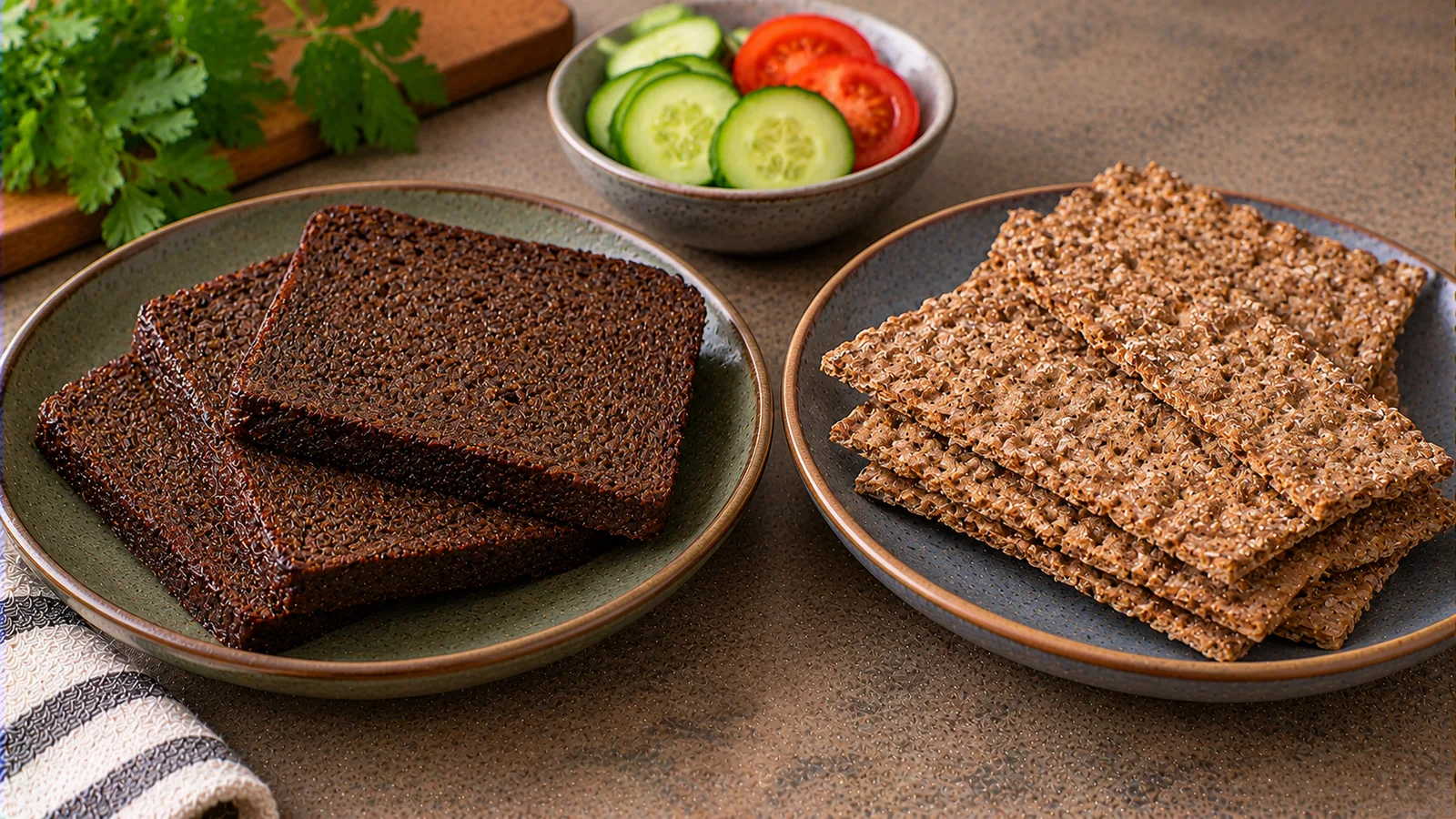
Pumpernickel and rye crispbread are both rye-based options for a quick lunch, but they are not nutritionally interchangeable by slice. Pumpernickel is a dense, moist, dark rye loaf; rye crispbread is a dry, crunchy product. Comparing one slice of each can therefore conceal major differences in weight. A better starting point is 50 g of each bread, weighed without toppings.
This comparison uses two named products whose public manufacturer specifications can be checked: Mestemacher Westfälischer Pumpernickel 500 g and Wasa Vollkorn Roggen crispbread. Those are examples of the categories, not averages for every pumpernickel or every crispbread. Prices are a dated cross-retailer illustration, not a claim that one item is always cheaper in every shop.
Answer first: what does 50 g provide?
| Nutrient or property | Mestemacher pumpernickel, 50 g | Wasa rye crispbread, 50 g |
|---|---|---|
| Dietary fibre | 4.8 g | 10.0 g |
| Salt | 0.335 g | 0.625 g |
| Energy | 88.5 kcal | 165 kcal |
| Protein | 2.2 g | 5.0 g |
| Sugars | 3.0 g | 0.75 g |
| Texture | Soft, dense and moist | Dry, thin and crisp |
The fibre comparison favours this particular crispbread: 10.0 g versus 4.8 g in 50 g. The salt comparison favours the pumpernickel: 0.335 g versus 0.625 g in 50 g. Neither conclusion applies to every brand. The same 50 g of the crispbread also supplies more energy because the food is much drier; this is not a controlled comparison of equal-calorie portions.
The exact figures above are calculated from Mestemacher's product table and Wasa's Vollkorn Roggen table, both reported per 100 g. The manufacturer's specific current packaging should still be checked before purchase.
Why the 50 g comparison matters
The simplest fair arithmetic is to multiply a per-100-g declaration by 0.5. For example, Wasa lists 20 g fibre per 100 g, so 50 g supplies 10 g. Mestemacher lists 9.6 g per 100 g, so 50 g supplies 4.8 g. The same conversion produces the salt and energy figures in the table.
A slice-based comparison gives a different impression. Wasa's manufacturer table specifies approximately 13 g per slice, so 50 g is around four slices; the number actually eaten may be closer to 52 g. A pumpernickel slice is thicker and substantially heavier. Counting one dark slice against one crisp slice without weighing them is not equivalent to comparing 50 g.
Crispbread contains less water and is visually larger per gram. That helps explain why 50 g of crispbread can look like more pieces, while still offering more calories per 50 g than this moist pumpernickel. A difference in calories here does not prove that one food is intrinsically more filling: toppings, portion size, individual appetite and the rest of lunch all matter.
Fibre: the product label decides
Dietary fibre is the first measure where the gap is substantial. In the selected products, Wasa Vollkorn Roggen declares 20 g per 100 g and Mestemacher pumpernickel declares 9.6 g per 100 g. On the fixed 50 g portion, that means 10.0 g versus 4.8 g, a difference of 5.2 g fibre.
That is a product-specific result, not a rule that crispbread always beats pumpernickel. A different crispbread containing refined flour can supply less fibre, while another wholegrain pumpernickel can have a different figure. Names such as “rye”, “dark” and “traditional” cannot replace an actual fibre number when one is printed on the label.
If a retail pack does not declare fibre, the correct value for that particular label comparison is unknown, not zero. In the EU, fibre is generally an optional element of the standard nutrition declaration. Check the European Commission's nutrition-labelling explanation before assuming an omitted field means none is present.
The two reference products both contain rye. They are not appropriate as gluten-free alternatives simply because they are rye-based rather than wheat-based. Pumpernickel here also lists barley malt extract, so check the exact ingredients if gluten or another allergen is a concern.
Salt: the smaller number is in pumpernickel
For salt, Mestemacher's reference label states 0.67 g per 100 g; Wasa's manufacturer page states 1.25 g per 100 g. Dividing by two gives 0.335 g in 50 g of pumpernickel and 0.625 g in 50 g of crispbread. The difference is 0.290 g salt per matched portion.
Both values refer to salt, not sodium. Do not mix a sodium value from one label with a salt value from another. If a label uses sodium rather than salt, convert consistently before comparing; otherwise, use the salt quantity provided on the EU nutrition table.
Toppings are a separate source of salt. Adding cheese, smoked fish, cold cuts or a salty spread changes the salt content of the whole lunch. The table compares bread alone and therefore cannot tell you the final salt amount of a prepared sandwich or topped crispbread plate.
If you are choosing specifically to reduce the salt contributed by the bread portion, the listed pumpernickel wins this example. If your priority is the most declared fibre in those same 50 g, the listed crispbread wins. Those are different goals, and the article does not pretend one product wins every category.
Calories and protein: why moisture changes the figures
The selected Mestemacher bread lists 177 kcal and 4.4 g protein per 100 g. Wasa lists 330 kcal and 10 g protein per 100 g. For a 50 g portion, these become 88.5 kcal and 2.2 g protein for pumpernickel, versus 165 kcal and 5.0 g protein for crispbread.
Those comparisons are not “good” or “bad” scores. People needing a larger lunch may welcome more energy; someone adding a substantial topping may prefer less energy from the bread. The protein content is a modest part of a mixed meal and should not be confused with the protein contained in the fillings.
The sugars also differ: 6 g per 100 g in the selected pumpernickel versus 1.5 g per 100 g in the chosen crispbread, or 3.0 g versus 0.75 g in 50 g. That is an extra label detail, not grounds to rank all dark breads as sugary or all crispbreads as low-sugar.
For a complete lunch, combine the bread with fillings and vegetables that match your needs. our balanced-meal guide explains this overall meal-building task; it is separate from our narrowly defined comparison of two weighed bread portions.
Cost per 50 g: calculate it from the actual pack
A cheap-looking individual pack can be more expensive per equal quantity. The formula is straightforward:
Price for 50 g = pack price × 50 ÷ pack net weight in grams.
To illustrate the calculation with identifiable shop pages, the 21 October 2026 online reference figures were €1.99 for a 500 g Mestemacher pumpernickel pack at the Mestemacher shop and €2.49 for a 260 g Wasa crispbread pack at Knuspr. These offers come from different retailers and are not a same-shop promotion comparison. Delivery charges and future price changes are excluded.
| Pack example, online snapshot 21 Oct 2026 | Calculation | Bread cost for 50 g |
|---|---|---|
| Pumpernickel, 500 g for €1.99 | €1.99 × 50 ÷ 500 | €0.20 |
| Rye crispbread, 260 g for €2.49 | €2.49 × 50 ÷ 260 | €0.48 |
The unrounded intermediate costs are approximately €0.199 and €0.479. With these selected online examples, the pumpernickel costs about €0.28 less per 50 g after rounding. This does not establish a permanent bargain: sales, store brands, delivery fees, delivery area and price updates can reverse the price ranking.
For a fair real-world shopping decision, collect the prices of both products in the same store, on the same day. The manufacturer and retailer links here are traceable reference points rather than a guarantee of live price availability in your area.
What if the goal is fibre for the money?
Bread cost and fibre cost are not identical. The selected pumpernickel example is cheaper per 50 g, yet has roughly half as much fibre in that quantity. Using the illustrative pack prices, reaching 10 g labelled fibre from bread alone would require about 104.2 g pumpernickel or 50 g crispbread. The corresponding theoretical bread costs are about €0.41 and €0.48, respectively.
That mathematical exercise is not a recommendation to choose lunch by the cheapest 10 g of fibre. It intentionally ignores portion preference, total energy, salt, toppings and how much bread a person actually wants. It simply shows why price per gram of food and price per nutrient can answer different shopping questions.
Different products with different labels may also change which option is cheaper per unit of fibre. Read the exact pack rather than carrying these two brand numbers over to another item.
Practical lunch choices
Choose the pumpernickel if you prefer a moist, dense slice, want the lower salt and energy contribution in this 50 g example, and accept the lower fibre figure. It works well with vegetables and a filling that adds protein without forcing a second bread portion.
Choose the crispbread if you like a crunchy base, want the higher declared fibre in this comparison, and are comfortable with the higher salt and energy contributions per 50 g. If four sheets are more than you normally eat, weigh or estimate the smaller actual portion rather than treating the full 50 g as mandatory.
Both examples contain gluten-containing grains. Always check current ingredient lists, allergy statements, package weights and serving recommendations. Different markets or reformulations can change declarations. our guide to reading food nutrition labels provides the broader method for reading nutrition tables when the pack in front of you differs from these examples.
Which is the better buy?
There is no universal winner. For the two reference products only, at equal 50 g the rye crispbread offers 10.0 g fibre versus 4.8 g, while the pumpernickel contributes 0.335 g salt versus 0.625 g. In the dated cross-retailer price illustration, the pumpernickel is cheaper at €0.20 versus €0.48 per 50 g. Those results answer three separate questions; they should not be collapsed into a blanket health claim.
The reusable method is: pick the precise products, read both per-100-g labels, compare the same consumed weight, and calculate price using the current local shelf tags. That is enough to make an informed lunch-bread choice without turning a comparison of two breads into a general ranking of all grains.
Sources
- Mestemacher — Westfälischer Pumpernickel 500 g. Product-specific fibre, salt, energy, protein, sugars, and ingredients per 100 g.
- Wasa — Vollkorn Roggen crispbread. Manufacturer nutrition declaration, ingredients and approximate single-sheet values.
- Mestemacher online shop — Pumpernickel prices. €1.99/500 g example observed 21 October 2026; offers may change.
- Knuspr Berlin — Wasa Vollkorn Roggen. €2.49/260 g online example; delivery region and charges may differ.
- European Commission — Nutrition labelling. Standard per-100-g declarations and optional fibre labelling.
Nutrition numbers are specific manufacturer reference values, not a laboratory analysis of all pumpernickel and crispbread. The 50 g figures and price calculations are transparent arithmetic. The example prices come from two different retailers, not a verified identical-store basket, and must be rechecked before buying.