
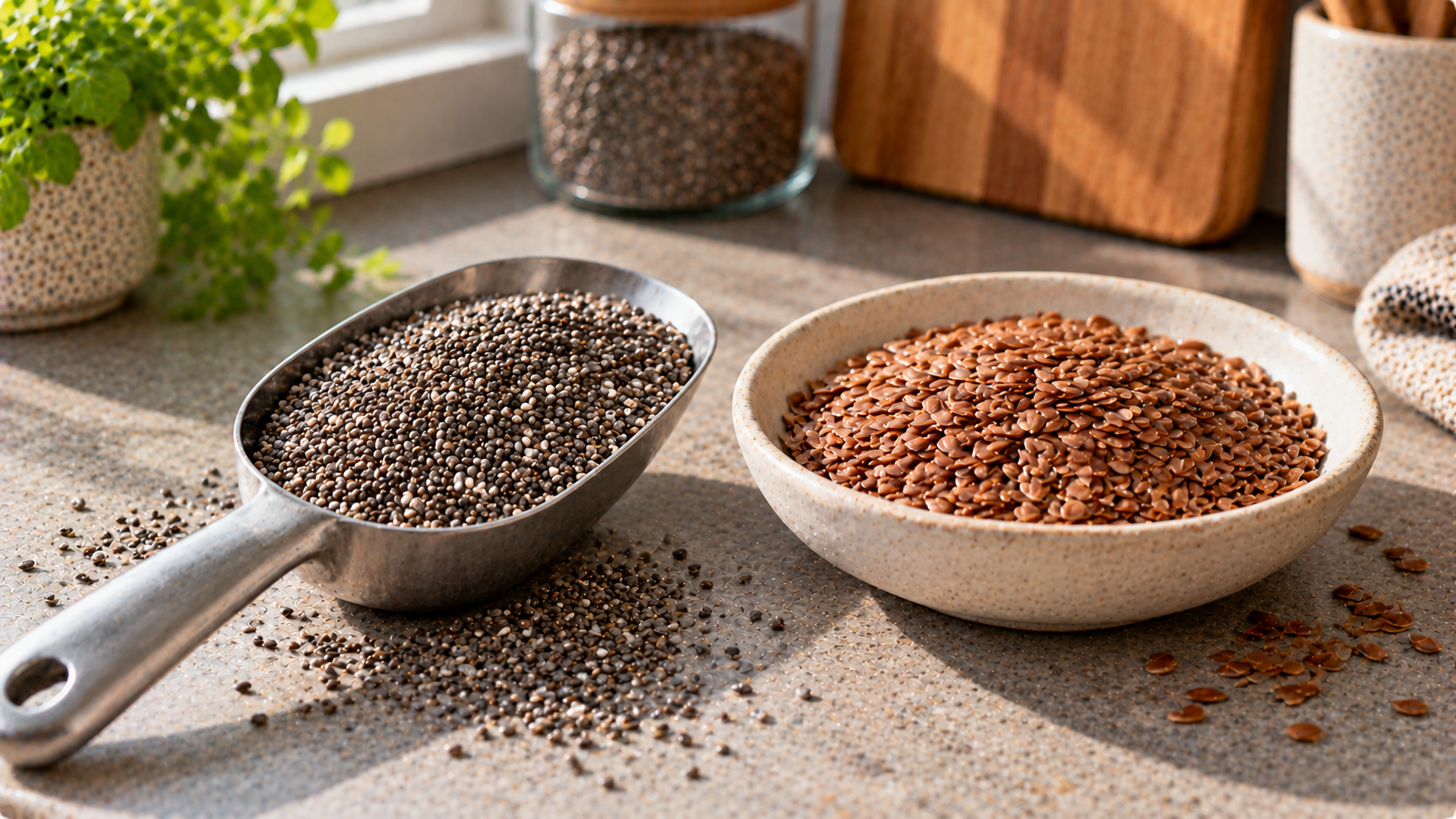
Chia seeds and flaxseed are small, fiber-rich foods with a substantial amount of plant omega-3 fat. They are not nutritionally interchangeable in every detail, however. Chia is particularly convenient for thickening moist dishes, while ground flaxseed is often a practical, affordable way to add alpha-linolenic acid (ALA) and fiber to breakfast. The useful comparison is not which seed is a universal “superfood,” but which one matches a realistic portion, recipe, budget and dietary need.
Chia versus flaxseed: the important differences
| Question | Chia seeds | Flaxseed (linseed) |
|---|---|---|
| Typical kitchen form | Whole seeds, hydrated or mixed into moist food | Ideally freshly ground or milled for nutrient access |
| Texture | Swells and forms a gel | Ground seed gives a nutty, thicker crumb |
| Fat profile | Rich in ALA omega-3 | Rich in ALA omega-3, often more per gram |
| Fiber | Very high, especially in a gram-for-gram comparison | High, with soluble and insoluble fractions |
| Protein | Moderate for a seed | Moderate for a seed |
| Everyday strengths | Puddings, overnight oats, moist toppings | Porridge, yogurt, baking, batters |
| Main limitation | Avoid swallowing large spoonfuls dry | Whole seeds may pass through partly undigested |
Neither seed replaces a varied diet. Both deliver energy as well as fiber and fat, and both contain far less protein per usual serving than eggs, skyr, soy foods or legumes. The decision becomes clearer when we compare an actual tablespoon-sized addition instead of an unrealistic 100 g bowl of seeds.
Nutrition per 100 g: useful reference, not a normal serving
The values below are rounded reference figures for plain dried seeds. Agricultural variety, analytical database, moisture and product processing account for differences among sources and labels. Use your package for precise tracking.
| Nutrient (approximately) | Chia, 100 g | Flaxseed, 100 g |
|---|---|---|
| Energy | 486 kcal | 534 kcal |
| Protein | 16.5 g | 18.3 g |
| Total fat | 30.7 g | 42.2 g |
| Carbohydrate, including fiber (US-style total carbohydrate) | 42.1 g | 28.9 g |
| Dietary fiber | 34.4 g | 27.3 g |
| ALA omega-3 | 17–18 g | 22–23 g |
A major label trap is the carbohydrate row. American databases often count dietary fiber within “total carbohydrate,” while European nutrition labels generally display carbohydrates that exclude fiber and list fiber separately. A direct comparison of those two numbers can make the same seed appear dramatically different. Do not calculate digestible carbohydrate by comparing differently defined rows.
A second trap is treating the ALA figure as the same thing as fish-derived EPA and DHA. The body converts only a limited proportion of ALA into longer-chain omega-3 fats; the conversion varies by person and circumstances. Neither seed automatically provides the same EPA or DHA intake as oily fish or algal oil.
What does a realistic 10 g or 20 g serving contribute?
| Serving | Approximate calories | Approximate fiber | Approximate ALA |
|---|---|---|---|
| Chia, 10 g | 49 kcal | 3.4 g | 1.8 g |
| Chia, 20 g | 97 kcal | 6.9 g | 3.5 g |
| Flaxseed, 10 g | 53 kcal | 2.7 g | 2.3 g |
| Flaxseed, 20 g | 107 kcal | 5.5 g | 4.6 g |
These are arithmetic illustrations from rounded reference values, not guarantees for every brand. Weigh the seed if accuracy matters: a tablespoon changes weight depending on whether seeds are whole, ground or heaped. Five grams added to porridge is a meaningful amount; an advertised “serving” of several tablespoons may not fit everyone's digestion or calorie target.
For a closer look at the calories and fibre in ordinary amounts of linseed, consult the flaxseed portion guide.
In energy terms the difference is small. Swapping 10 g of chia for 10 g of flax generally changes the meal by only a few calories. Adding either seed on top of an unchanged meal, however, adds roughly 50–55 kcal. For weight management, count that addition rather than treating fiber-rich foods as calorie-free.
Omega-3: both supply ALA, not EPA or DHA
The omega-3 in both seeds is predominantly alpha-linolenic acid, or ALA, an essential plant fatty acid. The US National Institutes of Health lists chia and flaxseed among plant ALA sources. Its reference intake figures for adults are approximately 1.6 g/day for men and 1.1 g/day for women, though national recommendations and individual circumstances vary.
The distinction between plant ALA and preformed marine EPA/DHA is explained further in the guide to dietary omega-3 sources.
Ten grams of either seed may contain more ALA than those reference amounts, but this does not mean that 10 g of seeds settles every omega-3 question. The ability to access the fatty acid matters, and conversion to EPA and especially DHA is limited. People who avoid fish may want to consider where preformed EPA/DHA fits within their broader diet; algae-derived sources are an option.
For flaxseed, form makes a substantial difference. In a small intervention study, milled flaxseed and flaxseed oil increased blood ALA, whereas whole flaxseed did not produce a statistically significant increase under the study conditions. This does not prove that every whole seed is nutritionally useless, but it is a practical reason to use ground flaxseed when ALA absorption is the main objective.
For chia, the seed coat is relatively easy to disrupt when soaked in moist food, so whole hydrated chia can be convenient. Preparation, chewing and individual digestion still affect what is available. Do not assume that dry, unchewed seeds behave identically to soaked chia pudding.
Fiber: choose the amount your stomach tolerates
A 20 g portion of chia provides around 7 g of fiber; the same amount of flaxseed supplies roughly 5–6 g. Both can noticeably increase a breakfast's fiber content. Fiber supports bowel function and contributes to the overall quality of a plant-rich diet, but the benefit depends on the rest of what you eat, drinking enough fluid and increasing intake gradually.
Someone who normally eats little fiber may find that a jump to a large chia pudding causes gas, bloating or abdominal discomfort. Start with a teaspoon or around 5 g, especially if beans, lentils and whole grains are already prominent in the same day. Increase over several days rather than chasing the highest possible number.
Both foods contain compounds that bind water, but a hydrated chia gel and milled flax mixed into baked batter behave differently in the mouth. For practical digestion, the best seed is often the one that makes you more willing to eat a balanced meal consistently, not the one with the marginally higher fiber figure per 100 g.
Protein and minerals: helpful extras, not the main reason to buy them
Flaxseed is slightly higher in protein per 100 g in many databases, but a 10 g serving delivers fewer than 2 g from either seed. If your breakfast goal is 25–30 g of protein, seeds are a topping; the main protein should come from something such as yogurt, quark, skyr, fortified soy yogurt or eggs, depending on preference.
Chia contributes calcium, phosphorus and magnesium, while flaxseed contributes magnesium, phosphorus and other micronutrients. The exact mineral content, and how much is absorbed, depend on composition and the overall meal. Seeds contain phytate, so it would be misleading to equate an analytical mineral number with a fully absorbed dose. Likewise, a tablespoon should not be promoted as a substitute for fortified drinks or other dependable calcium sources.
Neither food supplies meaningful vitamin B12. Neither makes an otherwise inadequate vegan diet automatically complete. Think of them as modest, concentrated additions that complement the larger ingredients in the meal.
Whole or ground: the biggest practical distinction
For flaxseed, buy ground seed in small quantities or grind whole seeds at home shortly before eating. Whole seeds store relatively well but can pass through the digestive system partially intact; grinding improves access to some nutrients. Once ground, the greater surface area makes flax more vulnerable to oxidation. Follow storage instructions, keep the product sealed, away from heat and light, and discard it if it develops an unpleasant rancid smell.
For chia, you can usually put whole seeds into yogurt, oats or a liquid mixture and give them time to hydrate. The resulting gel is useful for overnight oats and pudding. A splash of water alone is not a precise safety rule: the amount of liquid, food texture and ability to swallow all matter. Never eat large amounts of dry chia straight from a spoon, particularly if you have difficulty swallowing, because expansion after contact with liquid can present a choking or obstruction risk.
Pre-ground chia is also available. It changes texture and may be useful in baking, but it is not mandatory for every wet recipe. If you are serving someone with swallowing difficulties, seek individualized medical or dietetic advice rather than relying on ordinary food-preparation tips.
Cooking and baking: when each seed works best
Chia earns its place when you want a visibly gelled mixture. Mix it into a liquid base for an overnight pudding, or add a small amount to a watery smoothie or fruit compote. The texture develops gradually, so stir after a few minutes to prevent clumps. Chia can also be sprinkled onto already moist yogurt or porridge.
Ground flaxseed has a toasted, nutty character. It integrates into oatmeal, pancake batter, bread dough and savory sauces without the pronounced bead-like texture of hydrated chia. Small amounts can replace part of flour in baking, but a direct one-for-one exchange with wheat flour can affect moisture, rise and structure.
In egg-free baking, either seed can form a binder when mixed with water. A common starting point is approximately 1 tablespoon of ground seed with 3 tablespoons of water, left until thickened; recipes vary substantially. This mixture helps hold some muffins or pancakes together, but it will not reproduce all the foaming, emulsifying and structure-building properties of an egg in every cake.
Flavor, texture and everyday acceptance
Chia has a relatively mild flavor but makes a distinctive slippery, seeded texture after hydration. That can be welcome in pudding and unpleasant in a smooth dressing. Flaxseed has a more noticeable earthy or nutty taste and may be easier to hide in porridge or baked goods when ground.
Try the seed in the actual food you plan to eat before buying a large bag. If a child or adult refuses chia because of its texture, there is no nutritional advantage in insisting on it. Ground flax offers a viable alternative. Conversely, if flax's flavor dominates yogurt, chia may be the easier habit.
Neither seed must be eaten raw. Incorporating modest amounts into cooked foods is reasonable, although preparation may change flavor, texture and the amounts of some sensitive compounds. They are ingredients, not medicines, and cooking them does not make a meal nutritionally worthless.
Price comparison: calculate the cost of a usable serving
Price per kilogram can obscure the practical question: how much does your preferred portion cost? Suppose a hypothetical shop sells chia for €9/kg and flaxseed for €4/kg. A 15 g portion would cost around €0.14 for chia and €0.06 for flax. Those figures are illustrative, not live store prices; compare actual shelf labels and consider how quickly you will use the opened package.
| Example price calculation | Chia | Flaxseed |
|---|---|---|
| Illustrative price per kg | €9.00 | €4.00 |
| Cost per 10 g | €0.09 | €0.04 |
| Cost per 20 g | €0.18 | €0.08 |
If you buy pre-ground flax, the premium may be worthwhile for convenience, provided the package is stored appropriately. Buying large quantities to reduce the unit price is not necessarily economical if the product deteriorates before you finish it. A small bag that becomes a daily habit can provide better value than a bulk package that sits unused.
Three practical breakfast comparisons
Yogurt bowl: Add 10 g chia to plain yogurt, berries and oats if you like a little gel and crunch. Add 10 g ground flax instead for a softer, nutty finish. The yogurt supplies most of the protein; the seed mainly adds fiber, fats and texture.
Overnight oats: Chia is the convenient thickener when the mixture should set firmly overnight. Ground flax also thickens, but its consistency is usually less pudding-like. Adjust the liquid gradually rather than assuming equal grams have identical water-binding behavior.
Pancakes: Ground flax is easy to stir into the batter; chia can work if the recipe allows hydration time. Neither choice makes pancakes “high-protein” unless the remaining recipe provides enough protein. Evaluate the finished serving, including syrup or other toppings, rather than assigning nutritional properties based on a single ingredient.
How to choose in a supermarket
Check that you are buying plain edible seeds rather than sweetened mixes. Compare the price per 100 g or kilogram, the recommended storage after opening and the form you need. For ground flax, prefer packaging you can finish while fresh. For chia, decide whether your household will actually use the gelled texture.
If tracking calories, record the dry seed's weight before it absorbs water. A 15 g portion does not become more caloric when it absorbs liquid; its final weight increases because of water. Similarly, 15 g of seeds stirred into yogurt are not the same as 15 g of prepared chia pudding containing additional milk, syrup and fruit.
People with known allergies should check packaging for ingredients and cross-contact warnings. Individuals with gastrointestinal conditions, swallowing problems or medication-related restrictions should obtain personal advice rather than using this comparison as treatment guidance.
Which seed should you choose?
Choose chia when you want an easy whole-seed thickener for moist recipes and a little more fiber in a like-for-like reference amount. Choose ground flaxseed when you prefer a nutty flavor, a practical ALA source and often lower cost. Keep both if they genuinely serve different recipes; there is no need to buy both merely to obtain overlapping nutrients.
What matters most is a realistic, regularly eaten serving in an otherwise varied diet. A small portion of either seed can be useful. Neither is a shortcut to meeting every protein, omega-3 or micronutrient target, and neither warrants exaggerated disease or weight-loss promises.