
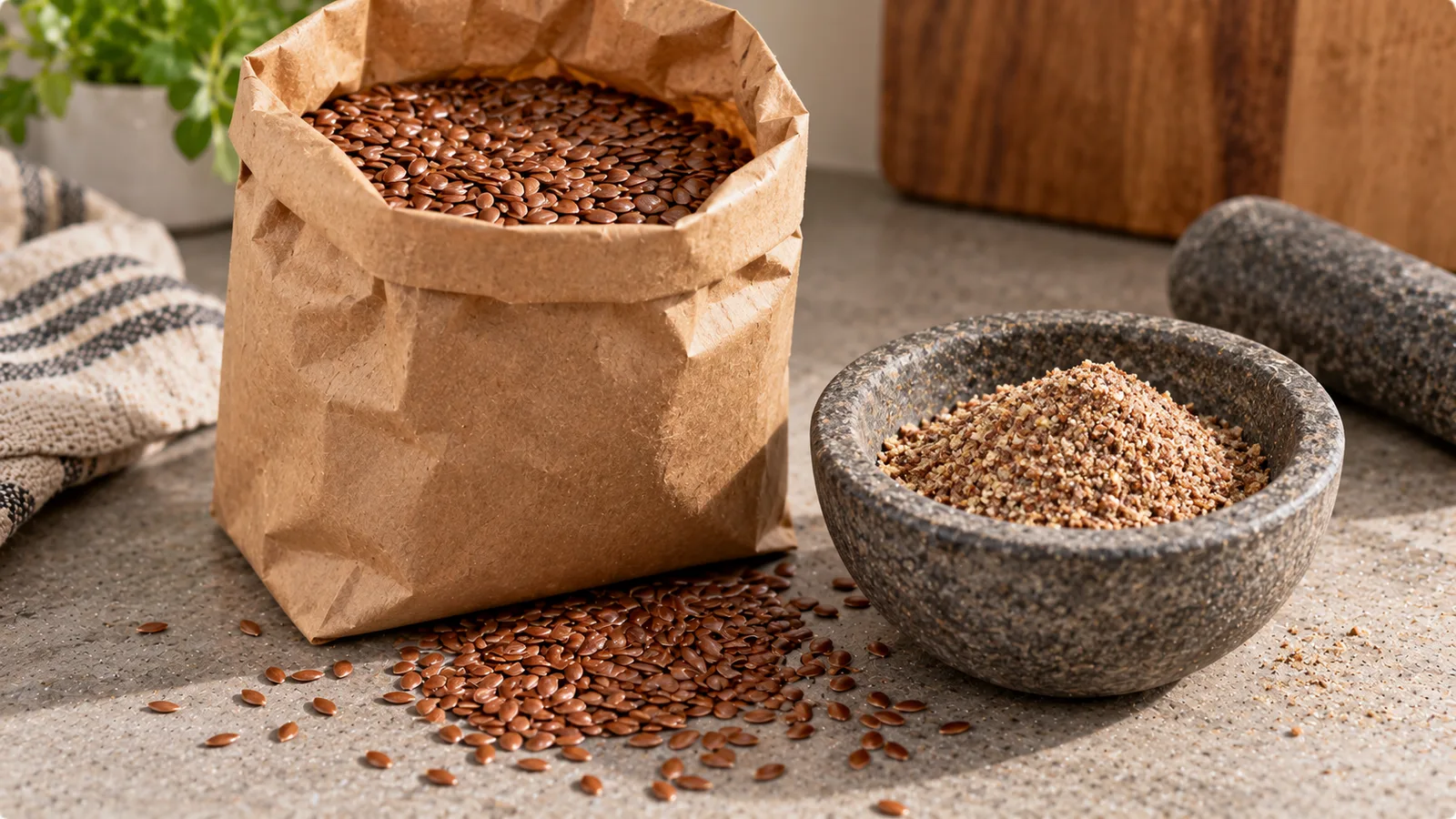
Flaxseed, also called linseed, is a small seed with a relatively high calorie density. It contains substantial fat, dietary fiber and some protein, so a small quantity can contribute meaningful nutrients to a meal.
The most useful way to understand its calories is to look at the weight you actually eat, not simply whether you add a teaspoon or a tablespoon.
Whole and ground flaxseed are made from the same seed. Grinding changes the physical form and can improve access to some nutrients, but it does not make the calories disappear.
How many calories are in flaxseed?
A commonly used reference value for raw flaxseed is approximately 534 kcal per 100 g.
Using that reference, the estimated energy content is:
| Flaxseed amount | Estimated calories |
|---|---|
| 5 g | 27 kcal |
| 10 g | 53 kcal |
| 15 g | 80 kcal |
| 20 g | 107 kcal |
| 25 g | 134 kcal |
| 30 g | 160 kcal |
| 40 g | 214 kcal |
| 50 g | 267 kcal |
| 100 g | 534 kcal |
These are calculated reference estimates, not guaranteed values for every product.
Nutrition labels may differ because of variety, moisture, processing, rounding rules and the energy calculation method used.
For packaged flaxseed, the product label is usually the most relevant starting point.
Calories in one tablespoon of flaxseed
A tablespoon is a volume measure, not a fixed weight.
A level tablespoon of ground flaxseed is often estimated at around 7 g, but the actual amount varies with grind size and how densely the spoon is filled.
At 534 kcal per 100 g:
7 g × 5.34 kcal/g = approximately 37 kcal.
A tablespoon containing 10 g would provide approximately 53 kcal.
That difference is meaningful when the ingredient is added repeatedly throughout the day.
For accurate tracking, weigh the portion rather than assuming every tablespoon contains the same amount.
Teaspoon versus tablespoon
A teaspoon contains roughly one-third the volume of a tablespoon, but that does not guarantee exactly one-third the weight.
Ground flaxseed may pack differently from whole seeds.
If you regularly use the same spoon and product, weigh it once or twice to establish a realistic household estimate.
Flaxseed nutrition per 100 g
The following values are approximate reference figures for raw flaxseed.
| Nutrient | Per 100 g |
|---|---|
| Energy | 534 kcal |
| Protein | 18.3 g |
| Total fat | 42.2 g |
| Carbohydrates, including fiber | 28.9 g |
| Dietary fiber | 27.3 g |
| Omega-3 ALA | Approximately 22.8 g |
These values are based on a commonly used USDA food composition profile and have been rounded.
Important: The carbohydrate figure above follows a total-carbohydrate convention that includes dietary fiber. On many EU nutrition labels, carbohydrate is reported separately from fiber. Do not add or compare those figures as though the conventions were identical.
Flaxseed also supplies minerals such as magnesium and phosphorus, although the amounts actually consumed depend on portion size.
Source: USDA FoodData Central.
Nutrition in a realistic 15 g portion
Most people do not eat 100 g of flaxseed at once.
A 15 g portion provides approximately:
| Nutrient | Per 15 g |
|---|---|
| Energy | 80 kcal |
| Protein | 2.7 g |
| Total fat | 6.3 g |
| Total carbohydrates, including fiber | 4.3 g |
| Dietary fiber | 4.1 g |
| Omega-3 ALA | 3.4 g |
These values are proportional estimates based on the 100 g reference.
A 15 g serving can add fiber and ALA to porridge, yogurt or a smoothie without becoming the main source of calories in the meal.
However, the total calorie contribution still matters if you are measuring energy intake.
Why is flaxseed relatively high in calories?
Flaxseed contains a substantial amount of fat.
Fat provides more energy per gram than protein or digestible carbohydrate, which helps explain why seeds can be calorie-dense despite their small size.
The fat in flaxseed is predominantly unsaturated.
Flaxseed is particularly known for alpha-linolenic acid, abbreviated ALA, a plant-based omega-3 fatty acid.
ALA is an essential fatty acid, meaning the body must obtain it from food.
However, ALA is not the same as the long-chain omega-3 fatty acids EPA and DHA found in certain fish and algae-derived products.
The human body can convert some ALA into EPA and DHA, but conversion is limited and variable.
Therefore, a high ALA intake should not automatically be treated as equivalent to consuming the same amount of EPA or DHA.
Reference: NIH Office of Dietary Supplements — Omega-3 Fatty Acids.
Whole versus ground flaxseed
Whole and ground flaxseed can have similar nutrient composition by weight, but their physical structure affects how they are digested.
The outer shell of a whole flaxseed can remain relatively intact during digestion.
Grinding breaks that shell and generally makes the seed's contents more accessible.
For this reason, ground flaxseed is often preferred when the goal is to obtain its nutrients.
That does not mean whole flaxseed contains fewer calories on the nutrition label.
The difference is between the food's stated composition and how much of its contents become available during digestion.
For routine food logging, use the label or database entry matching the product you consume.
Do not invent a lower calorie value for whole seeds because some may pass through the digestive tract intact.
Does grinding flaxseed increase its calories?
Grinding does not create additional energy.
If you grind 15 g of whole flaxseed and use all the resulting powder, the ingredient still originates from 15 g of seeds.
Its reference calorie value remains approximately 80 kcal.
What can change is:
- The ease of mixing the seeds into food.
- The amount of nutrients accessible during digestion.
- The weight that fits into a spoon.
- The speed at which the exposed fats may deteriorate during storage.
A spoonful of finely ground flaxseed can weigh differently from a spoonful of whole seeds.
That is why weighing is more reliable than comparing spoon volumes.
Brown versus golden flaxseed
Brown and golden flaxseed are both varieties of flax.
Their nutrient composition can vary, but their calorie density is generally broadly similar.
Differences may arise from variety, growing conditions, moisture and processing.
Color alone is not a reliable method for determining the exact calorie content.
If you purchase packaged golden or brown flaxseed, use the nutritional information on that specific product.
There is no need to treat one color as automatically lower in calories.
Flaxseed and dietary fiber
Flaxseed is a concentrated source of dietary fiber.
Using the reference value of 27.3 g fiber per 100 g:
- 5 g provides approximately 1.4 g fiber.
- 10 g provides approximately 2.7 g fiber.
- 15 g provides approximately 4.1 g fiber.
- 20 g provides approximately 5.5 g fiber.
- 30 g provides approximately 8.2 g fiber.
Fiber contributes to the overall nutritional value of the seed, but increasing fiber intake suddenly can cause bloating, gas or digestive discomfort in some people.
If you are not accustomed to fiber-rich foods, introduce flaxseed gradually and maintain adequate fluid intake.
Flaxseed should be incorporated into an overall varied diet rather than relied upon as the sole fiber source.
Flaxseed for weight management
Flaxseed can fit into a weight-loss, maintenance or weight-gain eating plan.
Its fiber and fat may contribute to meal satisfaction, but it still adds calories.
For example:
A bowl of plain yogurt provides a certain amount of energy.
Adding 15 g flaxseed contributes approximately 80 kcal, before any fruit, honey, nuts or other toppings.
If you add 30 g instead, the flaxseed contribution rises to approximately 160 kcal.
Neither amount is automatically good or bad.
The appropriate portion depends on the rest of the meal and your overall intake.
Flaxseed should not be presented as a food that directly burns body fat or guarantees weight loss.
Practical serving sizes
A useful portion depends on how you plan to use the seeds.
| Use | Example amount | Approximate calories |
|---|---|---|
| Small topping on yogurt | 5 g | 27 kcal |
| Added to porridge | 10 g | 53 kcal |
| Mixed into a smoothie | 10–15 g | 53–80 kcal |
| Mixed into homemade dough | 15 g | 80 kcal |
| Larger addition to breakfast | 20 g | 107 kcal |
These are culinary examples, not prescribed daily doses.
If flaxseed is new to your diet, smaller portions can be easier to tolerate.
For people with swallowing difficulties, gastrointestinal conditions or medication-related concerns, individual medical advice may be appropriate before using substantial amounts.
How to count flaxseed calories in recipes
The simplest approach is to weigh the flaxseed before mixing it into the dish.
Example: breakfast bowl
Suppose you prepare a bowl with:
- 200 g plain yogurt.
- 100 g berries.
- 15 g ground flaxseed.
- 20 g oats.
The flaxseed contributes approximately 80 kcal.
The calories from the yogurt, berries and oats must be calculated separately using their actual products and quantities.
Do not assume that the entire bowl contains only the calories from the flaxseed.
Example: homemade bread
Suppose a bread recipe contains 60 g flaxseed.
Estimated energy from flaxseed:
60 × 5.34 = 320 kcal, rounded.
If the finished bread is divided into 12 equal slices, the flaxseed contributes approximately:
320 ÷ 12 = 27 kcal per slice.
This is only the flaxseed contribution. Flour, oil and other ingredients add their own calories.
If slices differ substantially in weight, calculating nutrition per 100 g of finished bread can be more accurate than assuming every slice is identical.
Flaxseed versus flaxseed oil
Flaxseed and flaxseed oil are not nutritionally interchangeable.
Whole or ground flaxseed contains fat, protein and fiber.
Flaxseed oil consists almost entirely of fat and contains essentially no dietary fiber.
As a general reference:
| Product | Approximate calories per 10 g |
|---|---|
| Whole or ground flaxseed | 53 kcal |
| Flaxseed oil | 88–90 kcal |
The exact values depend on the product.
If a recipe uses flaxseed oil, log it as oil rather than as whole seeds.
The same applies to other seed oils.
Flaxseed versus chia seeds
Flaxseed and chia seeds are both used in yogurt, porridge and baking.
They differ in texture, hydration behavior and nutrient composition.
Chia seeds absorb substantial amounts of liquid and form a gel.
Ground flaxseed also interacts with water and can help bind ingredients, but it behaves differently in recipes.
Their calorie values per 100 g are in a similar general range, though not identical.
When substituting one for the other, weigh the replacement and calculate its nutrition separately.
Do not assume that one tablespoon of chia seeds and one tablespoon of ground flaxseed weigh the same.
Can flaxseed replace an egg in baking?
Ground flaxseed mixed with water is sometimes used as an egg substitute in certain baked goods.
A common starting method is approximately:
- 7 g ground flaxseed.
- 45 ml water.
Mix and allow it to thicken for several minutes.
This mixture may help bind ingredients in pancakes, muffins or some cookies.
It does not reproduce every functional property of an egg, particularly in recipes requiring strong aeration or a specific egg structure.
The flaxseed itself contributes approximately 37 kcal at 7 g.
Water adds no calories.
If a recipe replaces an egg with flaxseed, calculate the nutrition of the final recipe using the actual ingredients rather than assuming the substitution is nutritionally identical.
Storage: whole and ground seeds
Whole flaxseed generally keeps its quality longer than ground flaxseed because the fats are less exposed to air.
Ground flaxseed has more exposed surface area and can develop unpleasant flavors when stored poorly.
Practical storage steps:
- Keep seeds in a tightly closed container.
- Protect them from heat, moisture and direct sunlight.
- Follow the manufacturer's storage instructions.
- Consider refrigerating ground flaxseed, especially after opening.
- Discard products with an unpleasant rancid smell or taste.
The exact storage period depends on processing, packaging and conditions.
Grinding small quantities as needed can help maintain freshness.
Safety considerations
Flaxseed is commonly eaten as a food ingredient, but a few practical precautions matter.
Increase portions gradually
Because flaxseed contains considerable fiber, large sudden increases may cause gastrointestinal symptoms.
Start with a modest amount and observe tolerance.
Use sufficient liquid
Flaxseed absorbs water.
Consume it as part of adequately hydrated meals and maintain normal fluid intake.
Avoid swallowing large quantities of dry ground flaxseed without sufficient liquid.
Follow local food-safety guidance
Flaxseed naturally contains cyanogenic compounds. Food-safety authorities may provide specific advice about the quantities and preparation of flaxseed, especially for vulnerable groups.
For example, Germany's Federal Institute for Risk Assessment has published advice concerning flaxseed and cyanogenic glycosides.
Follow current guidance from the relevant national authority and the product label rather than treating large servings as automatically harmless.
Reference: German Federal Institute for Risk Assessment.
Medication and medical considerations
People taking medication, especially those with relevant gastrointestinal or swallowing problems, should ask a qualified healthcare professional about substantial or therapeutic use.
Flaxseed should not replace prescribed treatment.
Common calorie-tracking mistakes
Using a tablespoon as an exact weight. Spoon weights vary with grind size and packing.
Confusing flaxseed with flaxseed oil. Oil has a different calorie density and lacks the seed's fiber.
Assuming ground flaxseed is calorie-free because it is high in fiber. It still contains considerable fat and energy.
Logging the whole recipe as one serving. Divide the total nutrition by the actual number or weight of servings.
Comparing carbohydrate figures from different labeling systems without checking the definition. Some databases include fiber within total carbohydrate, while EU labels list fiber separately.
Ignoring small repeated additions. Several 10 g portions across the day can contribute meaningful calories.
Assuming golden flaxseed is always lower in calories than brown flaxseed. Check the actual product label.
A simple way to track flaxseed accurately
For routine meal logging:
- Choose the database entry that matches whole, ground or oil form.
- Weigh the amount before adding it to food.
- Use the product's nutrition label when available.
- Record the amount in grams.
- Calculate the full recipe if the seeds are mixed into a larger dish.
- Recheck portions when switching brands or changing from whole to ground seeds.
This approach is more reliable than relying on generic spoon estimates.
Final takeaway
Flaxseed provides approximately 534 kcal per 100 g, or around 80 kcal in a 15 g portion, using a common raw-flaxseed reference.
Its nutritional value comes from a combination of unsaturated fats, fiber, protein and plant-based omega-3 ALA.
Whole and ground flaxseed are similar in stated nutrient composition by weight, but grinding changes how the seeds are used and digested.
For accurate calorie tracking, weigh your portion, distinguish seeds from flaxseed oil and use the nutrition information for the specific product whenever possible.