
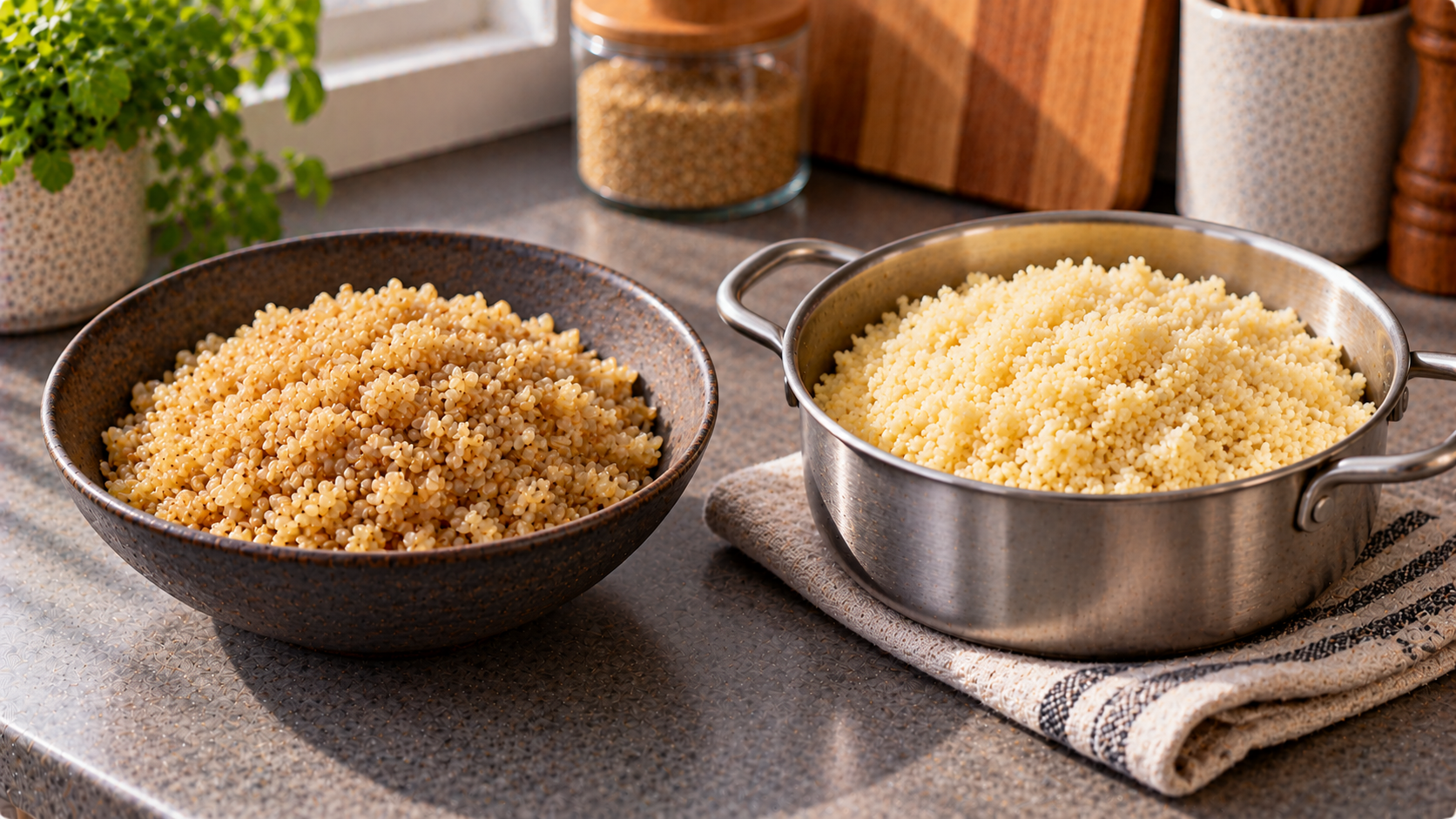
Bulgur and couscous look similar on a plate, yet they are made differently. Bulgur is wheat that has been parboiled, dried and cracked; conventional couscous is small granules formed from wheat semolina. This difference matters most for whole-grain content, fibre, texture and preparation—not because one is a miracle food. Both can be quick, affordable bases for a balanced meal, and both contain wheat gluten.
For an everyday choice, start with three questions: Is the couscous whole-wheat or conventional? Are the nutrition numbers based on dry or cooked weight? And what will you serve alongside it? Those answers are more useful than comparing two isolated calorie figures.
Bulgur and couscous: what are they actually made from?
Bulgur begins with wheat kernels, commonly durum wheat. The grain is partially cooked or parboiled, dried, then cracked into different sizes. Because the grain's bran and germ generally remain, conventional bulgur is typically a whole-grain wheat product. Fine bulgur can hydrate quickly; coarse bulgur may need simmering. The Whole Grains Council describes this processing method and explains why bulgur qualifies as a whole grain.
Standard couscous is closer to tiny pasta than to a separate cereal species. Semolina—usually from durum wheat—is moistened, rolled into granules and dried. Many supermarket versions are made with refined semolina, although whole-wheat couscous is also available. Whole-wheat couscous changes the comparison substantially: it can provide more fibre than the conventional version. Neither the word couscous nor the colour of the product alone guarantees whole-grain content.
Pearl or Israeli couscous is a larger pasta-like product and may have different cooking times and nutrition values. This guide focuses on ordinary small-grain couscous unless specified otherwise. Labels always take priority over a generic comparison.
Nutrition comparison: use the same cooked weight
The following values are illustrative rounded reference estimates for plain foods prepared in water without oil, stock, butter or salt. Product and food-database entries differ, as does the amount of water absorbed. They should not be treated as the guaranteed composition of a particular brand. Check the package for precise calculations.
| Per 100 g cooked, plain | Bulgur | Conventional couscous |
|---|---|---|
| Energy | About 83 kcal | About 112 kcal |
| Protein | About 3.1 g | About 3.8 g |
| Carbohydrate | About 18.6 g | About 23.2 g |
| Fibre | About 4.5 g | About 1.4 g |
| Fat | About 0.2 g | About 0.2 g |
At the same cooked weight, bulgur commonly offers appreciably more fibre. The lower calorie figure per 100 g is partly a question of cooked-food composition and water content. It does not prove that dry bulgur has dramatically fewer calories than dry couscous. Both are mainly starch-based grains, and the complete meal determines how filling it feels.
Use USDA FoodData Central to inspect the relevant entries and their preparation states: USDA FoodData Central. Never copy a value for dry semolina directly into a comparison with cooked bulgur.
For portion calculations beyond this comparison, the guides to bulgur and couscous distinguish dry and cooked quantities. Water absorption can change the figures per 100 g cooked without changing the original dry-grain calories.
What a realistic portion provides
A side serving of 150 g cooked food can be useful when building a plate. Applying the approximate figures above gives the following—not a fixed prescription for how much anyone must eat.
| Example cooked portion | Bulgur, 150 g | Couscous, 150 g |
|---|---|---|
| Energy | About 125 kcal | About 168 kcal |
| Protein | About 4.7 g | About 5.7 g |
| Fibre | About 6.8 g | About 2.1 g |
If you eat 200 g cooked, multiply the 100 g figures by two. If your bowl contains roasted vegetables, chickpeas, olive oil or dressing, calculate those separately. A tablespoon of oil can change the meal's energy more than swapping one cooked grain for another. Equally, 150 g of grain should not be mistaken for a complete, protein-rich lunch.
The most accurate portion workflow is to weigh the dry product you actually use, read its dry nutrition label and divide the finished batch by servings. Cooked weights fluctuate with water uptake. A calculator that assumes every 50 g dry portion finishes at exactly the same cooked weight will introduce avoidable errors.
Fibre and whole grains: the clearest difference
Fibre is the most meaningful nutritional distinction between ordinary bulgur and conventional refined couscous. Bulgur retains components of the wheat kernel; refined couscous generally contains less bran and germ. More fibre can help a grain-based meal contribute toward daily fibre goals and may improve fullness in the context of a balanced diet. It is not an automatic guarantee of better digestion for everyone.
However, comparing bulgur with whole-wheat couscous can narrow the gap. To make a fair supermarket comparison, look for whole-grain wheat or whole-wheat semolina early in the ingredient list, then compare fibre per 100 g in the same state. Some packs list dry product; some prepared-meal labels list cooked food. Comparing across those two states makes the higher-water product appear misleadingly weak in calories or nutrients.
The Whole Grains Council defines a whole grain as retaining the bran, germ and endosperm in their original proportions after processing. A product can be cracked or cooked and still qualify: whole-grain definition. The label, rather than the grain's fashionable reputation, should settle the question.
Protein: small differences, not complete meals
Couscous may show slightly more protein per 100 g cooked in common reference tables. That does not make it a high-protein food. A 150 g cooked portion of either grain provides only a few grams of protein; individual brands, particularly whole-wheat versions, vary.
To build a substantial main course, combine the grain with an appropriate protein source: lentils or chickpeas, tofu, eggs, fish, chicken, yogurt-based sauce or another option that fits your dietary pattern. For example, 150 g cooked bulgur with 120 g drained chickpeas, tomatoes, cucumber and lemon dressing is quite different from plain bulgur. The protein and fibre from the legumes are part of the answer, not a property of bulgur itself.
Bulgur and couscous both supply plant protein from wheat, but neither alone is an especially efficient way to meet a higher daily protein target. A meal plan should consider the full day's protein distribution rather than ranking grains based on a difference of less than a gram in one small serving.
Calories, blood sugar and weight-management claims
Neither product causes weight gain or loss by itself. The energy balance of the whole diet matters. If two plates contain equal cooked weights and no added fat, the example bulgur plate may contain fewer calories. But an equal dry quantity can lead to a different result because cooking changes the final weight primarily through water, not by eliminating the calories originally in the grain.
Fibre-rich whole-grain choices may support a useful eating pattern. Still, it would be inaccurate to promise that bulgur always produces a lower blood-glucose response than every couscous product. Processing, cooking time, portion size, meal composition and individual physiology all matter. The presence of vegetables, legumes and protein may change the meal-level response more than the choice between two similar starch portions.
A practical approach is to start with a portion that fits the plate, include vegetables and protein, then adjust according to hunger, medical advice where relevant and your overall nutritional goals. If managing diabetes, rely on your individual care plan rather than a universal ranking of these grains.
Gluten and wheat allergy: neither is a safe substitute
Traditional bulgur and traditional couscous are wheat products and contain gluten. Neither is suitable for someone who needs a strict gluten-free diet because of coeliac disease. They are also inappropriate for someone with a diagnosed wheat allergy unless a clinician has provided different individual advice. Couscous can look like a harmless alternative to rice, which makes this point easy to miss.
Special products labelled gluten-free couscous may be made from maize or rice rather than wheat. That is not the same food as conventional couscous and should be evaluated separately. For coeliac disease, check gluten-free certification or applicable labelling and cross-contact warnings. Useful references: Celiac Disease Foundation: sources of gluten and Beyond Celiac: couscous.
Suitable naturally gluten-free alternatives may include rice, quinoa, buckwheat or certified products appropriate to the individual. The choice depends on preparation methods as well as ingredients.
Cooking methods and texture
Both foods fit weeknight cooking, but their behaviour is different. Fine bulgur can often be soaked in hot water and fluffed. Medium or coarse bulgur may require simmering; packaging instructions vary. Finished bulgur tends to have a pleasantly chewy grain texture and a mild nutty note, particularly in larger cuts.
Small-grain couscous usually needs only hot water or stock and a short covered rest, followed by fluffing. It tends to be softer and lighter, with tiny granules that absorb sauce readily. Pearl couscous usually needs a separate, longer method and should not be treated like instant small-grain couscous.
| Cooking decision | Bulgur | Small-grain couscous |
|---|---|---|
| Starting material | Parboiled, cracked wheat | Granules of wheat semolina |
| Typical result | Chewy, distinct grains | Tender, fluffy grains |
| Good for | Tabbouleh-style salads, pilafs, hearty bowls | Fast sides, saucy vegetables, light grain salads |
| Time | Fine grades quick; coarse grades longer | Often quick hydration; check packet |
| Texture risk | Too much water can soften it | Too much water can make it clumpy |
For either grain, measure the water according to the specific product. A universal grain-to-water ratio cannot reliably cover fine bulgur, coarse bulgur, instant couscous and whole-wheat couscous. Season the cooking liquid if desired, but remember that salty stock adds sodium.
Which is better for salads, bowls and warm dinners?
For herb-heavy salads, bulgur's separate grains and chew work well with parsley, mint, tomato, cucumber and lemon. It also holds up in make-ahead grain bowls when thoroughly cooled and refrigerated. Couscous makes a fast, soft base for roast vegetables, fish or a stew, especially when you want sauce to coat many tiny grains.
Try these meal combinations rather than relying on either grain on its own:
- Bulgur and lentil bowl: cooked bulgur, lentils, roasted pepper, spinach and lemon. The legumes supply additional protein and fibre.
- Couscous with chickpeas: couscous, chickpeas, courgette, tomatoes and a yogurt or tahini dressing. Review the dressing if monitoring calories.
- Whole-wheat couscous side: a whole-grain-labelled version with vegetables and grilled fish or tofu, for someone who prefers its texture.
- Warm bulgur pilaf: coarse bulgur with onions, mushrooms and herbs, accompanied by beans or chicken.
For meal preparation, cool cooked grains promptly, refrigerate them and reheat thoroughly according to local food-safety guidance. Refrigeration does not make an unrefrigerated cooked grain safe indefinitely. Prepare dressings and moist toppings separately when texture is important.
Buying and comparing packages in Germany and elsewhere
In German supermarkets you may see Bulgur, Couscous, Vollkorn-Couscous or Dinkel-Couscous. The last two are not interchangeable: spelt is another form of wheat and not gluten-free. In French packaging, look for boulgour, couscous and semoule complète when checking whole-grain status. In English, whole-wheat couscous is the helpful phrase.
Examine these four things in order: ingredient list, fibre per 100 g, price per kilogram of the dry product, and preparation instructions. For a fair price example, suppose a 500 g pack of bulgur costs €1.80 and a 500 g pack of couscous costs €2.20. A 60 g dry serving then costs approximately €0.22 versus €0.26. These are illustrative arithmetic examples, not current store prices. The difference may be smaller than the cost of sauce, protein or vegetables.
Do not compare the price of a plain dry grain to a seasoned microwave cup without accounting for preparation, salt, oil, packaging and convenience. Prepared couscous salads can also contain dressing, raisins, nuts or added oil. Their nutrient profile belongs to the entire prepared dish, not to plain couscous.
A quick decision guide
Choose ordinary bulgur when a whole-grain wheat base with more fibre and a chewier texture is the priority. Choose small-grain couscous when speed, tenderness and sauce absorption are most useful. Consider whole-wheat couscous when you enjoy couscous but want to improve its whole-grain profile. For a strictly gluten-free meal, choose neither conventional option.
The stronger meal is usually the one you can prepare consistently with enough vegetables, a suitable protein component, sensible added fats and portions that match your needs. Bulgur and couscous can both play that role. The decision is about the exact product and the entire plate, not a winner declared from one nutrition number.
Sources and further reading
- USDA FoodData Central — nutrient reference database; match cooked and dry product states.
- Whole Grains Council: bulgur — grain processing and culinary use.
- Whole Grains Council: whole-grain definition — bran, germ and endosperm.
- Celiac Disease Foundation: sources of gluten — wheat products including couscous.
- Beyond Celiac: bulgur — why traditional bulgur is not gluten-free.