
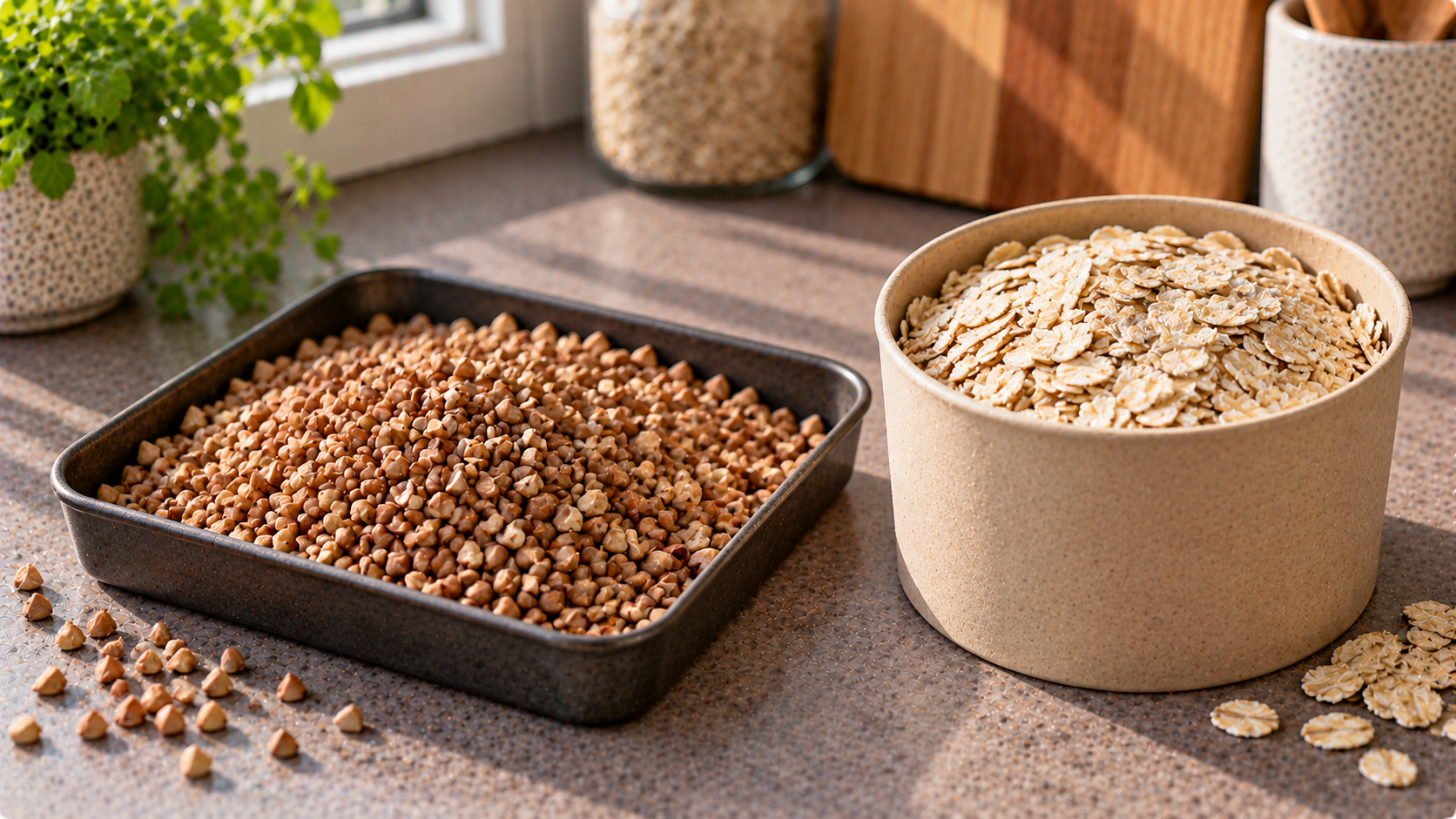
Buckwheat and oats are both practical foundations for porridge, grain bowls and homemade baking, but they are not interchangeable nutritionally or in the kitchen. Oats are a true cereal grain valued for their beta-glucan soluble fibre; buckwheat is a naturally gluten-free pseudocereal with a distinctive nutty taste and a different fibre profile. Either can fit a balanced diet. The useful choice depends on the product form, the portion you actually eat, your gluten requirements and the rest of the meal.
The most common comparison error is putting 100 g cooked buckwheat beside 100 g dry rolled oats. One contains a lot more absorbed water. This guide keeps dry and cooked measurements separate, explains what product labels can and cannot tell you, and shows where the two foods really differ.
What counts as buckwheat or oats?
Buckwheat comes from the plant Fagopyrum esculentum and is botanically closer to plants such as rhubarb than to wheat. The triangular seeds are sold as raw groats, toasted groats often called kasha, flour, flakes and noodles. Despite its English name, buckwheat is not wheat and does not naturally contain wheat gluten. Soba noodles are a special case: many brands mix buckwheat with ordinary wheat flour, so the name alone does not make them gluten-free.
Oats come from Avena sativa, a grass grown for its edible grain. Whole oat groats, steel-cut oats, rolled oats, quick oats, oat bran and oat flour reflect different processing methods and cooking times. Plain rolled oats and plain instant oats may have very similar nutrition per dry 100 g; sweetened instant sachets with added sugar are a different product. Steel-cut oats retain a firmer texture; rolled oats cook quickly and produce a creamier porridge.
Both foods are available with little added salt or sugar. Comparing plain versions first is more useful than comparing a flavoured oat breakfast cup with unsalted buckwheat groats.
Nutrition per 100 g: compare the same state
These are rounded, illustrative values for plain dry ingredients, not laboratory results for a specific brand. Buckwheat groats and ordinary rolled oats differ in variety, processing and analytical database entry. Always check the label for the product you use.
| Approximate values, per 100 g dry | Buckwheat groats | Plain rolled oats |
|---|---|---|
| Energy | 340–355 kcal | 370–390 kcal |
| Protein | 12–14 g | 12–17 g |
| Carbohydrate | 68–72 g | 60–68 g |
| Fibre | 8–10 g | 9–11 g |
| Fat | 3–4 g | 6–8 g |
Oats often contain more fat, largely unsaturated, while buckwheat usually contains less. Both contribute carbohydrates, plant protein and fibre. Neither dry ingredient is a low-calorie food by weight. They become less energy dense when cooked with water because they absorb liquid. A tablespoon of butter, syrup or oil changes the finished dish's nutrient profile independently of the grain.
For reliable entries, check USDA FoodData Central and compare whether an entry describes dry, cooked, raw groats or oatmeal prepared with water. Do not combine figures from those states into one ranking.
The individual guides to buckwheat and oats give additional dry-versus-cooked and serving-size context. Use the form and preparation state that match your meal.
What does a realistic breakfast portion deliver?
An ordinary dry portion might be 50 g of oats or 60 g of buckwheat; these are illustrations, not required serving sizes. Using the midpoint of the ranges above gives roughly 190 kcal and 7 g protein from 50 g dry oats, or about 210 kcal and 8 g protein from 60 g dry buckwheat. Exact numbers depend on the packet. A more controlled head-to-head comparison is 50 g dry of either ingredient.
| Example with 50 g dry ingredient | Buckwheat | Oats |
|---|---|---|
| Energy | About 175 kcal | About 190 kcal |
| Protein | About 6.5 g | About 7–8 g |
| Fibre | About 4.5 g | About 5 g |
Adding 150 g plain yogurt, berries or milk turns a grain serving into a different meal. If you want a protein-rich breakfast, protein mainly comes from the yogurt, skyr, eggs, soy product or nuts you combine with it, not from claiming that either grain is a complete high-protein meal. A spoonful of seeds can add fibre and fats; sweetened toppings can add substantial sugar.
For meal tracking, weigh the dry grain once and distribute its total nutrition across portions. For example, 150 g dry buckwheat made into three servings represents 50 g dry ingredient per serving, regardless of how much water was absorbed. If you cook for several people, weigh or divide the cooked batch consistently rather than assuming every cooked portion has the same dry-to-water ratio.
Why cooked-weight comparisons can mislead
Buckwheat groats simmer into separate tender kernels. Oat flakes often break down into a viscous porridge. Water absorption differs by grain type, pot, cooking time and preferred consistency, so cooked values per 100 g depend heavily on preparation. A loose oatmeal made with extra water can show fewer calories per 100 g than a thick oatmeal containing exactly the same dry oats.
Suppose 50 g dry oats supplies approximately 190 kcal. If the finished bowl weighs 200 g after cooking in water, 100 g of that bowl contains about 95 kcal before toppings. If it is cooked thicker and weighs only 150 g, 100 g contains roughly 127 kcal. The original 190 kcal has not changed. It has simply been distributed across a different amount of water. Use this same logic for buckwheat.
A package may give nutritional values for dry goods while an app lists cooked grains. Check the database entry before entering the portion. For prepared retail dishes containing milk, oil or sauce, use the full recipe or product label.
Fibre: oats have a distinctive beta-glucan advantage
Oats are particularly known for beta-glucan, a soluble fibre that forms a viscous gel in the digestive tract. Research on oat beta-glucan supports a modest LDL-cholesterol-lowering effect at sufficient intake as part of an appropriate diet. That does not mean that one spoonful of oatmeal treats high cholesterol, nor that every oat product contains an effective amount. Processing, actual beta-glucan content and the rest of the diet matter.
Harvard's Nutrition Source overview of oats explains this fibre mechanism and reviews evidence on heart-health outcomes. Regulatory claims are tied to specific conditions; they are not permission to promise medical outcomes from a recipe. Buckwheat contains fibre too, including different soluble and insoluble fractions, but it is not a like-for-like source of oat beta-glucan.
If your main reason for choosing a grain is its documented beta-glucan content, oats generally have the clearer advantage. If you mainly want grain variety, fibre and a savoury base, buckwheat remains an excellent practical option. Daily fibre is best assessed across vegetables, fruit, legumes and grains rather than from a single bowl.
Protein quality, minerals and the limits of small differences
Both foods contribute plant protein. Buckwheat is sometimes described as a uniquely “complete” protein, but this marketing shorthand can mislead: amino-acid profiles, digestibility and the total amount eaten all matter. Oats also supply useful amino acids. Neither 50 g portion provides enough protein by itself for a substantial main meal; legumes, dairy, tofu, eggs or other protein foods make a bigger difference.
Buckwheat and oats can contribute magnesium, manganese and other minerals. The exact totals differ across databases, cultivars and milling fractions. Mineral content on paper is also not the same as absorbed mineral intake: plant foods contain phytate, and preparation and meal composition affect bioavailability. Do not rank the foods as a treatment for a mineral deficiency on the basis of one generic table.
Buckwheat is noted for plant compounds including rutin, especially in some varieties and parts of the plant. That does not establish a clinical benefit from an ordinary bowl of groats. Oats contain avenanthramides and other phytochemicals. These are interesting food characteristics, but the stronger everyday reasons to eat these foods are fibre, meal quality, variety and convenience.
Blood sugar, fullness and weight management
Both grains contain digestible starch and can be part of a diet for someone monitoring blood glucose. There is no single glycaemic-index number that covers all buckwheat and oat products. Steel-cut oats, thin instant flakes, whole buckwheat kernels, buckwheat flour pancakes and sweetened breakfast mixtures differ in processing, texture, cooking and added ingredients. Portion size and the rest of the meal can matter as much as the grain.
Oat beta-glucan's viscosity may slow digestion in some contexts. Intact buckwheat groats may have a different response from finely milled buckwheat flour. Avoid blanket claims such as “buckwheat never spikes blood sugar” or “oats always have a low GI.” People with diabetes should use their established carbohydrate-counting and monitoring guidance.
For weight management, neither grain has a unique fat-burning property. A porridge made from 50 g oats and water may be more filling than a pastry breakfast for some people because it offers fibre and volume; adding large amounts of nut butter or syrup changes the energy total. Buckwheat with vegetables and beans can similarly form a satisfying meal. Preparation and portions are more actionable than declaring a winner.
Gluten and coeliac disease: the label matters
Pure buckwheat is naturally gluten-free. However, cross-contact with wheat, rye or barley can occur during processing; flour blends and soba often include wheat intentionally. If gluten exclusion is medically necessary, select appropriately labelled and controlled products rather than relying on the word buckwheat alone.
Pure oats do not contain wheat gluten, but oats are especially vulnerable to cross-contact with gluten-containing grains. Some people with coeliac disease also react to oat avenin even when the oats meet gluten-free standards. Follow individual specialist advice and choose oats expressly labelled gluten-free when medically indicated. The Celiac Disease Foundation addresses both buckwheat and gluten-free oats; its guidance is more relevant than a casual claim that all oatmeal is safe.
In EU markets, pay attention to local allergen declarations and gluten-free labelling rules. Gluten-free is not synonymous with allergen-free: individual buckwheat allergy exists, and oat-based products can contain nuts, milk or other declared allergens depending on the recipe.
Taste, texture and preparation time
Buckwheat has an earthy, slightly nutty flavour, particularly when toasted. Its kernels stay comparatively distinct, which makes it useful in savoury bowls, mushroom dishes, vegetable sides, soups and salads. Rinse if indicated on the packet; simmer using the packet's water ratio and timing. Raw and roasted buckwheat may behave differently, so do not assume one universal cooking time.
Rolled oats soften quickly and create a creamy texture as starch and soluble fibre hydrate. Steel-cut oats take longer and remain pleasantly chewy. Oats work in porridge, overnight oats, granola and baking, while plain oats can also thicken soups or be used in savoury breakfasts. Choose an unsweetened base if controlling added sugar.
| Your cooking goal | Often easier choice | Why |
|---|---|---|
| Creamy breakfast in a few minutes | Rolled oats | Fast hydration, soft texture |
| Distinct kernels for a savoury grain bowl | Buckwheat groats | More separate grains when cooked correctly |
| Overnight no-cook breakfast | Rolled oats | Soften in cold liquid |
| Wheat-free flour recipe | Pure buckwheat flour | Naturally lacks wheat gluten; recipe needs adaptation |
| Beta-glucan-focused cereal | Oats | Characteristic soluble fibre |
| Variety across weekly meals | Both | Different textures and culinary uses |
Swapping flour one-for-one requires care. Buckwheat flour has no gluten network for elastic wheat-style bread. Oat flour also behaves differently from wheat flour. Texture, hydration and binding usually need recipe adjustments; neither is automatically a direct substitute for wheat flour in yeast bread.
Price and value: compare edible portions
Prices vary with region, brand, organic status and whether the product is sold as flour, flakes or whole groats. The right comparison is cost per dry portion, not cost per bowl after adding different quantities of water. Use this example purely to understand the calculation, not as a live supermarket quote.
| Illustrative shop price | Oats | Buckwheat |
|---|---|---|
| Price per kg | €1.80 | €3.60 |
| Cost of 50 g dry | €0.09 | €0.18 |
| Cost of 70 g dry | €0.13 | €0.25 |
A food that costs twice as much per kilogram costs twice as much for an equal dry weight; it may still be worth buying for taste, dietary needs or variety. Prepared breakfast cups and speciality mixes usually cost more than the unflavoured ingredients. Checking the price per kilogram and ingredient list is a better habit than relying on “superfood” branding.
If meal planning on a limited budget, oats are often an economical everyday breakfast ingredient while buckwheat can provide a useful alternative for savoury meals. Compare actual local prices; the example is not an assertion about every store.
Three practical meal builds
Breakfast: Cook 50 g plain oats in water or milk. Add unsweetened yogurt or fortified soy yogurt, berries and a modest portion of nuts. Count the dairy or soy food, toppings and milk separately. Using rolled oats keeps the process quick and provides a creamy base.
Lunch: Cook 60–70 g dry buckwheat and combine it with roasted vegetables, chickpeas and a lemon dressing. The chickpeas supply extra protein and fibre; the dressing affects calories and fat. The grain's toasted flavour suits savoury combinations better than a sweet porridge topping.
Prep-ahead dinner: Make a measured batch of buckwheat groats, divide it into portions and add fish, tofu or beans plus vegetables. Cool and refrigerate cooked food promptly according to local food-safety guidance; reheat thoroughly where appropriate. Oats can also be prepared ahead as overnight oats, but use refrigerated storage for mixtures containing milk or yogurt.
The lesson is not that one bowl has a magic nutritional profile. It is that the same ingredient can be part of a balanced meal or a less balanced one depending on serving size and additions.
Which should you actually choose?
Choose oats when you prefer a convenient creamy breakfast, want to deliberately include oat beta-glucan or need an affordable pantry staple. Choose buckwheat when you want distinct savoury grains, enjoy its flavour, or want another naturally gluten-free ingredient while observing appropriate cross-contact precautions. For most people, alternating both improves variety without needing to rank every micronutrient.
When comparing two packets, follow a simple sequence: confirm they are plain products; check the dry per-100-g nutrition panel; choose the same dry portion; inspect fibre, protein and ingredients; verify gluten claims if relevant; then compare price per kilogram. This answers the everyday question more accurately than isolated charts using mismatched preparation states.
Further reading: USDA FoodData Central for food-composition records; Harvard Nutrition Source: Oats for oat-fibre evidence; Harvard Nutrition Source: Fibre for broader dietary context; Celiac Disease Foundation: Gluten-Free Foods for cross-contact and coeliac considerations.