
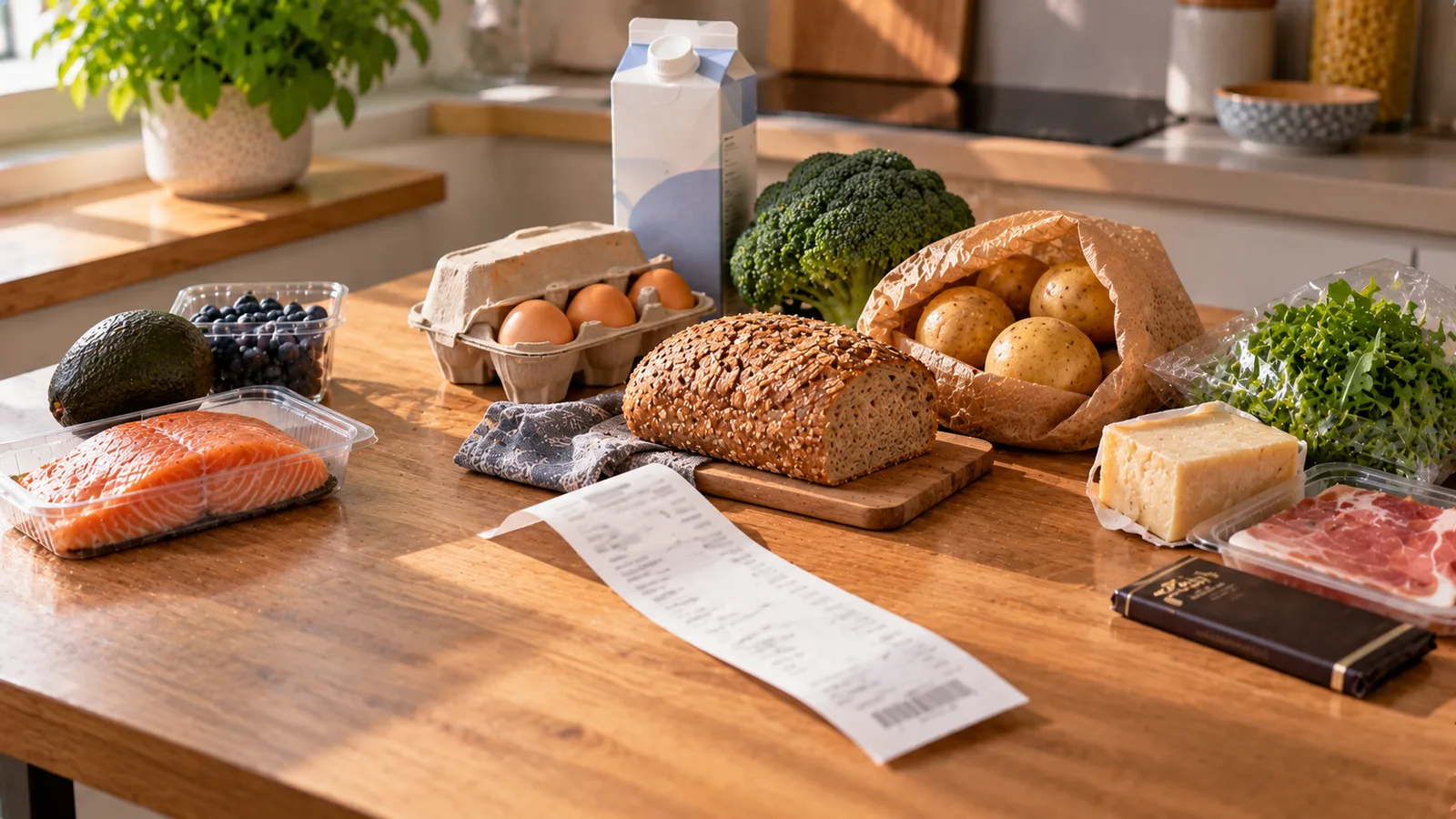
Splitting a grocery bill equally is simple. It is not always fair.
Housemates often share some foods while buying other products only for themselves. One person may eat breakfast at home every day, another may rarely be home for dinner, and a third may buy expensive specialty products that nobody else uses.
A useful system should be fair enough to reflect these differences without turning every grocery trip into an accounting exercise.
The practical solution is to separate groceries into a few clear categories and agree on the rules before the bill arrives.
Start with three categories
Most household grocery purchases can be classified as:
- shared equally;
- shared unequally;
- personal.
This distinction solves most disagreements.
Shared equally
These are products everyone regularly uses in roughly similar amounts.
Examples may include:
- salt;
- basic spices;
- dishwashing products;
- shared cooking oil;
- flour;
- household cleaning supplies.
If three housemates agree that these are communal, dividing their cost by three is straightforward.
Shared unequally
These are communal foods that everyone uses, but not in similar amounts.
Examples might include:
- milk;
- bread;
- eggs;
- coffee;
- fruit;
- shared dinners.
These items may need a different rule if the consumption difference is large and persistent.
Personal
These are products purchased for one person.
Examples:
- a specific protein product;
- a preferred breakfast cereal;
- specialty cheese;
- personal snacks;
- a particular plant-based milk;
- food required for an individual dietary preference.
The person buying or consuming the product normally pays for it.
Do not split the entire receipt automatically
Imagine three housemates spend €96 at the supermarket.
An equal split would be:
€96 ÷ 3 = €32 each
But suppose the receipt actually contains:
- €45 of shared groceries;
- €18 of products for Alex;
- €12 of products for Ben;
- €21 of products for Clara.
The shared portion is:
€45 ÷ 3 = €15 each
The final amounts become:
| Housemate | Shared share | Personal items | Total |
|---|---|---|---|
| Alex | €15 | €18 | €33 |
| Ben | €15 | €12 | €27 |
| Clara | €15 | €21 | €36 |
Total:
€33 + €27 + €36 = €96
This is only slightly more work than an equal split, but it reflects what was actually purchased.
Use equal splitting where it works
Fairness does not require calculating every gram of food.
If all housemates regularly use:
- onions;
- tomatoes;
- rice;
- cleaning products;
- basic condiments,
an equal split may be perfectly reasonable even if consumption is not mathematically identical.
The goal is not perfect precision.
The goal is to avoid systematic situations where one person repeatedly pays for another person's clearly higher or more expensive consumption.
Create a shared grocery list before shopping
A shared list helps distinguish communal purchases from personal additions.
For example:
Shared
- rice;
- onions;
- tomatoes;
- eggs;
- bread;
- cooking oil.
Anna
- Greek yogurt;
- protein bars.
Daniel
- oat drink;
- frozen pizza.
Mia
- specialty coffee;
- dark chocolate.
When the receipt arrives, most of the classification has already been decided.
Mark personal products immediately
Trying to reconstruct a long receipt several days later is frustrating.
A simple habit is to mark personal items while shopping or immediately after payment.
You can use:
- initials;
- categories in a shared note;
- separate sections of a grocery app;
- a quick receipt annotation.
For example:
S = shared
A = Anna
D = Daniel
This turns settlement into simple arithmetic.
What about products used by only two housemates?
Not every shared item needs to involve the whole household.
Suppose four people live together, but only two drink coffee.
If coffee costs €16, those two people can split it:
€16 ÷ 2 = €8 each
The other two pay nothing for the coffee.
This principle works well for recurring categories where participation is obvious.
Shared meals can be handled separately
Groceries for a shared dinner do not necessarily need the same rules as ordinary household staples.
Suppose three housemates cook dinner together.
Ingredients cost:
- chicken: €12;
- rice: €4;
- vegetables: €7;
- sauce ingredients: €4.
Total:
€27
If everyone eats approximately similar portions:
€27 ÷ 3 = €9 each
That is simple and reasonable.
But if one person is not eating the meal, there is little reason to charge them one third.
Different portion sizes do not always require different costs
Two people rarely eat exactly the same amount.
Trying to price every shared meal according to individual grams can create more work than value.
A practical threshold is useful.
If one person eats slightly more rice or takes an extra spoonful of vegetables, equal sharing may still be reasonable.
If one person routinely consumes twice as much of expensive shared ingredients, a different arrangement may be justified.
Focus on meaningful recurring differences rather than tiny variations.
A weighted split can handle predictable differences
Sometimes housemates know that consumption is consistently unequal.
For example, two adults share most groceries, but one typically consumes substantially more food at home.
Instead of tracking every item, they might agree on a weighted split such as:
55% / 45%
If shared groceries for the month cost €400:
- Person A pays €220;
- Person B pays €180.
This method is less precise than item-level accounting, but it can be easier to maintain.
The percentages should be an agreement between the people involved, not an assumption based on body size, gender or another proxy.
Keep expensive personal preferences personal
Problems often arise when a premium product is placed in the shared category even though only one person requested it.
Suppose the household normally buys €3 coffee, but one housemate wants a €12 specialty bag.
Possible solutions include:
- the specialty coffee is personal;
- the household contributes the normal shared amount and the person pays the difference;
- only the people who drink it split the cost.
The same approach can work for:
- premium meat;
- specialty cheese;
- expensive snacks;
- supplements;
- branded products;
- specialty dietary foods.
Dietary restrictions need a clear rule
A household may include people with different diets.
For example:
- one person is vegetarian;
- one avoids lactose;
- one prefers gluten-free products;
- another eats everything.
There is no universal rule that makes every situation fair.
A practical approach is:
- genuinely communal foods remain shared;
- individual substitutes remain personal when only one person uses them;
- products used by a subgroup are divided among that subgroup.
The rule should be consistent.
What about food that expires?
Suppose the household buys shared berries for €6, but nobody eats them and they spoil.
If they were genuinely purchased as a shared item, the waste can reasonably remain a shared cost.
It usually does not make sense to assign the cost afterward to whichever person happened to eat the last few berries.
However, repeated waste caused by one person's personal purchases is different. Those products should generally remain that person's cost.
Leftovers belong to the original cost arrangement
Imagine three people split the cost of a shared dinner equally, but one portion remains.
The simplest rule is that the leftover remains shared unless everyone agrees otherwise.
If one person takes the leftover for lunch, you usually do not need to reopen yesterday's bill for a small amount.
For frequent or expensive leftovers, households can agree on another rule.
Consistency matters more than perfect accounting.
When one person buys groceries more often
The person who visits the supermarket should not automatically bear more of the household's food cost.
Track what each person paid and what each person owes.
For example:
Week 1
Anna pays €90 at the supermarket.
After separating personal items:
- Anna owes €32;
- Ben owes €28;
- Clara owes €30.
Because Anna paid the full bill, Ben and Clara owe their amounts to Anna.
Week 2
Ben pays for a €42 shared shop.
Instead of immediately transferring money after every transaction, the household can maintain a running balance.
Running balances reduce unnecessary transfers
Suppose:
- Ben owes Anna €28;
- later Anna owes Ben €14.
Instead of two transfers, the balance becomes:
€28 - €14 = €14
Ben owes Anna €14.
A shared expense app or simple spreadsheet can automate this.
Set a settlement schedule
Constant small payments can become annoying.
Choose a schedule such as:
- after every major shop;
- once per week;
- twice per month;
- at the end of each month.
Monthly settlement works well when everyone has enough flexibility to carry temporary balances.
More frequent settlement may be better when budgets are tight.
A complete monthly example
Three housemates — Lara, Noah and Emma — buy groceries together.
During one month they spend:
Shared equally
- staples: €90;
- vegetables and fruit: €75;
- cleaning and kitchen supplies: €30.
Total:
€195
Each person's share:
€195 ÷ 3 = €65
Shared by Lara and Noah only
Coffee and milk:
€36
Each pays:
€18
Personal purchases
Lara:
€44
Noah:
€31
Emma:
€52
Final monthly responsibility:
| Person | Equal shared | Two-person shared | Personal | Total |
|---|---|---|---|---|
| Lara | €65 | €18 | €44 | €127 |
| Noah | €65 | €18 | €31 | €114 |
| Emma | €65 | €0 | €52 | €117 |
Household total:
€127 + €114 + €117 = €358
The important point is that payment responsibility is calculated independently of who physically paid at the checkout.
Use unit prices for shopping decisions, not bill splitting
Unit price answers questions such as:
- which package is cheaper per kilogram;
- whether the larger size offers better value;
- how two brands compare.
Bill splitting answers a different question:
Who should pay for the item?
Do not make the household system unnecessarily complicated by mixing these two calculations.
First decide whether an item is shared or personal.
Then assign its actual purchase cost.
Keep the number of categories small
A system with 15 categories may be technically precise and practically unusable.
For most households, these are enough:
- shared by everyone;
- shared by a subgroup;
- personal.
You can add a fourth category for shared meals if necessary.
The system should be simple enough that everyone actually uses it.
Agree on the rules before disagreements happen
Useful questions include:
- Which staples are always shared?
- Are snacks personal?
- Who pays for alcohol?
- Are cleaning products included?
- How are shared dinners handled?
- What happens when guests eat?
- How often are balances settled?
- What happens with expensive specialty foods?
There is no single correct answer.
The value comes from using the same rule consistently.
Guests
Occasional guests usually do not require detailed recalculation.
If a friend eats one shared dinner, treating it as ordinary household hospitality may be simplest.
If a partner stays several nights every week and regularly consumes shared groceries, the situation is different.
The household can decide whether:
- the host covers the extra cost;
- the guest contributes;
- the household adjusts the split.
Again, focus on recurring meaningful costs rather than isolated small events.
Household products can use the same system
A supermarket receipt often contains non-food items:
- toilet paper;
- dish soap;
- detergent;
- cleaning products;
- kitchen towels.
If everyone uses them, they can be placed in the shared category.
Personal toiletries such as shampoo or skincare products can remain personal.
This keeps one receipt manageable without pretending every supermarket purchase is food.
Avoid retroactive arguments over tiny items
A system becomes unpleasant if every €0.50 difference becomes a dispute.
Set an informal tolerance level.
For example, housemates might agree that small differences in ordinary shared staples are ignored, while:
- expensive personal items;
- repeated unequal consumption;
- premium products;
- non-participating housemates
are handled explicitly.
This keeps the system proportional to the money involved.
What if someone rarely eats at home?
An equal grocery split may become unfair when one person is away most of the week.
Possible approaches include:
Personal shopping
Everyone buys most of their own food, while only household staples are shared.
Reduced shared percentage
The person who is rarely home contributes less to variable food categories but still shares household supplies.
Item-level assignment
Shared items are split only among the people who actually use them.
Choose the method that requires the least administration while solving the actual imbalance.
What if one person is away for several weeks?
For a long absence, pause their participation in variable shared food costs.
They may still contribute to durable household products already purchased or other fixed household arrangements if that is what the household agreed.
The important distinction is between:
- food consumed during the absence;
- costs that genuinely remain communal.
Use actual prices, not assumptions
If one housemate believes another person's products are expensive, check the receipt.
A fair split should use actual purchase prices.
For example:
- shared vegetables: €14.60;
- personal yogurt: €3.49;
- shared rice: €4.20;
- personal snack: €2.79.
Actual prices remove unnecessary guessing.
A five-minute grocery bill workflow
A simple routine can look like this:
1. Photograph or save the receipt.
2. Mark personal items.
3. Mark subgroup items.
4. Treat everything else agreed as communal as shared.
5. Calculate each person's responsibility and update the balance.
With clear rules, most receipts take only a few minutes.
When equal splitting is the best system
Equal splitting can be ideal when:
- everyone has similar eating patterns;
- most food is communal;
- personal purchases are rare;
- nobody feels consistently disadvantaged;
- simplicity matters more than small differences.
Do not make the system more complicated merely because a more precise calculation is possible.
When item-level splitting is better
A more detailed split can be useful when:
- diets differ substantially;
- schedules are very different;
- personal foods make up a large share of the bill;
- premium products are common;
- one person rarely eats at home;
- disagreements already occur.
The best system is the simplest one that removes the meaningful unfairness.
A practical rule to remember
When reviewing a grocery receipt, ask:
Who reasonably benefits from this purchase?
Then classify it:
- everyone → split among everyone;
- some housemates → split among those people;
- one person → personal cost.
For shared meals, decide whether portions are similar enough for an equal split. If not, use an agreed weighted method rather than trying to price every bite.
A grocery budget works best when the rules are predictable before anyone reaches the checkout.