
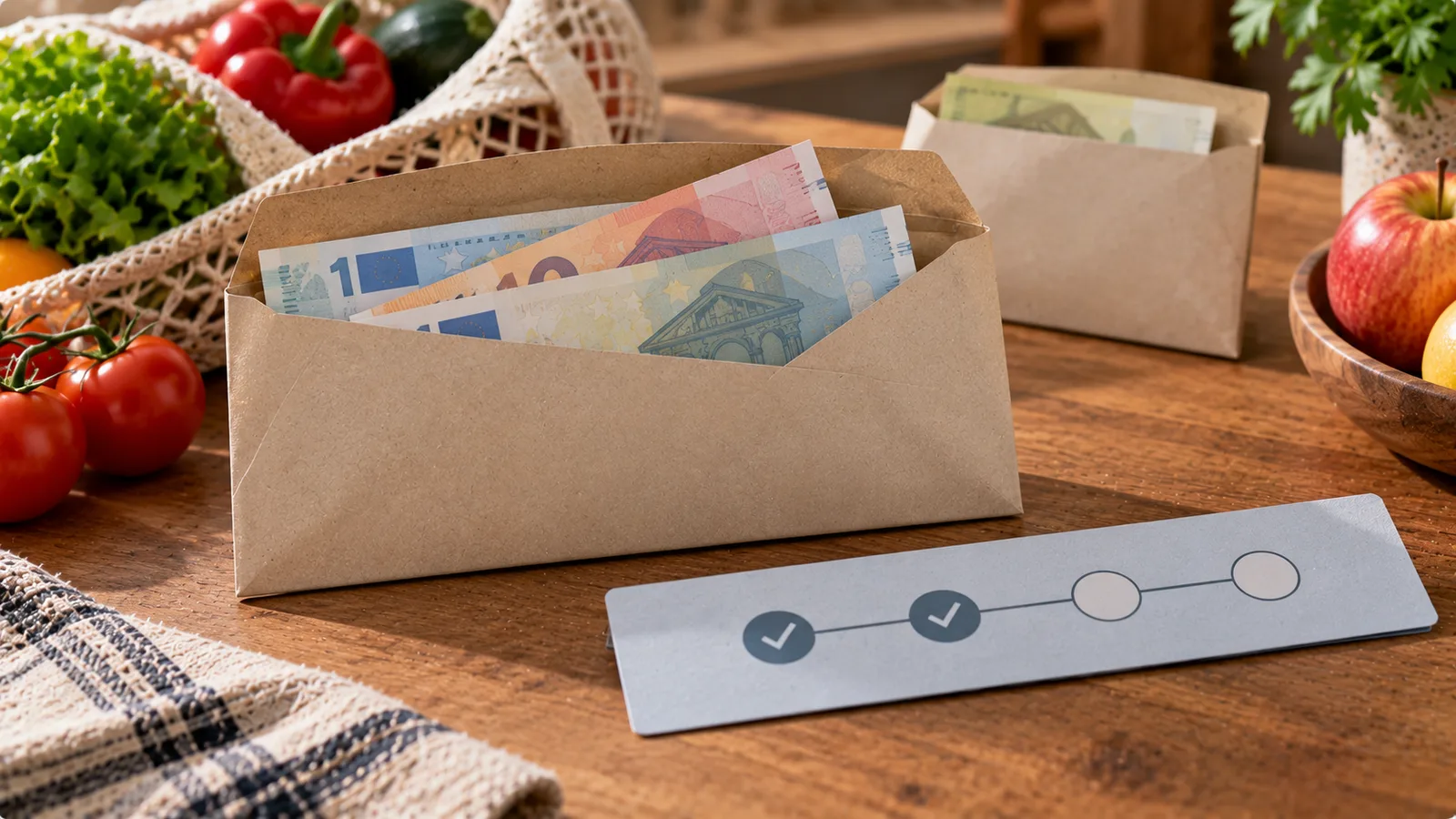
The cash envelope method gives grocery spending a physical limit.
Instead of deciding at every supermarket visit whether you can afford another purchase, you decide the grocery amount in advance. That money is placed in an envelope and becomes the spending pool for the chosen period.
When the envelope gets low, the remaining amount is visible. When it is empty, the budget has been used.
The method can be especially useful when card payments make grocery spending difficult to notice until the end of the month.
How the grocery envelope method works
The basic system has four steps:
- choose a grocery budget;
- put that amount into a dedicated envelope;
- pay grocery expenses from that envelope;
- track the remaining balance until the next refill.
The envelope can represent an entire month or a shorter period such as one week.
The important principle is separation: grocery money should not become indistinguishable from the rest of the household's available cash.
Example: €400 monthly grocery budget
Suppose a household decides that €400 is available for groceries this month.
One option is to place the entire €400 into one envelope.
After each shopping trip, the remaining balance changes.
| Purchase | Spent | Envelope balance |
|---|---|---|
| Starting amount | — | €400 |
| Shop 1 | €72 | €328 |
| Shop 2 | €46 | €282 |
| Shop 3 | €89 | €193 |
| Shop 4 | €51 | €142 |
The €142 remaining is not extra money. It is the grocery budget still available for the rest of the period.
This distinction becomes particularly important in the middle of the month.
Monthly envelope or weekly envelopes?
Both approaches can work.
A single monthly envelope gives more flexibility. If one week is expensive, another week can compensate.
Weekly envelopes provide stronger spending boundaries.
For example, a €400 monthly target might initially be divided into four €100 envelopes.
However, calendar months do not contain exactly four weeks. A simple four-way division can therefore create problems in months where grocery shopping occurs five times.
A better approach is to count the actual shopping periods before dividing the money.
Example with five shopping weeks
Suppose you have €400 available and expect five main grocery shops before the next budget reset.
A simple equal allocation would be:
€400 ÷ 5 = €80 per shopping period
You could prepare five €80 envelopes.
Alternatively, you might intentionally vary them:
- Week 1: €100;
- Week 2: €75;
- Week 3: €75;
- Week 4: €75;
- Week 5: €75.
The larger first envelope can support pantry restocking, while the later envelopes cover fresh food.
The total still remains €400.
Define what counts as groceries
Before starting, decide which purchases belong to the envelope.
Possible grocery expenses include:
- food for home;
- non-alcoholic drinks;
- basic cooking ingredients;
- snacks;
- coffee and tea.
Households differ on whether they include:
- cleaning supplies;
- toiletries;
- pet food;
- alcohol;
- takeaway meals;
- restaurant spending.
There is no need for every household to use the same categories.
What matters is consistency.
If detergent comes from the grocery envelope one week but from a household-supplies budget the next, the grocery numbers become difficult to interpret.
Start with a realistic amount
The envelope method cannot make an unrealistic food budget workable.
If your household normally spends €600 per month, suddenly placing €250 into an envelope does not automatically reduce the cost of the food you need.
Before setting the amount, review several weeks or months of actual grocery spending.
Then choose a target that reflects:
- household size;
- local food prices;
- dietary requirements;
- how often you cook at home;
- food already in the pantry and freezer;
- realistic opportunities to reduce spending.
The envelope controls the limit. It does not determine what the correct limit should be.
Separate fixed essentials from flexible purchases
One useful way to manage the envelope is to distinguish essential purchases from flexible ones.
For example:
More predictable essentials
- bread;
- milk;
- eggs;
- staple grains;
- vegetables;
- basic protein foods.
More flexible purchases
- premium snacks;
- desserts;
- convenience foods;
- specialty drinks;
- impulse purchases.
If the envelope balance becomes low, flexible items can be reduced before essential foods.
Use a mid-period checkpoint
Do not wait until the envelope is almost empty before checking progress.
Suppose the monthly grocery envelope starts with €500.
Halfway through the budget period, you have €170 remaining.
You have already spent:
€500 − €170 = €330
That means:
€330 ÷ €500 = 66%
of the monthly grocery budget has already been used.
If roughly half the period remains, spending needs to slow.
The checkpoint gives you time to adjust before the money runs out.
Calculate the remaining daily allowance
If the envelope has €120 remaining and there are 12 days until the reset:
€120 ÷ 12 = €10 per day
This does not mean you need to shop every day or spend exactly €10 daily.
It is simply a pacing indicator.
If your next grocery trip costs €70, you will have:
€120 − €70 = €50
for the remaining days.
That information can influence what goes into the basket.
Calculate the remaining weekly allowance
A weekly calculation is often more practical.
Suppose €180 remains and approximately three weeks are left:
€180 ÷ 3 = €60 per week
You can now build the next grocery list around approximately €60 rather than shopping first and checking the total afterward.
What happens when one week goes over budget?
Assume your weekly target is €80 but you spend €95.
You are €15 over the target.
If the monthly total is fixed, that €15 must come from somewhere.
One approach is to reduce the next week's envelope:
€80 − €15 = €65
The overspending is therefore carried forward instead of ignored.
This prevents weekly targets from becoming meaningless.
What happens when you spend less?
Suppose the weekly envelope contains €80 and you spend only €67.
You have €13 left.
There are several reasonable ways to handle it.
Option 1: roll it into the next week
Next week's available amount becomes:
€80 + €13 = €93
This gives the grocery budget flexibility.
Option 2: keep it as a grocery buffer
Place the €13 into a separate grocery reserve.
After four under-budget weeks, the buffer might contain enough to cover an expensive restocking trip.
Option 3: remove it from the grocery budget
You can move the €13 to savings or another goal.
This creates a stronger incentive to spend less.
Choose the rule before the month begins so leftover cash does not become unplanned spending.
A rollover system is often practical
Food expenses are uneven.
One week you may need only vegetables, dairy and bread. Another week you may need olive oil, rice, coffee and several other pantry staples at once.
Allowing unused grocery money to roll forward can accommodate this variation without increasing the overall budget.
For example:
| Week | Budget | Actual spending | Rollover |
|---|---|---|---|
| 1 | €80 | €68 | €12 |
| 2 | €92 | €84 | €8 |
| 3 | €88 | €73 | €15 |
| 4 | €95 | €91 | €4 |
The system remains bounded because all additional spending power comes from money that was not used earlier.
The envelope should match your shopping rhythm
If you shop once per week, weekly envelopes may be intuitive.
If you make one large monthly order and several small fresh-food trips, a different structure may work better.
For example, with €450 per month:
- €220 main stock-up;
- €50 Week 1 fresh foods;
- €50 Week 2;
- €50 Week 3;
- €50 Week 4;
- €30 reserve.
Total:
€220 + €50 + €50 + €50 + €50 + €30 = €450
This is still an envelope system even though the amounts are not equal.
Use a grocery reserve for irregular purchases
Some grocery expenses do not happen every week.
Examples include:
- cooking oil;
- spices;
- coffee;
- bulk rice;
- flour;
- frozen food restocking.
A small reserve prevents one of these purchases from destroying a normal weekly allowance.
If your monthly budget is €500, you might allocate:
- €450 to regular shopping;
- €50 to pantry restocking.
The correct split depends on your household.
Do not confuse buying food with consuming food
A grocery budget tracks cash spending.
It does not necessarily represent the cost of the food eaten during the same week.
For example, you may spend €30 on a large bag of rice, oil and canned beans this week but consume those foods over several months.
The cash envelope records the full €30 when you buy them.
That is appropriate because its purpose is controlling cash flow.
Recipe-cost calculations use a different method: they normally allocate only the amount of each ingredient actually consumed.
Cash envelopes and supermarket sales
A sale is useful only if the purchase fits the budget and the food will actually be used.
Suppose olive oil normally costs €9 and is on sale for €6.
Buying two bottles for €12 may be financially sensible if:
- you regularly use the product;
- it can be stored safely;
- the envelope has enough money;
- buying it does not prevent you from purchasing necessary food.
A discount does not create extra budget.
The €12 still leaves the envelope.
What if the envelope is empty?
An empty envelope is feedback.
First determine why it happened.
Possible reasons include:
- the budget was unrealistically low;
- prices increased;
- too many unplanned purchases were made;
- several pantry staples were restocked at once;
- guests or unusual events increased food needs;
- non-grocery purchases were charged to the grocery category.
The solution depends on the cause.
If the target was realistic but impulse spending was high, adjust shopping behavior.
If the household consistently cannot buy adequate food within the target despite reasonable choices, the budget itself may need to increase.
Do not reduce essential food just to protect an arbitrary number
Budgeting is a planning tool, not a reason to compromise adequate nutrition.
If the envelope repeatedly runs out despite careful shopping, examine whether the limit is appropriate.
A useful grocery budget should reflect actual needs and financial circumstances.
The objective is controlled spending, not achieving the lowest possible grocery number at any cost.
Build the shopping list from the envelope balance
Before shopping, check three things:
- how much cash remains;
- how many days or shopping trips remain;
- which foods are already available at home.
Then build the list.
Suppose €65 is available for the week.
Start with the meals you plan to prepare, then estimate the necessary ingredients.
If the preliminary list totals €78, reduce or substitute items before entering the store.
This is easier than discovering the problem at checkout.
Use approximate prices before shopping
You do not need perfect estimates.
Suppose the list contains:
- vegetables: €15;
- fruit: €8;
- dairy: €10;
- eggs: €4;
- chicken: €12;
- beans and grains: €8;
- bread: €4;
- flexible items: €6.
Estimated total:
€67
If your envelope contains €60, you know in advance that approximately €7 needs to be removed or substituted.
Keep receipts
Cash provides a visible limit, but receipts explain where the money went.
Keep the receipt after each shop, at least until the budget period ends.
At the end of the month, group purchases loosely into categories such as:
- protein foods;
- fruit and vegetables;
- dairy;
- grains and staples;
- snacks;
- drinks;
- household items accidentally included.
You do not need to create a complicated accounting system.
The goal is to identify the biggest opportunities for adjustment.
Cash envelope without carrying cash
The same principle can be used digitally.
You can create:
- a separate bank sub-account;
- a prepaid card;
- a budgeting-app category;
- a simple spreadsheet balance.
For example:
Starting grocery balance:
€400
After a €72 purchase:
€328
After a €46 purchase:
€282
The behavioral rule remains the same: grocery spending is limited to the dedicated balance.
Physical cash simply makes that limit harder to ignore.
Hybrid method
Some households prefer cash for in-store shopping but need a card for online grocery orders.
A hybrid system can work if every purchase is deducted from the same virtual envelope.
Example:
Starting envelope: €350.
Cash shop: €55.
Remaining: €295.
Online grocery order paid by card: €80.
New envelope balance:
€295 − €80 = €215
The payment method is different, but the budget is still unified.
Avoid borrowing repeatedly from other envelopes
If grocery money runs out and you always take money from entertainment, transport or savings, the grocery envelope no longer functions as a meaningful limit.
Occasional adjustments are normal, especially when circumstances change.
Repeated transfers indicate that either:
- the grocery target is too low;
- another category is too high;
- spending behavior does not match the plan.
Treat repeated borrowing as information for the next budget rather than hiding it.
Handling an expensive first week
Some months begin with a large pantry restock.
Suppose the monthly grocery budget is €480.
You spend €160 during the first week.
That leaves:
€480 − €160 = €320
If four shopping weeks remain:
€320 ÷ 4 = €80 per week
Instead of concluding that the first week “failed,” recalculate the remaining budget.
The monthly limit can still work.
Handling unexpected guests
Suppose you have €90 available for the week and unexpected guests add approximately €25 to grocery costs.
You can decide consciously whether to:
- use part of the grocery reserve;
- reduce flexible spending later in the month;
- increase the grocery budget using money from another category.
The important point is to record the change.
An envelope system should make exceptions visible rather than pretend they did not happen.
Should restaurant meals come from the grocery envelope?
Usually it is clearer to separate groceries from restaurants and takeaway food.
Groceries are food purchased for preparation or consumption at home.
Restaurant spending behaves differently and can easily consume a grocery envelope very quickly.
However, if your household intentionally uses one combined food budget, that can also work.
Just define the rule in advance.
One-person example
Suppose one person has a grocery budget of €240 for four weeks.
They create:
- Week 1: €60;
- Week 2: €60;
- Week 3: €60;
- Week 4: €60.
Week 1 spending is €52.
The €8 rolls over.
Week 2 therefore starts with €68.
Spending is €63, leaving €5.
Week 3 starts with €65.
The system automatically rewards lower spending with more flexibility later without increasing the original €240 budget.
Family example
A family sets a €700 monthly grocery limit.
They allocate:
- €150 pantry and freezer restock;
- €125 Week 1;
- €125 Week 2;
- €125 Week 3;
- €125 Week 4;
- €50 reserve.
This totals:
€700
If the pantry restock costs only €130, the unused €20 can move into the reserve.
If Week 3 requires €140, €15 can then come from that reserve without changing the overall monthly limit.
When to reset the envelope
Choose one consistent reset point.
Possible options include:
- first day of the month;
- payday;
- every Monday;
- every two weeks.
Payday-based budgeting can be easier for households whose income does not arrive on the first day of the month.
The best reset schedule is the one that matches actual cash flow.
Review the budget after each cycle
At the end of the period, record:
- starting budget;
- total spent;
- amount remaining;
- unusual expenses;
- number of shopping trips;
- whether essential foods were comfortably covered.
Suppose:
- budget = €450;
- spent = €438;
- remaining = €12.
That does not automatically mean next month's budget should be reduced to €438.
One month is not enough to establish a reliable baseline.
Look for patterns across several cycles.
When the method works best
A grocery cash envelope can be especially useful when:
- supermarket spending frequently exceeds your plan;
- many small purchases are difficult to notice;
- you want a clear weekly spending boundary;
- grocery spending competes with other household expenses;
- you respond well to visible limits.
It may be less convenient if most grocery spending is automated or shared across several people who cannot easily coordinate one physical envelope.
In that case, a digital envelope can preserve the same logic.
A simple starting system
If you want to test the method without creating a complex budget:
- choose a realistic four-week grocery amount;
- reserve 10% as a buffer;
- divide the remaining 90% across expected shopping weeks;
- roll unused money forward;
- deduct overspending from the next period;
- review the result after four weeks.
For a €400 budget:
Buffer:
€400 × 10% = €40
Regular shopping money:
€400 − €40 = €360
Across four weeks:
€360 ÷ 4 = €90 per week
You therefore have four €90 weekly limits plus a €40 grocery reserve.
The cash envelope method works because it converts an abstract monthly target into a visible remaining balance.
It does not require perfect spending every week. The useful part is knowing exactly how much grocery money remains, adjusting before the budget is exhausted, and carrying both underspending and overspending forward instead of starting each shopping trip as if the previous ones never happened.