
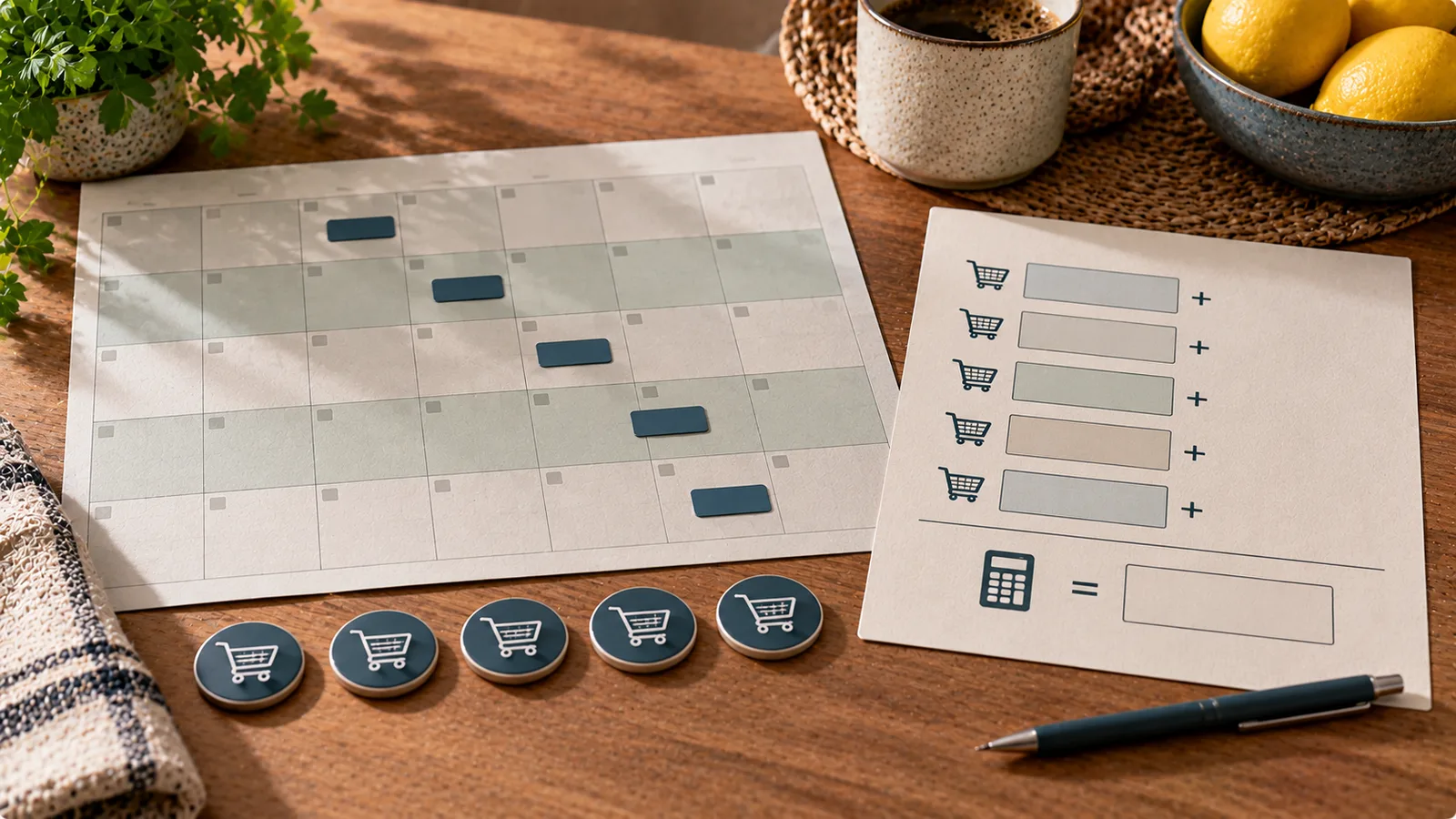
A grocery budget that works comfortably in one month can suddenly feel too small in another even when food prices and eating habits have not changed.
One common reason is simple:
some budgeting periods contain five grocery weeks instead of four.
If you normally spend €100 each week, four shopping weeks cost €400.
Five shopping weeks cost:
€100 × 5 = €500
Nothing necessarily went wrong with your spending. The calendar created another shopping cycle.
The solution is to decide whether your grocery budget is truly monthly, truly weekly or an annual amount divided into months.
Why the four-week assumption causes problems
A year has 52 weeks.
But:
12 months × 4 weeks = 48 weeks
Four weeks per month therefore accounts for only 48 of the year's 52 weeks.
Four weeks are missing.
That is why simply multiplying your weekly grocery spending by four tends to underestimate the amount needed over a full year.
If you spend €100 per week:
Four-week estimate:
€100 × 4 = €400 per month
Annual spending at €400 per month:
€400 × 12 = €4,800
But 52 actual weeks at €100 cost:
€100 × 52 = €5,200
Difference:
€5,200 − €4,800 = €400
That is the equivalent of four additional weekly grocery budgets.
The average month is about 4.33 weeks
A more useful conversion is:
52 weeks ÷ 12 months = 4.33 weeks per month
If your normal weekly grocery budget is €100:
€100 × 52 ÷ 12 = €433.33
Your average monthly grocery requirement is therefore approximately:
€433
not €400.
This does not mean you must spend exactly €433 every month.
It means €433 is a better monthly average for a €100 weekly spending pattern.
Weekly budget to monthly budget
Use:
Monthly average = weekly budget × 52 ÷ 12
Examples:
| Weekly grocery budget | Average monthly equivalent |
|---|---|
| €50 | €216.67 |
| €60 | €260.00 |
| €70 | €303.33 |
| €80 | €346.67 |
| €90 | €390.00 |
| €100 | €433.33 |
| €120 | €520.00 |
| €150 | €650.00 |
This method automatically accounts for the extra weeks across the year.
Monthly budget to weekly budget
If you have a fixed monthly grocery budget, reverse the calculation:
Weekly budget = monthly budget × 12 ÷ 52
For a €400 monthly grocery budget:
€400 × 12 ÷ 52 = €92.31
Your sustainable weekly average is approximately:
€92
rather than €100.
For €500 per month:
€500 × 12 ÷ 52 = €115.38
So the long-term weekly average is about:
€115
What exactly is a five-week grocery month?
There are several ways people define it.
You may shop every Saturday and encounter five Saturdays before the next monthly reset.
You may receive income monthly but make five normal grocery trips before the next payment.
Or your budgeting app may divide spending by calendar month while your actual shopping rhythm follows seven-day weeks.
The important question is not whether a calendar month technically contains five complete weeks.
The useful question is:
How many normal grocery cycles must this income or budget allocation cover?
If the answer is five, you need to fund five cycles.
Example: €100 weekly budget
Suppose your normal weekly allowance is:
€100
A four-shop month requires:
4 × €100 = €400
A five-shop month requires:
5 × €100 = €500
If you allocate only €400, the problem appears during the final week.
After four shops, the budget is exhausted even though another grocery period remains.
Method 1: budget by week
The simplest solution is to stop forcing weekly grocery spending into equal calendar months.
If your target is €100 per week, fund each grocery week with €100.
A month containing four shopping cycles receives €400.
A month containing five receives €500.
This works particularly well when income is flexible enough to accommodate the changing monthly total.
The disadvantage is that monthly spending reports will fluctuate even when your behavior is perfectly consistent.
Method 2: use a monthly average
If you prefer the same grocery allocation every month, convert the weekly budget to its annual monthly average.
For €100 per week:
Annual grocery budget:
€100 × 52 = €5,200
Monthly average:
€5,200 ÷ 12 = €433.33
You could therefore allocate approximately €433 each month.
In four-week periods, some money remains.
That surplus helps fund the five-week periods.
How the monthly-average method works
Imagine you allocate €433 every month but usually spend €100 per shopping week.
In a four-shop month:
Budget:
€433
Spending:
€400
Remaining:
€33
Do not treat the €33 as spare money.
Leave it in the grocery category.
Several months of these small carryovers create the amount needed when an additional shopping week appears.
Method 3: create a fifth-week reserve
Another approach is to keep your normal monthly budget and create a separate reserve.
Suppose you think of groceries as:
€400 for four weeks
The missing annual amount is approximately:
€400
You can build that reserve gradually.
Monthly contribution:
€400 ÷ 12 = €33.33
So you could budget:
- €400 for normal grocery spending;
- about €33 for the fifth-week reserve.
Total monthly grocery allocation:
about €433
Mathematically, this is essentially the same as using the monthly average, but the separate reserve can make the purpose of the extra money clearer.
Example with an €80 weekly budget
Weekly target:
€80
Annual amount:
€80 × 52 = €4,160
Average monthly amount:
€4,160 ÷ 12 = €346.67
If you budget only four weeks:
€80 × 4 = €320
Difference:
€346.67 − €320 = €26.67 per month
That €26.67 is what gradually covers the extra grocery weeks across the year.
A five-shop period would require:
€80 × 5 = €400
Example with a €150 weekly family budget
Weekly grocery budget:
€150
Four grocery weeks:
€600
Five grocery weeks:
€750
Annual spending:
€150 × 52 = €7,800
Average monthly allocation:
€7,800 ÷ 12 = €650
If the household budgets only €600 every month, the annual plan is short by:
€7,800 − €7,200 = €600
Again, that is four weeks of €150.
Do not divide a monthly budget by four
If your monthly grocery budget is fixed at €500, dividing by four gives:
€500 ÷ 4 = €125
But spending €125 every week for 52 weeks would cost:
€125 × 52 = €6,500 per year
Your €500 monthly budget provides only:
€500 × 12 = €6,000 per year
The weekly amount is therefore too high.
The sustainable weekly amount is:
€6,000 ÷ 52 = €115.38
This distinction becomes visible when a five-week period arrives.
A simple formula for a fixed monthly budget
If you know your monthly grocery amount:
Monthly amount × 12 ÷ 52 = weekly average
Examples:
| Monthly budget | Sustainable weekly average |
|---|---|
| €250 | €57.69 |
| €300 | €69.23 |
| €350 | €80.77 |
| €400 | €92.31 |
| €450 | €103.85 |
| €500 | €115.38 |
| €600 | €138.46 |
| €700 | €161.54 |
These values are averages, not mandatory weekly spending limits.
You may spend more one week and less another.
What if the fifth week has already arrived?
If you did not prepare for it, do not assume the only solution is to skip normal food purchases.
First calculate what remains.
Suppose:
Monthly grocery budget:
€450
Spent after four shopping cycles:
€390
Remaining:
€60
You have one more week to cover.
Instead of trying to reproduce a normal €100 shop, build the final week around the €60 that remains.
Start with food already available at home.
Then buy the items required to turn those foods into complete meals.
Inventory before the fifth shop
Check:
Grains and starches
- rice;
- pasta;
- oats;
- potatoes;
- bread in the freezer.
Protein foods
- beans;
- lentils;
- eggs;
- canned fish;
- frozen meat or fish;
- tofu.
Vegetables
- frozen vegetables;
- onions;
- carrots;
- canned tomatoes;
- vegetables that need to be used soon.
Other useful foods
- yogurt;
- cheese;
- sauces;
- cooking oil;
- spices.
The purpose is not to create an artificially restrictive week.
It is to avoid buying duplicates when the pantry already contains part of the week's food.
Build the final week from missing pieces
Suppose you already have:
- 500 g rice;
- 400 g pasta;
- two cans of beans;
- six eggs;
- frozen vegetables;
- oats.
You may only need to buy:
- milk or yogurt;
- fresh fruit;
- bread;
- additional vegetables;
- one or two protein foods.
The final shop can therefore be smaller without making the week's meals incomplete.
Five-week months are not an excuse to stockpile
Knowing that another grocery week is coming does not mean the first shop should be unusually large.
Buying five weeks of perishable food at once can create:
- refrigerator crowding;
- spoilage;
- cash-flow pressure;
- more food waste.
The budget should cover the extra cycle.
The food itself can still be purchased at the normal frequency.
Separate grocery cash flow from food consumption
A large purchase does not always mean you consumed more food that week.
Suppose you buy:
- a 5 kg bag of rice;
- several cans of beans;
- cooking oil;
- frozen vegetables
during a sale.
That week's receipt may be unusually high, but some of those foods will be eaten over several future weeks.
This matters when reviewing your budget.
A high shopping week is not automatically a failed week.
Look at the longer period.
Use rollover instead of resetting unused money
A strict reset can create the five-week problem.
Example:
You allocate €433.
You spend €397.
If you remove the remaining €36 from the grocery category at the end of the month, you lose part of the money intended to fund future extra weeks.
Instead:
€433 − €397 = €36
Let the €36 remain available for groceries.
Rollover turns irregular calendar months into a smoother annual system.
What if grocery prices are also rising?
The five-week effect and food inflation are separate issues.
Suppose your historical weekly budget was €90.
You may discover that current normal spending is closer to €100.
First update the realistic weekly baseline.
Then convert it correctly.
Old baseline:
€90 × 52 ÷ 12 = €390 per month
New baseline:
€100 × 52 ÷ 12 = €433.33 per month
Trying to solve both problems by cutting the fifth week to almost nothing can hide the fact that the underlying weekly budget itself has become outdated.
Include household products consistently
Decide what your grocery budget covers.
Possible items include:
- food;
- beverages;
- toilet paper;
- cleaning products;
- dishwashing supplies;
- toiletries.
There is no single correct category structure.
The important point is consistency.
If detergent is included in groceries one month and excluded the next, comparing the months becomes less useful.
A five-week month does not require five identical shops
Weekly spending can vary.
For example, with a €500 five-week allocation:
Week 1: €120
Week 2: €90
Week 3: €105
Week 4: €85
Week 5: €100
Total:
€500
The goal is not to force every week to exactly €100.
The goal is to make the total fit the period while maintaining enough food.
Use a remaining-per-week check
During a longer month, calculate:
Remaining grocery money ÷ remaining grocery weeks
Example:
Budget remaining:
€210
Weeks remaining:
3
Available average:
€210 ÷ 3 = €70 per week
This immediately shows whether your current spending pace is sustainable.
Example after an expensive first week
Five-week grocery allocation:
€500
Week 1 spending:
€140
Remaining:
€360
Four weeks remain.
Average available:
€360 ÷ 4 = €90
You do not necessarily need to cut the next shop dramatically.
You simply know the remaining four weeks need to average around €90.
Example after two weeks
Starting budget:
€500
Week 1:
€110
Week 2:
€125
Spent:
€235
Remaining:
€265
Three weeks remain.
Available average:
€265 ÷ 3 = €88.33
That gives you a useful target for the rest of the period.
Keep a small grocery buffer
Even after accounting for 52 weeks, real life is not perfectly predictable.
A small buffer can help with:
- unexpected guests;
- price increases;
- replacing spoiled food;
- an unusually expensive staple purchase;
- schedule changes.
For example, if your calculated monthly average is €433, you might choose a planned grocery allocation of €450 if your overall finances allow it.
The additional €17 is not a requirement.
It is simply a buffer.
Do not confuse a buffer with a spending target
If your budget allows €450, you do not need to deliberately spend €450.
If the month costs €412, the remaining €38 can stay in the grocery reserve.
A budget is a maximum allocation or planning amount, not an instruction to consume all available money.
Payday can matter more than the calendar
Suppose you are paid on the 25th of every month.
Your practical grocery period may run:
25th to 24th
rather than from the first to the last day of the month.
Count how many normal shopping trips occur between paydays.
If there are five, your grocery allocation must cover five.
This can be more useful than asking whether the calendar month itself has five Saturdays.
If you are paid every four weeks
A four-week pay cycle creates a different pattern.
Thirteen four-week periods fit into approximately one year:
52 ÷ 4 = 13
If you receive income every four weeks, a four-week grocery budget can align naturally with your pay cycle.
In that case, forcing the system into twelve calendar months may create unnecessary complexity.
Match the grocery budget to the income cycle when practical.
A practical annual method
If your food spending is relatively stable, start with the weekly amount.
Example:
Normal weekly groceries:
€90
Annual budget:
€90 × 52 = €4,680
Average monthly allocation:
€4,680 ÷ 12 = €390
You can then allocate €390 every month and allow unused amounts to roll forward.
This automatically prepares the category for months with more shopping cycles.
If you already know annual grocery spending
You can work backward.
Suppose last year's grocery spending was:
€6,240
Average monthly spending:
€6,240 ÷ 12 = €520
Average weekly spending:
€6,240 ÷ 52 = €120
These figures provide a realistic baseline for the next budget.
Then adjust for changes such as:
- household size;
- food prices;
- dietary changes;
- more or fewer meals eaten at home.
A simple five-week-month system
If you want a straightforward system without frequent calculations:
- Estimate your realistic weekly grocery spending.
- Multiply it by 52.
- Divide by 12.
- Transfer that amount to the grocery category each month.
- Let unused grocery money roll over.
- Continue shopping at your normal rhythm.
- Check remaining money against remaining shopping weeks during expensive periods.
Example:
Weekly spending:
€100
Annual:
€5,200
Monthly allocation:
about €433
That €433 monthly amount is designed to handle the extra weeks that a €400 four-week assumption misses.
Quick reference
If you think in weekly grocery budgets:
Weekly budget × 52 ÷ 12 = average monthly budget
If you think in monthly grocery budgets:
Monthly budget × 12 ÷ 52 = average weekly budget
If a specific budgeting period contains five shopping cycles:
Weekly target × 5 = amount needed for that period
The key is to stop treating every month as exactly four weeks.
A five-week grocery month is not necessarily evidence of overspending. Often it is simply a calendar effect that becomes predictable once weekly, monthly and annual food budgets are converted consistently.