
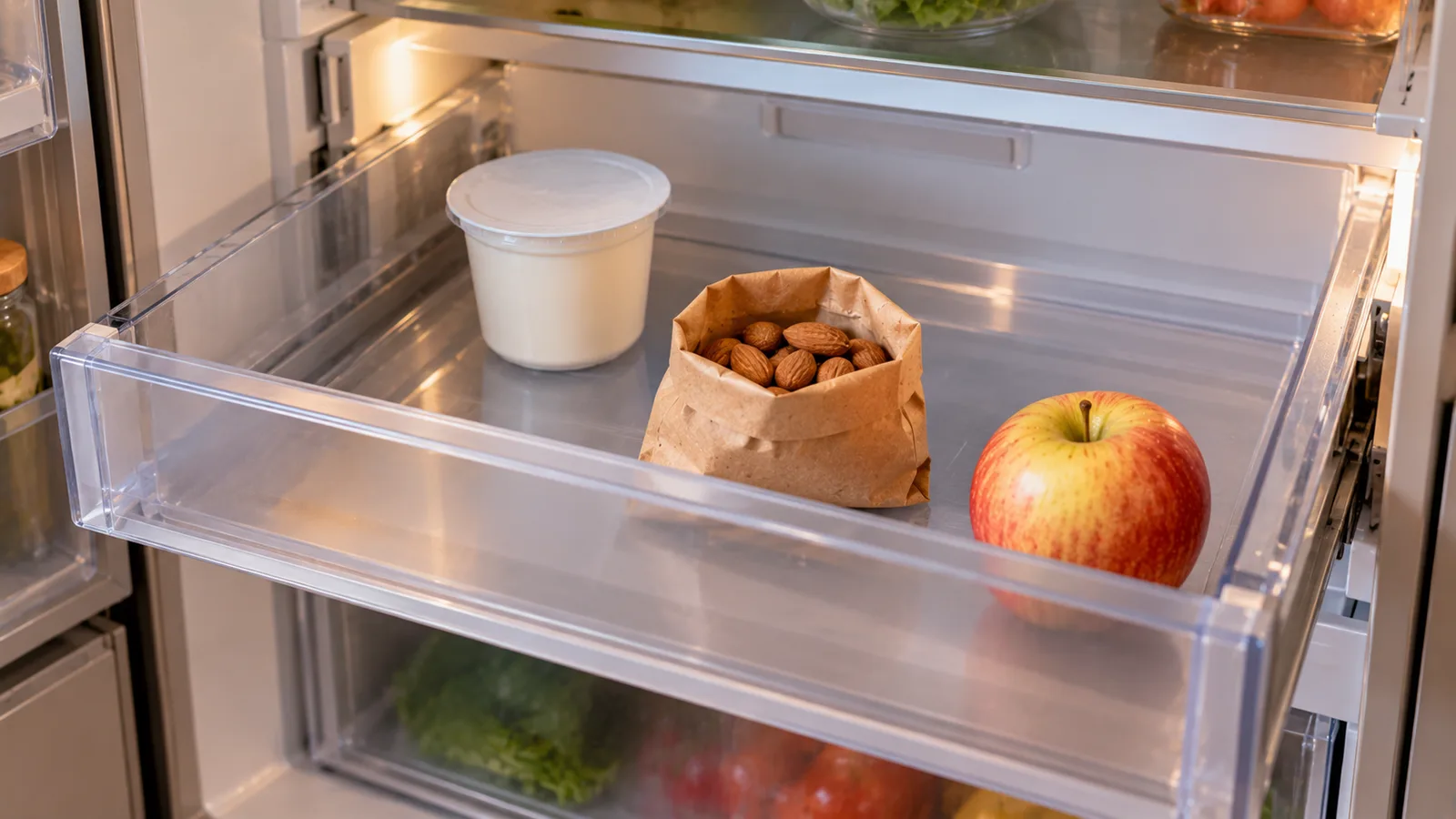
Snacks can fit into a weight-loss plan, but they are not automatically necessary.
For some people, a planned snack makes the time between meals easier to manage. For others, frequent snacking simply adds calories that would be more satisfying as part of breakfast, lunch or dinner.
The useful question is therefore not "What snacks make you lose weight?"
It is:
"When does a snack help my eating plan, and how should I plan it?"
Start by deciding whether you actually need a snack
Do not add snacks to your day just because a meal plan says you should eat every few hours.
Look at your actual routine.
A planned snack can be useful when:
- there is a long gap between meals;
- you regularly become very hungry before the next meal;
- your work or travel schedule delays a meal;
- you exercise between meals and prefer to eat around that time;
- an afternoon snack helps you arrive at dinner with manageable hunger;
- you consistently need something between two particular meals.
A snack may be unnecessary when:
- you are not physically hungry;
- your meals already keep you comfortable until the next meal;
- you snack mainly because food is visible or available;
- the snack repeatedly pushes your total intake above your target;
- you would rather use those calories for a larger meal.
Weight-loss planning does not require a fixed number of snacks.
Map the gaps between your meals
Before choosing snack foods, write down your usual meal times.
For example:
| Time | Eating occasion |
|---|---|
| 07:30 | Breakfast |
| 12:30 | Lunch |
| 16:30 | Possible snack |
| 20:00 | Dinner |
Here the longest practical problem may be the 7.5-hour period between lunch and dinner.
A planned afternoon snack could make sense.
Now consider another schedule:
| Time | Eating occasion |
|---|---|
| 08:00 | Breakfast |
| 12:00 | Lunch |
| 18:00 | Dinner |
If you are comfortable between these meals, adding snacks is not necessary simply to complete a schedule.
Plan around your hunger and routine rather than around an arbitrary snack frequency.
Give the snack a job
A useful snack usually solves a specific problem.
For example:
Bridge snack
Helps cover a long interval between meals.
Portable snack
Prevents being caught without food during work, commuting or travel.
Pre-planned evening snack
Provides room for something you regularly enjoy without turning it into an unplanned addition.
Post-activity snack
Fits around exercise when the timing of regular meals is inconvenient.
Emergency backup
Stays in your bag, desk or car for days when the schedule changes.
If you cannot explain what problem the snack solves, you may not need to plan it.
Fit snacks into the whole day's calories
Snacks count toward total energy intake just like meals.
Suppose your daily target is 1,800 kcal.
One possible structure is:
| Eating occasion | Planned calories |
|---|---|
| Breakfast | 400 |
| Lunch | 500 |
| Snack | 200 |
| Dinner | 700 |
| Total | 1,800 |
Another person may prefer:
| Eating occasion | Planned calories |
|---|---|
| Breakfast | 450 |
| Lunch | 550 |
| Dinner | 800 |
| Total | 1,800 |
Neither structure is inherently better.
The second person simply prefers to use the snack calories in larger meals.
This is why snacks should be planned inside the daily calorie budget rather than added on top of it.
Do not force every snack into a universal calorie limit
A 100-calorie snack is not automatically better than a 200-calorie snack.
The appropriate size depends on:
- your daily calorie target;
- the time until your next meal;
- how large your meals are;
- your hunger;
- your activity;
- what the snack is intended to do.
A small piece of fruit may be enough when dinner is one hour away.
A more substantial snack may be useful when you still have several hours before your next meal.
The snack should fit the situation and the whole day.
Build snacks around satisfaction, not just low calories
Very low-calorie snacks can be useful, but the lowest-calorie option is not always the most helpful.
If a snack leaves you hungry again almost immediately, it may not solve the problem you planned it for.
A practical snack can combine one or more of these elements:
- protein;
- fiber-rich foods;
- fruit or vegetables;
- whole grains;
- an appropriate portion of unsaturated-fat-rich foods.
Examples include:
- plain yogurt with berries;
- apple with a measured portion of peanut butter;
- cottage cheese with fruit;
- vegetables with hummus;
- whole-grain crackers with cottage cheese;
- fruit with a small portion of nuts;
- plain skyr with fruit;
- roasted chickpeas;
- whole-grain toast with a protein-rich topping.
The goal is not to create a perfect formula for every snack.
It is to choose something that fits your calories and makes the next part of the day easier.
Protein can be useful in a snack
Protein can contribute to fullness and can help you distribute your protein intake across the day.
Snack-friendly protein sources include:
- skyr;
- Greek yogurt;
- cottage cheese;
- eggs;
- tuna;
- edamame;
- roasted legumes;
- milk or unsweetened fortified alternatives where appropriate;
- nuts and seeds, although these also contain substantial fat and calories.
Protein does not make a snack a weight-loss food by itself.
The total portion and overall daily intake still matter.
For the broader role of protein and fullness, see Protein and Satiety.
Fiber can add volume and make snacks more substantial
Fruit, vegetables, legumes and whole grains can add fiber and volume.
Examples:
- pear + yogurt;
- berries + skyr;
- carrots + hummus;
- apple + cottage cheese;
- whole-grain crackers + tuna;
- air-popped popcorn with another suitable component if you need a more substantial snack.
Fiber-rich foods are useful beyond weight management, so there is no need to treat fiber as a special "fat-burning" ingredient.
Use a two-part snack when one item is not enough
A useful planning shortcut is:
base + complement
For example:
| Base | Complement |
|---|---|
| Apple | Yogurt |
| Berries | Skyr |
| Carrots | Hummus |
| Whole-grain crackers | Cottage cheese |
| Pear | Small portion of nuts |
| Cucumber | Egg |
| Whole-grain toast | Tuna |
This makes it easier to build a snack without needing a separate recipe.
You can also use just one component when that is enough.
Plan portions before you are hungry
Eating directly from a large packet makes the amount less obvious.
Instead, portion foods such as:
- nuts;
- crackers;
- popcorn;
- dried fruit;
- chocolate;
- granola;
- chips.
For example, if a 200 g bag contains 500 kcal per 100 g, the whole bag contains:
200 × 500 ÷ 100 = 1,000 kcal
A planned 30 g portion contains:
30 × 500 ÷ 100 = 150 kcal
The food has not changed. Only the portion has.
Planning the portion in advance makes the snack easier to fit into the day.
Energy-dense snacks require more attention to quantity
Foods such as nuts, nut butter, cheese, chocolate and granola can be nutritious or enjoyable additions to a diet, but they can contribute substantial calories in relatively small amounts.
For example:
20 g nuts at 600 kcal per 100 g:
20 × 600 ÷ 100 = 120 kcal
50 g of the same nuts:
50 × 600 ÷ 100 = 300 kcal
Both portions may look fairly small.
If you use energy-dense snacks regularly, knowing your usual portion can make planning easier.
Fruit can absolutely be part of a weight-loss snack
Whole fruit can be a convenient snack because it provides water, fiber and micronutrients.
Examples include:
- apple;
- orange;
- pear;
- berries;
- kiwi;
- banana;
- peach.
Fruit does not need to be avoided because it contains naturally occurring sugars.
If fruit alone does not keep you comfortable until the next meal, combine it with another food such as yogurt, cottage cheese or a measured portion of nuts.
What about packaged snacks?
Packaged snacks can fit into a weight-loss plan.
The useful questions are:
- What is the portion?
- How many calories does that portion contain?
- Will it actually satisfy the reason I am eating?
- Does it fit the rest of the day?
Check the nutrition label rather than relying on words such as:
- healthy;
- natural;
- protein;
- low fat;
- fitness.
Marketing language does not determine whether the portion fits your plan.
For help interpreting labels, see How to Read a Nutrition Label.
Plan for work before you get hungry
Workplaces often create predictable snack problems:
- vending machines;
- pastries in meetings;
- sweets on desks;
- long gaps between breaks;
- no time to buy food.
A simple system is to keep two types of snack available.
Fresh option
For example:
- yogurt;
- fruit;
- vegetables;
- cottage cheese.
Shelf-stable backup
For example:
- portioned nuts;
- whole-grain crackers;
- roasted chickpeas;
- a suitable packaged snack.
The backup is not something you must eat every day.
It is there when the schedule changes.
Plan portable snacks for commuting and travel
A snack is easier to manage when it survives the conditions in which you actually need it.
For a commute, you might choose:
- fruit;
- portioned nuts;
- roasted chickpeas;
- whole-grain crackers.
With refrigeration available:
- skyr;
- yogurt;
- cottage cheese;
- vegetables with hummus.
Choose foods based on storage safety as well as nutrition.
Afternoon snacking: diagnose the pattern
If you become very hungry every afternoon, do not automatically assume you need more willpower.
Review lunch.
Ask:
- Was lunch large enough?
- Did it contain a useful protein source?
- Was there a fiber-rich component?
- Was the meal unusually low in calories?
- Is the lunch-to-dinner gap simply very long?
Sometimes the solution is a planned snack.
Sometimes the better solution is improving lunch.
For meal composition, see How to Build a Filling Meal for Weight Loss.
Evening snacking needs a different plan
Evening eating may happen because of:
- genuine hunger;
- a very small dinner;
- habit;
- boredom;
- a desire for dessert;
- food availability;
- staying awake for many hours after dinner.
The solution depends on the cause.
If you are genuinely hungry, plan a snack that fits your day.
If you want dessert every evening, you can deliberately reserve calories for it.
If eating is mostly automatic while watching television, changing the environment may be more useful than searching for a different "healthy snack."
Planned treats can also fit
A weight-loss snack does not have to be yogurt, fruit or vegetables every time.
If you enjoy chocolate, for example, you can plan a portion into your calorie target.
The distinction is between:
planned portion
and
unplanned repeated eating from a large package.
A flexible plan can include foods chosen for enjoyment as well as foods chosen for nutrition.
Do not turn snack planning into constant grazing
A planned snack is a defined eating occasion.
Grazing is different: small amounts are eaten repeatedly over a long period, often without a clear sense of the total amount.
For example:
- a few nuts;
- then a biscuit;
- then cheese;
- then another handful of nuts;
- then something while cooking dinner.
Each amount may seem small, but the combined total can be substantial.
If this pattern is common, create a clear snack portion and end the eating occasion when it is finished.
Example: redesigning an afternoon snack
Suppose your usual afternoon pattern is:
- large flavored coffee;
- pastry;
- later, a few handfuls of nuts before dinner.
Rather than trying to "be good" each afternoon, create a repeatable plan.
Option A:
- plain yogurt;
- berries;
- measured nuts.
Option B:
- apple;
- cottage cheese.
Option C:
- planned pastry portion and a lower-calorie drink, if that is the food you actually want.
The best option is the one that fits your calorie budget, controls the pattern you are trying to solve and is realistic enough to repeat.
Create a small snack rotation
You do not need dozens of snack ideas.
Choose perhaps four to six combinations that:
- you enjoy;
- are easy to buy;
- fit your calorie budget;
- work in your usual locations;
- require little preparation.
Example:
| Situation | Planned option |
|---|---|
| Home | Skyr + berries |
| Work | Apple + portioned nuts |
| Very hungry afternoon | Cottage cheese + fruit |
| Need something savory | Vegetables + hummus |
| No refrigerator | Roasted chickpeas + fruit |
| Want something sweet | Planned dessert portion |
This reduces daily decision-making.
Make the grocery list support the plan
If you want to eat planned snacks, buy the ingredients for those snacks.
A weekly list might include:
Refrigerated
- skyr;
- yogurt;
- cottage cheese;
- hummus.
Produce
- apples;
- berries;
- carrots;
- cucumber.
Shelf-stable
- nuts;
- whole-grain crackers;
- roasted chickpeas.
Do not buy ten different snack options if you only need five snacks during the week.
Planning quantity can also reduce food waste.
Example weekly snack plan
Suppose you usually need an afternoon snack on workdays but rarely on weekends.
| Day | Plan |
|---|---|
| Monday | Yogurt + berries |
| Tuesday | Apple + nuts |
| Wednesday | Cottage cheese + fruit |
| Thursday | Carrots + hummus |
| Friday | Skyr + berries |
| Saturday | No planned snack |
| Sunday | Flexible if hungry |
Notice that "no planned snack" is a valid part of the plan.
The purpose is not to maximize the number of eating occasions.
What if the snack makes you hungrier?
Review what happens afterward.
A snack may be too small to solve the hunger problem.
Or you may prefer not to start eating between meals at all.
Experiment with:
- a more substantial planned snack;
- adding protein or fiber;
- moving calories from the snack into the previous meal;
- moving the snack closer to the time hunger normally appears;
- eliminating the snack if meals work better for you.
Use your actual response rather than assuming everyone should follow the same pattern.
What if snacks keep breaking your calorie target?
Audit them for several days.
Include:
- beverages;
- bites while cooking;
- office food;
- nuts;
- sauces and dips;
- evening treats.
Then calculate the total.
Suppose planned meals equal 1,650 kcal and your target is 1,900 kcal.
That leaves:
1,900 − 1,650 = 250 kcal
If snacks average 500 kcal, the issue is not necessarily the foods themselves.
There is simply a 250 kcal mismatch between the plan and the actual day.
Possible solutions include:
- smaller snack portions;
- fewer snacks;
- lower-calorie substitutions;
- reallocating calories from meals;
- changing the meal structure so you need less snacking.
Snacks are not mandatory for metabolism
You do not need to eat frequent snacks simply to "keep your metabolism running."
Meal frequency should be chosen for practical reasons such as hunger, schedule, preferences and overall dietary adherence.
A plan with three meals can work.
A plan with three meals and one snack can work.
Another structure can also work.
The total dietary pattern matters more than forcing a specific number of eating occasions.
A five-step snack-planning system
Use this process for the coming week:
1. Identify the difficult gap
Find the period when hunger or unplanned eating most often appears.
2. Decide whether a snack or a better meal solves it
Do not automatically choose the snack.
3. Allocate calories
Give the snack a realistic place inside your daily target.
4. Choose two or three repeatable options
Prioritize convenience and satisfaction rather than novelty.
5. Review after one week
Ask:
- Did the snack prevent unplanned eating?
- Was I still hungry?
- Did it fit my calories?
- Did I actually eat it?
- Would those calories work better in a meal?
Then adjust.
The practical rule
A snack is useful for weight loss when it helps you follow the overall eating plan.
It does not need to be extremely low in calories, and it does not need a special "weight-loss" ingredient.
Plan:
why you need it → when you need it → how much room it has in the day → what food will realistically work.
That turns snacking from an automatic extra into a deliberate part of the plan.