
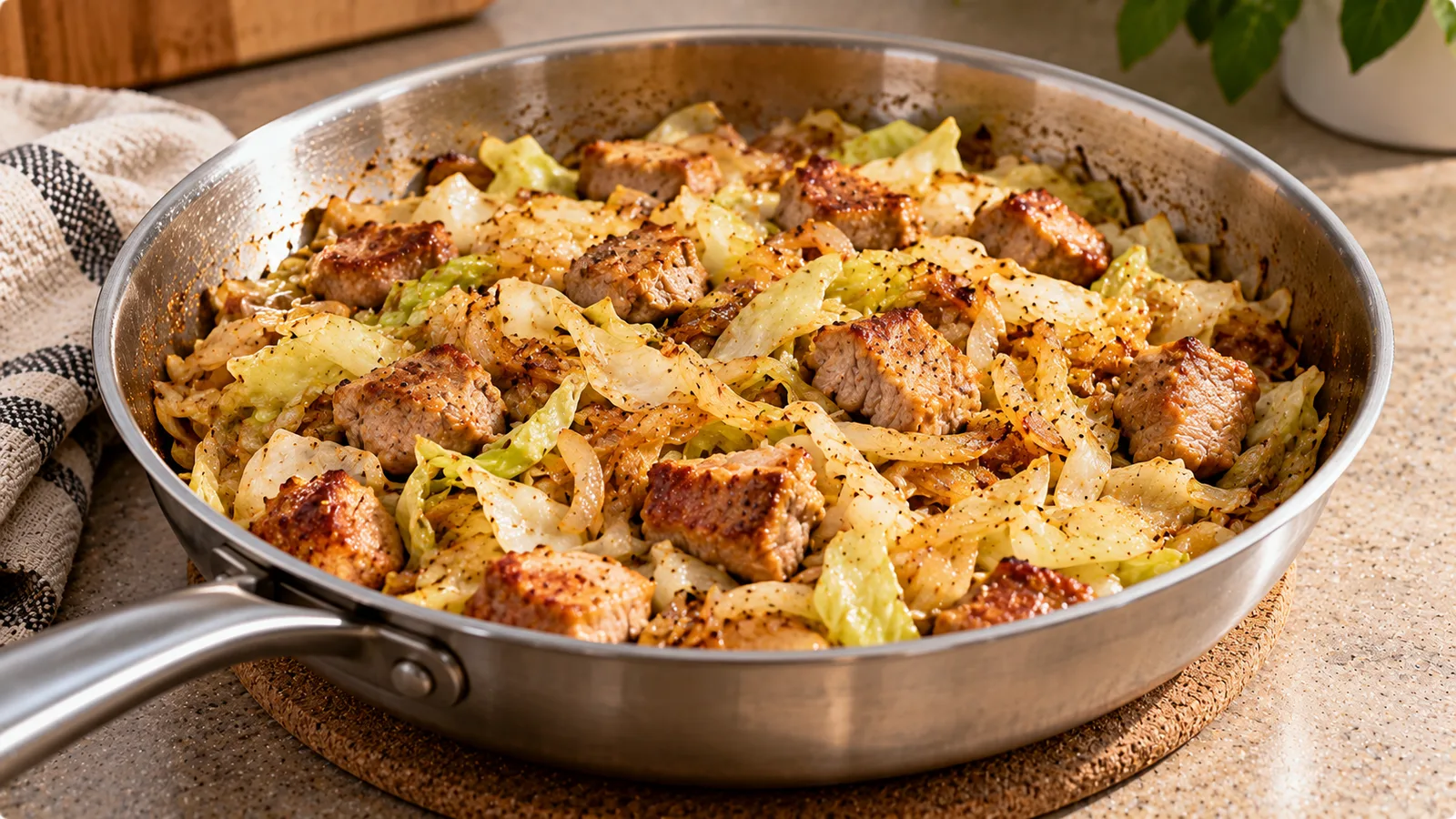
A pork and cabbage skillet is a practical dinner when you want a substantial meal without preparing several separate dishes. Pork provides the main protein, cabbage adds volume and texture, and a small amount of stock creates a savory sauce that coats the vegetables.
This version uses pork loin, green cabbage, carrots, onion, garlic and mustard. Everything cooks in one large skillet, although the pork is briefly removed while the vegetables soften.
The result is a warm, satisfying meal with tender pieces of pork and cabbage that retains a little bite rather than turning into a watery stew.
Recipe overview
| Detail | Amount |
|---|---|
| Servings | 4 |
| Preparation | 15 minutes |
| Cooking | 25–30 minutes |
| Total time | Approximately 40–45 minutes |
| Main equipment | Large deep skillet with lid |
| Difficulty | Easy |
| Cooking method | Browning, sautéing and covered simmering |
The recipe makes four moderate servings. Serve it on its own or with potatoes, rice or bread, depending on your energy needs and appetite.
Ingredients for four servings
| Ingredient | Quantity |
|---|---|
| Boneless pork loin, trimmed | 600 g |
| Green cabbage, prepared weight | 700 g |
| Carrots | 200 g |
| Onion | 180 g |
| Garlic | 3 cloves |
| Olive oil | 25 g |
| Low-sodium chicken or vegetable stock | 200 ml |
| Dijon mustard | 20 g |
| Apple cider vinegar | 15 ml |
| Sweet paprika | 1 teaspoon |
| Dried thyme | 1 teaspoon |
| Black pepper | To taste |
| Salt | To taste |
| Fresh parsley, optional | Small handful |
Use raw pork loin rather than a cured or smoked product. Pork shoulder can also work, but it generally requires a longer cooking method to become tender.
The cabbage weight refers to the usable portion after removing damaged outer leaves and the hard core.
Before you start
Cut the pork into strips approximately 1 cm thick and 4–5 cm long. Pieces of similar thickness cook more evenly.
Slice the cabbage into ribbons approximately 1 cm wide. Very thinly shredded cabbage softens quickly, while thick pieces retain more bite.
Slice the carrots thinly so they cook within the same time as the cabbage.
Cut the onion into thin half-moons and mince the garlic.
Keep raw pork and ready-to-eat ingredients separate. Wash hands, knives and cutting boards after handling raw meat.
Step-by-step instructions
1. Brown the pork
Heat a large skillet over medium-high heat.
Add approximately half the olive oil.
Pat the pork dry with kitchen paper. Season lightly with pepper and paprika.
Add the pork in two batches, leaving space between the pieces.
Cook for approximately 2 minutes per side until lightly browned. The pork does not need to be completely cooked at this stage because it will return to the skillet.
Transfer it to a clean plate.
Avoid overcrowding the skillet. Too much meat at once releases moisture and encourages steaming rather than browning.
2. Soften the onion and carrots
Reduce the heat to medium.
Add the remaining olive oil, followed by the onion and carrots.
Cook for 4–5 minutes, stirring occasionally.
The onion should soften and the carrots should begin to lose their raw firmness.
Add the garlic and dried thyme.
Stir for approximately 30 seconds, just until fragrant.
Do not let the garlic burn.
3. Add the cabbage
Add the cabbage in two or three handfuls.
Stir after each addition to help it begin to wilt.
If your skillet is very full, wait until the first handful reduces in volume before adding the next.
Cook uncovered for 5–7 minutes, stirring occasionally.
Some browned edges are desirable, but the cabbage should not scorch.
4. Make the pan sauce
Mix the stock, Dijon mustard and apple cider vinegar in a small bowl.
Pour the mixture into the skillet and scrape the bottom gently to release the browned cooking residues.
Bring to a gentle simmer.
Cover the skillet and cook for 6–8 minutes.
The cabbage should become tender while retaining some texture.
If the skillet becomes dry, add a small splash of water. If there is too much liquid, remove the lid and allow some to evaporate.
5. Return the pork
Add the browned pork and any juices collected on its plate.
Stir everything together.
Continue cooking for approximately 3–5 minutes, depending on the thickness of the pork.
Check the thickest pieces with a food thermometer. Whole-muscle pork should reach a safe minimum internal temperature of 63°C (145°F), followed by a 3-minute rest. If using ground pork instead, cook it to 71°C (160°F).
Do not rely on color alone to determine doneness.
6. Finish and serve
Taste the sauce before adding salt, particularly if the stock and mustard already contain sodium.
Add black pepper or a little additional vinegar if needed.
Sprinkle with parsley, if using.
Divide into four portions and serve warm.
How to keep the pork tender
Pork loin is relatively lean and can become dry when cooked for too long.
For better results:
- Cut the pieces to a similar thickness.
- Brown in batches rather than steaming a crowded pan.
- Remove the meat while the cabbage cooks.
- Return it near the end.
- Use a thermometer to confirm safe doneness.
- Avoid prolonged boiling after the pork is cooked.
Pork shoulder is not a direct one-for-one substitution for this quick method. Its connective tissue usually benefits from a much longer, slower cooking process.
How to avoid watery cabbage
Cabbage naturally releases moisture as it cooks.
A watery skillet usually results from adding too much stock, covering the pan for too long or using a pan too small for the quantity of vegetables.
The recipe uses only 200 ml of stock because the cabbage supplies additional moisture.
Start by cooking the cabbage uncovered. Add the stock only after the vegetables have reduced in volume.
If excess liquid remains at the end, remove the lid and simmer briefly until the sauce is concentrated.
Avoid thickening automatically with flour. A light pan sauce often works better with the texture of cabbage.
Flavor variations
With caraway seeds
Add approximately half a teaspoon of caraway seeds with the thyme.
Caraway complements cabbage and gives the dish a more traditional Central European character.
With mushrooms
Replace 150–200 g of the cabbage with the same weight of sliced mushrooms.
Brown the mushrooms with the onion before adding the cabbage.
The result will have a deeper savory flavor, although the nutrition and final volume will change.
With white beans
Add 200 g of cooked, drained white beans during the final minutes.
The beans contribute additional carbohydrates, fiber and protein.
This makes the skillet more substantial, but the recipe will yield more than four original portions unless you adjust the serving size.
With smoked paprika
Replace sweet paprika with smoked paprika.
Start with a modest quantity because its flavor can dominate the mustard sauce.
Without mustard
Omit the mustard and use a little additional stock with herbs.
The sauce will be less tangy. Check the seasoning before serving.
What to serve with pork and cabbage
The skillet can be eaten alone, but several side dishes work well.
| Side dish | Suggested cooked quantity per person | Why it works |
|---|---|---|
| Boiled potatoes | 150–200 g | Mild flavor and satisfying texture |
| Cooked rice | 120–150 g | Absorbs the sauce |
| Mashed potatoes | 150–200 g | Soft contrast with cabbage |
| Whole-grain bread | 50–70 g | Convenient for a quick dinner |
| Cooked barley | 120–150 g | Adds a chewy grain component |
These are serving examples, not nutritional requirements.
Add the calories and nutrients of the side dish separately when tracking the complete meal.
Estimated nutrition per serving
The following estimates apply to one quarter of the skillet without any side dish.
They assume trimmed raw pork loin, the listed vegetable quantities, 25 g olive oil, 20 g mustard and approximately 200 ml low-sodium stock.
| Nutrient | Approximate amount |
|---|---|
| Energy | 340 kcal |
| Protein | 37 g |
| Fat | 14 g |
| Carbohydrates | 18 g |
| Fiber | 6 g |
These are rounded recipe estimates, not laboratory measurements.
The exact values depend on the pork cut, trimming, vegetable sizes, stock, mustard and final cooked yield.
A fattier cut of pork can increase the calorie and fat content substantially.
For the most accurate calculation, use the nutrition labels and raw ingredient weights of the products you actually cook.
Nutrition reference: USDA FoodData Central.
How to adjust the recipe for different meal plans
If you want a larger meal, add a portion of potatoes, rice or another suitable side.
If you want more vegetables, increase the cabbage or carrots and use a sufficiently large skillet.
If you need more protein, adjust the amount of pork and recalculate the nutrition values rather than assuming the original estimates still apply.
If you are watching sodium intake, use unsalted or low-sodium stock and adjust the mustard and salt.
The best portion depends on your overall daily intake, activity and individual needs.
Grocery planning and cost control
This recipe works well for grocery planning because cabbage, carrots and onions are widely available and often keep longer than delicate leafy vegetables.
Before shopping, check what you already have:
- Cabbage remaining from another meal.
- Carrots and onions.
- Mustard, vinegar and dried herbs.
- Stock or ingredients for preparing it.
Buying a whole cabbage can be economical if you have a plan for the remainder.
However, the lowest price per kilogram is not necessarily the cheapest choice if part of the vegetable will be wasted.
For an accurate recipe cost, add the actual cost of the quantities used rather than charging the full price of every purchased package to one meal.
For example, if you buy a 1 kg bag of carrots but use 200 g, allocate approximately 20% of the bag's purchase cost to this recipe, assuming the remaining carrots are used elsewhere.
Storage and reheating
Refrigerate leftovers promptly in shallow containers.
Do not leave cooked pork and vegetables at room temperature for extended periods.
Store refrigerated leftovers at 4°C or below and use them within 3–4 days.
For longer storage, freeze portions promptly. For best eating quality, aim to use frozen portions within approximately 2–3 months, although food kept continuously frozen at a safe temperature may remain safe longer.
Thaw frozen portions in the refrigerator.
Reheat leftovers thoroughly to 74°C (165°F).
The cabbage may soften further during reheating, so use moderate heat and add a small splash of water if needed.
Food-safety reference: FoodSafety.gov — Cold Food Storage Chart.
Can you prepare it ahead?
Yes.
You can slice the cabbage, carrots and onions in advance and store them refrigerated in suitable containers.
Keep raw pork separately and follow safe storage guidance for the specific product.
For a convenient weeknight dinner, measure the mustard, vinegar and dried seasonings ahead of time.
Cook the pork and cabbage together shortly before serving for the best texture.
Alternatively, cook the full recipe and refrigerate individual portions promptly for later meals.
Common cooking problems
The pork is dry. It was probably cooked too long or cut too thin. Brown briefly and finish cooking near the end.
The cabbage is still hard. Cover and cook a little longer with a small amount of liquid.
The dish is watery. Simmer uncovered to reduce the liquid.
The cabbage tastes bland. Adjust the mustard, vinegar, herbs and salt gradually.
The pan is overcrowded. Use a larger skillet or cook the cabbage in stages.
The vegetables are too soft. Reduce covered cooking time on the next attempt.
Final cooking checklist
Before serving, make sure:
- The pork has reached its safe internal temperature and completed the required rest.
- The cabbage is tender enough for your preference.
- The sauce coats the ingredients without pooling excessively.
- The seasoning is balanced.
- Any leftovers are cooled and refrigerated promptly.
Pork and cabbage skillet is a flexible one-pan meal that relies on ordinary ingredients and straightforward cooking techniques. The most important steps are browning the pork without overcrowding, cooking the cabbage in stages and returning the meat only near the end.
With those details handled carefully, you get a flavorful dinner that is easy to portion, adapt and include in a weekly meal plan.