
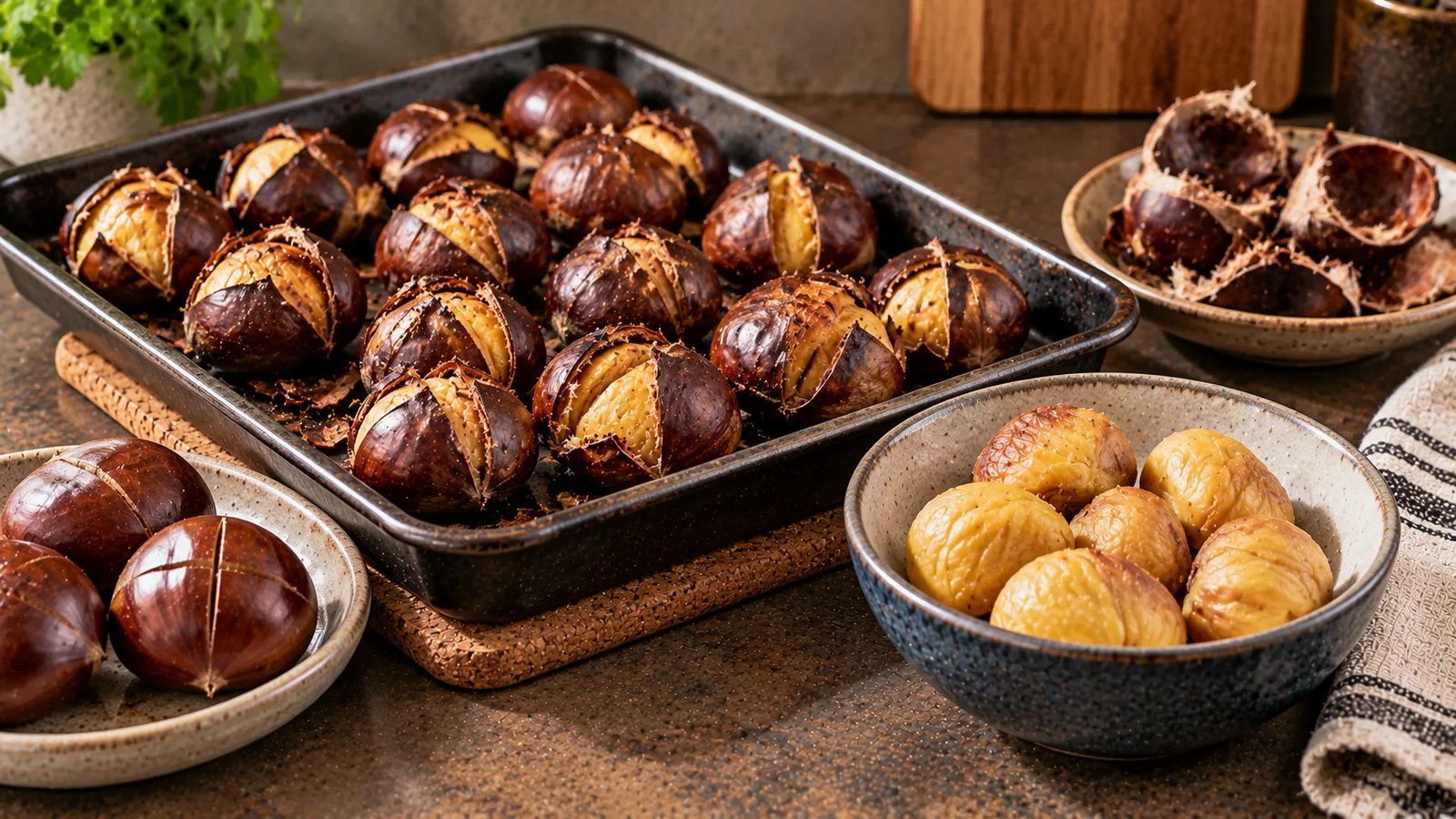
Roasting chestnuts is a small kitchen project with two very different weights: what you buy in shells and what you can actually eat. A careful cut, a hot oven and peeling while the nuts are still warm make the process more manageable. This guide uses a 600 g trial batch, explains what to look for at each stage and shows how to record edible yield without treating an example as a universal percentage.
Choose edible sweet chestnuts, not horse chestnuts
Buy clearly labelled edible sweet chestnuts (Castanea species) from a food seller. Horse chestnuts (Aesculus), sometimes collected from parks as conkers, are poisonous and must not be roasted for food. The similar common name is not proof that a nut is edible. Look for chestnuts that feel heavy for their size, with sound glossy shells and no mould, insect holes or unpleasant smell. Reject any visibly damaged specimens before weighing. A mix of sizes can cook unevenly; choosing broadly similar ones helps you judge when the tray is ready. Never rely on a taste test to identify foraged nuts.
Ingredients, equipment and oven settings
For a straightforward batch, use 600 g whole edible sweet chestnuts in their shells. You need a sturdy chopping board, a small sharp knife or chestnut scorer, a baking tray, clean tea towel, oven gloves and a kitchen scale. No oil or added sugar is required. Preheat a conventional oven to 200°C, or use 180°C fan as a starting point. This method makes a simple savoury or sweet-ready ingredient, not a sugary snack. Set aside enough space to peel safely; the freshly roasted centres retain heat longer than the shells suggest.
Score every shell without cutting your hand
Rinse off any grit and dry the nuts so they are easier to grip. Lay each chestnut on its flat face on the cutting board, rather than holding it in your palm. With a controlled motion make a generous slit, or an X, through the hard shell and thin skin underneath. Avoid driving the blade deeply into the edible kernel. The opening lets steam escape and gives you a starting edge for peeling. An unscored chestnut may burst in the oven. If a nut rocks or slips, steady it with a folded towel or a purpose-made scorer and keep fingers well away from the blade.
Roast in a single layer and check doneness
Spread the scored nuts cut-side up on a tray without piling them. Roast for about 30 minutes at 200°C conventional or 180°C fan. This is an oven guide, not a promise that every size needs precisely 30 minutes. The slits should gape and the shell edges curl; a test kernel should be hot, tender and cooked through. If the shells have not opened, check again after a few more minutes, watching for scorching or hard dry centres. Do not judge solely by colour: a darkened shell can surround a centre that still needs time. Use oven gloves when moving the tray.
Steam briefly and peel while still warm
Let the tray stand until the chestnuts are safe to handle with a folded cloth. Keeping them loosely covered for a few minutes can help hold moisture around the inner skins. Remove the brittle outer shell first, then the thin brown inner skin, which can cling to grooves in the pale kernel. Work in small groups so the remaining nuts stay warm, but never rush with a blade around hot food. If an inner skin refuses to come off, a short rest under a damp towel may help; a stubborn kernel can also be used in a dish once cleaned. Discard burned, mouldy or visibly spoiled pieces.
Measure raw, roasted and peeled weights separately
Put a bowl on the scale and tare it before each measurement. In our illustrative batch, 600 g is the purchased in-shell weight, 520 g is the weight of the roasted nuts still in their shells, and 390 g is the weight of clean edible kernels after removing shells and skins. These three numbers answer different questions. The difference between 600 g and 520 g is not exclusively shell waste: roasting also releases moisture. Likewise, the difference between 520 g and 390 g includes discarded peel and any damaged kernels. Do not report those differences as precise shell mass without weighing the waste separately.
| Stage | Mass |
|---|---|
| Purchased, with shells | 600 g |
| After roasting, with shells | 520 g |
| Edible peeled kernels | 390 g |
Calculate the edible yield and serving sizes
For this worked example, edible yield is 390 ÷ 600 × 100 = 65%. The remaining 35% is not necessarily all shells; it includes discarded material and moisture-related weight change between purchase and final kernels. Three equal portions of 130 g peeled chestnuts use the full 390 g, while a 100 g edible serving is always weighed after peeling. Your result may be higher or lower according to freshness, size, drying, cooking time and peeling technique. The 65% figure is an illustration for recordkeeping, not a published average for all chestnuts.
Work out the real cost per edible portion
Suppose the 600 g bag costs €6.00. Dividing the purchase price by 390 g gives €0.01538 per gram, or approximately €1.54 per 100 g edible chestnuts; each of the three 130 g portions represents €2.00 of the purchase cost. The in-shell bag appears to cost €1.00 per 100 g, but that is not the amount you can put on a plate. Use your actual receipt and final edible weight rather than these illustrative prices. If you want a fully loaded recipe cost, measure and add the oven electricity separately rather than pretending it was included in the bag price.
Serving, storage and nutrition tracking
Serve the kernels warm, or weigh and use them in stuffing, soups, salads or a simple snack. Refrigerate any leftovers promptly in a covered container and follow safe leftover-handling guidance; do not leave a large warm batch sitting out for hours. For a food diary, log the edible roasted kernels by weight and choose a reference entry that matches roasted chestnuts, not raw in-shell purchases. The FoodData Central catalogue can help identify the correct food state, but it does not turn an illustrative shell-yield calculation into a laboratory figure. If you add butter, syrup or oil, count those ingredients separately.
Sources