
Why carrot tops belong in a small batch
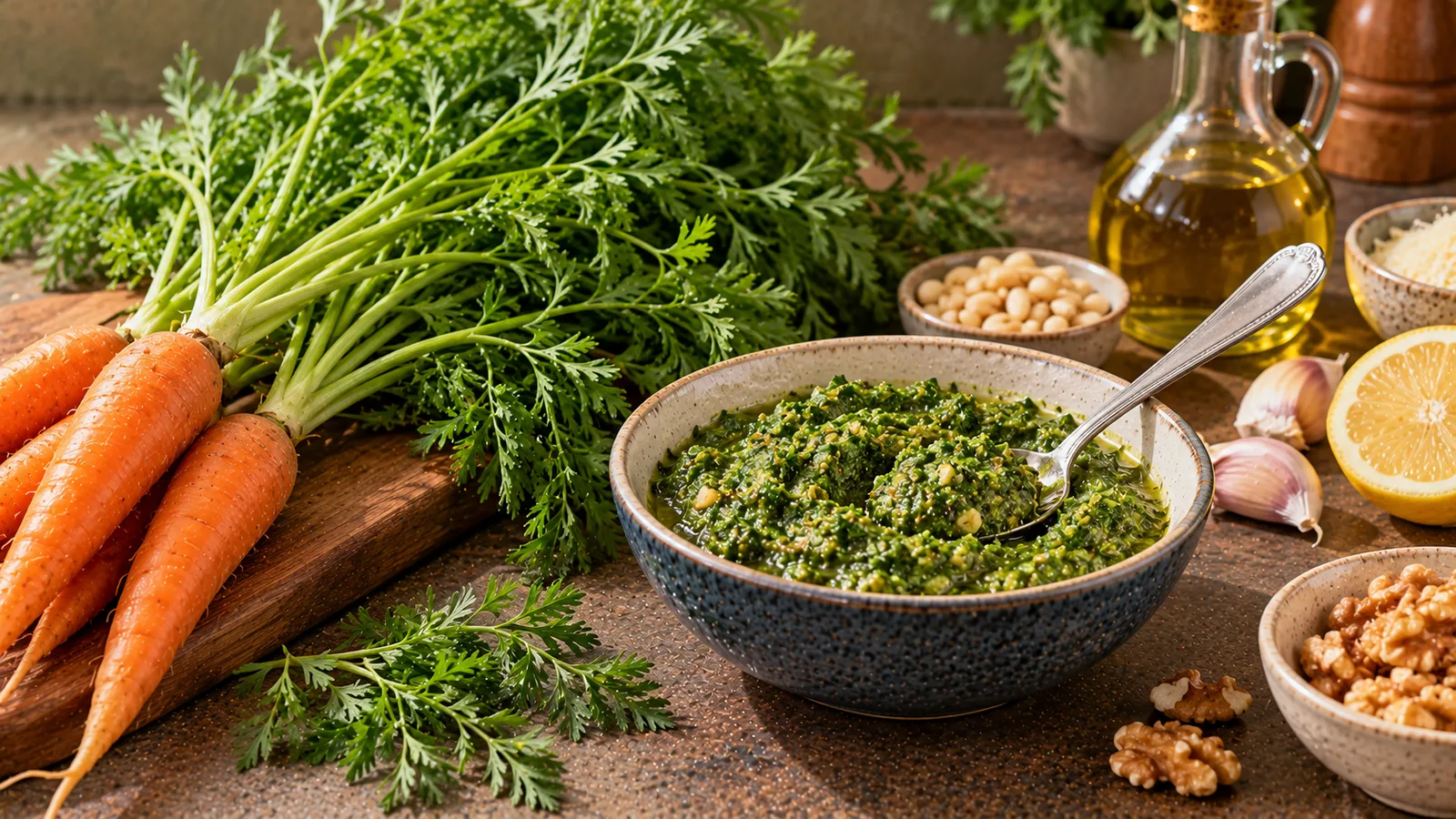
The leafy tops on a bunch of carrots are useful kitchen greens, not merely a decorative handle. Colorado State University Extension explicitly suggests using them in carrot-top pesto. Their flavor can be grassy, parsley-like and slightly bitter, so a modest quantity works better for a first attempt than processing every top from a large bunch. This recipe intentionally makes a small bowl: enough to dress several servings without leaving a jar forgotten at the back of the refrigerator. Use identifiable, sound carrot foliage from food carrots; do not pick unknown plants that merely resemble carrot leaves. The recipe is a way to use an edible part of a vegetable, not proof that every collected wild leaf is safe. Colorado State University Extension.
Exact ingredients for six servings
For one batch weigh 30 g of washed, well-dried tender carrot leaves, 20 g of unsalted sunflower seeds, 20 g of finely grated hard cheese, 45 g of olive oil, 10 g of lemon juice and approximately 3 g of peeled garlic. Set aside 15 g of cold drinking water, to be added only if the texture needs it. These seven masses total 143 g before any ingredients left in the processor or lost during transfer. The recipe gives six illustrative portions of about 23.8 g each. The cheese contains milk; check the seed packaging for allergies or cross-contact. Use a clean scale rather than estimating an irregular handful of greens or a variable spoon of oil.
How to clean and prepare the leaves
Separate the leaves from tough, stringy stems and discard yellow, slimy or visibly spoiled parts. Thoroughly rinse the leaves under clean running water; the FDA recommends this for fresh produce and advises against soap or detergent. Wash hands and clean the counter, knife and processor because this sauce is not cooked afterward. Dry the leaves in a salad spinner or on clean kitchen paper: clinging wash water changes the final weight and can make the pesto thinner than expected. Measure the 30 g only after discarding stems and removing excess water. Buying carrots with attached greens does not guarantee that the foliage is fresh enough to eat. FDA produce safety.
Blend the pesto without losing control of the texture
Pulse the sunflower seeds with the garlic first, just until roughly broken down. Add the prepared leaves and grated cheese; pulse again, scraping the bowl as needed. Pour in the 45 g of oil gradually while the machine is off between additions or running according to its safe operating instructions. Stop when the sauce is spoonable but still has a little texture. If it is too thick, incorporate part of the measured 15 g water and reassess before adding more. Finally fold in 10 g lemon juice and taste. There is no need to warm the pesto. Long continuous blending may heat delicate leaves and flatten their fresh character.
Taste, adjust and avoid a watery sauce
Carrot tops vary in bitterness and stem content, so exact ingredient weights produce a reproducible starting point rather than identical flavor every time. A squeeze more lemon or a little extra hard cheese will change mass, cost and nutrition; weigh such additions if the numbers matter. If the leaves taste harsh, reduce the greens at the next attempt or blend some with parsley, recording both weights. If the sauce is runny, do not assume adding more oil will solve it: oil also changes energy sharply. A small amount of ground seeds often thickens better. Keep the batch unsalted until after tasting the cheese, since hard cheese contributes salt.
Weigh the batch and divide fairly
The theoretical starting mass is 143 g: 30 + 20 + 20 + 45 + 10 + 3 + 15. In practice the finished mass can be lower because some sauce remains around the blades and inside the jug. Place a clean container on the scale, tare it and weigh the sauce actually recovered. Six portions based on the full theoretical 143 g are approximately 23.8 g each; if only 138 g reaches the jar, six equal portions are 23 g. For shared meals calculate the portion from recovered pesto, not from the starting weight of the carrot bunch. This distinction prevents a small but systematic serving error.
What the oil contributes to calories
Olive oil is the clearest energy contribution that can be calculated separately. Using an illustrative database value of 884 kcal per 100 g, 45 g contributes 397.8 kcal to the entire batch, or 66.3 kcal of oil alone across six equal servings. That is NOT the calorie count of the completed pesto: sunflower seeds and cheese also supply energy, and the other ingredients contribute smaller amounts. For a reliable full nutrition estimate, match each ingredient to an appropriately specified food record or the actual packaging, sum its contribution and divide by the measured servings. Do not label 66.3 kcal as a complete portion. USDA FoodData Central.
A transparent example of ingredient cost
An explicit hypothetical shopping calculation makes the cost easy to adapt. Value home-grown or otherwise already-paid-for carrot leaves at €0 solely for this marginal-cost example; allow €0.24 for 20 g seeds, €0.40 for 20 g cheese, €0.54 for 45 g olive oil, €0.10 for lemon and €0.05 for garlic. Water is treated as negligible. The illustrative batch totals €1.33, or roughly €0.22 for each of six portions. These are assumptions, not verified supermarket prices and not a claim that purchased carrot greens are free. If you buy carrots specifically for their tops, allocate the relevant purchase cost instead.
How to store a fresh herb-and-oil sauce
This is an uncooked mixture of fresh plant material and oil. Refrigerate it promptly in a clean covered container; do not treat a layer of oil, lemon juice or salt as a validated preservation method. The National Center for Home Food Preservation advises keeping freshly prepared pesto refrigerated no longer than three days, or freezing it. Oregon State University Extension explains that homemade herb-and-vegetable mixtures in oil can support Clostridium botulinum under unsafe storage conditions. For longer keeping, divide the fresh batch into small freezer-safe containers, label them and freeze promptly. A pleasant smell is not a safety test, and home-canning this recipe is not supported. NCHFP; OSU Extension.
Ways to serve it and sensible substitutions
Use a measured spoonful with pasta after cooking, thin a portion with hot cooking water just before serving or spread it on a sandwich eaten promptly. For a different result, try toasted sunflower seeds for nuttiness or substitute a different suitable hard cheese, but count the substitution as a new recipe rather than reusing the old nutrition totals. Leaving out cheese changes flavor, allergen information and cost; it does not automatically make a recipe nutritionally equivalent. This is a fresh, small-batch sauce designed for immediate use or prompt freezing, not a shelf-stable condiment.