
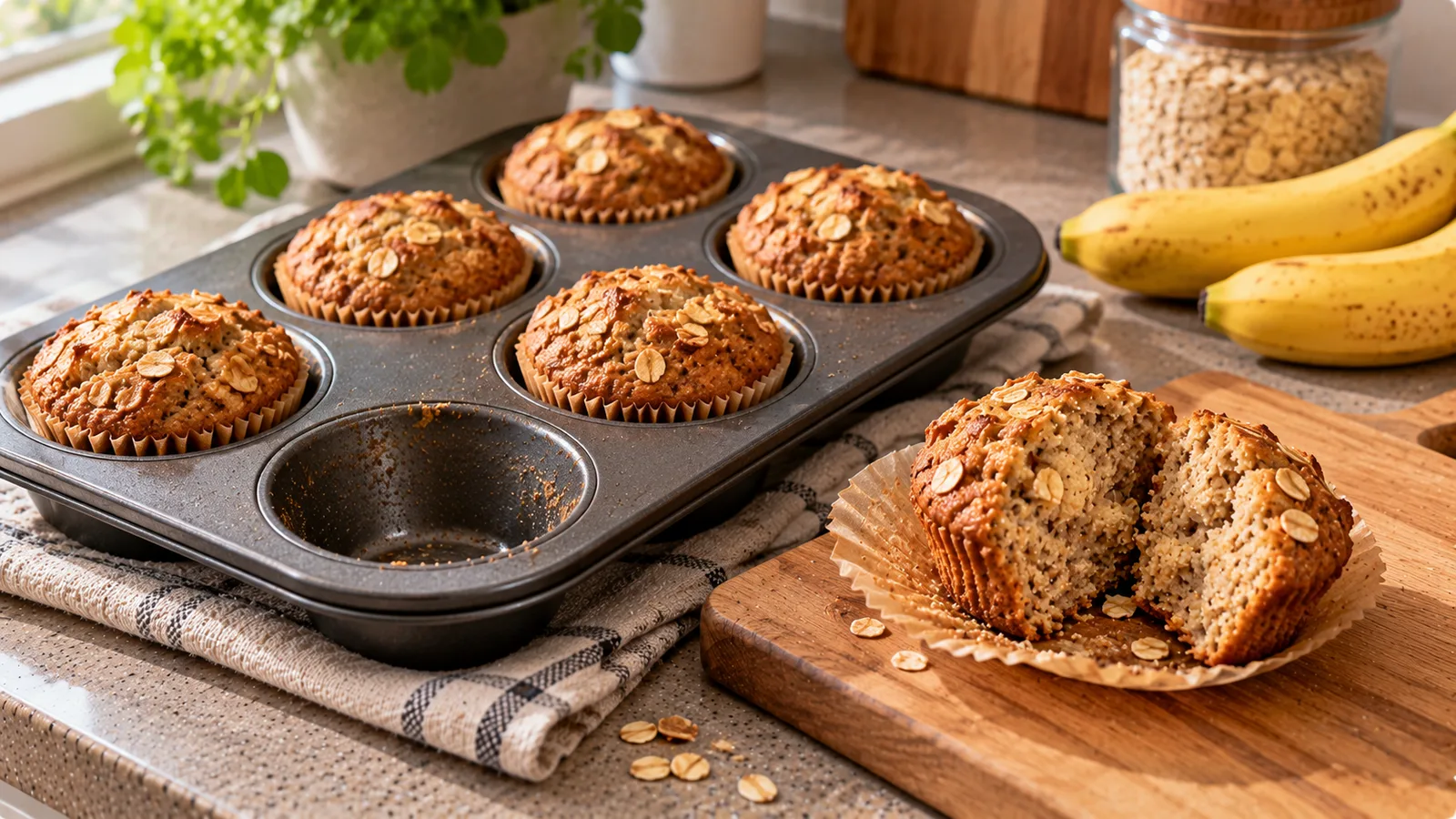
These muffins are designed for a practical homemade breakfast or snack.
Why this recipe works
Ripe bananas bring sweetness and moisture, rolled oats add texture, and eggs help the muffins hold together. A small amount of flour gives them a more familiar muffin crumb than recipes made entirely from oats.
These muffins are mildly sweet rather than dessert-like. They work as a breakfast component, a snack or something to pack alongside fruit and yogurt.
You do not need a blender, food processor or special baking equipment.
Recipe overview
| Detail | Amount |
|---|---|
| Yield | 12 standard muffins |
| Preparation | 15 minutes |
| Baking | Approximately 20–25 minutes |
| Oven | 180°C conventional / 160°C fan |
| Equipment | 12-cup muffin tin |
| Texture | Soft, moist, lightly textured |
Oven temperatures and baking times are guides. Muffin size, pan material and oven performance affect the result.
Ingredients for 12 muffins
| Ingredient | Quantity |
|---|---|
| Ripe banana flesh, peeled | 300 g |
| Rolled oats | 150 g |
| Plain wheat flour | 100 g |
| Plain unsweetened yogurt | 120 g |
| Large eggs | 2 |
| Neutral vegetable oil | 35 g |
| Maple syrup or honey | 30 g |
| Baking powder | 8 g |
| Ground cinnamon | 3 g |
| Vanilla extract | 5 ml |
| Salt | 1 g |
The banana weight refers to the edible flesh without the peel.
Use ripe bananas with brown spots for a naturally sweeter flavour. The recipe uses regular rolled oats rather than flavoured instant oatmeal.
Optional additions, such as chopped walnuts or chocolate chips, should be measured separately because they change the calorie content.
Step-by-step instructions
1. Prepare the oven
Preheat to 180°C conventional heat or approximately 160°C fan.
Line a 12-cup muffin tin with paper cases or lightly grease the cups.
2. Mash the bananas
Peel the bananas and weigh 300 g of flesh.
Mash thoroughly with a fork. Small lumps are fine, but large pieces can make the batter uneven.
3. Combine the wet ingredients
Add the eggs, yogurt, oil, maple syrup and vanilla to the mashed bananas.
Whisk until combined.
4. Combine the dry ingredients
In another bowl, mix the oats, flour, baking powder, cinnamon and salt.
Distribute the baking powder evenly before adding the liquid ingredients.
5. Make the batter
Add the dry ingredients to the banana mixture.
Stir just until no obvious pockets of dry flour remain.
Avoid prolonged mixing, which can make wheat-flour muffins tougher.
Leave the batter for approximately five minutes so the oats begin absorbing moisture.
6. Fill the muffin tin
Divide the batter evenly among 12 cups.
Each cup should be roughly two-thirds to three-quarters full, depending on the tin.
7. Bake
Bake for approximately 20–25 minutes.
The tops should look set and lightly golden. A skewer inserted into the centre should come out without wet batter.
A few moist crumbs are acceptable.
8. Cool
Leave the muffins in the tin for about five minutes, then transfer them to a rack.
Cooling allows the crumb to firm up and prevents moisture from collecting underneath.
Approximate nutrition per muffin
The following values are rounded estimates for one of 12 muffins, using the ingredients listed above without optional toppings.
| Nutrient | Approximate amount |
|---|---|
| Energy | 160 kcal |
| Protein | 4.5 g |
| Fat | 5.5 g |
| Carbohydrate | 24 g |
| Fibre | 2.3 g |
These are recipe estimates, not laboratory measurements. Ingredient brands, banana size, flour type and final muffin weight can change the values.
For a more precise calculation, combine product labels with a composition database such as USDA FoodData Central.
If you make 10 larger muffins instead of 12, the calories per muffin increase even though the total energy of the batter stays approximately the same.
Why banana ripeness matters
Bananas change in sweetness and texture as they ripen.
Very ripe bananas mash more easily and usually create a smoother batter.
Less ripe bananas can leave firmer pieces and produce a less sweet flavour.
If the bananas are small, use the weight rather than assuming two or three bananas will always equal 300 g.
If you have more banana than the recipe requires, save the excess rather than adding it automatically. Extra moisture can make the centre dense or underbaked.
How to keep the muffins soft
The most important controls are banana quantity, batter mixing and baking time.
- Weigh the peeled bananas.
- Do not add extra oats without increasing moisture.
- Mix only until combined.
- Avoid baking longer than necessary.
- Cool on a rack rather than leaving muffins in the hot pan.
If the batter looks unusually stiff because your oats absorb more liquid, add one or two tablespoons of milk.
If the mixture is very runny, allow it to rest briefly before deciding whether an adjustment is needed.
Useful variations
| Variation | Change |
|---|---|
| Banana and walnut | Add 40 g chopped walnuts |
| Banana and blueberry | Fold in 80 g blueberries |
| Banana and chocolate | Add 40 g chocolate chips |
| Less added sweetness | Reduce syrup to 10–15 g |
| More cinnamon | Increase cinnamon slightly |
| Smaller muffins | Use a mini-muffin pan and check earlier |
Nuts and chocolate increase the energy of the batch. Berries add moisture, so muffins with fruit may need slightly more baking time.
For a more substantial breakfast, serve one or two muffins with a separate protein-rich food rather than assuming the muffins alone provide a high-protein meal.
Can you make them without wheat flour?
You can experiment with oat flour in place of wheat flour, but the result will be different.
Oat flour does not behave like wheat flour in baking. The muffins may become more fragile or dense.
If gluten avoidance is medically necessary, use ingredients certified as suitable and verify the baking powder and other packaged products.
A direct substitution should be treated as a new recipe test rather than a guaranteed identical result.
Can you make them without eggs?
Eggs provide structure and help bind the banana and oat mixture.
An egg-free version can be tested using ground flaxseed mixed with water.
For two eggs, a possible starting point is 14 g ground flaxseed combined with 90 ml water.
Allow the mixture to thicken before using it.
This is not an exact replacement. The muffins may rise less and crumble more easily.
Check that the centre is fully baked and allow the muffins to cool completely before removing the cases.
Storage and freezing
Because these muffins contain moist fruit, eggs and yogurt, store them carefully.
Let the muffins cool, then place them in a covered container.
For meal preparation, refrigerating them promptly and using them within approximately three to four days is a practical approach when stored safely.
For longer storage, freeze individually or in small portions.
The FoodSafety.gov cold storage guidance provides general storage information.
Thaw frozen muffins safely and warm them if desired.
Do not leave moist muffins for extended periods in a warm kitchen, especially if there are signs of spoilage.
How to include muffins in a meal plan
The muffins are easy to portion because the recipe makes 12 individual pieces.
A practical approach is to record the full recipe once, then divide the nutrition by the actual number of muffins baked.
For example, if the finished batch contains approximately 1,920 kcal:
- 12 muffins: approximately 160 kcal each.
- 10 muffins: approximately 192 kcal each.
- 8 muffins: approximately 240 kcal each.
These are illustrative calculations based on the same total batch.
If you add chocolate chips, walnuts or a spread, include those ingredients separately.
A muffin can be paired with yogurt, skyr, fruit or another food depending on your nutritional goals.
Allergens and ingredient labels
The base recipe contains wheat, eggs and dairy.
Optional walnuts introduce a tree-nut allergen.
For anyone with an allergy, inspect packaged ingredient labels and avoid cross-contact during preparation.
The EU food information regulation sets out the framework for declaring allergens in food.
The FDA egg safety information provides additional guidance on handling eggs.
Do not assume a substitution automatically makes the entire recipe safe for a particular allergy.
Troubleshooting
| Problem | Possible reason | What to change |
|---|---|---|
| Dense centres | Excess banana or insufficient baking | Weigh fruit and bake until set |
| Dry muffins | Too much flour or overbaking | Weigh ingredients and check earlier |
| Muffins stick to cases | Removed while very warm | Cool more completely |
| Little rise | Old baking powder or overmixed batter | Check leavening and mix gently |
| Uneven muffins | Batter distributed unevenly | Portion with a scoop |
| Wet bottoms | Left in hot tin too long | Transfer to a rack |
For a predictable result, make the base recipe once before experimenting with several substitutions at the same time.
Final recipe notes
Banana oat muffins are a convenient way to use ripe bananas and prepare several breakfasts or snacks in one baking session.
Use 300 g peeled banana, measure the oats and flour, mix gently and bake until the centres are set.
The finished muffins can be eaten on their own or combined with other foods to create a more complete meal.