
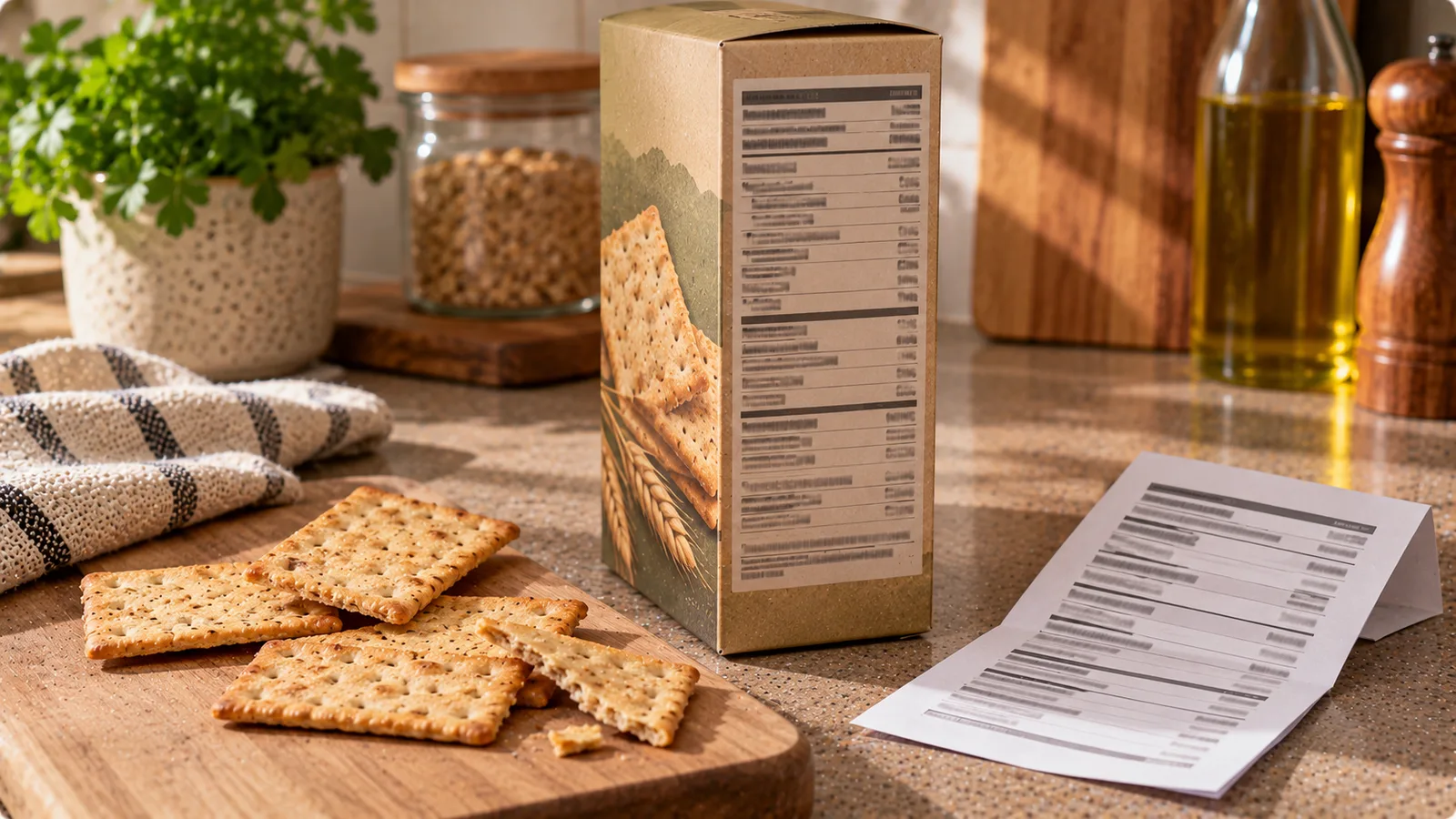
A food label says 0 g fat, 0 g sugar or 0 calories. It is tempting to interpret that as proof that the product contains absolutely none of that nutrient.
But zero on a nutrition label can be a rounded declaration rather than an exact laboratory measurement of zero.
The distinction matters when comparing products, tracking nutrition, interpreting claims and calculating the totals of several servings.
It also matters which country the label is designed for. US and EU nutrition labeling rules are not identical.
What does zero actually mean?
A displayed zero can have several explanations:
- The nutrient is genuinely absent or present only at a negligible level.
- The measured or calculated amount falls below a permitted rounding threshold.
- The declaration follows a specific rule for the nutrient and serving size.
- The food composition estimate has been rounded for labeling.
- A nutrition app has replaced a missing value with zero.
These situations are not interchangeable.
A labeled zero is not always the same thing as a verified analytical zero.
Why nutrition labels use rounding
Nutrition information is intended to be useful and readable.
Manufacturers do not generally print unlimited decimal places for every nutrient.
Instead, applicable regulations specify how quantities may be declared, including permitted rounding and tolerances.
For example, a very small amount of fat might appear as 0 g on a US Nutrition Facts label when the applicable declaration rule allows it.
That does not prove the food contains exactly 0.000 g fat.
The amount can be small enough to round to zero.
Importantly, there is no single universal zero threshold for every nutrient or every jurisdiction.
Fat, sugars, carbohydrates, sodium and calories may follow different rules.
US labels: zero can represent a small nonzero amount
Under US FDA nutrition labeling rules, certain nutrients may be declared as zero when they fall below specified amounts per serving.
Examples include:
| US Nutrition Facts declaration | General FDA rounding principle |
|---|---|
| Total fat: 0 g | Less than 0.5 g fat per serving may be declared as zero |
| Total carbohydrate: 0 g | Less than 0.5 g per serving may be declared as zero |
| Total sugars: 0 g | Less than 0.5 g per serving may be declared as zero |
| Calories: 0 | Fewer than 5 calories per serving may be declared as zero |
These are simplified descriptions of specific US labeling provisions.
Additional requirements and exceptions may apply, including rules for other nutrients, claims and product categories.
Always consult the applicable regulation rather than assuming the same threshold applies everywhere.
Why serving size changes the interpretation
US Nutrition Facts values are generally declared per serving.
That creates an important distinction between one serving and the amount actually consumed.
Imagine a hypothetical product contains 0.4 g fat per labeled serving.
Under the applicable US rounding rule, the label may display 0 g fat.
If you consume five servings, the underlying amount would be:
0.4 × 5 = 2 g fat.
The label's printed zeros do not mean that five servings necessarily contain zero fat.
However, you cannot determine the exact hidden amount from the printed zero alone.
The actual amount could be substantially lower than the threshold.
This example illustrates rounding and is not a measurement of a particular product.
Can a zero-calorie food contain calories?
Yes, under US labeling rules, a product containing fewer than 5 calories per serving may generally be declared as having zero calories, subject to applicable conditions.
For example, a hypothetical product with 4 calories per serving could display 0 calories.
Ten servings would then contain approximately 40 calories.
But the printed zero does not establish that the product contains exactly 4 calories.
It only tells you what has been declared under the applicable labeling rules.
Products marketed as calorie-free must also comply with the relevant nutrient-content-claim requirements.
The label declaration and the marketing claim are related but distinct regulatory concepts.
What about 0 g sugar?
A US label displaying 0 g total sugars does not necessarily mean that no sugar molecules are present.
A sufficiently small amount may be rounded to zero.
It is also important to distinguish:
Total sugars: Sugars present in the food, including naturally occurring and added sugars.
Added sugars: Sugars added during processing or preparation, as defined under the applicable labeling rules.
Sugar-free: A regulated marketing claim with specific conditions, not simply an informal synonym for a printed zero.
A product can have 0 g added sugars while still containing naturally occurring sugars.
Conversely, a product with 0 g total sugars may contain other carbohydrates.
Do not treat these different fields as equivalent.
Does 0 g carbohydrates mean zero energy?
No.
A food can contain protein, fat or other energy-contributing substances even if its declared carbohydrate value is zero.
Under US rules, total carbohydrate also follows rounding conventions.
A product's calories cannot be inferred from the carbohydrate field alone.
Likewise, 0 g sugars does not mean 0 g carbohydrates.
Starch and other carbohydrate components may still be present.
For accurate interpretation, read the complete nutrition panel rather than focusing on one line.
US and EU labels are not interchangeable
US and European labels differ in both structure and regulatory conventions.
| Feature | United States | European Union |
|---|---|---|
| Main reference basis | Usually per serving, with additional declarations in some cases | Generally per 100 g or 100 ml |
| Carbohydrate definition | Total carbohydrate generally includes dietary fiber | Carbohydrate generally excludes dietary fiber |
| Rounding | Specific FDA rules for individual nutrients | EU declaration rules, rounding guidance and tolerances |
| Zero interpretation | Depends on the nutrient and US rule | Depends on the nutrient, declaration context and applicable EU framework |
The EU does not simply use every US threshold unchanged.
European labels are governed primarily by Regulation (EU) No 1169/2011 and related guidance.
EU nutrition declarations are based on average values and are subject to applicable rounding and tolerance practices.
Therefore, do not assume that 0 g on a US label and 0 g on an EU label always represent exactly the same underlying range.
Why the per-100-g basis matters in Europe
European nutrition tables generally provide values per 100 g or 100 ml.
This makes it easier to compare products independently of manufacturer-selected serving sizes.
Suppose a European label shows a very small quantity for a nutrient per 100 g.
A larger consumed portion may contain a greater total amount.
However, the correct calculation depends on the declared precision and the underlying value.
You should not invent hidden decimal places.
If the label reports zero, the exact unrounded quantity is usually not available to the consumer.
For most everyday comparisons, the printed declaration remains the practical reference.
Is zero the same as a nutrient-content claim?
No.
A number in the nutrition table and a claim on the front of the package serve different purposes.
Examples of claims include:
- Sugar-free.
- Fat-free.
- Low fat.
- No added sugar.
- Calorie-free.
These terms may be legally defined and subject to conditions.
In the EU, nutrition claims are governed by Regulation (EC) No 1924/2006 and its annex.
For example, an EU sugar-free claim is generally permitted only when a product contains no more than 0.5 g sugars per 100 g or 100 ml.
That threshold is about the specific claim, not a universal rule for every displayed zero.
In the United States, FDA nutrient-content-claim rules use their own criteria.
Do not assume that the same marketing phrase has identical numerical conditions in every market.
A practical example: several small servings
Consider a hypothetical snack with the following unrounded amounts per serving:
| Nutrient | Actual illustrative amount |
|---|---|
| Fat | 0.4 g |
| Sugars | 0.3 g |
| Calories | 4 kcal |
Under relevant US declaration rules, these values may be displayed as zero.
If someone eats eight servings, the underlying totals would be:
- Fat: 3.2 g.
- Sugars: 2.4 g.
- Calories: 32 kcal.
These figures are an illustration of how rounding accumulates.
They are not values you can reconstruct from an actual label displaying zeros.
Without the unrounded data, the precise totals remain unknown.
Why calories and macros may not add up perfectly
A common question is why the calories printed on a label do not exactly match a calculation using protein, fat and carbohydrate.
There are several reasons:
- Nutrient values may be rounded independently.
- Calories may follow their own rounding rules.
- Fiber contributes energy differently under some calculation systems.
- Polyols and other components can have different energy factors.
- Nutrient composition values are estimates subject to permitted variation.
- US and EU carbohydrate conventions differ.
The familiar 4-4-9 calculation is useful as a rough estimate, but it is not a universal method for reconstructing every label exactly.
A small mismatch does not automatically indicate fraud or an error.
What if a nutrition app shows zero?
An app displaying zero may be reproducing a rounded label.
But it could also be showing zero because a nutrient field was missing.
That is a separate data-quality issue.
For example:
- A manufacturer reports 0 g sugar.
- A database record has no sugar information.
- An importer converts an empty sugar field into 0.
These three records may look identical in an app but have different meanings.
Ideally, nutrition software should distinguish a reported zero from an unknown value.
For users, checking the original label and data source is often the best first step.
How to track foods with rounded zeros
For routine food tracking, the declared label values are usually a reasonable starting point.
A practical method is:
- Use the nutrition label for the exact product and country.
- Check whether the values are per serving or per 100 g.
- Record the amount actually consumed.
- Avoid assuming that a printed zero is an exact laboratory zero.
- Do not invent a precise nonzero value without supporting information.
- Be especially cautious when many small servings are consumed.
- Check whether an app value is missing rather than truly reported as zero.
If precise values are essential, the manufacturer may be able to provide additional information, although unrounded nutrient data may not always be available.
When does the distinction matter?
For many people, tiny rounded amounts make little practical difference to their overall diet.
The issue becomes more relevant when:
- Someone consumes many servings of the same product.
- A food is used frequently throughout the day.
- An app combines large numbers of rounded entries.
- A nutrition database is being validated.
- A person follows a medically prescribed diet.
- A specific nutrient must be monitored carefully.
For medical nutrition management, use professional guidance rather than estimating hidden values from a printed zero.
Common misconceptions
"Zero means the nutrient is completely absent."
Not necessarily. It may be a permitted rounded declaration.
"Every nutrient rounds to zero below 0.5 g."
Incorrect. Thresholds differ by nutrient and jurisdiction.
"A zero-calorie label means unlimited servings have no calories."
Not necessarily. Small underlying amounts can accumulate.
"No added sugar means sugar-free."
Incorrect. Naturally occurring sugars may still be present.
"US and EU labels use the same rules."
They do not.
"If the macros do not reproduce the calories exactly, the label is wrong."
Not necessarily. Rounding and different energy factors can explain discrepancies.
Sources and regulatory references
- FDA: Nutrition Facts Label — US nutrition labeling information.
- 21 CFR § 101.9 — US nutrition labeling requirements and rounding provisions.
- 21 CFR § 101.60 — US nutrient-content claims relating to calories and sugars.
- EU Regulation No 1169/2011 — EU food information and nutrition declarations.
- EU Regulation No 1924/2006 — EU nutrition and health claims.
The bottom line
A zero on a nutrition label is a declared value under a particular labeling system, not necessarily proof that the underlying amount is exactly zero.
Read the serving basis, distinguish nutrient values from marketing claims and remember that US and EU rules differ.
For food tracking, use verified label information without treating rounded zeros as exact measurements or inventing hidden nutrient quantities.