
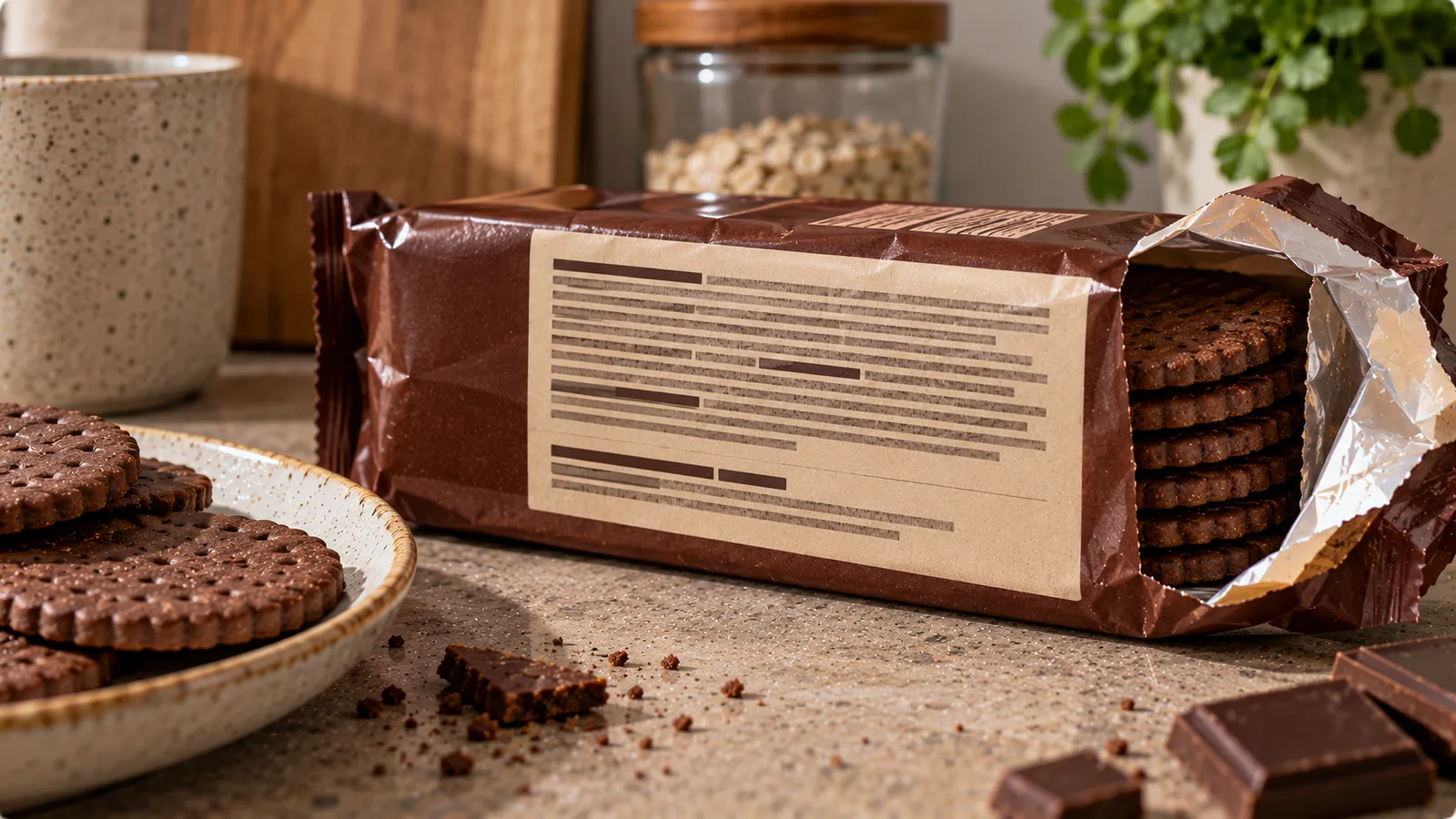
A food label that says "may contain milk", "may contain nuts" or "may contain traces of wheat" is warning about a possible allergen that is not intentionally included as an ingredient.
This is called precautionary allergen labelling, often abbreviated to PAL.
The warning usually concerns unintended allergen presence caused by cross-contact during manufacturing, processing, handling or packaging.
It is different from an allergen deliberately used in the recipe.
The key distinction: "Contains milk" identifies milk as an ingredient or ingredient-derived allergen. "May contain milk" warns that milk could be present unintentionally.
For someone with a diagnosed food allergy, that difference matters. A precautionary warning is not proof that the allergen is present in every package, but it also cannot be treated as proof that the product is safe.
What does “may contain” actually mean?
Manufacturers use precautionary allergen statements when they identify a possible risk of unintended allergen presence that cannot be adequately controlled through their normal preventive measures.
Cross-contact can happen when different products share equipment, production lines, storage areas or handling processes.
For example, a factory might make plain oat biscuits and milk-chocolate biscuits using some of the same equipment.
Even if milk is not part of the plain biscuit recipe, small amounts of milk-containing material could potentially transfer between production runs.
A manufacturer may then use a precautionary statement such as "may contain milk".
This does not tell you how much milk, if any, is present in a particular biscuit.
It is a warning about a possible exposure.
“Contains” versus “may contain”
These statements serve different purposes.
| Label wording | What it generally means | What you should understand |
|---|---|---|
| Contains milk | Milk is deliberately present as an ingredient or allergen derived from an ingredient | Milk is part of the declared composition |
| May contain milk | Unintended milk cross-contact is possible | Milk might be present even though it is not a recipe ingredient |
| May contain traces of milk | Precautionary warning about possible milk cross-contact | “Traces” does not guarantee a particular maximum quantity |
| Made in a facility that also handles milk | Milk is handled at the production site | The wording alone does not quantify the risk |
| No milk listed in ingredients | Milk is not declared as an intentionally used ingredient | This alone does not rule out cross-contact |
Do not interpret these phrases as a numerical scale of allergy risk.
In particular, "may contain traces" is not automatically safer than "may contain".
The exact risk depends on the manufacturing process, controls, allergen and product.
Why would a product contain an allergen that is not in its ingredients?
Food manufacturing involves more than combining the ingredients listed in a recipe.
Allergens can be transferred unintentionally at several stages.
Shared production equipment
Two products may pass through the same mixer, conveyor belt, oven, packaging line or filling machine.
Cleaning procedures reduce the possibility of transfer, but their effectiveness depends on the equipment, allergen and validated cleaning process.
Shared handling areas
Ingredients containing allergens may be stored, weighed or transferred near other ingredients.
Powders and small particles can be particularly difficult to contain in some production environments.
Ingredient supply chains
An ingredient supplied to a manufacturer may itself carry a cross-contact risk from earlier processing.
Manufacturers therefore need reliable information from their suppliers.
Packaging and production changes
Production arrangements can change.
A product that was manufactured on a dedicated line in the past may later be produced in a different facility or with different equipment.
That is one reason people managing allergies should read the packaging every time they purchase a product, even if they have bought it before.
Is “may contain” legally required in the EU?
European Union food information rules distinguish between mandatory allergen declarations for ingredients and precautionary information about possible unintended allergen presence.
Under Regulation (EU) No 1169/2011, specified allergens intentionally used as ingredients must be declared according to the applicable requirements.
For prepacked foods, allergens from the regulation's list must generally be emphasised within the ingredients list, for example through bold type.
Precautionary "may contain" statements are different.
They concern possible unintended presence rather than intentionally used ingredients.
There is no general EU-wide rule requiring every manufacturer to print a "may contain" statement whenever an allergen is handled somewhere in the facility.
Precautionary allergen labelling is not a substitute for proper allergen management.
Under Article 36 of Regulation 1169/2011, voluntarily provided food information must not mislead consumers, must not be ambiguous or confusing, and, where appropriate, must be based on relevant scientific data.
This does not mean that every package bearing a PAL statement has been assessed using an identical EU-wide threshold or method.
National guidance, industry practice and risk-assessment approaches can differ.
Which allergens must be declared as ingredients in the EU?
Annex II of Regulation (EU) No 1169/2011 identifies 14 groups of substances or products causing allergies or intolerances that are subject to mandatory declaration when used as ingredients, subject to specified exemptions.
| Allergen group | Common examples |
|---|---|
| Cereals containing gluten | Wheat, rye, barley, oats and relevant hybrids |
| Crustaceans | Prawns, crab, lobster |
| Eggs | Egg and egg-derived ingredients |
| Fish | Fish and fish-derived ingredients |
| Peanuts | Peanuts and peanut-derived ingredients |
| Soybeans | Soy and soy-derived ingredients |
| Milk | Milk and milk-derived ingredients, including lactose |
| Nuts | Almonds, hazelnuts, walnuts, cashews and other listed nuts |
| Celery | Celery and celery-derived ingredients |
| Mustard | Mustard and mustard-derived ingredients |
| Sesame seeds | Sesame and sesame-derived ingredients |
| Sulphur dioxide and sulphites | At concentrations above the specified legal threshold |
| Lupin | Lupin and lupin-derived ingredients |
| Molluscs | Mussels, oysters, squid and other molluscs |
The legal list contains precise definitions and exemptions.
For example, "nuts" in this context refers to particular listed tree nuts, not every food commonly described as a nut.
Peanuts are a separate allergen category.
The mandatory ingredient declaration system should not be confused with the voluntary wording of precautionary warnings.
Does “may contain traces” mean the amount is tiny?
Not necessarily in a way that is useful for an individual allergy decision.
The word "traces" may suggest a small amount, but it does not, by itself, provide a measured concentration.
It does not establish that the product contains less than a particular number of milligrams of allergen.
Nor does it guarantee that any amount present would be below a person's reaction threshold.
The quantity of unintended allergen may vary between products, batches and production conditions.
For someone with a food allergy, reaction thresholds can differ substantially between individuals.
A statement about possible traces should therefore not be used as a substitute for medical advice about individual risk.
Is a product without a “may contain” warning automatically safe?
No.
The absence of a precautionary statement does not establish that a food is free from all possible allergen cross-contact.
It may reflect the manufacturer's assessment and controls, its labelling approach or other factors.
Conversely, the presence of a precautionary warning does not establish that the allergen is actually present in the particular package.
Both situations have uncertainty.
A product without a PAL statement may be appropriate for many people with food allergies, but the decision should be based on the specific allergen, the product information and the individual's clinical guidance.
If you are uncertain about a product, contact the manufacturer or follow advice from your allergy specialist.
Does “may contain nuts” include peanuts?
Not necessarily.
Peanuts and tree nuts are different allergen categories.
In EU mandatory allergen declarations, peanuts are listed separately from nuts such as almonds, hazelnuts, walnuts and cashews.
However, the word "nuts" in voluntary precautionary wording can be less precise than a detailed declaration naming individual allergens.
If you have a peanut allergy, do not assume that a vague "may contain nuts" statement clearly identifies or excludes peanuts.
If you have an allergy to a particular tree nut, such as cashew or hazelnut, it can be important to know which nuts are involved.
Where the wording is unclear, ask the manufacturer for clarification rather than guessing.
What about “made in a facility that processes nuts”?
A shared-facility statement tells you that the allergen is handled at the production site.
It does not automatically tell you whether the product shares equipment with that allergen, how effective the cleaning procedures are or whether a quantitative risk assessment was performed.
A statement about a shared facility should not be interpreted as necessarily lower risk than "may contain".
Neither phrase, by itself, provides enough information to rank products by a reliable numerical risk level.
Can people with food allergies eat products labelled “may contain”?
This depends on the individual allergy and the advice given by the person's treating clinician.
Food allergies vary in severity, and the amount of allergen capable of triggering a reaction can vary between individuals.
Some people may have specific guidance from their allergy specialist about managing precautionary labels.
Others may need to avoid products with relevant warnings.
It would be unsafe to make a universal rule that all products with PAL are acceptable, or that all are necessarily dangerous for every person.
If you have a diagnosed allergy, follow your personalised allergy management plan.
Do not deliberately test your reaction to a precautionary-labelled food without appropriate medical supervision.
If you have been prescribed adrenaline auto-injectors, carry and use them according to your clinical instructions.
How to read an allergen label step by step
A consistent process makes shopping easier.
1. Identify the exact product
Check the product name, flavour, manufacturer and packaging.
Different flavours or package sizes can have different ingredient lists or production arrangements.
2. Read the entire ingredients list
Look for allergens that are deliberately included.
In the EU, mandatory allergens used as ingredients are generally emphasised in the ingredients list.
Do not rely only on the front-of-pack description.
3. Look for precautionary statements
Check for phrases such as:
- May contain milk.
- May contain peanuts.
- May contain traces of nuts.
- May contain sesame.
- Made in a facility that also handles wheat.
Precautionary statements can appear near the ingredients list or elsewhere on the package.
4. Check whether the warning is relevant to your allergy
A warning about milk does not have the same significance for someone with a sesame allergy as it does for someone with a milk allergy.
However, multiple allergies require checking every relevant declaration.
5. Avoid making assumptions from familiar packaging
Recipes, suppliers and manufacturing sites can change.
Read the current label even when you have previously used the product without problems.
6. Ask when information is unclear
Contact the manufacturer for information about the specific product and allergen.
If the answer does not resolve the uncertainty, follow your clinical guidance rather than guessing.
Practical examples
Example 1: Chocolate without peanuts in the ingredients
A chocolate bar lists cocoa, sugar and milk ingredients but says "may contain peanuts".
Peanuts are not deliberately listed as ingredients.
The warning indicates a possible unintended peanut exposure.
A person with a peanut allergy should use their individual allergy-management guidance when deciding whether the product is suitable.
Example 2: Oat biscuits with a milk warning
A packet of oat biscuits has no milk ingredient but carries "may contain milk".
This could reflect shared manufacturing equipment or another identified cross-contact route.
The warning does not provide a measured milk quantity.
Someone with a diagnosed milk allergy should not assume that the product is safe simply because milk is absent from the ingredients list.
Example 3: A product with no precautionary statement
A packaged snack has no relevant allergen in its ingredients and no "may contain" warning.
That is useful label information.
It is not an absolute guarantee that cross-contact is impossible.
The person's allergy-management plan and the product's reliability remain relevant.
Example 4: A warning that says “may contain nuts”
A consumer is allergic specifically to cashews.
The wording does not identify which tree nuts may be involved.
The consumer may need more precise information from the manufacturer before deciding whether to buy the product.
Does a vegan or dairy-free label override “may contain milk”?
No.
A vegan claim generally concerns the intentional use of animal-derived ingredients.
A dairy-free claim concerns the product's declared characteristics, but its exact regulatory meaning and supporting controls can depend on the market and product.
Neither should automatically be treated as overriding a relevant precautionary allergen statement.
For example, a product may be formulated without milk ingredients but still carry "may contain milk" because of possible cross-contact.
People with milk allergy should evaluate the complete label and follow their clinical guidance.
The same principle applies to products advertised as plant-based.
Are gluten-free and “may contain wheat” contradictory?
Not necessarily, but the combination requires careful interpretation.
In the EU, the claim "gluten-free" is regulated and generally requires the food as sold to contain no more than 20 mg/kg gluten under Commission Implementing Regulation (EU) No 828/2014.
A precautionary wheat statement can relate to possible unintended wheat presence.
Wheat allergy and coeliac disease are also different conditions.
A person with wheat allergy may react to wheat proteins other than gluten.
A gluten-free claim therefore should not automatically be treated as a guarantee of suitability for someone with wheat allergy.
If a product displays both statements, seek product-specific clarification where needed.
What does a food allergy app need to record?
When recording foods in a nutrition app, it helps to distinguish several different kinds of information.
| Information | Example | Why it matters |
|---|---|---|
| Declared ingredient allergen | Milk listed in ingredients | Indicates intentional inclusion |
| Precautionary warning | May contain milk | Indicates possible cross-contact |
| Product identity | Brand, flavour, package | Labels differ between products |
| Label date or version | Current package information | Recipes and warnings may change |
| Individual restriction | Diagnosed milk allergy | Determines which warnings are relevant |
A general nutrition database may contain calories and macronutrients without capturing every precautionary allergen statement.
For that reason, a nutrition-app entry should not replace checking the physical package when managing a food allergy.
Photographing the current ingredients and warning panel can help keep a personal record, but an older photo may become outdated.
What should you do if a label is ambiguous?
If you cannot determine whether a product is appropriate:
- Do not assume that "may contain" means a harmless quantity.
- Do not assume that the absence of a warning proves the absence of risk.
- Check the complete label and exact product identity.
- Contact the manufacturer for clarification when necessary.
- Follow the advice in your individual allergy-management plan.
For people at risk of severe allergic reactions, uncertainty should be handled conservatively and with appropriate professional guidance.
The essential distinction
"Contains" and "may contain" do not mean the same thing.
"Contains" identifies an allergen that is intentionally present through an ingredient.
"May contain" warns about possible unintended cross-contact.
A precautionary warning does not specify the amount of allergen in a package and should not be interpreted as a universal measure of safety.
For people managing food allergies, the safest approach is to read the current label, understand which allergens are relevant, avoid guessing from vague statements and follow personalised medical guidance.
Sources
- Regulation (EU) No 1169/2011 — Food information to consumers, including Articles 9, 21 and 36 and Annex II
- Commission Implementing Regulation (EU) No 828/2014 — Information on the absence or reduced presence of gluten
- Food Standards Agency — Food allergies and intolerances
- Food Standards Agency — Precautionary allergen labelling guidance