
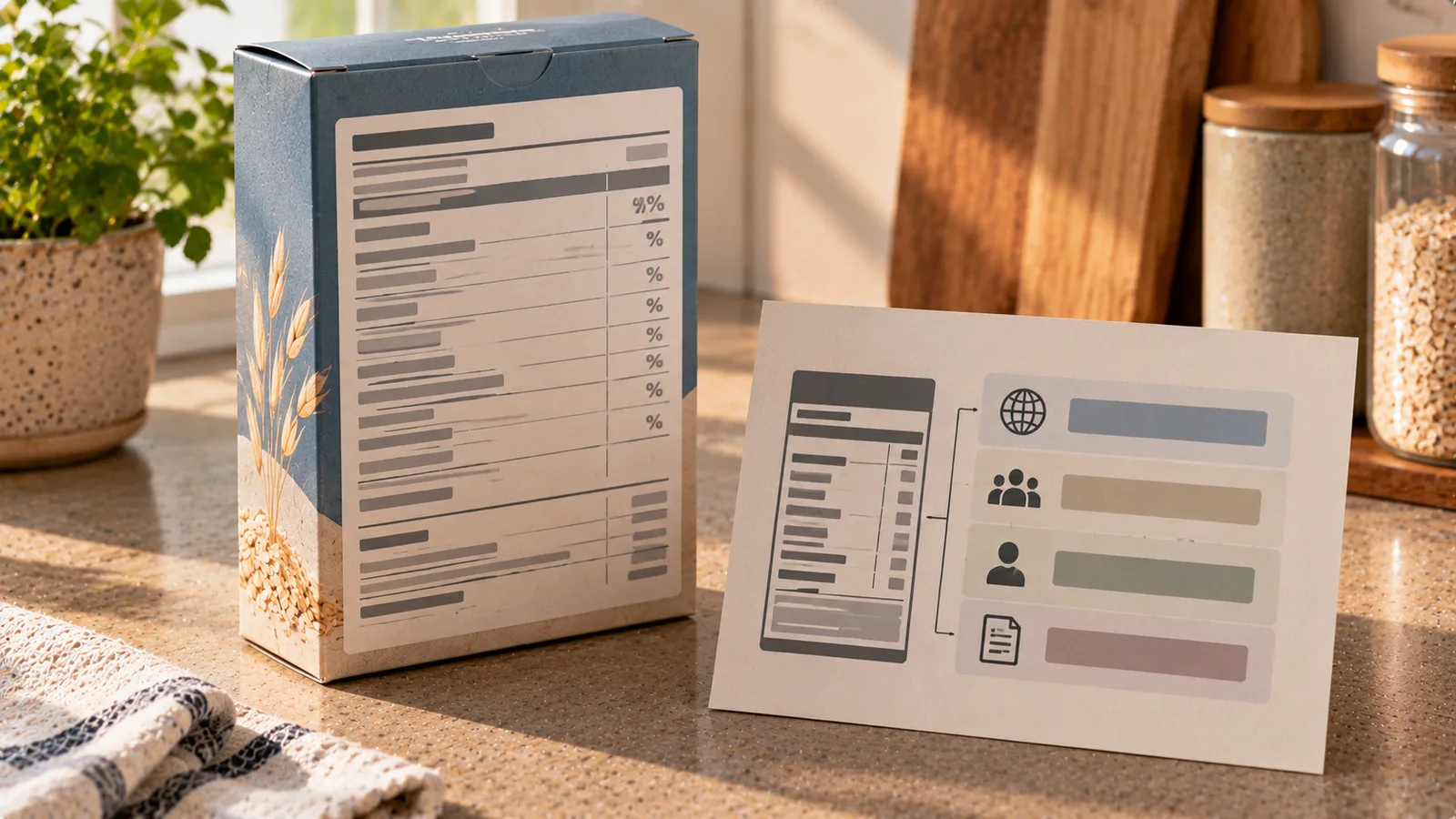
If you look at a U.S. Nutrition Facts label, many nutrients have a percentage next to them.
You might see:
- Total Fat: 10%
- Sodium: 18%
- Dietary Fiber: 21%
- Calcium: 15%
These percentages are called Percent Daily Value, usually written as %DV.
They are designed to help you understand how much a serving of a food contributes to standardized daily reference amounts.
They are useful for comparing foods, but they are not personalized nutrition targets.
What does % Daily Value mean?
Percent Daily Value shows how much of a standardized Daily Value for a nutrient is provided by one labeled serving of a food.
For example, if a product provides:
20% DV for calcium
the serving contains about 20% of the Daily Value used for calcium on the label.
That does not necessarily mean you personally need exactly five servings of that product or that 20% represents 20% of your individual requirement.
The Daily Value is a labeling reference.
What is a Daily Value?
Daily Values are reference amounts established for nutrition labeling.
They provide a common basis for showing the relative contribution of nutrients in a serving.
Without a reference value, seeing something like:
230 mg sodium
may be difficult to interpret quickly.
Adding a %DV gives the number context.
If 230 mg represented 10% DV on a particular label, you could immediately see that the serving provides one-tenth of the standardized Daily Value.
How %DV is calculated
Conceptually, Percent Daily Value is based on:
amount of nutrient in a serving ÷ Daily Value for that nutrient × 100
Suppose the Daily Value for a hypothetical nutrient is 100 units.
If one serving contains 20 units:
20 ÷ 100 × 100 = 20% DV
If it contains 50 units:
50 ÷ 100 × 100 = 50% DV
In practice, manufacturers calculate labels according to applicable regulatory requirements and rounding rules.
%DV is based on the labeled serving
The percentage normally refers to the serving size shown on the Nutrition Facts label.
Suppose one serving provides:
15% DV sodium
If the package contains two servings and you eat both, you consume roughly twice the labeled nutrient amount.
That means the contribution would also be approximately twice the amount represented by one serving.
This is why serving size should be checked before interpreting the percentages.
The 5% and 20% rule
A useful U.S. label-reading shortcut is:
- 5% DV or less per serving is considered low;
- 20% DV or more per serving is considered high.
This can help you compare products quickly.
For example:
Product A
Fiber: 4% DV
Product B
Fiber: 22% DV
Product B provides substantially more fiber relative to the Daily Value per labeled serving.
The shortcut provides context. It does not mean every nutrient should always be minimized or maximized.
Nutrients you may want more of
Depending on the nutrient and your overall diet, %DV can help identify foods contributing meaningful amounts of nutrients such as:
- dietary fiber;
- vitamin D;
- calcium;
- iron;
- potassium.
For example, comparing two similar foods by fiber %DV can be faster than interpreting grams without context.
Nutrients commonly limited
%DV can also help put nutrients commonly limited in many dietary guidelines into context, such as:
- saturated fat;
- sodium;
- added sugars.
If several foods eaten throughout the day each provide a high %DV of the same nutrient, their contributions can add up.
Again, the percentage is a reference tool rather than an individualized prescription.
Example: comparing two breakfast products
Imagine two products have similar serving sizes.
Product A
- Sodium: 7% DV
- Fiber: 4% DV
- Added Sugars: 18% DV
Product B
- Sodium: 8% DV
- Fiber: 20% DV
- Added Sugars: 5% DV
The %DV values make several differences easy to see.
Product B provides substantially more fiber and less added sugar relative to the corresponding Daily Values.
Whether it is the better choice still depends on the rest of the food, your preferences and your overall diet.
%DV is not your personal percentage
This is one of the most important points.
If a food provides:
25% DV iron
that does not necessarily mean it provides exactly 25% of your personal iron requirement.
Individual needs can vary according to factors such as:
- age;
- sex;
- pregnancy;
- health conditions;
- life stage.
%DV exists primarily to make standardized food labels easier to interpret.
It is not a personalized nutrition calculation.
Why labels need standardized references
Imagine if every nutrition label used a different reference person.
One product might calculate percentages for a young athlete.
Another might use an older sedentary adult.
A third might use a child.
The percentages would be difficult to compare.
Standardized reference values create a consistent labeling framework so consumers can compare products using the same reference system.
Does %DV mean the food is healthy?
No.
A single percentage cannot determine the overall nutritional quality of a food.
A product can be high in one desirable nutrient and also contain large amounts of another nutrient you may want to moderate.
For example, a food might provide:
- 25% DV calcium;
- 30% DV saturated fat.
Both values are useful.
Neither one alone tells you whether the food fits your overall eating pattern.
Why serving size can change the interpretation
Suppose a snack contains two labeled servings.
Per serving:
- Saturated Fat: 12% DV
- Sodium: 15% DV
If you eat the whole package, the amount consumed is roughly equivalent to:
- 24% of the Daily Value for saturated fat;
- 30% of the Daily Value for sodium.
The label percentages only become meaningful when they are connected to the amount actually eaten.
%DV does not mean percent of calories
If a label says:
Sodium: 15% DV
that does not mean 15% of the food's calories come from sodium.
%DV compares the amount of a nutrient with its Daily Value.
It is not a measure of calorie distribution.
Similarly:
Fiber: 20% DV
does not mean fiber provides 20% of the calories in the product.
Why some nutrients do not show a %DV
Not every line on every label necessarily has a Percent Daily Value.
Depending on the nutrient and labeling rules, a Daily Value may not be established or a percentage may not be required in the same way.
This is why you should not assume a missing percentage means the nutrient is absent.
Look at the actual amount and the full label.
What about calories?
Calories are shown as an energy amount rather than as a normal %DV line on the U.S. Nutrition Facts label.
The familiar statement about a 2,000-calorie diet provides general labeling context, but it does not mean every person should eat exactly 2,000 calories.
Personal calorie needs can be lower or higher.
This is another example of the difference between a standardized labeling reference and an individual target.
U.S. %DV vs European reference intakes
European nutrition labels do not generally use the U.S. "% Daily Value" system.
Instead, you may see terms such as:
- Reference Intake
- RI
- percentage of reference intake
For example, a European package may show that one portion provides a certain percentage of the reference intake for:
- energy;
- fat;
- saturates;
- sugars;
- salt.
The underlying purpose is similar: giving the nutrient amount standardized context.
However, U.S. Daily Values and European reference intakes are different regulatory systems.
Do not assume that every percentage or reference number is interchangeable.
Example of an EU-style reference intake
Imagine a food displays:
Energy: 250 kcal — 13% RI
The percentage tells you how the portion relates to the reference energy intake used on that label.
It does not mean the portion represents exactly 13% of your personal calorie needs.
Your own energy requirement may differ substantially.
Sodium vs salt can also look different
U.S. labels commonly list sodium.
European labels commonly list salt.
These are related but not numerically identical measurements.
Therefore, comparing a U.S. sodium %DV directly with a European salt value without conversion or context can be misleading.
When comparing international products, first make sure the labels are reporting the same nutrient in the same way.
Added sugars are another important difference
U.S. Nutrition Facts labels can show:
- Total Sugars;
- Includes Added Sugars;
- %DV for Added Sugars.
European labels generally use a different structure and do not reproduce the U.S. added-sugar line in the same format.
So if one product is from the United States and another from Europe, the absence of an "Added Sugars %DV" line on the European product does not mean it necessarily contains no added sugar.
It reflects a different labeling framework.
Example: reading a U.S. label step by step
Suppose one serving contains:
- 220 kcal;
- Total Fat: 8 g — 10% DV;
- Saturated Fat: 2 g — 10% DV;
- Sodium: 460 mg — 20% DV;
- Dietary Fiber: 5 g — 18% DV;
- Added Sugars: 4 g — 8% DV.
You can interpret it like this:
Fat
10% DV is between the low and high reference points.
Saturated fat
10% DV contributes a noticeable portion of the daily reference amount.
Sodium
20% DV is considered high per serving using the common label-reading rule.
Fiber
18% DV is close to the high threshold and represents a meaningful contribution.
Added sugars
8% DV is below the 20% high threshold but still contributes to the daily total.
This interpretation provides context without turning the label into a judgment about the entire food.
Compare similar serving sizes
%DV is especially useful when comparing similar products.
But check serving sizes first.
Suppose:
Cereal A
Serving: 30 g
Fiber: 12% DV
Cereal B
Serving: 60 g
Fiber: 20% DV
At first glance, Cereal B appears much higher in fiber.
But its labeled serving is twice as large.
If your goal is a precise comparison, you may also want to compare the products on the same weight basis.
%DV is useful, but serving-size differences still matter.
Do percentages need to add to 100?
No.
The %DV values on a food label are not slices of one shared 100% total.
You should not add:
- 10% DV fat;
- 20% DV calcium;
- 15% DV fiber
and conclude that the food provides "45% nutrition."
Each percentage refers to the separate Daily Value for that specific nutrient.
They are independent reference percentages.
Can one food provide more than 100% DV?
For some nutrients, a serving can provide 100% DV or more.
That simply means the nutrient amount is equal to or greater than the standardized Daily Value used for labeling.
It does not automatically mean the food is beneficial, harmful or appropriate for every person.
The meaning depends on the nutrient, amount and individual context.
%DV and fortified foods
Fortified foods can contain relatively high amounts of certain vitamins or minerals.
A high %DV can make this easy to identify.
But if you are evaluating total nutrient intake, you may also need to consider:
- other fortified foods;
- supplements;
- naturally occurring nutrients.
The %DV on one product does not represent your total intake from the entire day.
Mealisa covers fortified-food labels separately because combining multiple fortified sources raises a different practical question from simply understanding %DV.
%DV and food tracking
When tracking food, you normally record the actual nutrient amounts provided by your serving rather than treating %DV as your personal target.
For example, a database may store:
- calories;
- protein;
- carbohydrates;
- fat;
- fiber;
- sodium.
%DV can help you interpret the label, but your tracking system may use grams or milligrams for the underlying nutrient totals.
This distinction matters when comparing your intake with personalized goals.
A quick method for using %DV
When reading a U.S. label:
1. Check the serving size
Make sure it matches the amount you expect to eat.
2. Look at the nutrient amount
See the grams or milligrams first.
3. Use %DV for context
Ask whether the serving provides a relatively low, moderate or high contribution to the standardized Daily Value.
4. Compare similar foods
Use %DV to identify meaningful differences between products.
5. Keep the whole day in mind
One food is only part of your overall intake.
6. Do not treat %DV as personalized advice
Your individual needs may differ from the standardized reference.
Common interpretation errors
Several mistakes can make %DV less useful.
Mistake 1: assuming 20% DV means 20% of your personal requirement
It means 20% of the standardized Daily Value used on the label.
Mistake 2: ignoring serving size
Eating two servings changes the nutrient amount consumed.
Mistake 3: adding unrelated percentages together
Each nutrient has its own Daily Value.
Mistake 4: assuming a low %DV always means "better"
For some nutrients you may want more, not less.
Mistake 5: comparing U.S. and EU percentages as if they were identical systems
They use different regulatory frameworks and terminology.
The practical takeaway
Percent Daily Value is a standardized reference tool.
It helps answer a simple question:
How much does one serving of this food contribute relative to the Daily Value used on the label?
For U.S. labels, a useful shortcut is:
- 5% DV or less is low;
- 20% DV or more is high.
But remember:
- %DV is based on the labeled serving;
- it is not a personalized nutrition target;
- percentages for different nutrients should not be added together;
- calories are not represented as a normal %DV nutrient line;
- European reference intakes are similar in purpose but belong to a different labeling system.
Used this way, %DV can make nutrition labels faster to interpret without pretending that one standardized percentage describes your individual nutritional needs.