
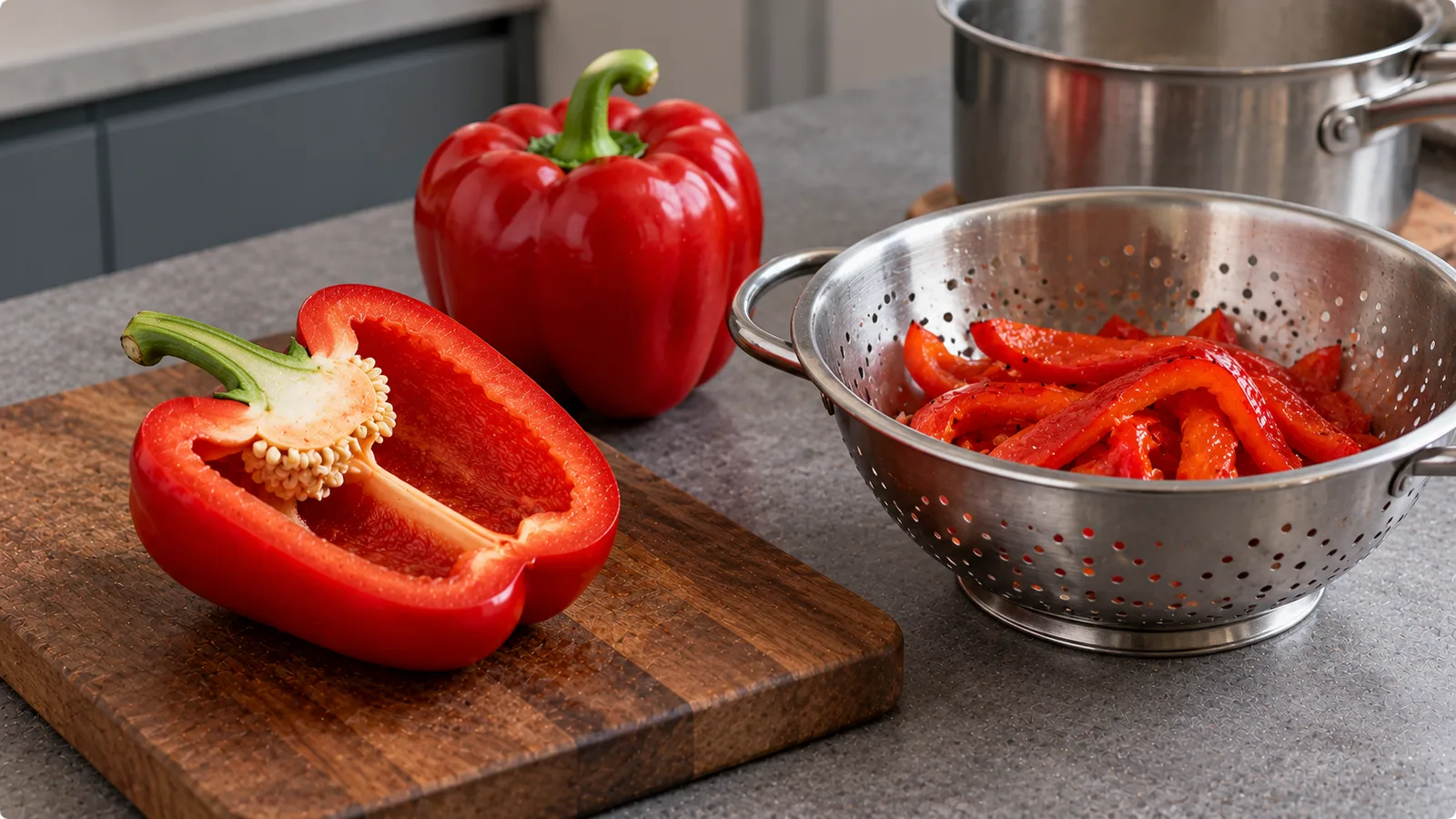
Vitamin C is an essential water-soluble nutrient found in many fruits and vegetables. It contributes to normal collagen formation, supports normal immune function and helps the body absorb non-haem iron from plant foods.
Unlike some nutrients, vitamin C is sensitive to several conditions encountered during food preparation and storage. Heat, oxygen, water and time can all affect how much remains in food.
But cooking does not remove all vitamin C, and raw food is not always the most practical or nutritious choice overall.
The useful question is not whether cooking is good or bad. It is which foods supply vitamin C, what happens during different preparation methods, and how to retain more of it without making meals unnecessarily complicated.
Which everyday foods contain vitamin C?
Vitamin C occurs naturally in citrus fruits, berries, peppers, cabbage-family vegetables, potatoes and several other plant foods.
The following figures are approximate reference values per 100 g of edible food. Values vary by cultivar, ripeness, growing conditions, preparation and database entry.
| Food | Approximate vitamin C per 100 g | Typical way to eat it |
|---|---|---|
| Red bell pepper, raw | 128 mg | Salads, sandwiches, snacks |
| Kiwi fruit, green | 93 mg | Fresh fruit |
| Broccoli, raw | 89 mg | Cooked or finely chopped |
| Brussels sprouts, raw | 85 mg | Usually cooked |
| Strawberries, raw | 59 mg | Fresh or thawed |
| Orange, raw | 53 mg | Whole fruit |
| Red cabbage, raw | 57 mg | Slaw or cooked |
| Cauliflower, raw | 48 mg | Raw or cooked |
| White potato, raw | 20 mg | Cooked before eating |
| Tomato, raw | 14 mg | Fresh or cooked |
These figures are examples based on commonly used food-composition references, not guarantees for a specific purchase.
A raw-food reference value should not be treated as the value of the same food after boiling or roasting.
Also, 100 g is not necessarily a typical serving for every food.
How much vitamin C do you need?
Requirements vary according to age, sex, pregnancy, lactation and other factors.
Different authorities also use somewhat different reference values.
For example, the US National Institutes of Health lists recommended daily amounts of 90 mg for most adult men and 75 mg for most adult women. Smoking increases vitamin C requirements in its guidance.
European dietary reference values may differ from those US figures.
These recommendations describe usual intake targets for population groups, not a requirement to consume an exact number of milligrams at every meal.
Most people can obtain vitamin C from a varied diet containing suitable fruits and vegetables.
People with restrictive diets, malabsorption or specific medical circumstances may need individualized advice.
Why vitamin C changes during cooking
Vitamin C is water-soluble and can undergo chemical degradation, particularly under certain combinations of heat, oxygen, pH and time.
Two important processes are often involved.
Leaching: Vitamin C can move from vegetables into the water used for boiling.
Degradation: Some vitamin C can break down during preparation, heating and storage.
The amount lost depends on the food and the conditions.
For example, chopped broccoli boiled in a large volume of water for a long time may retain less vitamin C than broccoli cooked briefly with minimal water.
However, the exact difference cannot be predicted reliably from cooking method alone.
Boiling, steaming, microwaving and roasting
Different methods expose food to different combinations of water, heat and cooking time.
| Method | What can happen to vitamin C | Practical approach |
|---|---|---|
| Boiling | Vitamin C may leach into cooking water and degrade | Use less water and avoid unnecessary cooking time |
| Steaming | Usually less direct contact with water | Steam until appropriately tender |
| Microwaving | Often uses little added water and can be brief | Use suitable covered cookware and avoid overcooking |
| Stir-frying | Limited water contact, but relatively high heat | Cook quickly and avoid prolonged heating |
| Roasting | Little water leaching, but heat exposure can be substantial | Avoid cooking longer than needed |
| Raw preparation | No cooking-related heat exposure | Store appropriately and eat while fresh |
Steaming and microwaving can preserve vitamin C well in many vegetables, but neither method guarantees the highest retention in every situation.
A short cooking time can be as important as the cooking method itself.
Food safety and appropriate doneness still take priority.
Does boiling destroy vitamin C completely?
No.
Boiling may reduce vitamin C through both leaching and degradation, but the remaining amount depends on the vegetable, piece size, water volume and cooking time.
For example, a vegetable that originally contains 80 mg vitamin C per 100 g does not automatically contain zero after boiling.
It is also important to distinguish between nutrient concentration and total nutrient retention.
Cooking can change food weight because water is gained or lost. Comparing 100 g raw with 100 g cooked without considering yield can be misleading.
A reliable retention calculation accounts for the amount of nutrient in the food before and after cooking, as well as changes in food weight.
What happens to vitamin C in soup?
When vegetables are boiled and the cooking liquid is discarded, some water-soluble vitamin C may be lost with that liquid.
In soup, the cooking liquid is usually consumed.
That means vitamin C that has moved from vegetables into the broth may still be part of the meal, although vitamin C can also degrade during heating.
Soup should therefore not be considered vitamin-C-free simply because the vegetables were cooked.
The final amount depends on ingredients, cooking duration, temperature and storage.
Adding fresh herbs, lemon juice or another suitable vitamin-C-containing ingredient shortly before serving can contribute additional vitamin C.
The amount depends on how much is added.
Does cutting vegetables reduce vitamin C?
Cutting increases the exposed surface area of a fruit or vegetable.
That can increase contact with oxygen and may accelerate certain changes during storage.
The effect is influenced by time, temperature, food type and how finely the food is cut.
A pepper chopped immediately before lunch and a pepper cut into small pieces and stored for several days do not have identical storage conditions.
Practical steps include:
- Wash produce before cutting where appropriate.
- Cut close to serving time when convenient.
- Refrigerate prepared produce promptly.
- Store cut produce in a suitable covered container.
- Avoid leaving chopped vegetables at room temperature for long periods.
Cutting vegetables is not inherently a nutritional mistake. Convenience may make it easier to eat vegetables regularly.
Refrigeration and storage
Vitamin C can decline during storage, but the rate is not the same for all foods.
Temperature, oxygen exposure, humidity, light, packaging and storage duration all matter.
Refrigeration can slow many deterioration processes in fresh produce, although some fruits and vegetables have different optimal storage conditions.
For refrigerated produce, use suitable packaging and avoid unnecessary delays between purchase and consumption.
A slightly lower vitamin C concentration does not automatically make a stored vegetable nutritionally worthless.
Fresh produce also provides fibre and other nutrients.
Fresh vs frozen vegetables
Frozen vegetables can be useful sources of vitamin C.
Many vegetables are blanched before freezing. Blanching may cause some initial vitamin C losses.
However, freezing can slow further changes during storage, and frozen produce may remain nutritionally useful for extended periods when stored correctly.
Fresh vegetables are not automatically superior if they have spent a long time in transport, retail display or home storage.
The result depends on the particular food and its handling history.
For everyday meal planning, both fresh and frozen vegetables can contribute to a varied diet.
Choose products without unnecessary added sauces when you want to control ingredients.
Does reheating reduce vitamin C?
Additional heating can contribute to further vitamin C losses.
The extent depends on temperature, duration, food composition and previous processing.
Repeatedly heating a large pot of vegetables or soup may expose it to more cumulative heat than reheating one portion.
A practical approach is to refrigerate cooked food promptly and reheat only the portion needed.
For food safety, follow appropriate cooling, storage and reheating practices. Nutrient preservation should never come at the expense of safe handling.
A practical example: two ways to prepare broccoli
Suppose you have 200 g of raw broccoli.
One option is to boil it in a large pan of water for a relatively long time and discard the water.
Another is to steam it briefly until tender.
Both methods produce edible broccoli, but the second generally reduces direct contact with cooking water and may help retain more water-soluble nutrients.
The actual milligrams of vitamin C remaining cannot be calculated accurately without food-specific retention data and cooking yields.
Avoid assigning a universal percentage loss to every boiled or steamed vegetable.
Five ways to retain more vitamin C
- Use a variety of sources. Include foods such as peppers, citrus fruits, kiwi, berries and vegetables across the week.
- Avoid unnecessary cooking time. Cook vegetables until they are appropriately done rather than continuing to heat them without a reason.
- Use less cooking water when practical. Steaming and brief microwaving are useful options for many vegetables.
- Store produce appropriately. Refrigerate perishable items and use prepared vegetables within a sensible period.
- Combine cooked and uncooked foods. For example, serve cooked lentils with a fresh pepper salad or add fresh fruit to a meal.
There is no need to eat every vegetable raw or avoid nutritious cooked meals.
Vitamin C and iron absorption
Vitamin C can improve absorption of non-haem iron from plant-based foods when consumed in the same meal.
For example, adding fresh bell pepper or lemon juice to a lentil dish can provide vitamin C alongside the lentils' iron.
The amount of iron absorbed also depends on the rest of the meal and individual physiology.
This is a useful food-combination principle, not a guarantee of treating iron deficiency.
Anyone with suspected iron deficiency should seek appropriate medical assessment rather than relying on food combinations alone.
Do you need vitamin C supplements?
A varied diet can provide sufficient vitamin C for many people.
Supplements are not automatically necessary because someone cooks vegetables or uses frozen produce.
Needs can differ with health status, dietary restrictions and other circumstances.
Very high supplemental doses may cause adverse effects and are not a substitute for medical evaluation.
This article focuses on food sources and preparation, not personalized supplementation.
How to track vitamin C in a food diary
For a useful estimate:
- Record the actual food and edible weight.
- Distinguish raw from cooked entries.
- Use the correct preparation method when a suitable database entry exists.
- Include vitamin-C-containing foods added after cooking.
- Treat nutrient totals as estimates rather than exact laboratory measurements.
For example, 100 g raw red pepper should not automatically be assigned the same vitamin C value as 100 g heavily cooked pepper.
Food-composition databases can also differ in their entries.
For routine nutrition, looking at patterns across multiple days is often more meaningful than trying to optimize every milligram in a single meal.
Sources and further reading
- USDA FoodData Central — reference nutrient composition of foods.
- NIH Office of Dietary Supplements: Vitamin C — physiological functions, dietary sources and intake recommendations.
- USDA Table of Nutrient Retention Factors — reference framework for nutrient changes during food preparation.
- World Health Organization: Healthy diet — broader dietary guidance.
Food-composition figures are approximate. Vitamin C retention varies by food, preparation method, cooking time and storage conditions.