
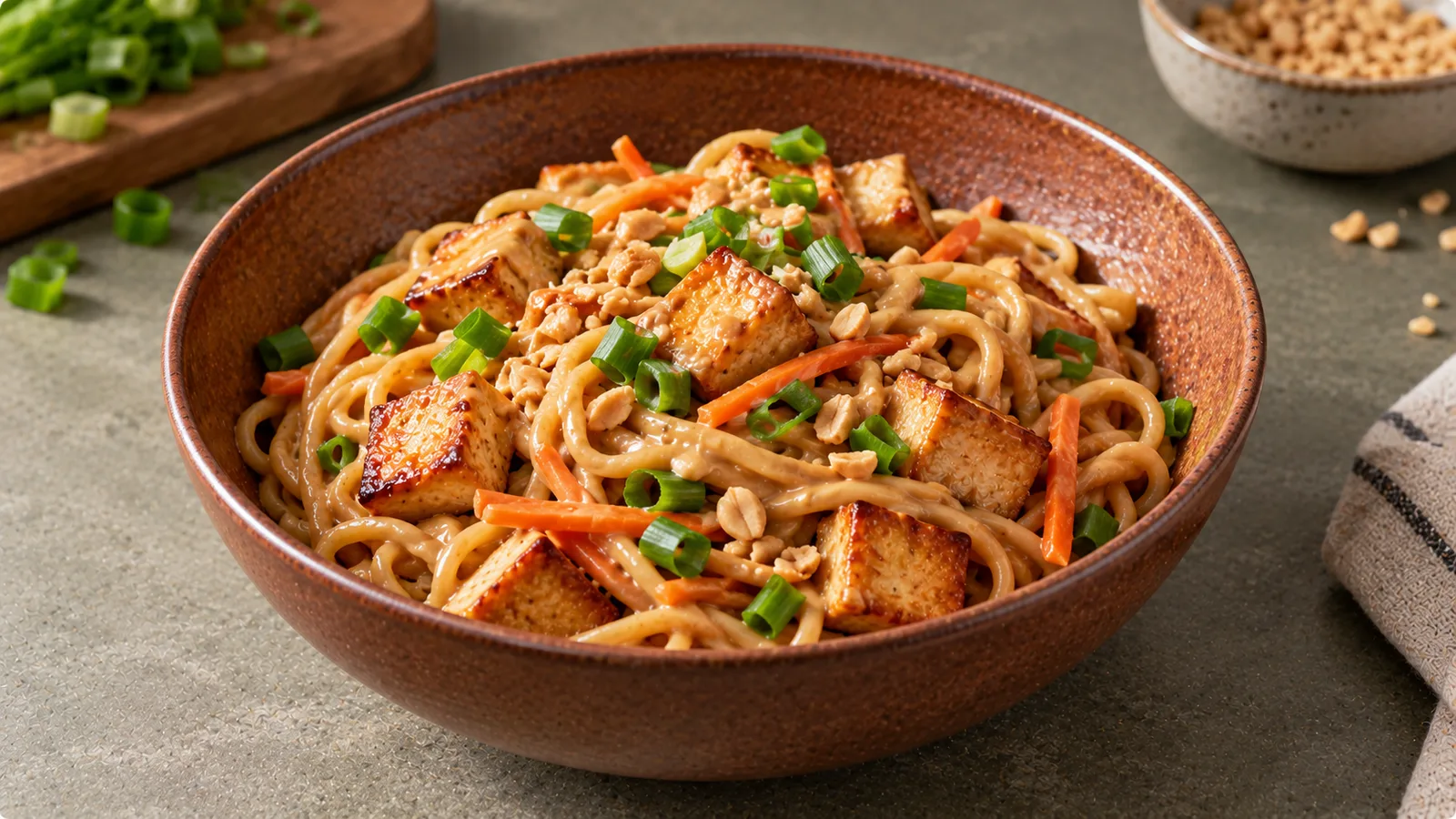
These tofu noodles with peanut sauce combine golden tofu, tender rice noodles, crunchy vegetables and a creamy, savoury peanut dressing.
The recipe is designed for a substantial main meal rather than a small side dish. It uses a clearly defined quantity of dry noodles, firm tofu and peanut butter so the portions and nutrition can be estimated consistently.
Servings: 4 main-course portions
Preparation: 20 minutes
Cooking: 20 minutes
Total: approximately 40 minutes
Equipment: large frying pan, saucepan, mixing bowl and kitchen scale
Ingredients for four servings
Noodles, tofu and vegetables
| Ingredient | Quantity | Preparation |
|---|---|---|
| Firm tofu, drained | 400 g | Pat dry and cut into 2 cm cubes |
| Dry rice noodles | 240 g | Weigh before cooking |
| Red bell pepper | 150 g | Thin strips |
| Carrot | 150 g | Thin matchsticks |
| Broccoli | 200 g | Small florets |
| Spring onions | 40 g | Thinly sliced |
| Neutral cooking oil | 15 g | For frying |
| Fresh ginger | 15 g | Finely grated |
| Garlic | 10 g | Finely minced |
Peanut sauce
| Ingredient | Quantity |
|---|---|
| Smooth peanut butter, unsweetened | 60 g |
| Reduced-sodium soy sauce | 30 ml |
| Fresh lime juice | 30 ml |
| Maple syrup | 15 g |
| Warm water | 100 ml |
| Chilli flakes | 1 g, optional |
The recipe uses regular firm tofu, not silken tofu or pre-fried tofu. It also uses rice noodles weighed dry, rather than a package of already cooked noodles.
These distinctions matter because different tofu types and noodle preparations contain different amounts of water and therefore different calories per 100 g.
Peanut butter should ideally contain peanuts as the main ingredient. Sweetened peanut spreads may produce a sweeter sauce and different nutritional values.
Step 1: Prepare the tofu
Drain the tofu and gently press it between clean kitchen towels to remove surface moisture.
Cut it into cubes approximately 2 cm wide.
Heat 10 g of the oil in a large non-stick frying pan over medium-high heat.
Add the tofu in a single layer.
Cook for approximately 8–10 minutes, turning occasionally, until several sides are golden.
Avoid stirring constantly: leaving the cubes in contact with the pan helps a crust develop.
Transfer the tofu to a plate.
If your pan is small, cook the tofu in two batches rather than overcrowding it.
Should tofu be pressed first?
Firm tofu benefits from removing excess surface moisture, especially when frying.
An extended tofu press is not essential for this recipe.
Very wet tofu may take longer to brown, while extra-firm tofu may brown more readily.
Silken tofu is not a direct substitute because it is much more delicate and can break apart during frying.
Step 2: Cook the rice noodles
Bring a saucepan of water to the boil.
Cook or soak the rice noodles according to the instructions on the package.
Different rice noodles need different cooking times. Thin vermicelli may require only a short soak, while wider noodles can need several minutes.
Drain the noodles when they are just tender.
Rinse briefly if the package recommends it or if you need to stop the cooking process.
Do not overcook them: they will be mixed with warm vegetables and sauce later.
The recipe uses 240 g dry noodles, not 240 g cooked noodles.
Cooked noodles absorb water and become heavier, but that absorbed water does not add calories.
Step 3: Mix the peanut sauce
In a bowl, combine:
- 60 g smooth peanut butter.
- 30 ml reduced-sodium soy sauce.
- 30 ml lime juice.
- 15 g maple syrup.
- 100 ml warm water.
- Optional chilli flakes.
Whisk until smooth.
At first, the peanut butter may look thick or separated. Continue whisking while adding the water gradually.
The finished sauce should be pourable but still creamy.
If it is too thick, add water one tablespoon at a time.
If it tastes too salty, dilute it slightly with water and lime juice rather than adding more syrup automatically.
The sauce should coat the noodles without collecting as a thick paste at the bottom of the bowl.
Step 4: Cook the vegetables
Return the frying pan to medium heat.
Add the remaining 5 g oil.
Cook the broccoli for approximately 3 minutes with a small splash of water and a lid, until it begins to soften.
Remove the lid and add the pepper, carrot, garlic and ginger.
Cook for another 3–4 minutes, stirring occasionally.
The vegetables should be tender enough to eat but retain some texture.
If using a very large pan, the vegetables can be cooked together. In a smaller pan, cooking the broccoli first prevents overcrowding.
Step 5: Combine everything
Reduce the heat to low.
Add the cooked noodles and browned tofu to the vegetables.
Pour over the peanut sauce.
Toss gently for 1–2 minutes until the noodles and tofu are evenly coated.
If the noodles absorb too much sauce, add a little warm water.
Taste before adding extra soy sauce. The original sauce already contains a significant amount of sodium.
Divide into four portions and finish with sliced spring onions.
Serve immediately.
Expected yield and portion size
The recipe begins with approximately:
- 400 g drained tofu.
- 240 g dry rice noodles.
- 565 g vegetables, ginger, garlic and spring onions.
- Approximately 235 g sauce ingredients, including water.
- 15 g cooking oil.
Rice noodles absorb water during cooking. Vegetables may lose some moisture in the pan.
The final cooked weight will therefore depend on the noodle brand, cooking time, drainage and evaporation.
A practical expected finished yield is approximately 1.7–1.9 kg, or roughly 425–475 g per serving when divided into four equal portions.
This is an estimated yield, not a laboratory-measured result.
For accurate meal logging, weigh the finished dish after cooking and divide the actual weight by four.
Estimated nutrition per serving
The following calculation uses representative ingredient values for plain firm tofu, dry rice noodles, unsweetened peanut butter, vegetables and the other listed ingredients.
It assumes that all sauce and cooking oil are consumed.
| Nutrition | Whole recipe | Per serving, ¼ recipe |
|---|---|---|
| Energy | Approximately 2,010 kcal | Approximately 503 kcal |
| Protein | Approximately 81 g | Approximately 20 g |
| Fat | Approximately 78 g | Approximately 20 g |
| Carbohydrates | Approximately 253 g | Approximately 63 g |
| Fibre | Approximately 23 g | Approximately 6 g |
These are estimates, not tested nutritional laboratory results.
Actual values can change significantly with the tofu brand, rice noodle formulation, peanut butter and the amount of oil remaining in the pan.
The carbohydrate figures are approximate available-carbohydrate estimates intended for EU-style meal logging; do not substitute US total-carbohydrate figures that include fibre without adjustment.
For precise calculations, use the actual package labels and weighed quantities.
Reference ingredient database: USDA FoodData Central. European nutrition-labelling definitions: Regulation (EU) No 1169/2011.
Why the ingredients affect the calorie total
The largest energy contributions come from the dry noodles, tofu, peanut butter and cooking oil.
Using a different amount of vegetables generally changes the calorie total less than substantially changing the noodles or peanut butter.
For example:
| Change | Approximate effect on whole recipe |
|---|---|
| Reduce dry rice noodles from 240 g to 200 g | About 145 kcal less |
| Reduce peanut butter from 60 g to 40 g | About 120 kcal less |
| Reduce oil from 15 g to 10 g | About 45 kcal less |
| Add 100 g more broccoli | About 34 kcal more |
These calculations use typical ingredient reference values.
Reducing peanut butter changes the texture of the sauce, so additional water and lime juice may be needed.
Reducing noodles also makes the recipe less substantial.
Choose adjustments based on appetite and meal requirements, not solely on the lowest calorie number.
Can I use wheat noodles instead?
Yes.
Wheat noodles, udon or other noodle types can work, but cooking instructions and nutritional values differ.
For a consistent substitution, compare dry weights with dry weights.
Do not assume that 240 g cooked wheat noodles are equivalent to 240 g dry rice noodles.
Cooked noodles contain absorbed water, so their weight and calorie density differ from the dry product.
If using a packaged ready-to-eat noodle product, follow its nutrition label.
For someone avoiding gluten, check the noodle ingredients and the soy sauce. Ordinary soy sauce often contains wheat.
A certified gluten-free tamari or suitable alternative may be necessary.
Can I use a different tofu?
Yes, with adjustments.
Extra-firm tofu: Usually works well and may need less drying.
Medium-firm tofu: Can work, but handle gently and allow more time for browning.
Silken tofu: Not recommended for the same frying method because it breaks easily.
Pre-fried tofu: Convenient, but it may already contain added oil and have a different calorie value.
Smoked tofu: Adds a stronger flavour and may contain more salt.
Always calculate nutrition using the specific tofu product.
Protein content can differ considerably between brands.
How to make the sauce without peanut butter
For someone with a peanut allergy, peanut butter must not be used.
Sunflower seed butter may be a possible alternative if it is suitable for the person's allergies and the product has been checked for cross-contact warnings.
Its flavour, thickness and nutritional composition differ from peanut butter.
Other nut butters are not automatically safe for people with peanut allergies or tree-nut allergies.
Do not treat substitutions as allergen-safe without checking ingredients and individual restrictions.
The original recipe contains peanuts and soy. Depending on the noodle and sauce brands, it may also contain wheat/gluten.
How to prevent sticky noodles
Rice noodles can stick together when overcooked or left to stand without sauce.
Three practical steps help:
- Cook only until just tender.
- Drain promptly and follow the package's rinsing instructions.
- Combine with the sauce shortly before serving.
If the noodles have already become sticky, gently loosen them with a small amount of warm water.
Avoid adding large amounts of oil without counting it in the recipe.
How to adjust the peanut sauce
A balanced peanut sauce should have four elements:
- Creaminess from peanut butter.
- Saltiness and savoury flavour from soy sauce.
- Acidity from lime juice.
- A small amount of sweetness from maple syrup.
Water controls thickness without adding meaningful calories.
For a sharper sauce, add a little more lime juice.
For more heat, increase the chilli flakes gradually.
For a less salty sauce, choose a lower-sodium soy sauce and use less of it.
Reduced-sodium soy sauce is still a source of sodium.
Meal preparation and storage
The noodles can be prepared for packed lunches, but the texture is best immediately after cooking.
For advance preparation, store the cooked tofu and vegetables separately from the sauce when practical.
Cooked rice noodles require careful handling because cooked starchy foods can support bacterial growth if left at room temperature.
Cool leftovers promptly and refrigerate them.
Use clean containers and follow applicable local food-safety guidance.
As a conservative household practice, consume refrigerated leftovers within 1–2 days, especially when noodles are already mixed with sauce.
Reheat thoroughly and only once when possible.
Do not leave cooked noodles or tofu at room temperature for extended periods.
Source: UK Food Standards Agency.
Common problems and solutions
The sauce is too thick
Add warm water gradually and whisk until pourable.
The tofu is soft rather than golden
Dry it more thoroughly, avoid overcrowding the pan and allow the cubes to brown before turning.
The noodles are mushy
Shorten the cooking time and mix them with the sauce only when ready to serve.
The dish tastes too salty
Use less soy sauce next time. For the current batch, add more vegetables and a little water or lime juice.
The sauce tastes too sweet
Reduce the maple syrup. Some commercial peanut butters also contain added sugar.
The dish feels too heavy
Serve a smaller portion or reduce the dry noodles and peanut butter while keeping enough sauce to coat the ingredients.
Frequently asked questions
Can I make tofu peanut noodles vegan?
Yes. The listed recipe is vegan when the packaged ingredients contain no animal-derived additions.
Is this recipe high in protein?
It provides approximately 20 g protein per serving based on the specified ingredients. Whether that is considered high depends on the applicable nutritional definition and individual requirements.
Can I serve it cold?
Yes, after proper cooling and refrigeration. The sauce may thicken, so loosen it with a little water before serving.
Can I use crunchy peanut butter?
Yes. The sauce will have a different texture but can still work.
Can I double the recipe?
Yes. Double every ingredient, use a sufficiently large pan and cook the tofu in batches to maintain browning.
Can I omit the maple syrup?
Yes. The sauce will taste less sweet, but it remains usable.
Sources and calculation notes
- USDA FoodData Central — reference composition for tofu, noodles, peanut butter and vegetables.
- Regulation (EU) No 1169/2011 — nutrition-labelling definitions and allergens.
- UK Food Standards Agency — general food-safety and leftover-storage guidance.
Nutrition and final cooked weight are estimates based on the specified ingredients. Actual results depend on product labels, cooking losses and portioning.