
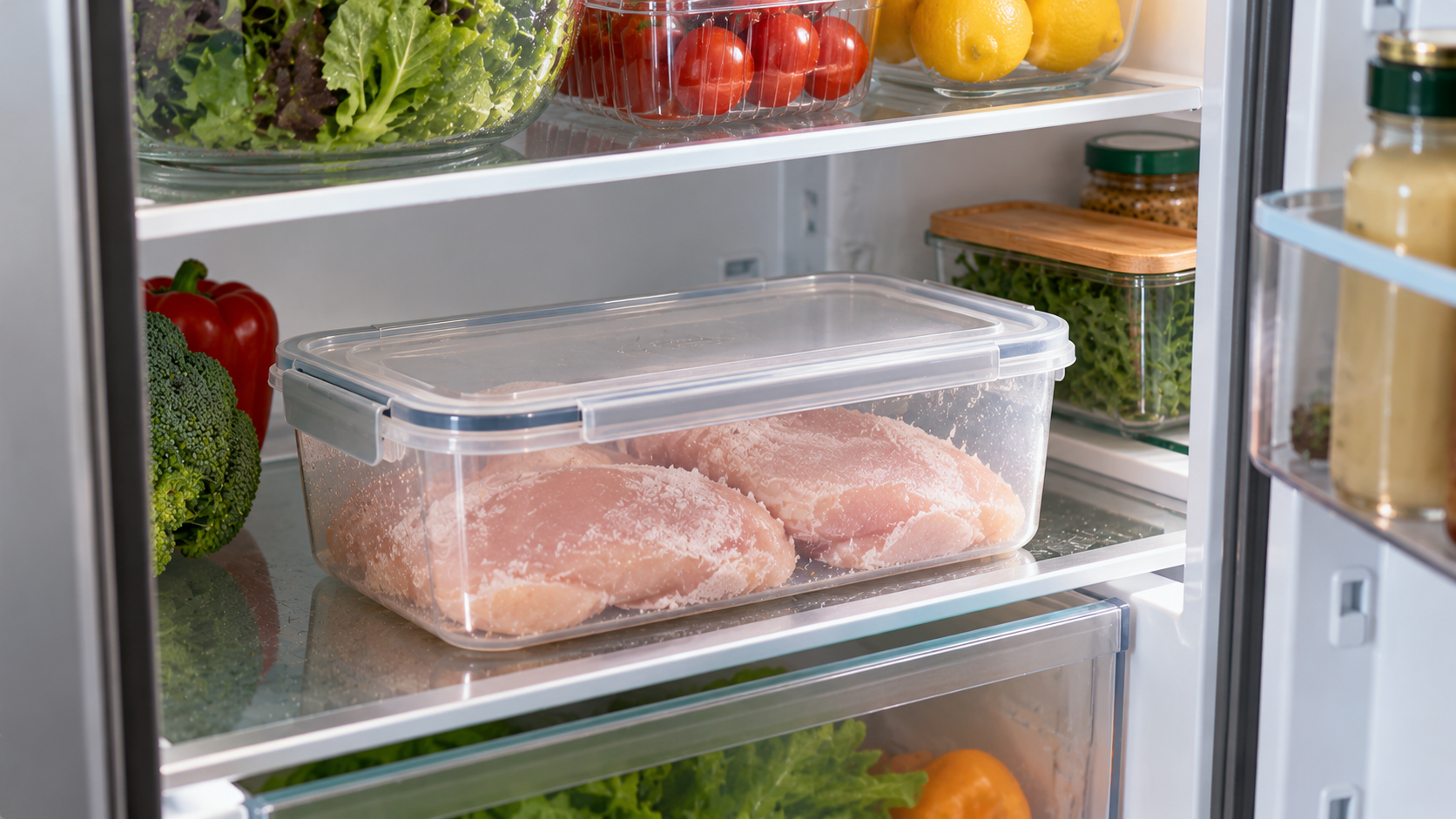
A frozen ingredient can be the easiest way to rescue tonight's dinner, but the safe method depends on what the food is, how much time is available and whether cooking starts immediately after thawing. For perishable raw meat, poultry and fish, the refrigerator is the simplest method to plan around. A sealed cold-water bath or a microwave can help when time is short, provided the food is cooked straight away. A suitable product can sometimes be cooked directly from frozen, using its verified instructions.
The crucial distinction is between thawing and cooking. Softening a frozen chicken breast does not eliminate pathogens. Conversely, keeping it at room temperature until the middle feels soft can leave its surface warm enough for microbial growth long before the center has thawed. This guide explains how to make a practical decision without inventing a single thawing time for every food.
Choose the method before taking food out of the freezer
| Method | Practical use | What to do afterward | Main limitation |
|---|---|---|---|
| Refrigerator | Planned meals; raw meat, fish, poultry and prepared portions | Cook within the appropriate product-specific refrigerated period | Can take overnight or longer |
| Cold water in a leakproof package | Faster thawing of small, sealed packages | Cook immediately after thawing | Requires attention and fresh cold water |
| Microwave defrost | A small portion needed immediately | Cook immediately, without leaving the partly warmed food waiting | Uneven warming and partly cooked edges |
| Cook from frozen | Products whose instructions and cooking method permit it | Cook thoroughly, checking the center | Not suitable for every dish or appliance |
| Countertop, sunlight, warm water | Do not use for perishable foods | — | Outer layers can warm while the center stays frozen |
USDA FSIS identifies the refrigerator, cold water and microwave as three safe thawing methods, and also notes that cooking from frozen is possible for many foods. Its recommendations are based on a refrigerator at 40°F / about 4°C or below, with the cold-water and microwave methods followed by immediate cooking. USDA FSIS — The Big Thaw.
The refrigerator method: slow, controlled and usually easiest
Transfer frozen food from the freezer to a tray or container in the refrigerator. Put raw meat, poultry or fish below ready-to-eat food so juices cannot drip onto salads, fruit or cooked dishes. Follow the manufacturer's instructions if the package specifies a thawing procedure; do not assume that a package suitable for freezing is also suitable for microwaving.
Time depends on thickness, packaging, the refrigerator's temperature and the amount of food. Even a small pack of meat can need a full day; a dense roast or whole bird may need much longer. Plan from the cooking time backward rather than leaving frozen meat out on the counter to catch up. As an example, moving a tightly packed 500 g portion to the refrigerator late the previous evening may not guarantee a fully thawed center by an early dinner.
Germany's Federal Institute for Risk Assessment (BfR) recommends thawing frozen food in the refrigerator whenever possible. For raw animal foods it emphasizes a covered bowl, removal and disposal of thawing liquid, and thorough cleaning of hands, surfaces and utensils that touch that liquid. BfR — Correct refrigeration at home.
Unlike a rapid water or microwave thaw, refrigerated thawing gives you some flexibility. But the allowed storage period depends on the product: USDA guidance permits roughly one to two additional refrigerated days for thawed poultry, ground meat and seafood, versus three to five for certain whole cuts of red meat. These are US references for properly handled foods, not a universal rule for every country or prepared meal. Shorter package instructions take precedence. If you cannot establish how the food was stored, do not use those maximum windows as reassurance. USDA FSIS — The Big Thaw.
Cold water: an active method for a last-minute dinner
Cold water is a deliberate, closely managed thaw — not placing an open chicken breast under a tap or leaving a bag in tepid water until bedtime. First check the packaging. If it is not reliably airtight, place the food in a clean leakproof bag; remove excess air and close it securely. Submerge the sealed package in cold tap water in a clean container. Keep it submerged and change the water every 30 minutes so it stays cold. When thawed, cook immediately. USDA FSIS — Freezing and Food Safety.
Smaller, flatter packets thaw faster than thick blocks. USDA examples suggest that approximately 450 g of boneless chicken breast can thaw within about an hour, but treat this as an example, not a timer that proves your own food is safe or fully thawed. A frozen roast may take hours. Check the thickest section, then cook all the way through; the absence of ice crystals alone is not proof of safe cooking.
The cold-water method is an option described by USDA, while BfR's primary household recommendation is refrigeration. If local food-label instructions give a stricter or different method, follow those instructions. Keep raw-food bags and their outside surfaces away from utensils used for salads or bread. Wash the container and any surface exposed to raw juices after use.
Microwave defrost: quick, but the next step must be cooking
Use the appliance's defrost setting or the manufacturer's power instructions and a microwave-safe dish. Remove unsuitable packaging, especially absorbent meat pads or materials not approved for microwave use. Spread pieces apart where possible. Pause, turn and separate food as the appliance instructions allow; the outside can begin cooking while the center still contains ice.
Do not microwave-defrost raw meat or fish and then put it back in the refrigerator for tomorrow's dinner. Some areas may already be warm or partly cooked. USDA advises completing cooking immediately after microwave thawing. USDA FSIS — Microwave-thawing meat.
Microwave thawing is particularly practical for a small, separate portion. For a large tightly frozen block, it may be difficult to distribute heat evenly. Separating foods into thin meal-sized packs before freezing is often a better long-term solution than trying to thaw the entire week's protein on a busy evening.
Can dinner go straight from freezer to pan or oven?
Sometimes yes. USDA notes that many foods, including some raw meat and cooked casseroles, can be cooked from frozen, although heating commonly takes longer than from thawed. Its rough estimate of around 50% more time is not a substitute for product instructions, appliance conditions or checking the center. USDA FSIS — Freezing and Food Safety.
For example, frozen vegetable pieces can often go straight into boiling water or a hot pan, and a commercially frozen pizza is designed to cook from frozen when the label says so. Previously cooked soup may be reheated from frozen in a saucepan while stirring regularly. A thick frozen chicken joint, a stuffed product or a slow-cooker recipe is a different matter. USDA cautions against cooking frozen chicken in a slow cooker; some prepared foods must be cooked from frozen and others must be thawed first. Always use the instructions for the actual product and appliance. USDA FSIS — Chicken from Farm to Table.
Thawing safely does not mean the food is cooked safely. The thickest part still needs to reach the appropriate safe internal temperature for that food. When reheating previously cooked leftovers, USDA gives 165°F / 74°C as the internal target. A thermometer is more reliable than browned surfaces, clear-looking sauce or elapsed time. USDA FSIS — Leftovers and Food Safety.
A useful decision tree when dinner is in two hours
If the ingredients are already in the refrigerator: leave them chilled until cooking. Check whether they are fully thawed and how long they have been stored. If still partly frozen, use the correct cooking instructions rather than placing them on the counter.
If you have a small sealed portion of raw meat: a supervised cold-water thaw can work, followed by immediate cooking. A microwave is faster for some portions but may cause uneven texture. Both require that you are ready to cook now.
If the food is a dense joint or whole bird: two hours may be unrealistic for a safe complete thaw. Choose a different meal, a product specifically intended to cook from frozen, or plan tomorrow's thaw in the refrigerator. Do not use hot water as a shortcut.
If it is vegetables or a commercially prepared frozen item: inspect the cooking directions. Many can be cooked directly from frozen. The packaging may specify not to thaw.
If it is a box of previously cooked leftovers: you may be able to reheat from frozen, including in a covered pan or microwave, as long as you heat it thoroughly and evenly. Split large portions when practical. Follow the separate rules for rice and other higher-risk foods rather than assuming they have identical storage limits.
| Tonight's situation | Better choice | Avoid |
|---|---|---|
| Frozen flat pack of chicken; you can start cooking immediately | Sealed cold-water thaw or microwave, then thorough cooking | Leaving it on the worktop |
| Thick frozen roast; dinner soon | Change tonight's menu or use validated from-frozen instructions | Warm water or guessing a short thaw time |
| Frozen peas and other plain vegetables | Cook from frozen according to product directions | Unnecessary countertop thaw |
| Frozen cooked stew | Reheat from frozen where appropriate, stir and check all of it is hot | A hot edge with an icy center |
| Raw seafood in the fridge from yesterday | Check actual thawing history and product instructions, cook promptly | Applying red-meat storage limits to fish |
How to handle defrosting liquid and prevent cross-contamination
Raw poultry, meat and fish can carry microorganisms even when they look normal. Freezing generally stops growth while sufficiently cold, but it does not make a contaminated food sterile. During thawing, the outer surface and any released liquid can contaminate other foods. Use a separate tray or bowl in the lowest safe refrigerator position and clean the sink or work surface after contact.
BfR specifically advises disposing of thawing liquid from raw animal foods, washing hands after contact, and cleaning knives, boards and surfaces immediately. Do not rinse raw chicken under a tap: spraying water can spread organisms across nearby equipment and food. Keep ingredients that will be eaten without further cooking out of the raw-food preparation area. BfR — Household food infections.
A reusable box that held thawing chicken is not automatically suitable for your lunch salad until cleaned. Replace torn or leaking thawing bags. Do not return raw dripping packages directly onto clean refrigerator shelves. These habits matter whether the food is destined for a high-protein dinner or a batch meal-prep recipe.
Refreezing after thawing: method and local guidance matter
USDA says food thawed safely in the refrigerator may generally be refrozen without cooking, although quality can deteriorate. Foods thawed in cold water or the microwave should be cooked before being refrozen. After cooking previously frozen raw ingredients, the cooked meal can be frozen again when cooled and stored correctly. USDA FSIS — Freezing and Food Safety.
UK FSA consumer advice is more conservative: it tells households to cook and eat defrosted food within 24 hours and generally advises against refreezing food simply after it has thawed. These recommendations should not be flattened into one worldwide rule. Follow the guidance applicable to your location and the product's label. FSA — University food-safety guidance, September 2026.
If an appliance failed and you do not know how warm frozen food became or for how long, you cannot decide safety from the fact that it still feels a little cold. Do not refreeze food of uncertain handling just to avoid waste.
Plan freezer portions so thawing does not become an emergency
The easiest improvement happens before food is frozen. Divide raw meat into one-meal portions in sealed bags and flatten them; label each with the contents, freezing date and raw/cooked status. Leave adequate space in the refrigerator for a drip-catching container. Freeze cooked meals in shallow portions, cool them promptly beforehand, and choose containers suitable for how they will later be reheated.
For a planned dinner, move the portion to the refrigerator sufficiently early, remembering that a large block can take more than a day. For a spontaneous dinner, choose a frozen ingredient with validated direct-from-frozen cooking instructions or a small bag you can thaw in cold water while supervising it. Keep a separate shelf of quick-cook vegetables or other products that need no thawing.
The core rule is simple: keep perishable food cold while it thaws; if you use cold water or a microwave, cook immediately; if the package says cook from frozen, follow that method; and never assume a warm countertop is a harmless shortcut.
For a broader approach to freezing meals and reducing waste, read how to freeze food to reduce waste. Making smaller labelled portions in advance also makes safe thawing easier.
Official sources and scope
- USDA FSIS — The Big Thaw: Safe Defrosting Methods — safe methods, immediate cooking after rapid thawing, chilled storage.
- USDA FSIS — Freezing and Food Safety — cold-water changes, refreezing, cooking from frozen.
- BfR — Correct refrigeration of foods at home — refrigerator thawing, thawing liquid and cross-contamination.
- BfR — Household food infections — hygiene for raw animal foods.
- UK FSA — Food-safety guidance, September 2026 — conservative 24-hour advice after defrosting.