
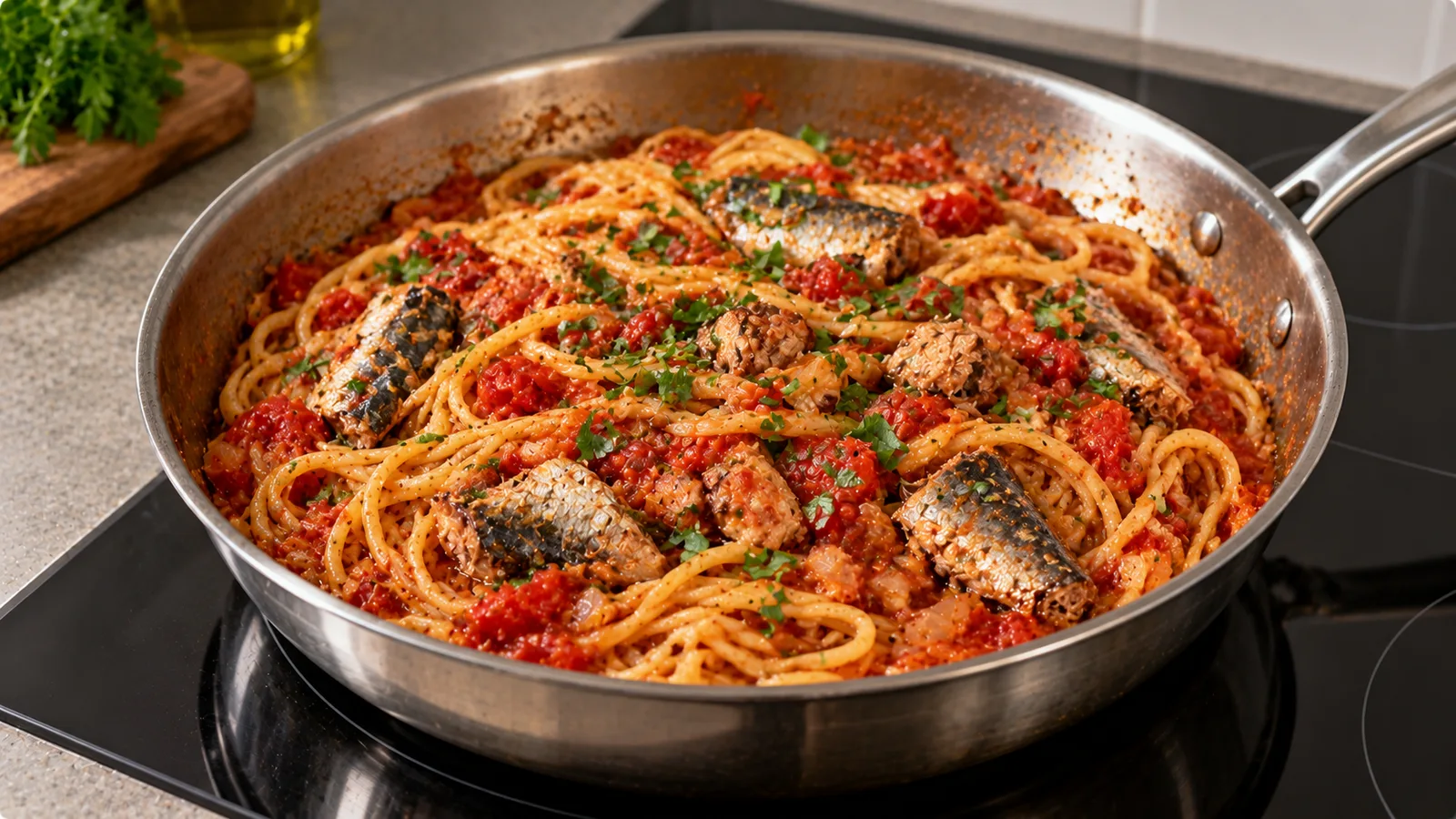
Sardine and tomato pasta is a practical Mediterranean-style meal made with canned sardines, pasta, tomatoes, garlic and olive oil. It uses ingredients that are easy to keep in the cupboard and can be prepared in approximately 30 minutes.
The recipe below specifies dry pasta weight and drained sardine weight. Those details matter because pasta absorbs water during cooking, while canned sardines may be packed in oil, water or tomato sauce.
Servings: 4 main-course portions
Preparation: 10 minutes
Cooking: 20 minutes
Total: approximately 30 minutes
Equipment: large saucepan, frying pan, colander and kitchen scale
Ingredients for four servings
| Ingredient | Quantity | Notes |
|---|---|---|
| Dry spaghetti or linguine | 280 g | Weigh before cooking |
| Canned sardines, drained | 360 g | Preferably boneless if desired |
| Chopped tomatoes, canned | 500 g | No added sugar required |
| Onion | 120 g | Finely diced |
| Garlic | 12 g | Approximately 3 cloves |
| Baby spinach | 120 g | Fresh |
| Olive oil | 15 g | Weighed separately |
| Lemon juice | 30 ml | Fresh |
| Dried oregano | 2 g | Or fresh herbs |
| Chilli flakes | 1 g | Optional |
| Black pepper | To taste | |
| Fresh parsley | 15 g | Chopped |
| Pasta cooking water | 100–150 ml | Add as needed |
The 360 g of sardines refers to the fish after draining, not the total weight printed on the can.
If a can contains 90 g of drained fish, four cans provide 360 g. If its drained weight is different, adjust the number of cans.
Sardines packed in oil can have a different nutritional profile from sardines packed in water. Draining removes some packing liquid but may not remove all the oil associated with the fish.
For the most accurate nutrition calculation, use the label of the specific canned product.
Step 1: Prepare the ingredients
Drain the sardines.
Check for any large bones if you prefer a boneless texture. Small edible sardine bones are often soft, but their presence varies by product.
Dice the onion, mince the garlic and chop the parsley.
Measure the olive oil separately rather than pouring directly from the bottle.
Open the tomatoes and set out the spinach.
Bring a large saucepan of water to the boil.
Preparing the ingredients first makes the cooking process easier because the sauce and pasta will finish at approximately the same time.
Step 2: Cook the pasta
Add the dry pasta to boiling water.
Cook according to the package instructions until al dente.
Before draining, reserve approximately 150 ml of the starchy cooking water.
Drain the pasta.
Do not rinse it unless the product instructions specifically require rinsing. The starch remaining on the pasta helps the tomato sauce adhere.
The recipe uses 280 g dry pasta. Do not substitute 280 g cooked pasta without recalculating the recipe.
The noodles gain weight as they absorb water, but that water does not add calories.
Step 3: Build the tomato sauce
While the pasta cooks, heat 15 g olive oil in a large frying pan over medium heat.
Add the diced onion and cook for 4–5 minutes until softened.
Add the garlic, oregano and optional chilli flakes.
Cook for approximately 30–60 seconds, stirring to prevent the garlic from burning.
Pour in the chopped tomatoes.
Stir and simmer gently for 6–8 minutes.
The sauce should thicken slightly while retaining enough moisture to coat the pasta.
If it becomes too thick, add a small amount of water.
Taste before adding salt. Canned sardines may already contribute a considerable amount.
Step 4: Add the spinach and sardines
Add the spinach to the tomato sauce.
Stir for 1–2 minutes until wilted.
Break the drained sardines into large pieces with a fork.
Add them to the pan and fold gently into the sauce.
Avoid stirring aggressively if you want the fish to remain in recognizable pieces.
Warm the sardines for approximately 2 minutes.
They are already cooked during canning, so prolonged frying is unnecessary.
Add the lemon juice and black pepper.
The lemon should brighten the tomato and fish flavours without dominating the dish.
Step 5: Combine and serve
Add the drained pasta to the pan.
Pour in approximately 50 ml of reserved pasta water.
Toss gently until the pasta is coated.
Add more cooking water a tablespoon at a time if needed.
The sauce should cling to the pasta rather than collect as a watery pool.
Divide the finished dish into four portions.
Sprinkle with chopped parsley and serve immediately.
How much pasta and sardines are in one serving?
The recipe provides, before cooking:
| Ingredient | Whole recipe | Per serving |
|---|---|---|
| Dry pasta | 280 g | 70 g |
| Drained sardines | 360 g | 90 g |
| Chopped tomatoes | 500 g | 125 g |
| Spinach | 120 g | 30 g |
| Olive oil | 15 g | 3.75 g |
The remaining ingredients are also divided into four portions.
The pasta absorbs water during cooking, while the sauce loses some moisture during simmering.
Consequently, the finished weight cannot be determined precisely from the raw ingredient weights.
A reasonable working estimate is approximately 1.6–1.9 kg of finished pasta, depending on the pasta shape, water absorption and sauce reduction.
That corresponds to roughly 400–475 g per serving.
For accurate meal logging, weigh the complete cooked dish and divide the actual weight by four.
Estimated calories and nutrition
The following estimates assume 280 g dry pasta, 360 g drained sardines, 500 g canned tomatoes, 15 g olive oil and all the remaining ingredients.
They are based on representative ingredient composition rather than a laboratory analysis of the finished recipe.
| Nutrient | Whole recipe | Per serving |
|---|---|---|
| Energy | Approximately 2,100 kcal | Approximately 525 kcal |
| Protein | Approximately 130 g | Approximately 33 g |
| Fat | Approximately 72 g | Approximately 18 g |
| Carbohydrates | Approximately 230 g | Approximately 58 g |
| Fibre | Approximately 22 g | Approximately 5.5 g |
Important: The actual values can differ substantially between sardine products. Fish packed in oil may retain additional fat after draining, and pasta brands also vary.
The figures are illustrative estimates, not guaranteed values for every brand.
For accurate tracking, enter each ingredient using its actual packaging information.
Reference data: USDA FoodData Central.
European labels report available carbohydrates separately from fibre. US databases commonly report total carbohydrates including fibre, so the two figures should not be mixed without accounting for the definition.
Reference: Regulation (EU) No 1169/2011.
Why the drained weight matters
Canned fish packaging commonly displays both a total net weight and, for certain products, a drained weight.
The total net weight can include packing oil, water or sauce.
Suppose a can is labelled 120 g net weight and contains 90 g drained sardines.
Using four cans gives:
- Total contents before draining: 480 g.
- Drained sardines: 360 g.
- Packing liquid removed: approximately 120 g.
The discarded liquid should not automatically be included in the recipe's calories.
However, oil can remain on the fish after draining.
For the best estimate, select a database entry that matches the product and its packing medium, or follow the manufacturer's drained-product nutrition information when available.
Sardines in olive oil versus water
Both types can be used.
Sardines in water: Often make it easier to control the amount of added oil. The tomato sauce may taste lighter.
Sardines in olive oil: Can provide a richer flavour. Some oil may remain after draining.
Sardines in tomato sauce: Can also work, but the product's sauce may contain salt, sugar or additional oil. Adjust the chopped tomatoes and use the product label.
The recipe already includes 15 g olive oil.
If you deliberately add the packing oil from the can, include that oil in the calorie calculation.
Do not assume all canned sardines have identical calories per 100 g.
Can I use whole-wheat pasta?
Yes.
Whole-wheat spaghetti or linguine can replace regular pasta at the same dry weight.
Cooking time and texture may differ.
Whole-wheat pasta generally contains more fibre than standard refined wheat pasta, although the exact amount depends on the product.
Use the nutritional label of the chosen pasta to update the calculation.
If substituting gluten-free pasta, check its ingredients and cooking instructions. Different starch blends can have different protein and fibre values.
How to make the sauce less acidic
Canned tomatoes vary in acidity and sweetness.
If the sauce tastes too sharp, first allow it to simmer a little longer.
The onion provides some natural sweetness as it softens.
A small additional amount of olive oil can round out the flavour, but it will add calories.
There is no need to add sugar automatically.
Lemon juice should be added near the end so you can control the balance.
If the tomatoes are already very acidic, use slightly less lemon juice and adjust after tasting.
How to keep the sardines from breaking apart
Sardines are delicate after canning.
To preserve larger pieces:
- Drain them carefully.
- Add them only after the tomato sauce is nearly finished.
- Use a spatula rather than vigorous stirring.
- Warm briefly.
- Toss the pasta gently.
If the fish breaks into smaller flakes, the dish is still suitable to eat. The sauce will simply have a more uniform fish texture.
Is sardine pasta a high-protein meal?
This recipe provides an estimated 33 g protein per serving, primarily from the sardines and pasta.
The exact amount depends on the fish and pasta brands.
Sardines are also a source of several nutrients, including vitamin B12. Products containing edible bones can contribute calcium.
Nutrient levels vary with the species, product and processing method.
For authoritative composition information, consult USDA FoodData Central.
Protein requirements differ between individuals. A meal containing more protein is not automatically better for every person.
What about omega-3 fats?
Sardines are oily fish and can provide long-chain omega-3 fatty acids.
The amount varies by species, serving size and canned product.
For general background on omega-3 fatty acids and their dietary sources, see the NIH Office of Dietary Supplements.
The presence of omega-3 fats does not justify claiming that this particular pasta recipe prevents or treats a medical condition.
How to reduce or increase the calories
The simplest adjustments are the pasta and olive oil quantities.
| Change | Approximate effect on whole recipe |
|---|---|
| Reduce dry pasta from 280 g to 240 g | About 145 kcal less |
| Reduce olive oil from 15 g to 10 g | About 45 kcal less |
| Increase dry pasta from 280 g to 320 g | About 145 kcal more |
| Add 10 g olive oil | About 90 kcal more |
The calculations use representative energy values for dry pasta and olive oil.
Reducing pasta also changes the carbohydrate content and the size of the meal.
Adding more tomatoes or spinach can increase the vegetable content without changing the recipe's character.
Adjust portions according to your appetite and nutritional needs.
Can sardine tomato pasta be made without onion?
Yes.
Omit the onion and begin by gently heating the garlic in olive oil for a short time.
Add the tomatoes promptly to prevent the garlic from burning.
The sauce will taste less sweet and may need a little longer to develop flavour.
You can add extra herbs or a small amount of finely diced carrot if desired.
Any additional ingredients should be included in the nutrition calculation.
Storage and reheating
The pasta is best served freshly cooked.
If preparing leftovers, cool them promptly and refrigerate in clean, covered containers.
As a cautious household practice, consume refrigerated leftovers within 1–2 days.
Reheat thoroughly until steaming hot throughout.
Avoid repeatedly cooling and reheating the same portion.
Do not leave cooked pasta or fish at room temperature for extended periods.
For general food-safety guidance, consult the UK Food Standards Agency.
If you plan to prepare meals ahead, storing the sauce separately from freshly cooked pasta may improve texture.
Common cooking problems
The sauce is watery
Simmer uncovered for a few more minutes before adding the pasta.
The pasta is dry
Add a small amount of reserved cooking water and toss gently.
The sardines taste too strong
Use a little more tomato, parsley and lemon, and choose a sardine product with a flavour you prefer.
The dish is too salty
Avoid adding salt before tasting. Check the sodium content of the sardines and tomatoes.
The pasta is overcooked
Cook it for less time next time and finish it briefly in the sauce.
The fish has disappeared into the sauce
Add the sardines later and fold them in more gently.
Quick questions
Can I use canned sardines for pasta?
Yes. Canned sardines are already cooked and can be added directly to a hot tomato sauce.
How much dry pasta per person?
This recipe uses 70 g dry pasta per serving, alongside 90 g drained sardines and vegetables.
Can I use sardines with bones?
Yes, if you are comfortable with the product. The small bones in many canned sardines are softened during processing.
Can I make the recipe without spinach?
Yes. Omit it or use another suitable vegetable. Recalculate nutrition if precision matters.
Is the recipe dairy-free?
The listed ingredients contain no dairy, but packaged ingredients should still be checked for individual dietary restrictions.
Does the recipe contain gluten?
Regular wheat pasta contains gluten. A suitable gluten-free pasta is required for a gluten-free version, with attention to cross-contact.
Sources and calculation notes
- USDA FoodData Central — ingredient nutrition reference values.
- NIH Office of Dietary Supplements: Omega-3 Fatty Acids — information about omega-3 fatty acids and food sources.
- Regulation (EU) No 1169/2011 — nutrition labelling and allergen definitions.
- UK Food Standards Agency — food storage and reheating guidance.
Nutrition, calorie adjustments and finished yield are estimates. Use actual package labels and measured quantities for precise meal logging.