
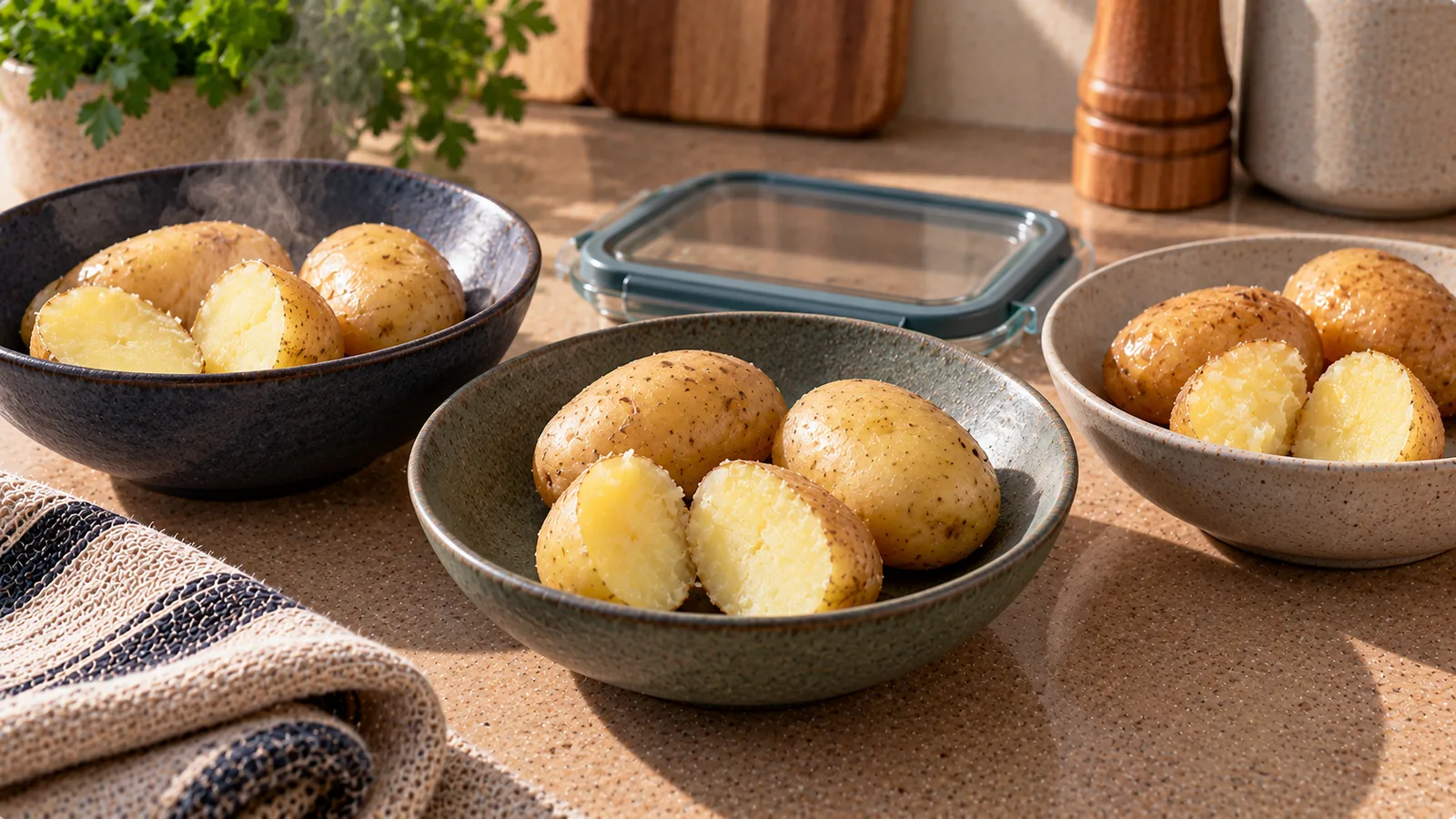
Resistant starch is a fraction of starch that is not digested in the small intestine in the same way as rapidly digestible starch. Instead, it reaches the large intestine, where some of it can be fermented by gut microorganisms.
It occurs naturally in several starchy foods, and its amount can also change during processing and preparation.
This is why the resistant starch content of a potato, rice dish or pasta meal is not determined only by the ingredient itself. Variety, processing, cooking, cooling, storage and reheating can all influence starch structure.
The important point is that these effects are variable. There is no reliable universal rule such as “cooling rice removes a fixed percentage of its calories.”
What is resistant starch?
Most digestible starch is broken down into glucose in the small intestine.
Resistant starch is the portion that resists digestion there.
Nutritionally, resistant starch is generally considered part of dietary fiber or non-digestible carbohydrate.
It is not one single substance with identical properties in every food.
Different forms of resistant starch arise for different reasons.
Main types of resistant starch
Resistant starch is commonly divided into several categories.
RS1: physically inaccessible starch
The starch is enclosed within intact or partly intact plant structures, making it less accessible to digestive enzymes.
Examples can include:
- whole or coarsely milled grains;
- seeds;
- some legumes.
Grinding, chewing and processing can alter how accessible this starch becomes.
RS2: naturally resistant starch granules
Some uncooked starches have a structure that makes them relatively resistant to digestion.
Sources can include:
- green bananas;
- raw potato starch;
- some high-amylose starches.
Cooking can substantially reduce this type of resistance by gelatinizing the starch.
RS3: retrograded starch
This form can develop after starch is cooked and subsequently cooled.
During cooling, some gelatinized starch molecules reorganize into structures that digestive enzymes have more difficulty breaking down.
This process is known as retrogradation.
Cooked and cooled potatoes, rice and pasta are commonly discussed in this context.
RS4
RS4 refers to starch that has been chemically modified to resist digestion.
It is more relevant to manufactured food ingredients than ordinary home cooking.
Other resistant starch structures
Some classifications also describe starch-lipid complexes as an additional category.
For everyday food choices, however, it is more useful to understand that resistant starch exists in different forms and that preparation can affect those forms differently.
Foods that can contain resistant starch
Potential food sources include:
- legumes;
- beans;
- lentils;
- peas;
- oats and other grains;
- green bananas;
- potatoes;
- rice;
- pasta;
- some high-amylose starch products.
The amount is not fixed.
Two portions of the same general food can contain different amounts because of differences in variety, processing and preparation.
Green bananas
Unripe bananas can contain substantial amounts of naturally resistant starch.
As bananas ripen, starch is progressively converted into sugars.
For this reason, a green banana and a fully ripe banana do not have the same carbohydrate composition.
This does not mean that one is universally “better.” They are simply different stages of the same food with different starch and sugar profiles.
Legumes
Beans, lentils, chickpeas and peas can contribute resistant starch as part of their overall carbohydrate and fiber content.
Their digestibility is affected by:
- plant variety;
- processing;
- cooking;
- physical structure.
Legumes should still be prepared according to normal food-safety instructions. Resistant starch is not a reason to deliberately undercook foods that require adequate cooking.
Potatoes
Potatoes are one of the most familiar examples used when discussing cooking and cooling.
Raw potato starch can contain substantial resistant starch, but potatoes are normally cooked before eating.
Cooking gelatinizes much of the starch and generally makes it more digestible.
When cooked potatoes cool, some starch can retrograde and become more resistant again.
The exact amount depends on preparation conditions and cannot be accurately predicted from temperature alone.
Rice
Rice starch also changes during cooking and cooling.
Freshly cooked rice contains gelatinized starch that is generally more accessible to digestive enzymes than the starch in uncooked grains.
Cooling can promote retrogradation of some of that starch.
However, the effect depends on factors such as:
- rice variety;
- amylose content;
- cooking method;
- water ratio;
- cooling conditions;
- storage duration;
- reheating.
Therefore, there is no single resistant-starch value that applies to all cooked-and-cooled rice.
Pasta
Pasta provides another example where preparation can influence starch digestibility.
Its structure, cooking time, cooling and reheating can affect how starch is digested.
Human studies have found differences in post-meal glucose responses between freshly cooked, cooled and reheated pasta under specific experimental conditions.
That does not mean every reheated pasta meal will produce the same effect.
The size of the response can vary with the pasta, meal composition and individual.
What cooking does to starch
When starch is heated in the presence of water, its granules can absorb water and lose some of their original ordered structure.
This is called gelatinization.
Gelatinized starch is generally more accessible to digestive enzymes.
As a result, cooking can reduce some naturally resistant forms of starch, particularly RS2.
But the story does not end when cooking stops.
Cooling can reorganize part of the gelatinized starch into more resistant structures.
What cooling does
During cooling, some starch molecules—particularly amylose—can reassociate into more ordered structures.
This retrograded starch can be less accessible to digestive enzymes.
The effect is one reason cooked-and-cooled starchy foods are studied in resistant-starch research.
However, cooling does not transform all starch into resistant starch.
A cooled potato, bowl of rice or portion of pasta still contains substantial digestible carbohydrate.
Does refrigeration increase resistant starch?
It can increase resistant starch in some cooked starchy foods, but the magnitude is food- and method-dependent.
Factors include:
- starch composition;
- cooking temperature and duration;
- cooling temperature;
- storage time;
- moisture;
- previous processing.
This makes simple numerical claims difficult to generalize.
A result measured in one rice variety under laboratory conditions should not automatically be applied to every rice meal prepared at home.
What happens when cooled food is reheated?
Reheating does not necessarily return starch to exactly its original freshly cooked state.
Some retrograded starch structures may persist, while others may change again depending on temperature and food composition.
Research on foods such as pasta suggests that cooling and reheating can alter postprandial glucose responses under controlled conditions.
But this should not be interpreted as a guaranteed or large metabolic effect for every meal.
Does resistant starch lower the calories in food?
This question needs careful interpretation.
Cooking and cooling do not make the original carbohydrate simply disappear.
Instead, they can change how part of the starch is digested and fermented.
The energy contribution of resistant starch is therefore not identical to that of fully digestible starch, but this does not justify applying a simple calorie discount to home-cooked food.
For example, it would be misleading to take a bowl of rice listed as 300 kcal and automatically subtract 10%, 20% or another fixed number because it was refrigerated.
The actual resistant-starch amount is usually unknown.
For ordinary calorie tracking, use the established nutrition value for the food and preparation method rather than inventing a resistant-starch correction.
Resistant starch and blood glucose
Because resistant starch escapes or delays digestion in the small intestine, replacing some digestible starch with resistant starch can affect post-meal glucose responses.
Studies and reviews have reported potentially lower postprandial glucose responses in some settings.
However, effects vary with:
- the type and amount of resistant starch;
- the food matrix;
- the comparison food;
- the person consuming it;
- the rest of the meal.
Resistant starch should not be treated as a guaranteed method for controlling blood glucose or as a replacement for medical advice.
Resistant starch and the gut microbiota
Resistant starch that reaches the large intestine can be fermented by gut microorganisms.
This fermentation can produce short-chain fatty acids and other metabolites.
Different resistant starches may be fermented differently, and individual microbiomes can also respond differently.
This is one reason resistant starch is studied in relation to gastrointestinal and metabolic health.
The evidence is promising in several areas, but effects should not be presented as universal outcomes for every person.
Is resistant starch the same as fiber?
Resistant starch is commonly included within broader definitions of dietary fiber because it escapes digestion in the small intestine.
But dietary fiber includes many other compounds as well.
For example, foods can contain:
- cellulose;
- hemicelluloses;
- beta-glucans;
- pectins;
- resistant oligosaccharides;
- resistant starch.
Therefore, a food's total fiber content and its resistant starch content are not interchangeable measurements.
Preparation example: potatoes
Imagine two portions made from the same batch of potatoes.
Portion A
The potatoes are cooked and eaten hot immediately.
Portion B
The potatoes are cooked, cooled under safe refrigeration and eaten later.
The second portion may contain more retrograded resistant starch.
But without laboratory analysis, you cannot accurately calculate how many additional grams were formed.
The sensible nutrition-tracking approach is still to record the potato portion according to its actual weight and the appropriate cooked-food entry.
Preparation example: rice
Suppose you cook rice for meal prep.
You refrigerate part of it and reheat it the following day.
Cooling and reheating may alter starch structure.
However, this does not justify changing a 200 g cooked-rice entry into an arbitrary lower-calorie entry.
For tracking purposes, record the 200 g cooked portion using a suitable cooked-rice value.
Treat the resistant-starch change as a property of the food rather than as a precisely known calorie subtraction.
Preparation example: pasta
Pasta can be:
- eaten freshly cooked;
- cooled for a pasta salad;
- cooled and reheated later.
These preparations may differ somewhat in starch digestibility.
But sauce, oil, cheese, meat and other ingredients can have a much larger impact on the total calories of the meal than any uncertain resistant-starch difference.
When tracking the meal, count those ingredients normally.
Does cooking time matter?
Potentially.
The extent of starch gelatinization and the physical structure of the food can be influenced by cooking conditions.
But there is no universal rule such as “cook exactly X minutes to create Y grams of resistant starch.”
Food type, particle size, water availability and starch composition all matter.
Prepare food for appropriate texture and safety rather than deliberately undercooking it solely to maximize resistant starch.
Does processing matter?
Yes.
Processing can change the physical accessibility and molecular structure of starch.
Examples include:
- milling;
- grinding;
- extrusion;
- fermentation;
- cooking;
- cooling;
- drying;
- specialized industrial treatments.
Some processes can reduce particular resistant-starch fractions, while others can promote formation of resistant structures.
The direction and magnitude depend on the food and process.
Whole grains and physical structure
RS1 exists partly because starch is physically protected within food structures.
Breaking those structures through fine milling or extensive processing can make starch more accessible to digestive enzymes.
This illustrates an important principle: starch digestibility depends not only on chemical composition but also on food structure.
Should you eat raw potato starch for resistant starch?
Raw potato starch is often discussed as a concentrated source of resistant starch, but a concentrated ingredient is different from obtaining resistant starch through ordinary foods.
There is no need to consume raw starch supplements to include resistant starch in a normal diet.
Large sudden increases in fermentable carbohydrate may also cause gastrointestinal symptoms in some people.
If using concentrated resistant-starch products, follow the product instructions and consider individual tolerance.
Food safety still comes first
Attempts to increase resistant starch should never override safe food preparation.
This is particularly important for legumes.
Some beans contain naturally occurring lectins that can cause illness when beans are inadequately cooked.
Proper soaking and cooking practices should be followed where required.
Similarly, cooked rice, potatoes and pasta should be cooled and stored safely rather than left for long periods at room temperature.
Resistant starch does not make unsafe storage practices beneficial.
Practical ways to include resistant starch sources
You do not need a special resistant-starch protocol.
A varied diet can naturally include foods such as:
- beans and lentils;
- whole or minimally processed grains;
- potatoes;
- rice;
- pasta;
- bananas at different stages of ripeness.
Some cooked starches can also be prepared ahead, refrigerated safely and used in later meals.
This can be useful for convenience regardless of the exact resistant-starch amount.
Avoid treating resistant starch as a calorie hack
One of the most misleading interpretations is that cooling a starchy food makes its calories “not count.”
That is not what resistant starch research shows.
The food still provides energy, and most of its starch may remain digestible.
Changes in resistant starch are better understood as changes in carbohydrate digestibility and fermentation rather than as a way to erase calories.
What the evidence can and cannot tell you
Research supports several broad conclusions:
- resistant starch escapes digestion in the small intestine;
- different resistant-starch types exist;
- food processing can change resistant-starch content;
- cooking can reduce some naturally resistant starch;
- cooling can promote formation of retrograded resistant starch in some foods;
- resistant starch can influence post-meal metabolic responses under some conditions;
- it can be fermented in the large intestine.
What research does not support is assigning one universal resistant-starch value to every cooled potato, rice or pasta meal.
Preparation details and food composition matter too much for that.
Practical takeaway
Resistant starch is a normal component of many plant foods and can also form when some cooked starches cool.
Potatoes, rice, pasta, legumes, grains and green bananas can all contribute resistant starch, but the amount varies substantially.
Cooking, cooling, storage and reheating can change starch structure, yet these changes should not be converted into arbitrary calorie deductions.
For everyday nutrition tracking, continue using the appropriate nutrition values for the food you actually eat. Think of resistant starch as one aspect of carbohydrate quality and food structure—not as a precise method for subtracting calories from a meal.