
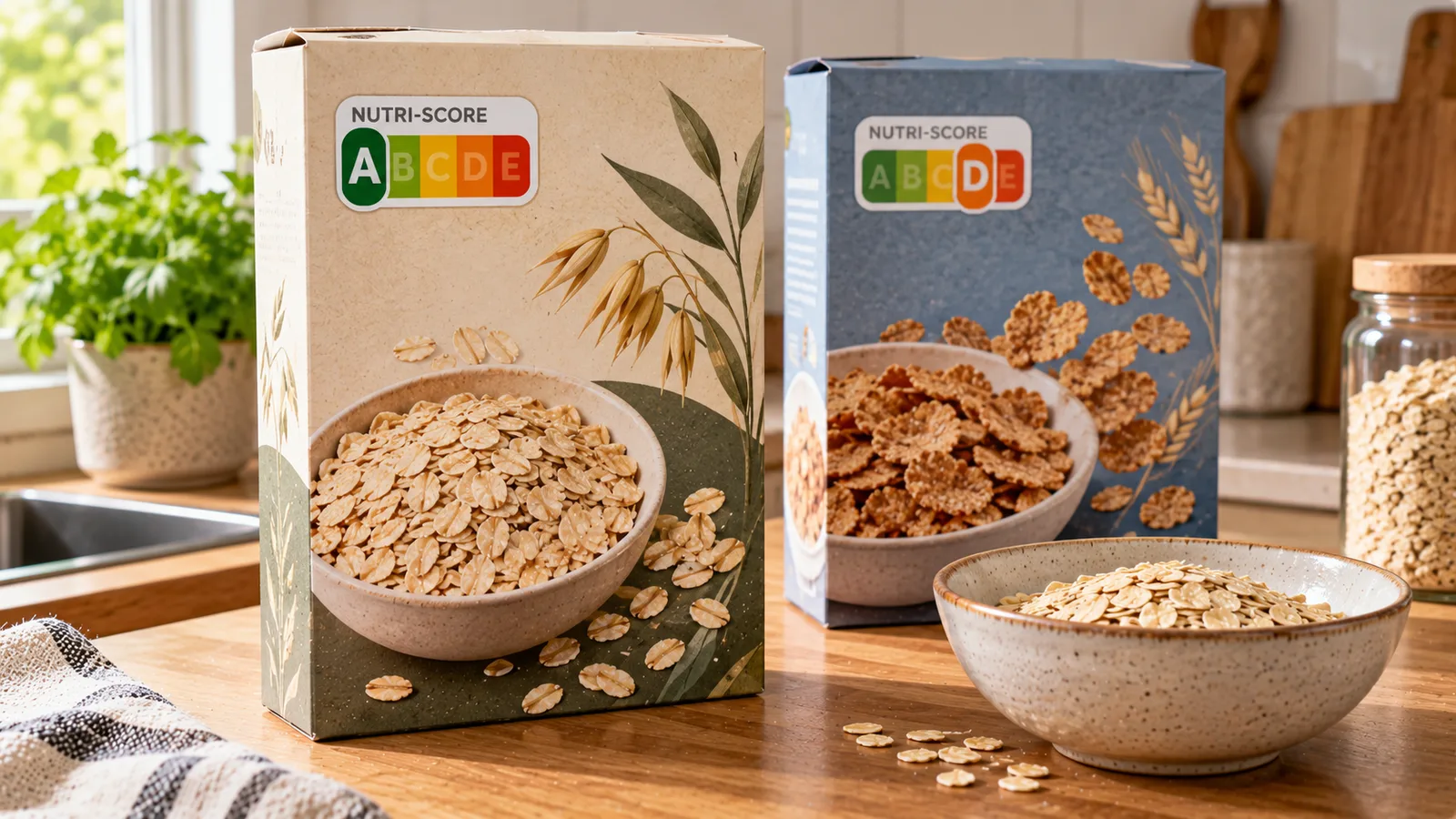
Nutri-Score is a front-of-pack nutrition label designed to make certain aspects of a packaged food's nutritional quality easier to understand at a glance. Its familiar scale combines five letters, from A to E, with colors ranging from dark green to orange-red.
The label can help when comparing relevant products in a grocery store. However, it is not a complete assessment of a person's diet, and it does not prescribe what anyone should eat throughout the day.
The useful approach is to understand what the score summarizes, compare products thoughtfully, and then consider the information alongside ingredients, portions, dietary needs and the rest of the meal.
Information checked: 9 October 2026. Nutri-Score's algorithm has been updated, and implementation dates have differed between participating countries. Packaging in circulation may therefore not always reflect the same calculation version.
What does Nutri-Score mean?
Nutri-Score is a simplified nutrition logo that may appear on the front of participating food packages. It complements rather than replaces the mandatory nutrition declaration and ingredient list.
| Label element | What it communicates |
|---|---|
| A, dark green | The most favorable category on the scale |
| B, light green | A relatively favorable category |
| C, yellow | The middle category |
| D, orange | A less favorable category |
| E, orange-red | The least favorable category on the scale |
The letters describe the result of the system's calculation for a product. They are not grades for a person's diet, and they do not mean that every food with the same letter has identical nutritional properties.
A product rated A is not automatically suitable in unlimited quantities. A product rated D or E is not automatically forbidden or incompatible with a balanced diet.
Nutri-Score is also not displayed on every food package. Its use is voluntary within the participating scheme, subject to the applicable rules.
How is Nutri-Score calculated?
Nutri-Score uses a defined algorithm to produce an overall product-level score. It evaluates nutritional characteristics using information expressed per 100 g or 100 ml, with calculation rules that depend on the relevant food or beverage category.
The algorithm considers components that are generally encouraged and components that are generally limited.
| Broad component | Examples |
|---|---|
| Elements that can contribute positively | Fiber and certain protein or food-group components under the applicable rules |
| Elements that can contribute negatively | Energy, sugars, saturated fatty acids and salt |
| Category-specific rules | Special calculation treatment for certain product groups, including beverages and fats |
This is a simplified explanation, not a substitute for the official scoring rules. The calculation is more detailed than adding up a few numbers from the nutrition panel. Product category and the applicable algorithm matter.
A consumer generally does not need to calculate the score manually. The practical task is to interpret the displayed result without assuming that it describes every aspect of the food.
Why the algorithm's version matters
Nutri-Score has undergone scientific review and algorithm updates. The aim has been to improve how the scale differentiates products and to better reflect dietary recommendations and current scientific understanding.
According to Santé publique France, the updated algorithm for solid foods and beverages took effect in Germany, Belgium, Switzerland and the Netherlands on 1 January 2024. Luxembourg implemented the update on 5 March 2024, while France began implementing it on 16 March 2025.
Implementation and packaging transitions can differ. In particular, a package already on the market may carry a score calculated under an earlier version during an authorized transition period.
For this reason:
- Do not assume that every package carrying Nutri-Score uses the same algorithm version.
- Check official national guidance when a precise implementation date matters.
- Treat the displayed label as useful product information, not as a complete nutrient-by-nutrient comparison.
- Avoid assuming that a score change necessarily means the product's recipe changed; the algorithm itself may have changed.
The updated algorithm also means that older articles, screenshots and examples may no longer describe the current calculation accurately.
How to compare two products fairly
Nutri-Score is often most useful when comparing products that serve a similar purpose.
For example, when choosing between two comparable breakfast cereals, the labels can provide a quick indication of how the products differ under the scoring system.
A practical comparison can follow four steps.
1. Start with similar products
Compare breakfast cereal with breakfast cereal, or one similar type of yogurt with another. Comparing unrelated foods solely by their letters can be misleading because they may play very different roles in a meal.
2. Check the actual nutrition declaration
Look at the quantities of sugars, saturated fat, salt, fiber and other relevant nutrients. The nutrition panel helps explain the product's composition in more detail than a single letter.
3. Read the ingredient list
Ingredients provide information that the Nutri-Score grade does not communicate fully, including the ingredients used and their order by weight.
The ingredient list is especially relevant when checking for a particular ingredient or a known allergy. Nutri-Score is not an allergen-detection system.
4. Consider how you will use the food
A product's role depends on the meal and portion. The rating alone does not establish how much of it someone should eat or how frequently it should appear in their diet.
What Nutri-Score cannot tell you
The score is a simplified summary, so several important questions require other information.
| Question | Does Nutri-Score answer it by itself? | What else to check |
|---|---|---|
| How many calories are in my portion? | No | Serving weight and nutrition declaration |
| Does the product contain an allergen? | No | Ingredient list and allergen declaration |
| Is the product suitable for my medical needs? | No | Relevant clinical or dietary guidance |
| How much protein does my whole meal provide? | No | Protein values and amounts of all meal ingredients |
| Is this the best choice for my complete diet? | No | Overall eating pattern, portions and individual needs |
| Is a product suitable for unlimited consumption? | No | Portion size and the context of the diet |
| Are two unrelated foods interchangeable? | No | Their roles, ingredients and nutritional characteristics |
A favorable grade does not establish that a food meets an individual's protein target, calorie requirements or other personal goals.
Likewise, the label does not determine meal frequency, prescribe a weekly menu or account for every intolerance and dietary restriction.
Nutri-Score versus the full nutrition label
The two forms of information serve complementary purposes.
| Nutri-Score | Full nutrition declaration |
|---|---|
| Condenses selected characteristics into one letter and color | Provides numerical values for specified nutrients |
| Useful for quick comparisons | Useful for detailed comparisons and calculations |
| Uses a defined scoring algorithm | Shows the declared nutrient quantities |
| Does not explain every ingredient | Read alongside the ingredient list for a fuller picture |
| Does not personalize a diet | Can provide inputs for an individualized calculation, but does not prescribe a diet on its own |
For example, if you need to calculate calories in a particular portion, use the product's energy value and the amount actually eaten. The letter alone cannot provide that calculation.
If you are comparing the protein content of two foods, inspect their protein values rather than inferring them from the Nutri-Score category.
Does a better Nutri-Score mean a food is always healthier?
Not necessarily in every context.
The score summarizes selected nutritional characteristics according to its algorithm. It does not capture every property of a food, every aspect of its preparation or every dietary consideration relevant to a particular person.
A better rating can be informative when comparing relevant alternatives. It should not be interpreted as a universal ranking of all foods for every purpose.
For example, a breakfast cereal and an ingredient used in cooking have different roles. Their letters alone do not establish which one should occupy a larger share of someone's diet.
Similarly, a product with a less favorable score can still be used in an overall eating pattern that includes a variety of foods.
Does Nutri-Score replace portion awareness?
No. The score is calculated using a standardized quantity of product, while people eat different portions.
The actual amount consumed affects the total calories, salt, sugars, fats and other nutrients in a meal.
For practical tracking, distinguish between the value per 100 g and the value for the portion you eat.
For example, if a nutrition declaration lists 400 kcal per 100 g and the portion weighs 30 g, the portion provides:
400 × 30 ÷ 100 = 120 kcal.
Nutri-Score does not replace this calculation. The example is an illustration of portion arithmetic, not a statement about the calories or rating of a particular cereal.
How to use Nutri-Score while grocery shopping
A sensible shopping routine is to use the label as an initial comparison tool rather than as the only decision criterion.
- Identify the type of product you need.
- Compare the Nutri-Score labels on relevant alternatives when available.
- Check the numerical nutrition declaration for the nutrients important to you.
- Read ingredients and allergen information where relevant.
- Consider serving size, price, taste, convenience and the intended role in your meals.
- Make the decision in the context of your overall eating pattern.
This approach keeps the score useful without giving it more meaning than it was designed to provide.
Frequently asked questions
Is Nutri-Score mandatory on all European food packages?
No. It is a voluntary front-of-pack labeling scheme in participating markets, subject to the relevant rules. Mandatory nutrition and ingredient information is governed separately.
Does Nutri-Score A mean a food is perfect?
No. It is the most favorable category within the scoring scale, not a guarantee that the product is ideal for every individual or suitable in unlimited amounts.
Does Nutri-Score E mean I should never eat the product?
No. A lower category indicates a less favorable result under the algorithm. Decisions about a complete diet require broader context.
Why can the same product have different Nutri-Score labels?
The algorithm may have been updated, and packaging transition periods can allow different versions to appear in the market. Formulation differences may also matter. Check the package and current official guidance.
Can Nutri-Score tell me whether a product is gluten-free or allergen-free?
No. Read the ingredient list and allergen declarations. For medically necessary restrictions, follow appropriate professional guidance and applicable labeling requirements.
Does the score calculate my daily calorie target?
No. It rates a product under a defined algorithm. Personal energy needs depend on individual circumstances and cannot be derived from the product's letter.
Sources
- Santé publique France — Nutri-Score — official description of the label, calculation system and implementation dates.
- Bundeszentrum für Ernährung — Nutri-Score — German consumer guidance on the label and algorithm updates.
- Regulation (EU) No 1169/2011 — EU framework for food information provided to consumers.
- European Commission — Food Information to Consumers — background on nutrition labeling and consumer information.
Key takeaway
Nutri-Score is a convenient way to summarize selected nutritional characteristics of a product. It is most useful for comparing relevant alternatives and works best alongside the numerical nutrition declaration and ingredient list.
It is not a personalized meal plan, an allergen checker or a complete judgment of someone's diet. Use the label as one source of information, then consider portions, ingredients and the wider context of your meals.