
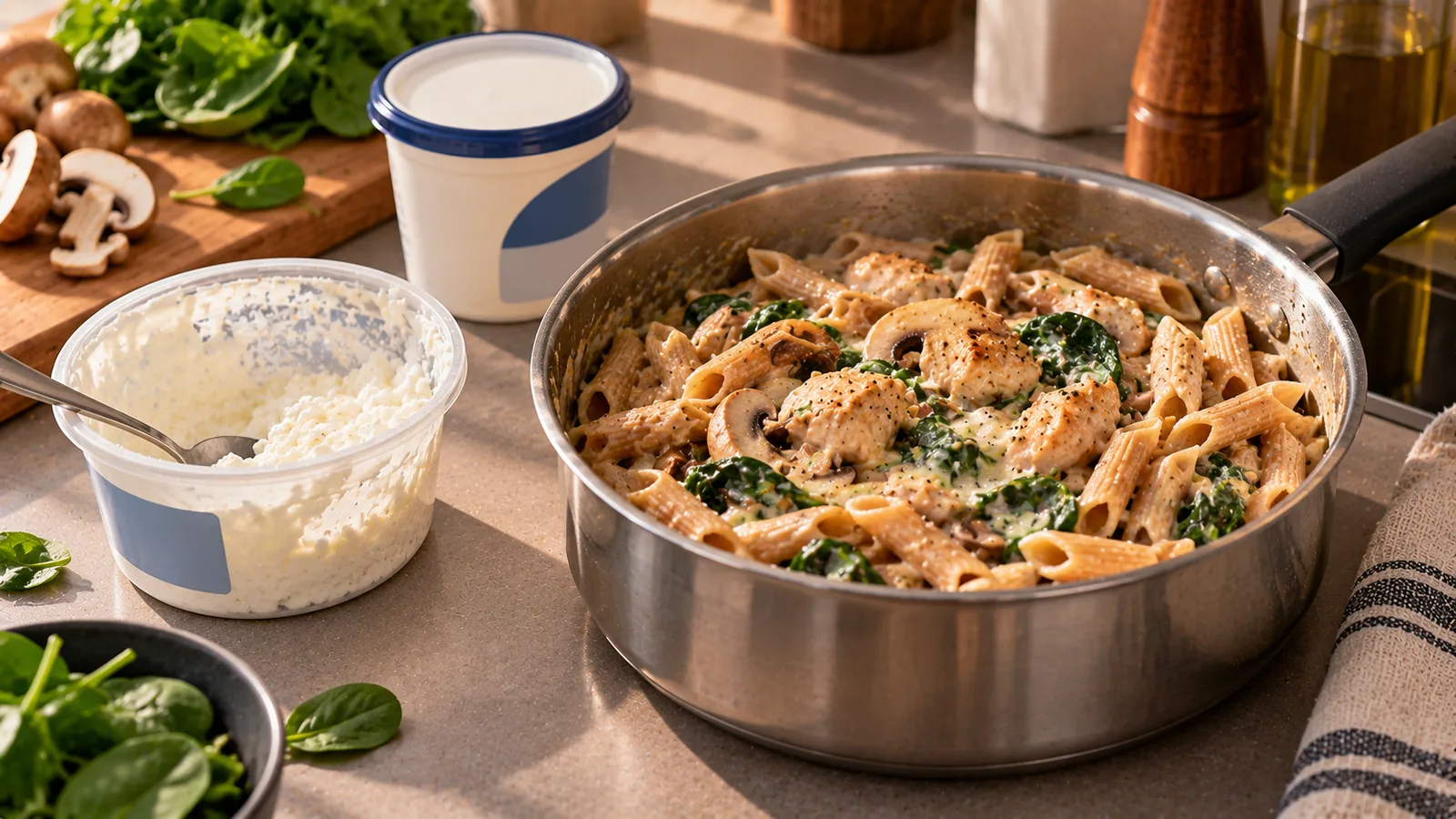
Saved recipes make food tracking faster because you do not have to enter every ingredient each time you cook.
But a saved recipe is accurate only when it still represents the food you actually made.
If you replace an ingredient, change its amount or alter the finished yield, logging the old recipe unchanged can produce misleading calories and macros per portion.
The solution is not necessarily to build a completely new recipe every time. You need to update the parts that actually changed and make sure the final portion calculation still matches the cooked food.
When a substitution matters for tracking
Not every recipe change has the same nutritional impact.
Replacing one herb with another will usually have much less effect than replacing:
- cream with milk;
- lean meat with a higher-fat cut;
- oil with another ingredient;
- regular cheese with a reduced-fat version;
- dry beans with a different quantity of canned beans;
- sugar with another caloric sweetener;
- 200 g of an ingredient with 350 g.
The key question is:
Did the substitution materially change the nutrients or the final amount of food?
If yes, the saved recipe should be updated before you rely on its per-serving values.
Do not simply rename the ingredient
Suppose a saved pasta recipe contains:
- 300 g dry pasta;
- 500 g lean minced beef;
- 400 g tomato sauce;
- 20 g olive oil.
Today you use 500 g of a different minced meat with substantially different nutrition.
If you keep the original recipe and only remember that today's version was different, the diary still calculates the old version.
Instead, replace the ingredient entry itself.
The recipe calculation needs the nutrition values of the food actually used.
A simple substitution workflow
When an ingredient changes, use this sequence:
- open the saved recipe;
- identify the ingredient being replaced;
- remove or edit the original ingredient;
- add the actual replacement;
- enter the amount actually used;
- verify the replacement's nutrition entry;
- recalculate the recipe;
- update the finished yield if it changed;
- log the portion you actually ate.
This separates two important variables:
- what went into the recipe;
- how much finished food the recipe produced.
Both can affect the nutrition of the portion.
Example: replacing cream with milk
Imagine a soup recipe originally contains 200 g of cream.
The saved cream entry provides:
- 300 kcal per 100 g;
- 30 g fat per 100 g.
The original 200 g therefore contributes:
600 kcal and 60 g fat.
This time you use 200 g of milk containing:
- 60 kcal per 100 g;
- 3.5 g fat per 100 g.
The milk contributes:
120 kcal and 7 g fat.
The substitution changes the whole recipe by approximately:
-480 kcal and -53 g fat.
If the recipe produces four equal portions, the difference is approximately:
-120 kcal and -13.25 g fat per portion.
Logging the old recipe would therefore produce a meaningful error.
Equal weight does not mean equal nutrition
One of the easiest mistakes is assuming that replacing 100 g with 100 g preserves the recipe's nutrition.
It preserves ingredient weight, not necessarily:
- calories;
- protein;
- carbohydrate;
- fat;
- fiber;
- sodium.
For example, 100 g of one cheese can differ substantially from 100 g of another.
The same applies to:
- meat cuts;
- yogurts;
- sauces;
- plant-based alternatives;
- breads;
- nut butters.
When the exact packaged replacement is available, its current nutrition label can be more appropriate than a generic database entry.
Different quantities need to be entered explicitly
Substitutions often change both the food and the amount.
A recipe may call for 150 g of an ingredient, while the available replacement requires 220 g.
Do not enter the original 150 g simply because that was written in the recipe.
The nutrition calculation should use what actually went into the dish.
A useful recipe record answers:
"What ingredients and quantities were used this time?"
rather than:
"What did the original instructions say?"
Dry and cooked substitutions require extra attention
Consider a recipe calling for 200 g dry lentils.
You decide to use canned lentils instead.
Entering 200 g canned lentils as a direct replacement may not reproduce the original recipe because dry lentils absorb water during cooking.
Dry and cooked weights are not interchangeable.
The correct approach is to record the actual amount of canned, drained lentils used and then recalculate the recipe from that amount.
This principle also applies to:
- dry versus cooked beans;
- dry versus cooked rice;
- dry versus cooked pasta;
- dehydrated versus prepared ingredients.
Use database entries that match the state of the ingredient you actually measured.
Check drained ingredients
If the replacement comes in brine, water or oil, decide which weight belongs in the recipe.
For example, a can may contain:
- 400 g net weight;
- 240 g drained weight.
If you discard the liquid and add only the drained beans, entering 400 g would overstate the amount of beans used.
Use the amount that corresponds to the edible ingredient added to the recipe and make sure the nutrition data uses a compatible basis.
Oil substitutions can be easy to underestimate
Suppose a recipe originally uses 10 g of oil, but during cooking you actually use 25 g.
If the saved recipe still contains 10 g, the calculation misses 15 g of oil.
At roughly 9 kcal per gram of fat, seemingly small differences in added fats can noticeably affect the recipe total.
The same principle applies when an ingredient is replaced with something that requires a different amount of cooking fat.
Track what was actually added rather than assuming the cooking process stayed nutritionally identical.
Update the finished yield
Changing ingredients can alter how much cooked food the recipe produces.
This is particularly important for:
- soups;
- sauces;
- stews;
- casseroles;
- baked dishes;
- recipes where water evaporates;
- recipes where an ingredient absorbs substantial water.
Suppose the original recipe produced 1,600 g of finished food.
After a substitution, the new version weighs 1,850 g.
Even if total recipe calories changed only slightly, calories per 100 g will be different because the finished yield changed.
If your app supports recipe yield by weight, update it.
Why finished weight matters
Assume a recipe contains 2,400 kcal in total.
Version A
Finished weight: 1,600 g.
Calories per gram:
2,400 ÷ 1,600 = 1.5 kcal.
A 400 g portion contains:
600 kcal.
Version B
The ingredients are modified and the recipe still totals 2,400 kcal, but finished weight becomes 1,900 g.
Calories per gram:
2,400 ÷ 1,900 ≈ 1.26 kcal.
A 400 g portion contains approximately:
505 kcal.
The total calories are identical, but the same weight of finished food no longer represents the same fraction of the recipe.
Portion count can also change
Some people save recipes by servings rather than finished weight.
That can work when portions are genuinely divided consistently.
But substitutions may change the number or size of portions.
If the old recipe produced four servings and the new batch clearly produces five, keeping "4 servings" will overstate each portion.
Update the serving count when necessary.
For mixed dishes, finished weight can often provide a more flexible basis because each portion can be logged in grams.
Example: changing meat and sauce
Original recipe:
| Ingredient | Amount | Calories |
|---|---|---|
| Dry pasta | 300 g | 1,050 |
| Lean minced beef | 500 g | 700 |
| Tomato sauce | 400 g | 240 |
| Olive oil | 20 g | 177 |
| Total | — | 2,167 |
Modified version:
| Ingredient | Amount | Calories |
|---|---|---|
| Dry pasta | 300 g | 1,050 |
| Different minced meat | 500 g | 950 |
| Tomato sauce | 550 g | 330 |
| Olive oil | 15 g | 133 |
| Total | — | 2,463 |
The modified recipe contains 296 kcal more in total.
If you log the old saved recipe, that difference disappears from the diary.
But there is another step.
If the finished weight also changes, you need the new yield before calculating an accurate portion.
Copy the recipe when the change is temporary
Editing the original saved recipe is not always the best option.
Suppose you normally cook Recipe A exactly as saved, but today you make a one-time variation.
If you permanently overwrite Recipe A, future tracking may become less convenient.
Instead, duplicate it and create something like:
- Lentil Curry — Standard;
- Lentil Curry — Coconut Milk Version.
This is useful when the alternative is likely to be cooked again.
For a one-time change, some apps may allow temporary editing without replacing the master recipe.
Edit the original when the new version becomes standard
If you have permanently changed how you prepare the dish, updating the original recipe makes more sense.
For example, you may now always use:
- 300 g vegetables instead of 150 g;
- a different yogurt;
- less oil;
- another type of meat.
The saved recipe should represent the version you actually cook most often.
Historical diary entries should ideally retain the nutrition values they had when they were logged rather than changing retroactively whenever a recipe is edited.
Verify replacement database entries
A perfectly updated recipe can still be wrong if the replacement food entry is wrong.
Check:
- brand when relevant;
- raw versus cooked state;
- per-100-g versus per-serving basis;
- calories;
- macros;
- package label;
- units.
If a packaged ingredient says 120 kcal per 100 g but the selected database entry says 260 kcal, investigate before saving the recipe.
Do not assume the first search result is correct.
Barcode data can help—but verify it
Scanning the replacement ingredient can be convenient.
But a barcode is a lookup key, not a guarantee that the associated nutrition record is current.
Compare the result with the package.
If they disagree substantially, use the current label or another verified entry.
This is especially important for products that manufacturers reformulate.
Recipe substitutions and macros
A substitution can affect one macro much more than total calories.
For example:
- replacing a high-protein yogurt with a lower-protein alternative may reduce protein substantially;
- changing a lean meat to a fattier version can increase fat;
- replacing whole grains with a refined product may change fiber;
- using a sweetened alternative can increase carbohydrate and sugars.
If you track macros, review more than the calorie total after changing a recipe.
Fiber can change even when calories barely move
Suppose two ingredients provide similar calories but very different fiber.
Replacing beans with another ingredient may alter fiber substantially while leaving the recipe's total calories relatively close.
That means a recipe update should not be judged only by whether the calorie number changed.
The nutrients you actually track should be recalculated.
Salt and sodium can change substantially
Sauces, stocks, cheeses, canned foods and processed substitutes can differ greatly in salt or sodium.
If your diary tracks sodium or salt, use the actual replacement's label data.
Do not assume products in the same category are nutritionally interchangeable.
What about very small substitutions?
You do not need to rebuild an entire recipe because you used parsley instead of dill.
Tracking precision should be proportional to the likely impact and your reason for tracking.
A practical distinction is:
Usually worth updating:
- main protein source;
- cooking fats;
- cheese;
- cream or milk;
- grain quantity;
- legumes;
- calorie-containing sauces;
- substantial ingredient amounts.
Often less consequential for calorie and macro tracking:
- small quantities of herbs;
- spices;
- tiny amounts of low-energy seasonings.
This is not an absolute rule. The relevant nutrients and quantities still matter.
Avoid double-counting the replacement
Another common mistake occurs when someone adds the new ingredient but forgets to remove the old one.
The recipe then contains both.
For example:
Original:
- 200 g cream.
Modified:
- 200 g cream;
- 200 g milk.
If the cream was actually replaced rather than supplemented, this doubles part of the calculation.
When substituting, verify that the old ingredient was removed or its quantity changed to zero.
Keep preparation additions in mind
A substitution may change the cooking process.
Perhaps the replacement requires:
- extra oil;
- additional flour;
- more sauce;
- another topping.
Those additions are part of the actual recipe and should be recorded if they contribute meaningfully to the nutrients you track.
The substitution is not always a one-for-one ingredient change.
A useful recipe update checklist
Before logging the finished dish, check:
| Question | Why it matters |
|---|---|
| Did I remove the original ingredient? | Prevents double-counting |
| Did I add the actual replacement? | Uses correct nutrition data |
| Is the quantity correct? | Controls total contribution |
| Is the food entry correct? | Avoids database errors |
| Is it raw, cooked or drained as appropriate? | Prevents state mismatch |
| Did other ingredients change too? | Captures secondary changes |
| Did finished yield change? | Affects nutrition per gram |
| Did serving count change? | Affects nutrition per serving |
A reliable workflow for frequently modified recipes
If you regularly improvise while cooking, use a recipe as a template rather than treating it as a fixed nutritional object.
Before cooking
Duplicate the base recipe if today's version will be substantially different.
While cooking
Update ingredients and quantities as they are added.
After cooking
Weigh the finished food when practical.
In the app
Enter the finished yield.
At the meal
Weigh or estimate your actual portion and log it against the updated recipe.
This approach is particularly useful for soups, curries, stews, pasta dishes and casseroles that change from batch to batch.
When exact weighing is not practical
Tracking does not have to be perfect to be useful.
If the dish has already been cooked and you forgot to weigh one replacement ingredient, use the best reasonable estimate available rather than pretending the original recipe was unchanged.
Possible references include:
- amount remaining in the package;
- package size;
- measuring cup used;
- fraction of a container;
- known number of pieces.
Marking the entry as an estimate can also help you interpret the diary later.
False precision is not more useful than an honest estimate.
Example: estimating from the package
You started with a new 500 g tub of yogurt.
After cooking, approximately 300 g remains.
A reasonable estimate is that about 200 g was used.
That is usually more informative than keeping the original recipe's 100 g entry simply because you did not weigh the ingredient beforehand.
Do substitutions require a new recipe every time?
No.
Use the simplest method that keeps the diary representative.
Edit the recipe
Best when the change becomes your new normal.
Duplicate the recipe
Best when you alternate between two recurring versions.
Temporarily modify a batch
Best when today's change is a one-off and your app supports batch-specific editing.
The goal is not to create hundreds of nearly identical saved recipes.
The goal is to make the logged version correspond reasonably well to the food you actually ate.
What a recipe tracker should preserve
Ideally, a tracking system separates:
- the reusable recipe template;
- the ingredients used for a specific batch;
- the finished yield of that batch;
- the portion logged in the diary.
That prevents a later recipe edit from rewriting the nutritional history of meals already eaten.
If a recipe changes in November, a meal logged from the September version should not suddenly inherit November's nutrition values.
Final workflow
When you substitute an ingredient in a tracked recipe:
- start from the saved recipe;
- remove or edit the ingredient being replaced;
- add the actual replacement;
- record the actual quantity;
- verify its nutrition data and units;
- include any additional changes caused by the substitution;
- recalculate calories and relevant nutrients;
- update the finished weight or serving count;
- log the amount you actually ate;
- save the variation separately if you expect to use it again.
A saved recipe is a calculation model of the food you cooked.
When the ingredients change, the model should change with them.
Sources
- USDA FoodData Central, food composition and branded food data.
- U.S. Food and Drug Administration (FDA), Nutrition Facts Label guidance.
- European Commission, nutrition labelling and food information under Regulation (EU) No 1169/2011.
- European Food Safety Authority (EFSA), food and nutrition reference information.