
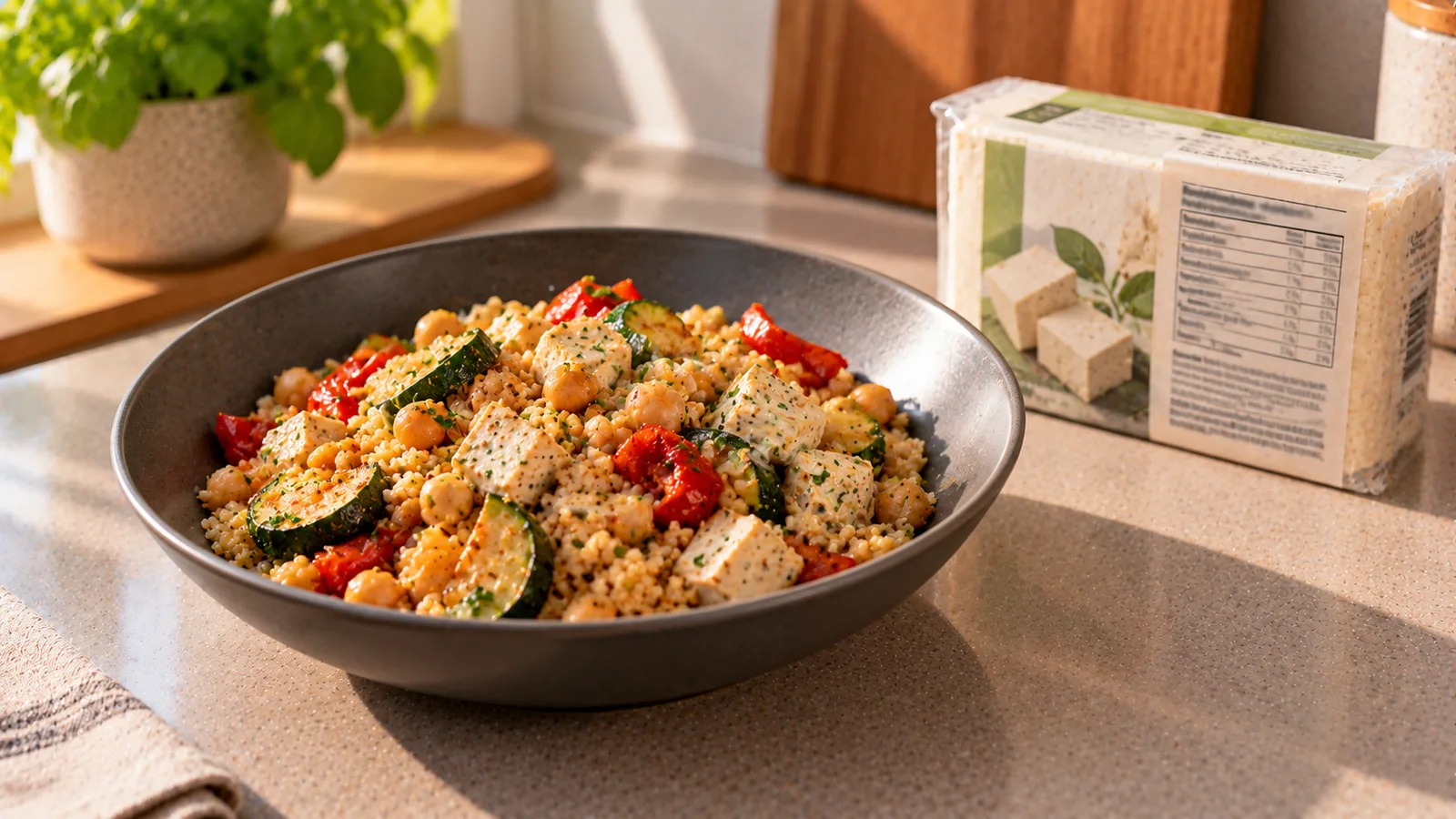
AI food scanners can recognize many visible foods from a photo, but a meal does not become untrackable when one ingredient cannot be identified.
The most useful response is not to force the AI to make a confident guess. Instead, separate what is known from what is uncertain and resolve the unknown ingredient with the best information available.
That may take only a few seconds if you know what the ingredient is. In other cases, a package label, recipe or manual estimate is more appropriate.
First, keep the ingredients the AI identified correctly
Imagine a meal contains:
- cooked rice;
- grilled chicken;
- broccoli;
- a pale sauce.
The scanner correctly identifies the first three items but cannot determine the sauce.
There is no reason to discard the entire meal analysis.
Keep the foods that are reasonably identified and focus only on the uncertain component.
This is usually more reliable than replacing the whole meal with a generic database entry such as “chicken rice bowl.”
Why some ingredients are difficult to identify from a photo
A photo contains visual information, not a complete ingredient list.
Several foods can look nearly identical after preparation.
A white sauce, for example, might be:
- yogurt sauce;
- sour cream;
- mayonnaise-based sauce;
- cream sauce;
- tahini mixture;
- cheese sauce.
Their calorie and macro profiles can differ substantially.
Other difficult cases include:
- cooking oils that are no longer visible;
- butter melted into food;
- sugar dissolved in drinks;
- fillings hidden inside food;
- ingredients beneath a topping;
- blended soups;
- mixed casseroles;
- dressings;
- marinades;
- spreads.
When appearance cannot reliably distinguish these possibilities, asking for clarification is better than pretending the image contains information that it does not.
Step 1: identify the unknown ingredient yourself if possible
If you prepared or ordered the meal, you may already know the answer.
Instead of asking the scanner to infer the ingredient again, provide the missing information directly.
For example:
Unknown item: sauce
You know it was:
30 g mayonnaise
The meal can now be completed using a suitable mayonnaise entry and the amount consumed.
This is more useful than repeatedly rescanning the same image.
Step 2: use the ingredient name even if the amount is uncertain
Sometimes you know what the ingredient is but not how much was used.
Separate those two uncertainties.
For example:
- identity: olive oil;
- amount: unknown.
This is a better starting point than treating both identity and amount as unknown.
You can then estimate the quantity from:
- the recipe;
- the person who prepared the food;
- package usage;
- the amount added to the pan;
- a reasonable portion range.
The estimate should remain an estimate rather than being presented as an exact measurement.
Step 3: check the package when the ingredient came from a packaged product
If the unknown component came from a jar, bottle, carton or packet, the package can resolve much of the uncertainty.
Check:
- exact product name;
- brand and variant;
- nutrition values;
- serving size;
- weight or volume used.
Suppose the scanner recognizes “creamy dressing” but cannot determine the type.
The bottle says:
- 320 kcal per 100 g;
- serving: 20 g.
If you used about 20 g, the dressing contributes approximately:
320 × 20 ÷ 100 = 64 kcal
The package is more informative than trying to infer the dressing recipe from its appearance.
Step 4: use the recipe for homemade mixed foods
For homemade dishes, the recipe is often the best source for hidden ingredients.
Consider a pasta sauce made from:
- tomatoes;
- olive oil;
- onion;
- cream;
- Parmesan.
A photo may mainly look like tomato sauce. It cannot reliably reveal the exact amount of oil, cream or cheese.
If the recipe is available, calculate the dish from the ingredients and final yield rather than expecting image recognition to reconstruct the recipe.
Example
A sauce contains:
- 500 g tomatoes;
- 20 g olive oil;
- 100 g cream;
- 40 g Parmesan.
After cooking, the finished sauce weighs 550 g.
If you eat 165 g:
165 ÷ 550 = 0.30
You consumed approximately 30% of the finished batch.
Apply that proportion to the nutrition of the complete recipe.
Step 5: distinguish an unknown ingredient from an unknown dish
These are different problems.
Unknown ingredient
Most of the meal is understood, but one component is uncertain.
Example:
- rice;
- salmon;
- vegetables;
- unknown dressing.
Keep the known components and resolve the dressing separately.
Unknown dish
The image shows a mixed food whose composition cannot be determined reliably.
Example:
- a restaurant casserole with no visible ingredient separation.
In this case, identifying individual hidden ingredients may not be realistic. A menu description, recipe, restaurant information or comparable dish estimate may be more appropriate.
Step 6: ask a narrow clarification question
When clarification is possible, make it specific.
Useful questions include:
- Was this sauce mayonnaise, yogurt or cream based?
- Was the tuna packed in water or oil?
- Is this meat beef, pork or chicken?
- Was oil added during cooking?
- Is the drink sweetened?
- Is the yogurt plain or flavored?
A narrow question reduces uncertainty much more effectively than asking the user to describe the entire meal again.
Step 7: choose the right database entry
Once the ingredient is identified, do not stop at the ingredient name.
Check whether the database entry matches:
- brand when relevant;
- raw or cooked state;
- drained or undrained state;
- fat percentage;
- sweetened or unsweetened version;
- preparation method;
- unit.
For example, identifying an ingredient as “yogurt” is not enough if the actual product is a sweetened 10% fat yogurt and the selected database entry is plain 0% yogurt.
Step 8: enter the ingredient manually when needed
Manual entry is not a failure of AI tracking.
It is the appropriate fallback when you have better information than the image.
Manual entry can be useful for:
- oils;
- sauces;
- spreads;
- condiments;
- powders;
- drink additions;
- hidden fillings;
- packaged ingredients;
- recipe components.
The goal of AI is to reduce input, not to prevent manual correction.
When the ingredient is known but the portion is not
Portion estimation can be handled separately from identification.
Use the strongest available evidence.
Best case: weigh it
If the ingredient is still available separately, use a kitchen scale.
Use the package
If a 200 g container had about one quarter removed:
200 × 0.25 = 50 g
This is still an estimate, but it has a concrete basis.
Use the recipe
If 30 g of oil went into a four-portion recipe and portions were approximately equal:
30 ÷ 4 = 7.5 g oil per portion
Use a range when uncertainty remains
If a restaurant sauce appears to be roughly 20–40 g and no better information exists, the useful conclusion may be that the amount is uncertain within that range.
Do not convert weak visual evidence into an artificially precise number such as 27.4 g.
Hidden oil deserves special attention
Cooking oil is difficult for image-based systems because much of it may not be visible in the finished meal.
Suppose vegetables are recognized correctly, but they were sautéed in oil.
Logging only the vegetables misses the added oil.
If 10 g of olive oil was added and consumed as part of the portion, that is approximately:
10 × 9 = 90 kcal
The exact energy value can vary slightly by product labeling, but the example shows why invisible ingredients can matter.
Use the actual oil amount or recipe information when available.
Sauces can create more uncertainty than the visible main food
A scanner may estimate chicken, potatoes and vegetables reasonably well while being unable to distinguish a light yogurt sauce from a mayonnaise-based sauce.
The visual volume could look similar while the calorie density differs substantially.
For uncertain sauces:
- identify the type if possible;
- check the product label or recipe;
- estimate or weigh the amount;
- log it separately.
This is generally better than changing the calorie estimate of the entire plate.
Drinks can contain invisible ingredients too
A coffee image does not reliably reveal whether it contains:
- no milk;
- 30 ml milk;
- 100 ml milk;
- sugar;
- syrup;
- cream.
If the scanner cannot identify an addition, provide it separately.
Example:
- coffee;
- 90 ml whole milk;
- 10 g sugar.
The visible drink remains one item, but its nutrition depends on ingredients the image cannot fully reveal.
What if you do not know the ingredient at all?
Sometimes neither the user nor the scanner knows what a component is.
For example, a restaurant serves an unfamiliar sauce and provides no ingredient description.
Use this order:
- check the menu description;
- ask the restaurant if practical;
- look for official nutrition information;
- identify the closest reasonable category;
- record it explicitly as an estimate.
Do not invent a detailed recipe without evidence.
A broad but transparent estimate is preferable to a precise fictional ingredient list.
What if the unknown ingredient is nutritionally minor?
Not every uncertainty has the same effect.
A few grams of fresh herbs will usually have less impact on total meal energy than an unknown quantity of:
- oil;
- butter;
- mayonnaise;
- cream;
- cheese;
- nuts;
- nut butter;
- sugary syrup.
When time is limited, prioritize uncertainties that can materially affect the meal total.
This is a practical tracking decision, not a claim that small ingredients have zero nutritional value.
What if several ingredients are unknown?
Resolve them in order of importance.
For example, the scanner identifies a grain bowl but is uncertain about:
- a few herb leaves;
- the sauce;
- cooking oil;
- a seed topping.
A practical order might be:
- oil;
- sauce;
- seed topping;
- herbs.
This focuses effort where the potential calorie difference is larger.
Restaurant meals
Restaurant dishes are particularly difficult because recipes and cooking quantities are often hidden.
Use information in this order when available:
- official restaurant nutrition data;
- ingredient or allergen description;
- menu description;
- visible components;
- a comparable generic dish.
If an unknown ingredient remains, record the uncertainty rather than assuming the scanner can recover a restaurant recipe from a photograph.
Homemade meals
Homemade food provides an advantage: the ingredients may be known even when the final dish is visually complex.
For repeat meals, save the recipe.
Then future portions can be logged from the finished recipe instead of re-identifying every ingredient from each photo.
This is especially useful for:
- soups;
- stews;
- casseroles;
- curries;
- sauces;
- baked dishes;
- mixed salads.
Example: one unknown sauce
The scanner identifies:
- 180 g cooked rice;
- 140 g grilled chicken;
- 100 g vegetables;
- unknown white sauce.
You confirm that the sauce is 35 g of a yogurt dressing containing 120 kcal per 100 g.
Sauce calories:
120 × 35 ÷ 100 = 42 kcal
The meal does not need to be rescanned. Add the 35 g dressing to the already identified components.
Example: unknown cooking fat
A photo shows eggs and vegetables.
The foods are identified correctly, but the scanner cannot determine how they were cooked.
You know that 8 g butter was used.
If the butter label provides 740 kcal per 100 g:
740 × 8 ÷ 100 = 59.2 kcal
Add approximately 59 kcal from the butter rather than changing the estimated quantity of eggs or vegetables.
Example: uncertain restaurant dressing
A salad contains clearly visible:
- lettuce;
- tomato;
- cucumber;
- chicken.
The dressing is unknown.
The menu describes it only as “house creamy dressing.”
There is no official nutrition information.
In this case:
- keep the identifiable salad components;
- record the dressing as a reasonable creamy-dressing estimate;
- mark or remember that its quantity and composition are uncertain.
Do not assign an exact homemade recipe to the dressing without evidence.
When should you rescan the meal?
A second photo can help when the original image is poor because:
- an ingredient is hidden behind another food;
- lighting obscures the food;
- the angle hides the portion;
- several foods overlap.
A second angle may reveal the missing component.
Rescanning is less useful when the information is fundamentally invisible, such as:
- exact amount of cooking oil;
- sugar dissolved in a drink;
- ingredients blended into a sauce;
- fat percentage of a dairy product.
For those cases, external information is more useful than another photo.
Do not replace uncertainty with false precision
An AI system may be able to propose a likely ingredient. That does not mean the guess is certain.
A good tracking workflow should distinguish among:
- recognized;
- user-confirmed;
- estimated;
- unknown.
If the evidence only supports “probably a creamy sauce,” the result should not silently become “31 g mayonnaise.”
The level of precision should reflect the quality of the available information.
A fast workflow for unknown ingredients
When an ingredient is not recognized:
1. Keep the correctly identified foods.
2. Determine whether you know the missing ingredient.
3. If packaged, check the label.
4. If homemade, check the recipe.
5. If the identity is known but quantity is not, estimate or weigh the amount separately.
6. If neither is known, use the closest defensible category and treat it as an estimate.
7. Prioritize oils, sauces, spreads and other calorie-dense unknowns.
8. Correct the individual ingredient rather than replacing the whole meal whenever possible.
What accurate AI-assisted tracking should do
AI food recognition is most useful when it reduces routine work while still allowing correction.
A practical system should let you:
- accept correctly identified foods;
- rename a mistaken ingredient;
- add a missing ingredient;
- change the portion;
- choose a better database entry;
- enter label data;
- use a saved recipe;
- preserve uncertainty when exact information is unavailable.
This combination is more robust than expecting every calorie in a meal to be inferred from pixels alone.
The main principle
When an AI food scanner cannot identify an ingredient, do not force a guess and do not throw away the rest of the meal.
Separate the uncertain ingredient from the known components.
Then use the strongest available source:
your knowledge → package label → recipe → official restaurant information → reasonable estimate
AI can provide a useful first pass. Verification and correction handle the information that a photograph cannot reliably contain.