
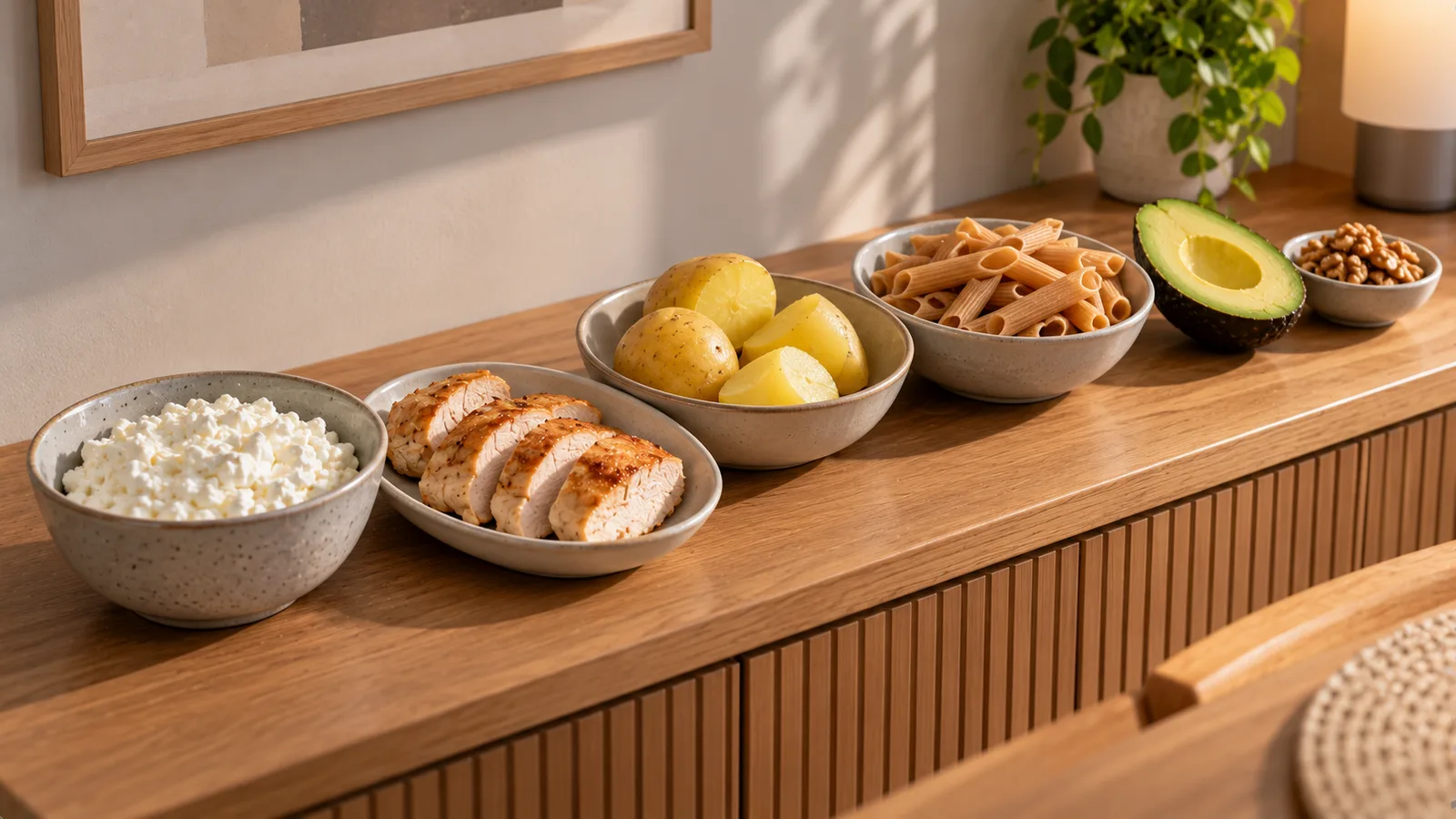
Hitting your macros does not require eating chicken, rice and broccoli every day.
Macro targets describe how much protein, carbohydrate and fat you aim to eat. They do not prescribe one fixed menu.
The practical goal is to build enough flexibility into your meals that different foods can produce a similar overall macro balance.
Start with targets, not a fixed menu
Suppose your daily targets are:
- 140 g protein;
- 220 g carbohydrates;
- 65 g fat.
You could reach those numbers through many different combinations of foods.
The mistake is turning one successful day into a permanent meal plan.
If chicken, rice and yogurt happened to fit your targets yesterday, that does not mean those exact foods are required today.
Think of your macros as a daily framework rather than a list of mandatory foods.
If you still need to establish your targets, see How to Calculate Your Macros.
Use food roles instead of fixed foods
A useful way to create variety is to group foods by the role they play in a meal.
Protein-focused foods
Examples include:
- chicken;
- turkey;
- lean beef;
- fish;
- shrimp;
- eggs and egg whites;
- Greek yogurt;
- cottage cheese;
- tofu;
- tempeh;
- lentils;
- beans.
These foods are not nutritionally identical, but they can serve a similar practical role: helping you reach your protein target.
Carb-focused foods
Examples include:
- rice;
- potatoes;
- pasta;
- oats;
- bread;
- couscous;
- quinoa;
- fruit;
- beans and lentils.
Fat-focused foods
Examples include:
- olive oil;
- avocado;
- nuts;
- seeds;
- nut butter;
- cheese;
- olives.
Many foods contribute to more than one macro. Eggs contain both protein and fat, while lentils provide protein and carbohydrates.
The categories are therefore practical tools, not strict nutritional classifications.
Build meals from interchangeable components
Instead of planning:
Monday lunch = chicken + rice + broccoli
plan:
lunch = protein + carbohydrate + vegetables + optional fat
That gives you many possible combinations:
| Protein | Carbohydrate | Vegetables | Fat / flavor |
|---|---|---|---|
| Chicken | Rice | Peppers | Olive oil |
| Tuna | Potatoes | Tomatoes | Olives |
| Tofu | Noodles | Broccoli | Sesame seeds |
| Turkey | Couscous | Cucumber | Tahini |
| Lentils | Bread | Mixed salad | Feta |
The exact macros will differ, so portions may need adjustment.
But the structure makes variety much easier.
Use macro swaps instead of meal repetition
A macro swap means replacing one food with another that serves a similar role while adjusting the portion if necessary.
For example, instead of eating the same protein every day, rotate among:
- chicken breast;
- turkey;
- tuna;
- salmon;
- shrimp;
- eggs;
- cottage cheese;
- tofu;
- tempeh;
- lentils.
You are not looking for foods with perfectly identical nutrition.
You are looking for alternatives that can fit after reasonable portion adjustments.
Protein swaps require attention to fat
Protein foods can differ substantially in fat content.
For example, replacing a lean protein with salmon may increase both protein and fat.
Replacing whole eggs with egg whites reduces fat.
Replacing chicken with lentils adds more carbohydrates.
So a useful swap considers the complete macro profile.
If the new protein source contains more fat, you may use less added oil or another fat source elsewhere in the meal.
If it contains more carbohydrates, you may slightly reduce the rice, bread or other carbohydrate source.
Carbohydrate swaps are easier when you use weighed portions
Rice, pasta, potatoes, bread and oats can all fit a macro-based diet.
But equal weights do not contain equal amounts of carbohydrate or calories.
Instead of assuming:
100 g rice = 100 g potatoes
check the nutrition data and adjust the portion.
The same principle applies when switching between cooked and dry weights.
Always make sure your database entry matches the state in which you weighed the food.
For more detail, see Raw vs Cooked Weight: Which Should You Use for Calories?.
Fat swaps can change portions quickly
Fat is energy-dense, so relatively small changes can noticeably affect your daily totals.
You might rotate among:
- olive oil;
- nuts;
- seeds;
- avocado;
- cheese;
- nut butter.
But the portions are not interchangeable gram for gram.
A spoonful of oil and the same weight of avocado have very different macro profiles.
Use the nutrition values rather than assuming all “healthy fats” are equivalent.
Give each meal a macro range
You do not need to hit an identical macro number at every meal.
Instead of requiring exactly 35 g protein at lunch, you might work with a practical range such as:
30–40 g protein
This creates room for different foods and portion sizes.
The daily total can still end up close to your target even if individual meals differ.
For example:
| Meal | Protein range |
|---|---|
| Breakfast | 25–35 g |
| Lunch | 30–40 g |
| Dinner | 35–45 g |
| Snacks | Remaining amount |
This is only an example. Your distribution depends on your own targets, meal frequency and preferences.
For a more detailed approach, see How to Split Macros Across Meals.
Do not force all three macros to be perfect at every meal
One meal can be higher in carbohydrates.
Another can contain more fat.
A third may be particularly protein-focused.
What matters for macro tracking is how those meals combine across the day.
Trying to make every plate match the same macro ratio can make food choices unnecessarily repetitive.
Plan protein first when protein is hardest to reach
For many people, protein is the macro that requires the most deliberate planning.
A simple approach is:
- choose a protein source for each main meal;
- estimate how much protein those meals provide;
- fill the remaining protein gap with snacks or another meal;
- adjust carbohydrates and fats around those choices.
Example:
- breakfast: 30 g protein;
- lunch: 35 g;
- dinner: 45 g;
- snacks: 30 g.
Total:
140 g protein
The foods providing those amounts can change from day to day.
Create a protein rotation
Instead of buying one protein source for the entire week, choose several.
For example:
Monday: eggs, chicken, Greek yogurt
Tuesday: cottage cheese, tuna, tofu
Wednesday: yogurt, turkey, salmon
Thursday: eggs, lentils, chicken
Friday: cottage cheese, shrimp, tempeh
The point is not to follow this exact schedule.
The principle is to rotate foods while keeping their macro role in mind.
Rotate carbohydrate sources too
Variety becomes much easier when carbohydrates change as well.
For example:
- rice one day;
- potatoes the next;
- pasta another day;
- bread at lunch;
- oats at breakfast;
- fruit as a snack;
- couscous or quinoa for another meal.
Different foods bring different textures, flavors and nutrient profiles.
Macro tracking does not require eliminating that variety.
Use different cuisines with the same basic structure
The same macro framework can support very different meals.
For example:
Mediterranean-style
- chicken or fish;
- potatoes or bread;
- tomatoes and cucumber;
- olive oil or feta.
Asian-inspired
- tofu, chicken or shrimp;
- rice or noodles;
- mixed vegetables;
- sesame or a measured sauce.
Mexican-inspired
- chicken, lean beef or beans;
- rice or tortillas;
- tomato, lettuce and peppers;
- avocado or cheese.
Simple European-style
- fish, eggs or poultry;
- potatoes or bread;
- vegetables;
- yogurt-based sauce or measured fat.
Changing seasonings, cooking methods and cuisines can create variety without abandoning your macro targets.
Save templates, not identical meals
A meal template describes the structure rather than the exact recipe.
For example:
Breakfast template
- protein-rich base;
- fruit;
- carbohydrate source;
- optional fat.
Possible versions:
- Greek yogurt + berries + oats + nuts;
- cottage cheese + banana + bread + nut butter;
- eggs + toast + fruit + avocado.
The meals are different, but each can be adjusted to serve a similar macro role.
Use a small library of flexible meals
You do not need hundreds of recipes.
A library of 10–15 meals that you genuinely enjoy can already create substantial variety.
For example:
- yogurt bowl;
- eggs and toast;
- overnight oats with yogurt;
- chicken rice bowl;
- tuna potato salad;
- turkey wrap;
- lentil bowl;
- tofu noodles;
- salmon potatoes;
- pasta with lean meat sauce;
- chickpea couscous;
- soup with bread and protein;
- cottage cheese snack;
- fruit and yogurt;
- sandwich with a protein filling.
Rotate these rather than trying to invent an entirely new menu every day.
Adjust portions before changing the whole meal
Suppose your planned dinner is:
- salmon;
- potatoes;
- vegetables;
- olive oil.
You check your daily totals and find that you need more carbohydrates but already have enough fat.
You do not necessarily need a different dinner.
You could:
- increase potatoes;
- reduce added oil;
- keep the salmon and vegetables.
Small portion changes can bring the meal closer to your remaining macros without rebuilding it.
Use your remaining macros as a decision tool
Near the end of the day, look at what remains.
Mostly protein remaining
Choose something protein-focused, such as:
- Greek yogurt;
- cottage cheese;
- lean meat;
- fish;
- tofu;
- egg whites.
Mostly carbohydrates remaining
Possible options:
- fruit;
- bread;
- rice;
- potatoes;
- oats;
- cereal.
Mostly fat remaining
Possible options:
- nuts;
- seeds;
- avocado;
- olive oil;
- nut butter.
Protein and carbohydrates remaining
You might use:
- yogurt with fruit and oats;
- a turkey sandwich;
- lentils with bread;
- cottage cheese with fruit.
The goal is not to find a mathematically perfect food. It is to make a practical adjustment.
Avoid saving all corrections for the final snack
If you repeatedly reach the evening needing 60 g protein while already at your fat and carbohydrate targets, the problem is probably earlier in the day.
Instead of trying to solve everything at 9 PM, review the pattern.
You might need:
- more protein at breakfast;
- a leaner lunch protein;
- less unplanned fat earlier;
- a different snack structure.
Macro tracking becomes easier when you correct recurring patterns rather than repeatedly fixing the final meal.
Pre-log when a day is difficult to balance
You do not have to pre-log every day.
But it can help when:
- you have a restaurant meal planned;
- dinner will be unusually high in fat;
- you know breakfast will be small;
- you have a social event;
- your protein target is difficult to reach.
Enter the less flexible meal first.
Then build the rest of the day around it.
This creates flexibility where you actually have control.
Example: adjusting around a higher-fat dinner
Suppose dinner will include salmon and a richer sauce.
Instead of avoiding the meal, you might choose earlier foods that are:
- higher in protein;
- lower in added fat;
- easy to portion.
Breakfast could use Greek yogurt and fruit.
Lunch could use lean chicken with rice and vegetables.
Dinner can then fit more comfortably without requiring the entire day to use the same foods.
Example: vegetarian macro day
A vegetarian day might combine:
Breakfast: Greek yogurt, oats and berries
Lunch: lentil bowl with vegetables and bread
Snack: cottage cheese and fruit
Dinner: tofu with rice and vegetables
Because lentils contain both protein and carbohydrates and tofu contains protein plus some fat, the portions can be adjusted around the total target.
The important point is that macro tracking still allows different food patterns.
Example: two different days with similar goals
Day A
Breakfast:
- eggs;
- toast;
- fruit.
Lunch:
- chicken;
- rice;
- vegetables.
Snack:
- Greek yogurt;
- berries.
Dinner:
- salmon;
- potatoes;
- salad.
Day B
Breakfast:
- cottage cheese;
- oats;
- banana.
Lunch:
- turkey wrap;
- vegetables.
Snack:
- yogurt;
- fruit.
Dinner:
- tofu;
- noodles;
- vegetables.
The foods are different, but both days can be adjusted toward similar macro targets by changing portions.
Do not chase exact numbers unnecessarily
A target of 140 g protein does not mean that 139 g is failure and 141 g is perfect.
Food labels, databases and portion estimates already contain some uncertainty.
For most everyday tracking, being consistently close to your intended targets is more practical than repeatedly modifying meals to make every number exact.
Use macro targets as guidance, not as a reason to turn food into a precision exercise.
Watch the weekly pattern
One day may naturally be higher in carbohydrates.
Another may contain more fat.
If your goals allow flexibility, looking at recurring patterns can be more useful than reacting to every small daily deviation.
For example, if you repeatedly miss protein by a substantial amount, that pattern deserves attention.
Being a few grams away on one day usually does not require a complete menu redesign.
Variety matters beyond macros
Two foods can have similar macro roles while providing different micronutrients, fiber, textures and flavors.
Rotating foods can help create a broader dietary pattern.
Instead of always asking:
Which food has the perfect macros?
also ask:
What different foods can fit this macro role?
That shift makes macro tracking more flexible.
A practical weekly system
At the start of the week, choose:
- 3–4 protein sources;
- 3–4 carbohydrate sources;
- several vegetables and fruits;
- 2–3 fat sources;
- a few flexible snacks.
Then combine them differently across the week.
For example:
Proteins: chicken, salmon, eggs, tofu
Carbs: rice, potatoes, oats, bread
Produce: broccoli, tomatoes, cucumber, berries, bananas
Fats: olive oil, avocado, nuts
Snacks: yogurt, cottage cheese, fruit
This provides many possible combinations without requiring a completely different grocery list every day.
A simple workflow for hitting macros with variety
- Know your daily macro targets.
- Give each meal a rough macro role or range.
- Choose several interchangeable foods for each role.
- Rotate protein and carbohydrate sources.
- Adjust portions instead of rebuilding meals.
- Check remaining macros during the day.
- Use flexible snacks for small gaps.
- Review recurring misses and adjust earlier meals.
- Keep enough meal templates to avoid boredom.
- Treat the target as a useful range rather than a demand for mathematical perfection.
Macro tracking works best when it helps you make decisions without forcing you into an unnecessarily repetitive diet.
The goal is not to find one perfect set of foods.
It is to build a flexible system in which many different meals can still move you toward the same daily targets.