
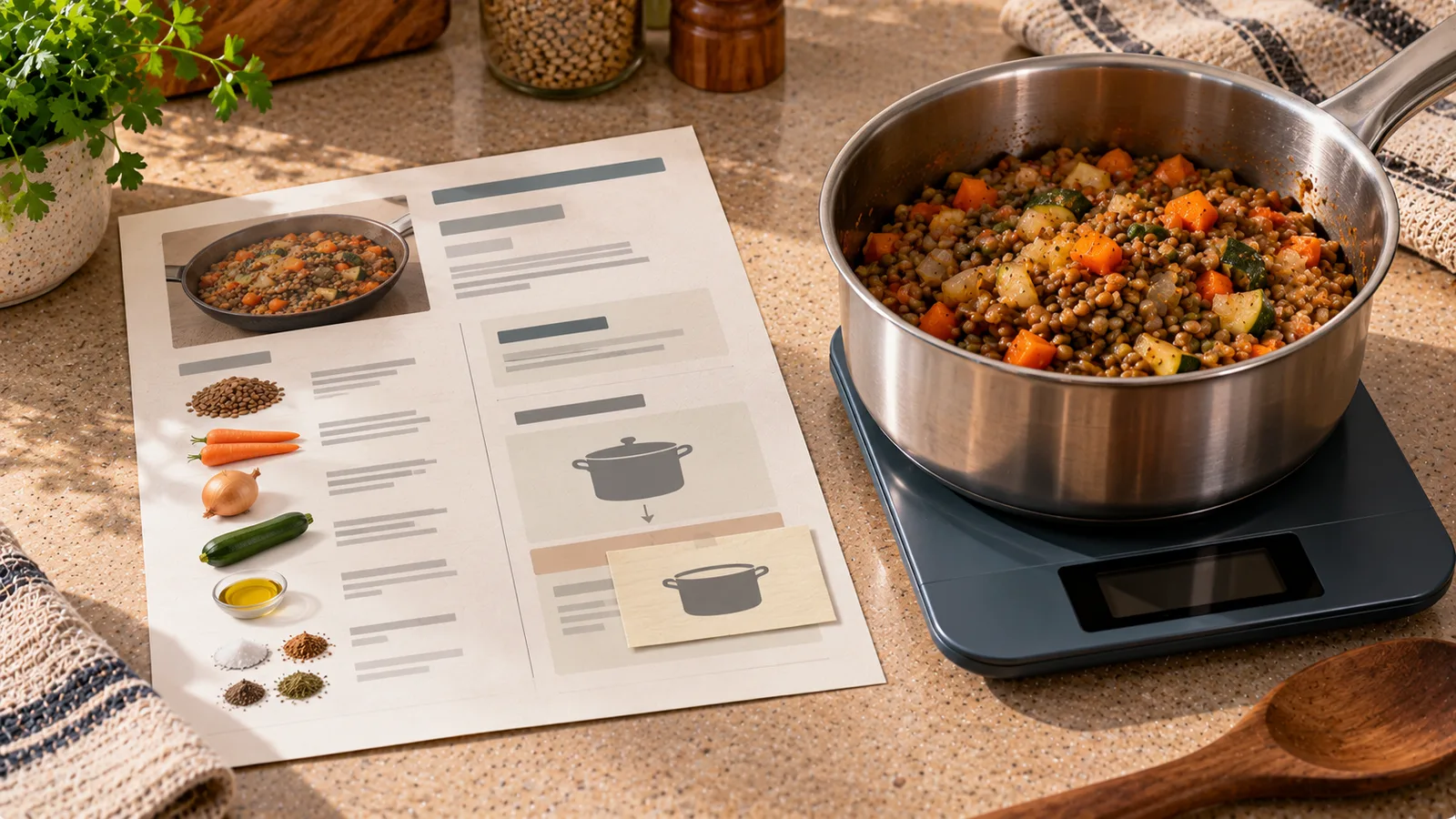
A saved recipe can contain exactly the same ingredients and still produce a different final weight each time you cook it.
Rice may absorb more water. A stew may simmer longer. Meat may lose more moisture. A sauce may reduce further than usual.
When this happens, the total calories and macros in the recipe do not automatically change. What changes is how those nutrients are distributed across the final cooked weight.
The key is to update the cooked batch yield without changing the ingredient totals.
Ingredients and cooked yield are two different things
A recipe has two separate sets of information:
- the ingredients that determine the total nutrition;
- the final cooked amount that determines how that nutrition is distributed.
Suppose a recipe contains ingredients totaling:
- 1,800 kcal;
- 120 g protein;
- 210 g carbohydrates;
- 55 g fat.
Those totals come from the ingredients.
If the finished batch weighs 1,500 g, the calories per 100 g are:
1,800 ÷ 1,500 × 100 = 120 kcal per 100 g
If you cook the same ingredients again but the final batch weighs only 1,350 g:
1,800 ÷ 1,350 × 100 = approximately 133 kcal per 100 g
Nothing was added to the recipe.
The second batch simply contains less water and therefore has more calories per gram.
Why cooked yield changes
Final batch weight can vary for many ordinary reasons.
Evaporation
Soups, stews, sauces and curries lose water while simmering.
A longer cooking time usually means more evaporation.
Water absorption
Rice, pasta, grains and legumes can absorb different amounts of water depending on cooking time, variety and method.
Meat moisture loss
Meat and poultry lose water during cooking.
The amount lost varies with:
- cut;
- fat content;
- cooking temperature;
- cooking time;
- cooking method.
Draining
A recipe may lose liquid when ingredients are drained after cooking.
Small measurement differences
Even when following the same recipe, actual ingredient amounts may vary slightly.
This is why a saved recipe should not assume that every future batch will have exactly the same final cooked weight.
The correct workflow
If the ingredient quantities are unchanged but the cooked yield changes, use this process:
- keep the saved ingredients unchanged;
- cook the recipe;
- weigh the finished edible batch;
- update the recipe's final cooked yield;
- log the amount you actually eat.
Do not alter ingredient calories simply to force the recipe to match the new cooked weight.
Example: same recipe, different yield
Imagine a homemade chicken and rice recipe.
The complete ingredient list contains:
2,100 kcal
Batch 1
Finished cooked weight:
1,750 g
Calories per gram:
2,100 ÷ 1,750 = 1.2 kcal/g
Calories per 100 g:
1.2 × 100 = 120 kcal
A 400 g portion contains:
400 × 1.2 = 480 kcal
Batch 2
You make exactly the same recipe again, but it cooks longer.
Finished weight:
1,600 g
Calories per gram:
2,100 ÷ 1,600 = 1.3125 kcal/g
Calories per 100 g:
approximately 131 kcal
A 400 g portion now contains:
400 × 1.3125 = 525 kcal
The recipe did not gain calories.
The second 400 g serving simply contains a larger fraction of the same ingredients because the batch contains less water.
What if the batch weighs more?
The opposite can also happen.
Suppose the same 2,100 kcal recipe finishes at:
1,900 g
Calories per 100 g:
2,100 ÷ 1,900 × 100 = approximately 111 kcal
A 400 g serving contains approximately:
444 kcal
Again, the total remains 2,100 kcal.
More retained or added water spreads those calories across a greater cooked weight.
Do not change the ingredients when only water changed
One common mistake is editing ingredient amounts because the final cooked weight is different.
For example, a soup contains:
- vegetables;
- beans;
- oil;
- stock;
- water.
If the soup simmers longer and loses 200 g of water, the calories from the vegetables, beans and oil have not disappeared.
You should not reduce the ingredient quantities.
Instead, keep the nutrition totals and update the finished yield.
Added water does not add calories
Suppose a soup contains 1,500 kcal and weighs 1,500 g after cooking.
That equals:
100 kcal per 100 g
You then add 300 g of water.
New weight:
1,800 g
Total calories remain:
1,500 kcal
New calorie density:
1,500 ÷ 1,800 × 100 = approximately 83 kcal per 100 g
The recipe became less calorie-dense because it contains more water.
Evaporated water does not remove calories
The reverse principle applies when water evaporates.
Suppose a sauce contains:
1,200 kcal
At 1,500 g finished weight:
1,200 ÷ 1,500 × 100 = 80 kcal per 100 g
After further reduction, it weighs 1,200 g:
1,200 ÷ 1,200 × 100 = 100 kcal per 100 g
The pot still contains approximately the same total calories, assuming no calorie-containing ingredients were removed.
There is simply less water.
When the total nutrition really does change
Updating only the cooked yield is appropriate when the ingredient totals remain the same.
But sometimes cooking changes more than water.
For example:
- you add extra oil;
- you add cheese after weighing;
- some sauce is discarded;
- rendered fat is drained away;
- part of an ingredient is left in the pan;
- you add another ingredient;
- you use a different amount of an ingredient.
In those situations, the saved ingredient list may also need to be updated.
The important question is:
Did only the final weight change, or did the amount of calorie-containing food in the batch change too?
Weigh the edible finished batch
When measuring cooked yield, weigh the food that can actually be served.
Do not include:
- the pot;
- baking dish;
- bones that will not be eaten;
- packaging;
- removable cooking equipment.
A simple method is to weigh the empty cooking container first.
For example:
Empty pot:
1,250 g
Pot plus finished food:
2,940 g
Finished food:
2,940 - 1,250 = 1,690 g
Enter 1,690 g as the cooked batch yield.
Tare the container when possible
A kitchen scale makes this easier.
If the scale can handle the full pot safely:
- place an empty container on the scale;
- tare it to zero;
- transfer the cooked food;
- record the displayed weight.
Alternatively, record the empty pot weight before cooking and subtract it afterward.
Avoid placing cookware on a scale if it exceeds the scale's weight or temperature limits.
Use grams for flexible portions
If you frequently eat different amounts of a batch recipe, saving the final yield in grams is useful.
Suppose:
- total recipe = 2,400 kcal;
- final cooked weight = 2,000 g.
Calories per gram:
2,400 ÷ 2,000 = 1.2 kcal/g
Then:
- 250 g = 300 kcal;
- 350 g = 420 kcal;
- 500 g = 600 kcal.
You do not need to force the batch into arbitrary equal servings.
Fixed servings can still work
If you always divide the finished batch into exactly six equal containers, you can use six servings.
Suppose the recipe contains 2,400 kcal.
2,400 ÷ 6 = 400 kcal per serving
If all six containers really contain equal portions, this works well.
However, if one container contains 300 g and another 450 g, treating both as one identical serving introduces error.
For unequal portions, logging by cooked weight is more precise.
Worked example with macros
Suppose the saved ingredients contain:
- 2,000 kcal;
- 140 g protein;
- 220 g carbohydrates;
- 60 g fat.
The finished batch weighs:
1,600 g
Per gram:
- calories: 2,000 ÷ 1,600 = 1.25 kcal;
- protein: 140 ÷ 1,600 = 0.0875 g;
- carbohydrates: 220 ÷ 1,600 = 0.1375 g;
- fat: 60 ÷ 1,600 = 0.0375 g.
For a 400 g portion:
- calories: 500 kcal;
- protein: 35 g;
- carbohydrates: 55 g;
- fat: 15 g.
Now imagine the next batch uses exactly the same ingredients but finishes at 1,800 g.
The total nutrition remains unchanged.
For a 400 g portion:
- calories: about 444 kcal;
- protein: about 31 g;
- carbohydrates: about 49 g;
- fat: about 13 g.
The difference comes from the changed cooked yield.
Rice is a common example
Cooked rice can vary substantially in weight depending on how much water it absorbs.
Suppose you cook the same 300 g dry rice on two occasions.
One batch finishes at:
850 g
Another finishes at:
930 g
If the dry rice used was identical, its total calories are essentially the same in both batches.
But 200 g of the wetter batch contains a smaller proportion of the original rice than 200 g of the drier batch.
This is why mixing dry-food nutrition data with cooked-food weight can cause inaccurate entries.
Use a consistent basis.
Pasta has the same issue
Pasta gains water during cooking.
If you save a recipe using dry pasta as an ingredient, keep the dry pasta amount in the ingredient list.
Then use the total cooked recipe weight as the final yield.
Do not replace the dry pasta ingredient with the cooked pasta weight unless you also switch to nutrition data specifically defined for cooked pasta.
Stews and soups often change through evaporation
A stew may weigh:
- 2,300 g after 30 minutes;
- 2,100 g after 45 minutes;
- 1,950 g after 60 minutes.
If no calorie-containing food is removed, the total calories remain broadly the same while calorie density increases.
This is why copying an old cooked yield into a new batch can produce a noticeable error.
Sauces can change even more
Tomato sauces, curries and other reductions can lose a large proportion of their water.
For these foods, final cooked weight can be especially useful.
Suppose a sauce contains 900 kcal.
At 1,200 g:
75 kcal per 100 g
Reduced to 900 g:
100 kcal per 100 g
A saved yield from the first version would underestimate a portion of the more concentrated second batch.
What about baking?
Baked foods also lose moisture.
However, some baked recipes are easier to track as fixed pieces when the pieces are deliberately cut into equal sizes.
If you need nutrition for individual slices based on the finished mass of a loaf or cake, that is a separate portion-calculation workflow.
For a general batch recipe, the principle remains the same: the ingredients determine total nutrition and the finished edible yield determines how that nutrition is distributed.
Do you need to update the yield every time?
Not necessarily.
If a recipe consistently finishes within a small range and you do not need high precision, using a typical saved yield can be practical.
For example, if several batches weigh:
- 1,780 g;
- 1,805 g;
- 1,790 g;
the difference may be too small to matter for your purpose.
But if batches vary more substantially, such as:
- 1,500 g;
- 1,750 g;
- 1,950 g;
updating the yield can materially improve portion estimates.
Use a typical yield for repeat recipes
After cooking the same recipe several times, you may establish a normal range.
For example:
- batch 1: 1,620 g;
- batch 2: 1,670 g;
- batch 3: 1,640 g.
Average:
(1,620 + 1,670 + 1,640) ÷ 3 = approximately 1,643 g
You could use about 1,640 g as a practical default and update it only when a batch is clearly different.
What if you already ate part of the batch?
Ideally, weigh the full batch before serving.
If you forget, you can sometimes reconstruct the yield.
Suppose:
- remaining food = 1,250 g;
- portion already eaten = 420 g.
Estimated original cooked yield:
1,250 + 420 = 1,670 g
This works only if the eaten portion was weighed or can be estimated reasonably.
Avoid creating false precision if the missing amount is unknown.
What if some food stays in the pot?
Small residues usually do not require elaborate corrections.
If a meaningful amount remains in the cooking vessel and will not be eaten, the edible yield is slightly lower than the measured total.
For ordinary food logging, consistency is often more useful than trying to account for every gram stuck to the pan.
What if liquid is discarded?
This requires more care.
If you discard plain water, the calorie total changes little.
If you discard a liquid containing:
- oil;
- rendered fat;
- sugar;
- starch;
- protein;
- sauce ingredients;
some nutrients may leave the recipe as well.
In that case, simply changing the final weight assumes all original calories remain in the food and may overestimate the final dish.
Unless you can measure what was discarded, the result should be treated as an estimate.
Do not invent missing precision
Food tracking is already based on estimates.
Ingredient labels vary. Cooking changes water content. Kitchen scales have limits. Portions are not always perfectly uniform.
Updating cooked yield can improve the calculation, but it does not make the result laboratory-precise.
Use the best information you reasonably have.
A simple rule to remember
When a repeated recipe comes out heavier or lighter than usual, ask:
Did I change the calorie-containing ingredients?
If the answer is no and the difference is mainly water gain or loss:
- keep the ingredients;
- keep the total calories and macros;
- update the final cooked weight.
If the answer is yes:
- update the affected ingredients as well;
- then record the new cooked yield.
Quick example
Saved recipe:
- total calories: 1,800 kcal;
- old cooked yield: 1,500 g.
Old calorie density:
120 kcal per 100 g
New batch:
- same ingredients;
- new cooked yield: 1,350 g.
New calorie density:
133 kcal per 100 g
A 300 g portion changes from:
360 kcal
to approximately:
400 kcal.
The total recipe is still 1,800 kcal.
Only the amount of recipe represented by each gram has changed.
Practical workflow for repeat batches
For a recipe you cook regularly:
- Keep the ingredient list saved.
- Update ingredients only when their actual quantities change.
- Weigh the finished edible batch when cooking is complete.
- Save that weight as the current cooked yield.
- Log portions by grams when portions vary.
- Use equal serving counts only when the batch is genuinely divided equally.
- Treat unusual losses of calorie-containing liquids or fat separately.
This separates two concepts that are easy to mix up: what went into the recipe and how much the recipe weighs after cooking.
Keeping those values separate makes saved recipes much easier to reuse accurately.