
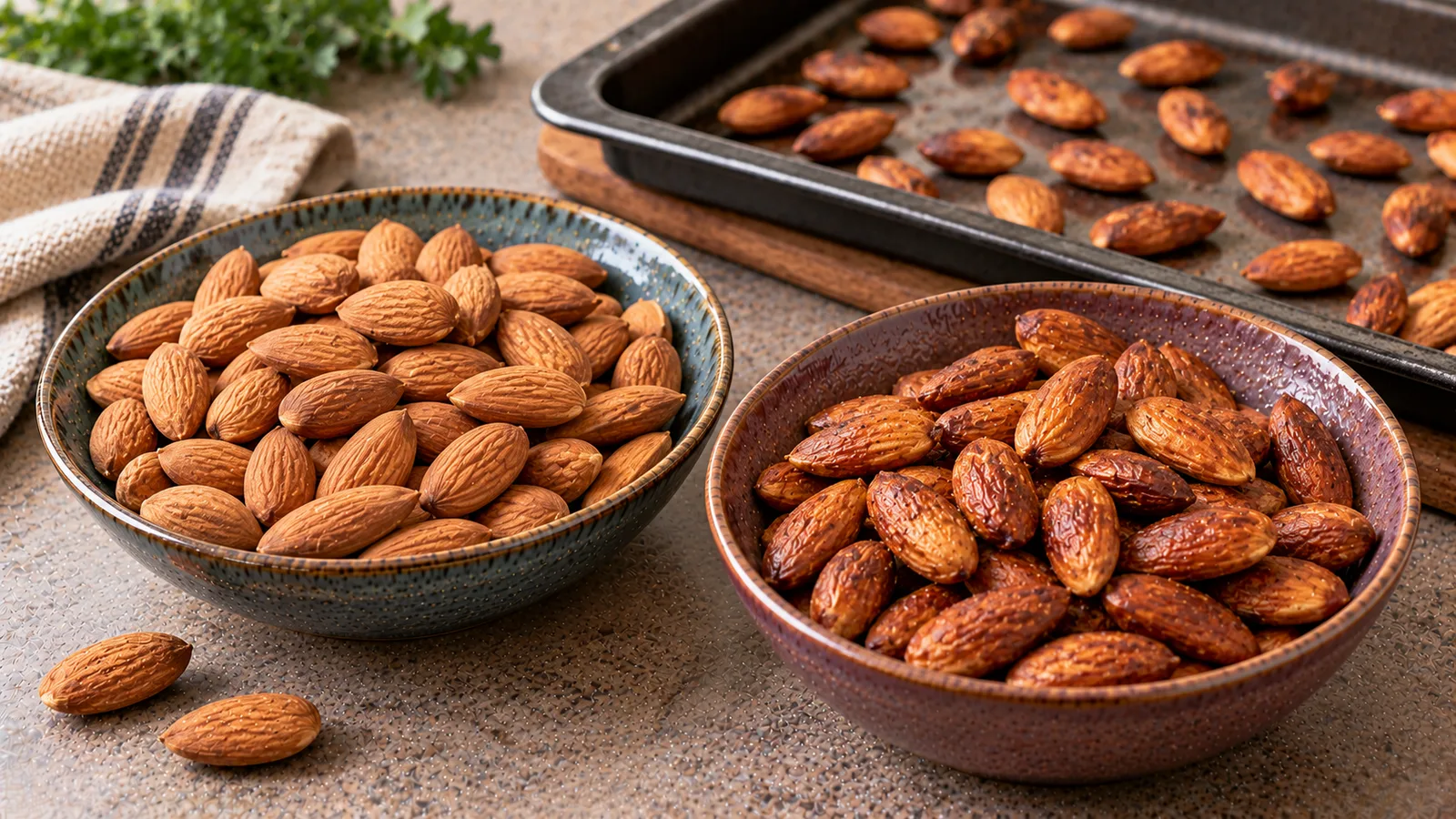
Roasting nuts makes them fragrant and crisp, but it does not automatically create extra energy inside a nut. The confusing part is the unit of comparison. A handful weighed before roasting, a handful weighed after roasting, and 100 g of finished nuts are three different questions. Most home cooks can estimate the change without laboratory equipment: weigh the starting nuts, weigh the finished cooled batch, and record any oil or sweet coating actually retained.
The short answer: total calories versus calories per 100 g
For a dry-roasted batch with no added ingredients, losing some water makes the finished nuts lighter. That can raise kcal per 100 g even if the energy in the entire batch remains approximately the same. The roast also changes texture, and some laboratory or digestion-related properties can change, so do not claim an exact zero-calorie change for every process. For practical meal logging, keeping track of mass and ingredients is more useful than assuming roasting adds a fixed percentage of calories.
USDA SR Legacy provides useful, separate reference profiles: regular almonds, FDC 170567: 579 kcal per 100 g; dry-roasted unsalted almonds, FDC 170158: 598 kcal per 100 g; and oil-roasted unsalted almonds, FDC 170159: 607 kcal per 100 g. These are database foods, not one controlled trial of the same 100 g sample. They should not be used to assert that your own home roast must increase by exactly 19 or 28 kcal per 100 g. See the USDA FoodData Central search and the identifiable raw, dry-roasted and oil-roasted SR Legacy records.
Example: 100 g of raw almonds becomes 97 g
Imagine starting with 100 g raw almonds at 579 kcal per 100 g and ending with 97 g of dry-roasted almonds. Assume, solely for this mass-balance illustration, that the 3 g loss is water and that no oil, sugar or edible nut material is added or lost. The starting batch holds about 579 kcal. The finished 97 g still holds approximately 579 kcal, so 100 g of this modeled finished product would equal 579 ÷ 97 × 100 = 597 kcal. The 597 is a calculated example, not a new laboratory value for roasted almonds.
If you eat the entire cooled batch, the starting and ending total are approximately the same under those assumptions. If you serve 30 g of the finished batch, the modeled estimate is 30 × 579 ÷ 97 ≈ 179 kcal. Conversely, 30 g of the original raw almonds contains approximately 174 kcal. Comparing those equal-weight portions is not the same as following the same individual nuts through roasting.
| What is being measured | Amount | Estimated kcal | What it means |
|---|---|---|---|
| Raw almonds, USDA reference | 100 g | 579 | Original raw weight |
| Raw almonds, smaller portion | 30 g | 174 | Based on 579 kcal/100 g |
| Home-roasted example, entire batch | 97 g | ~579 | Assumes only 3 g water lost |
| Home-roasted example, finished portion | 30 g | ~179 | Calculated from that batch |
| USDA dry-roasted reference | 100 g | 598 | Separate database food |
| USDA oil-roasted reference | 100 g | 607 | Separate database food |
What changes when you add oil?
Oil can genuinely add energy to a batch. As a transparent example, start with the same 100 g raw almonds (579 kcal). Suppose 2 g oil is actually retained, contributing approximately 18 kcal at the usual calculation of 9 kcal per gram of fat. Suppose the nuts lose 3 g water, so the final scale reads 99 g (100 − 3 + 2). The batch is then about 597 kcal, or 597 ÷ 99 × 100 ≈ 603 kcal per 100 g. This is an illustrative accounting model, not a measured recipe outcome; some oil can remain on the tray, and the nut's composition and losses vary.
Do not automatically count every millilitre poured into a roasting pan as eaten. Measure a suitable amount where possible, use a brand label for packaged oil-roasted nuts, and avoid assigning an exact uptake fraction without evidence. Sugar, honey, butter or other coatings also contribute energy and may alter the finished weight. Salt alone does not meaningfully contribute calories, but seasoned snack products may include oils and sugars alongside salt.
Which weight should you enter in a food tracker?
When logging a packaged product, first use its own nutrition label and the grams actually eaten. The label may use a serving size different from your handful. For homemade dry-roasted nuts, a raw entry is reasonable when you recorded each ingredient before cooking and are allocating the completed batch in proportion to the final weight. If you weigh only the cooked portion, a suitable roasted food entry or a batch recipe calculator is usually easier. Never add a second set of calories for the same raw nuts simply because they were roasted.
For mixed nuts, use separate records for almonds, walnuts, cashews and others where practical. They have different baseline values and different moisture contents. A general statement such as “roasting adds 20 calories” has no useful unit unless it specifies which nut, amount and preparation. If you prepared 200 g, the grams per serving and the final batch weight matter more than whether the bowl looks larger or smaller.
How to measure a batch at home
Weigh the empty baking tray or bowl if necessary, then weigh the raw edible nuts. Record oil, syrup or sugar separately. Roast without burning, allow the nuts to cool, and weigh the finished edible batch after removing any crumbs or discarded material. Record the finished weight; divide total estimated recipe calories by that weight to find kcal per gram. Multiply by the actual portion served. A note with the date, nut type and seasoning makes future repeated batches easier to estimate.
A scale cannot tell you the exact grams of water, oil or nut solids lost. The arithmetic above uses assumptions and works best for straightforward home batches. For commercial flavored nuts, a label is usually a stronger source than reverse-engineering oil retention. If a recipe uses nut butter, flour or chopped nuts, consult the correct form because grinding can affect the energy released during digestion, not just the number on a nutrition table.
For related measurement guidance, see weighing raw versus cooked food.
Does roasting affect calories absorbed by the body?
There is a deeper distinction between label energy and metabolizable energy. A systematic review of human and in-vitro studies found that, for studied nuts, measured metabolizable energy was often lower than conventional Atwater-factor predictions. The physical form of a nut and processing may influence how much fat is released during digestion. That does not produce a reliable personal discount like “subtract 15% from every almond serving.” Laboratory findings do not justify editing the label of an individual bag without a validated method.
For ordinary calorie tracking, use the best matching USDA or packaged-food data consistently. For a scientific explanation, separate three quantities: the amount present in the edible material, the standard database/label estimate and the energy a person actually absorbs. Roasting, chopping and grinding do not affect all three in precisely the same way. A useful article should make that uncertainty explicit rather than promising precision that a kitchen scale cannot supply.
Practical answers to common situations
A small handful: weigh a typical handful at least once. For example, 30 g raw almonds ≈ 174 kcal using the stated USDA record, while 30 g dry-roasted reference almonds ≈ 179 kcal. The difference is small compared with an unmeasured handful varying from 20 g to 45 g. A large batch: track ingredient weights before cooking and finished weight after cooling. Air-fryer or oven nuts: neither appliance defines calorie content; oil, coating and final mass do. Roasted nuts in salads: count the weighed nuts plus any dressing separately so the same oil is not added twice.