
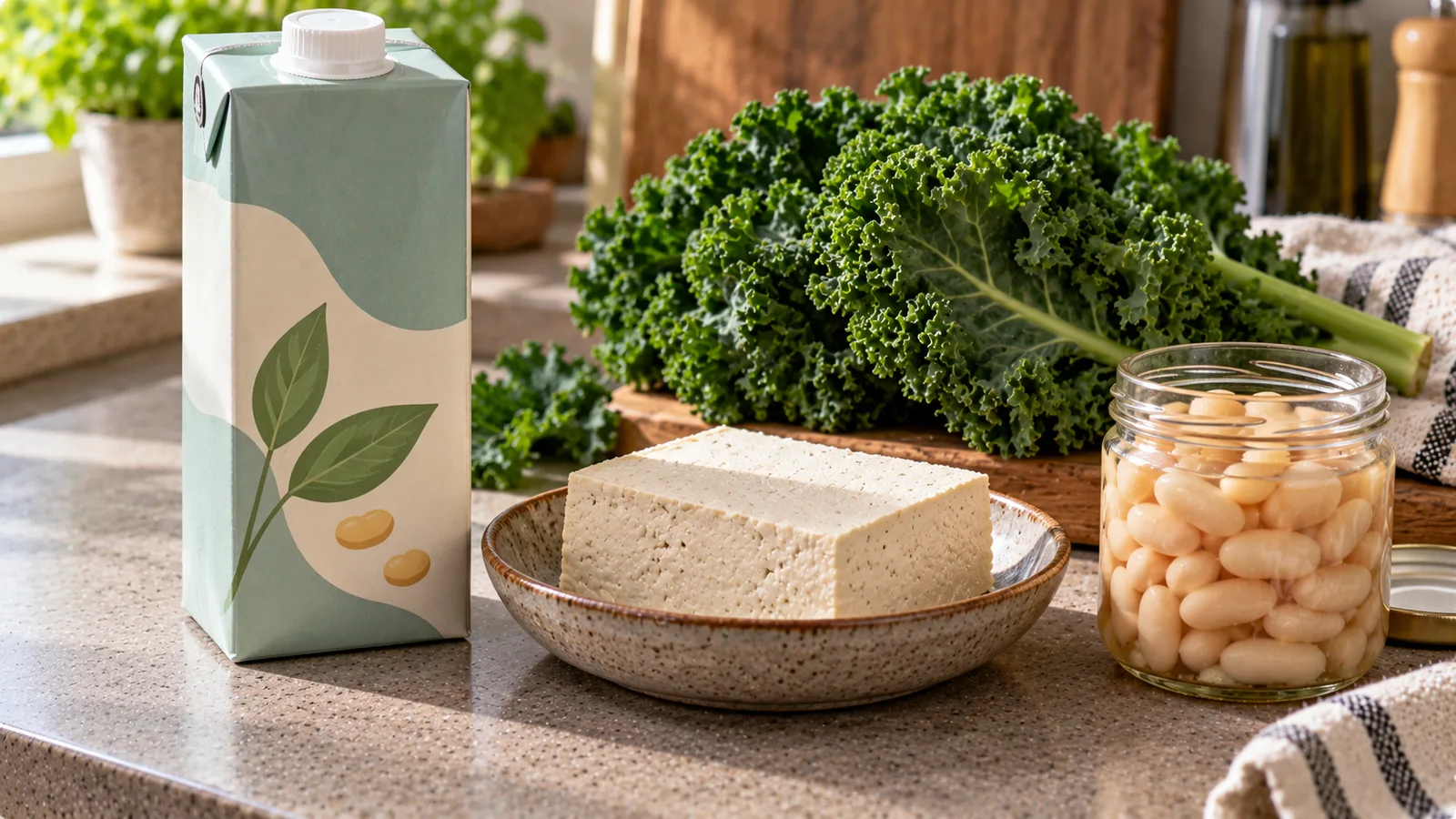
You can obtain calcium without drinking milk or eating cheese. The important question is not simply whether a food contains calcium, but how much calcium it provides in the portion you actually eat.
Calcium is needed for normal bone and tooth structure, as well as functions involving muscles and nerves. The US National Institutes of Health (NIH) explains its roles, food sources and recommended intakes.
For people avoiding dairy because of preference, allergy, intolerance or a plant-based eating pattern, the most useful approach is to combine naturally calcium-containing foods with carefully selected fortified products.
This guide explains which foods to consider, why some apparent sources contribute less than expected, and how to read labels without relying on marketing claims.
How much calcium do adults need?
Calcium requirements vary by age and life stage.
For adults aged 19–50, the US recommended dietary allowance is 1,000 mg per day. It is 1,200 mg for women aged 51–70 and for adults aged 71 and older. Requirements for adolescents and pregnancy-related age groups differ.
These are US reference values from the NIH Office of Dietary Supplements.
European and national reference systems may differ. The German Nutrition Society (DGE) uses a reference value of 1,000 mg per day for adults.
A daily reference is not a requirement to obtain exactly the same quantity at every meal. It is a tool for assessing overall intake.
People with kidney disease, a history of kidney stones, certain medical conditions or prescribed supplements may need individualized advice.
Non-dairy calcium sources at a glance
The following are illustrative food-composition ranges, not guaranteed values for every brand or preparation.
| Food | Example portion | Approximate calcium |
|---|---|---|
| Calcium-fortified plant drink | 250 ml | 250–300 mg |
| Calcium-set firm tofu | 100 g | 200–350 mg |
| Canned sardines with edible bones | 85 g | 250–325 mg |
| Cooked kale | 100 g | 100–180 mg |
| Cooked broccoli | 150 g | 50–75 mg |
| Tahini | 20 g | Highly variable |
| Almonds | 30 g | Around 75–80 mg |
| Cooked white beans | 150 g | Approximately 90–140 mg |
Values depend on product formulation, processing, drained weight and the food database used.
Calcium-set tofu in particular can vary substantially. Some tofu products contain far less calcium than the range above.
For specific foods, consult the USDA FoodData Central database or the manufacturer's nutrition declaration.
1. Fortified plant drinks
Fortified soy, oat, almond and other plant drinks can be convenient calcium sources.
A drink containing 120 mg calcium per 100 ml provides:
| Amount consumed | Calcium |
|---|---|
| 100 ml | 120 mg |
| 150 ml | 180 mg |
| 200 ml | 240 mg |
| 250 ml | 300 mg |
| 300 ml | 360 mg |
These figures apply only to a product with the stated concentration.
Not every plant drink is fortified. Organic, unfortified or homemade versions may contain substantially less calcium.
Check the ingredient list for added calcium compounds and the nutrition panel for the declared amount.
Some fortified drinks require shaking because minerals can settle. Follow the package instructions.
2. Tofu: the coagulant matters
Tofu can be a substantial calcium source when calcium salts are used in its production.
Look for ingredients such as calcium sulfate or other calcium-containing coagulants.
However, the presence of a calcium coagulant does not tell you the exact calcium content.
Two tofu products with similar protein and calorie values can provide very different amounts of calcium.
For example, if one tofu lists 300 mg calcium per 100 g:
- 75 g provides 225 mg.
- 100 g provides 300 mg.
- 150 g provides 450 mg.
If another tofu lists only 80 mg per 100 g, a 150 g portion provides 120 mg.
Check the product declaration when available instead of assuming that all firm tofu is calcium-rich.
3. Fish with edible bones
Some canned fish contain calcium because their softened bones are eaten.
Sardines and certain canned salmon products are examples.
The key distinction is with bones versus boneless.
A boneless fillet may provide much less calcium than the corresponding product with edible bones.
Check the product description and use a food-composition record that matches the actual preparation.
This source is suitable for some omnivorous diets but not vegetarian or vegan diets.
4. Green vegetables
Vegetables can contribute calcium, but the amount absorbed differs between foods.
Kale, bok choy and broccoli can be useful additions.
Spinach contains calcium, yet its high oxalate content reduces the proportion that the body can absorb.
The NIH calcium fact sheet discusses the influence of oxalates and phytates on calcium absorption.
This is why comparing calcium per 100 g alone can be misleading.
A large serving of a vegetable with better calcium bioavailability may be more useful than choosing a food solely because a database lists a high total calcium value.
Vegetables also contribute other nutrients, so calcium should not be the only reason to include them.
5. Beans, nuts and seeds
Legumes, nuts and seeds can add calcium to a dairy-free eating pattern.
Examples include white beans, almonds, sesame and tahini.
However, these foods differ considerably in calcium concentration, serving size and bioavailability.
A tablespoon of tahini may contain much less calcium than expected, depending on whether the product is made from hulled or unhulled sesame and how it is processed.
Nuts and seeds also contain substantial amounts of energy relative to their typical portions.
They can contribute to calcium intake, but it may be impractical to rely on them as the only major source.
Use product-specific data where possible.
How to read calcium on food labels
A nutrition label may show calcium in milligrams, as a percentage of a daily reference value, or both.
The most useful calculation is:
Calcium per portion = calcium per 100 g or 100 ml × portion size ÷ 100.
Example:
A fortified drink lists 120 mg calcium per 100 ml.
For a 250 ml glass:
120 × 250 ÷ 100 = 300 mg calcium.
A tofu product lists 240 mg per 100 g.
For a 175 g portion:
240 × 175 ÷ 100 = 420 mg calcium.
For foods sold in the European Union, the food information regulation establishes requirements for nutrition declarations.
Calcium is not necessarily displayed on every ordinary product label. Its absence from the panel does not prove that the food contains no calcium.
What does “source of calcium” mean in the EU?
European nutrition claims are regulated rather than being unrestricted marketing phrases.
Under Regulation (EC) No 1924/2006, claims such as “source of calcium” and “high in calcium” are linked to conditions involving the amount of calcium present.
The applicable thresholds depend on the food category and relevant reference values.
For adults, the EU nutrient reference value for calcium is 800 mg, as specified in the framework of Regulation (EU) No 1169/2011.
This reference value is used for labeling and should not be confused with every individual's recommended daily intake.
The EU rules on adding vitamins and minerals to foods also provide relevant context for fortified products.
When choosing a product, the declared milligrams per actual portion are usually more useful than the claim on the front of the package.
Does “dairy-free” mean calcium-rich?
No.
“Dairy-free,” “vegan,” “plant-based” and “lactose-free” describe different product characteristics.
None of these descriptions guarantees a high calcium content.
For example:
| Product description | What it does not guarantee |
|---|---|
| Dairy-free | That calcium has been added |
| Vegan | That calcium content is high |
| Organic plant drink | That it is fortified |
| High-protein plant drink | That it contains much calcium |
| Lactose-free milk | That it is dairy-free |
Lactose-free cow's milk is still a dairy product and is not suitable for someone with a cow's milk protein allergy.
People with food allergies should check the full allergen information rather than relying on a single front-of-pack phrase.
Build a calcium-aware dairy-free day
Here is a hypothetical example, using specific assumed calcium concentrations.
| Food | Portion | Example calcium |
|---|---|---|
| Fortified plant drink, 120 mg/100 ml | 250 ml | 300 mg |
| Calcium-set tofu, 250 mg/100 g | 150 g | 375 mg |
| Cooked kale | 150 g | 225 mg |
| Almonds | 30 g | 75 mg |
| Total from these foods | 975 mg |
This is a calculation example, not a complete daily meal plan.
The assumed kale and tofu values may not match your products. Other foods eaten during the day may also contribute calcium.
If your tofu is unfortified or contains little calcium, the total could be substantially lower.
The point is to verify the main sources rather than treating every plant-based product as nutritionally interchangeable.
What about calcium absorption?
The calcium shown on a label is not identical to the amount absorbed by the body.
Absorption depends on several factors, including the food matrix, the calcium compound, other dietary components and physiological conditions.
Vitamin D also plays a role in calcium metabolism.
The NIH professional calcium fact sheet discusses these factors and the evidence concerning calcium sources.
For everyday meal planning, the practical priorities are to obtain adequate calcium from varied foods and to avoid assuming that all sources have identical bioavailability.
Do you need a calcium supplement?
Not everyone who avoids dairy needs a supplement.
A well-planned diet may provide sufficient calcium through fortified products and other foods.
However, people with very restricted diets, consistently low calcium intake or relevant medical conditions may need professional assessment.
Calcium supplements can interact with some medications, and excessive total intake may carry risks.
The NIH consumer guidance explains recommended amounts, upper limits and interactions.
Do not automatically add a high-dose supplement merely because you do not consume dairy.
Common label-checking mistakes
| Mistake | Better approach |
|---|---|
| Assuming all oat drinks contain calcium | Check calcium in mg per 100 ml |
| Treating all tofu as calcium-rich | Check the coagulant and nutrition data |
| Comparing different serving sizes | Convert values to a common unit |
| Using calcium percentage without understanding the reference | Check the underlying mg amount |
| Assuming spinach calcium is fully available | Consider differences in absorption |
| Counting calcium supplements without checking dose | Review the product and medical guidance |
A simple dairy-free shopping checklist
When buying food specifically to support calcium intake:
- Choose one or more reliable calcium sources you will actually consume.
- Check whether plant drinks are fortified.
- Compare tofu products rather than relying on the word “tofu.”
- Include suitable vegetables and other varied foods.
- Record calcium in milligrams for your normal portion.
- Recheck labels when changing brands.
- Seek individualized advice if your intake remains consistently low.
The practical conclusion
A dairy-free diet can provide calcium, but it requires attention to actual portions, product formulation and label information.
Fortified plant drinks, calcium-set tofu, certain fish with edible bones and selected vegetables can all contribute.
The strongest approach is to calculate the calcium in foods you regularly eat, rather than assuming that a food is calcium-rich because it is plant-based, high in protein or marketed as healthy.