
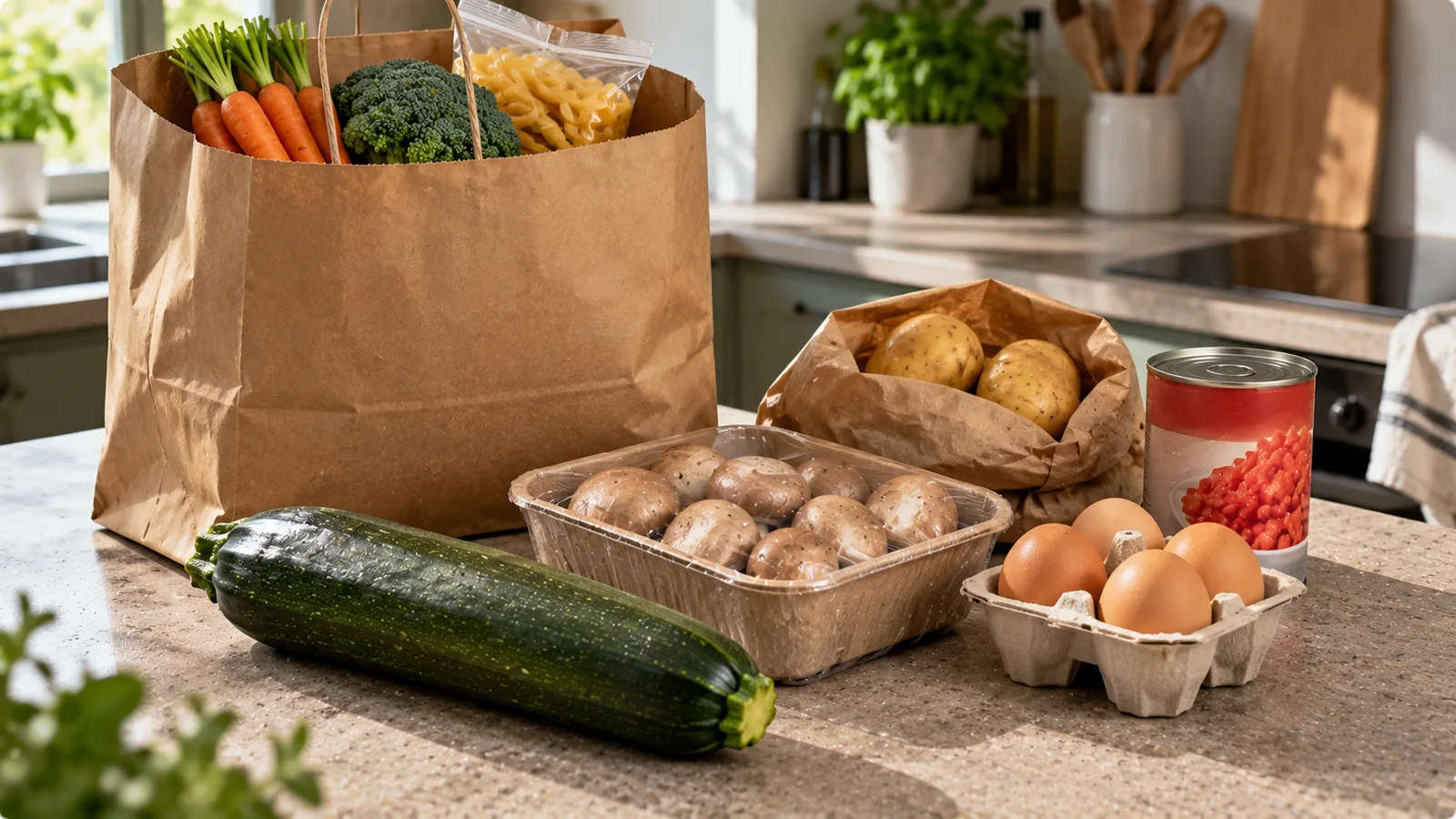
A grocery delivery can change your meal plan before the week even begins. The store may replace fresh spinach with frozen spinach, deliver a different package size, substitute chicken thighs for chicken breast, or leave an ingredient out entirely.
These changes do not necessarily mean you need to start planning from scratch.
The most useful approach is to repair the affected meals first, then update the shopping quantities and cooking order. A good substitution preserves the purpose of an ingredient, not just its appearance or supermarket category.
This guide provides a practical system for adapting a weekly meal plan after an unexpected delivery.
First, compare the order with what actually arrived
Do not begin by changing every recipe. Start with a quick inventory of the differences between the original order and the delivered groceries.
Sort each change into one of four categories:
| Delivery result | Example | First action |
|---|---|---|
| Equivalent replacement | One brand of plain canned tomatoes replaces another | Check quantity and ingredients, then keep the recipe |
| Usable but different | Frozen spinach replaces fresh spinach | Adjust preparation and water content |
| Important mismatch | Sweetened yogurt replaces plain yogurt | Check whether the intended recipe still works |
| Missing or unsuitable item | Chickpeas unavailable or an allergen-containing substitute arrives | Find a safe replacement or change the affected meal |
This classification helps avoid unnecessary work. An equivalent product may need no recipe change at all.
Check the actual label before accepting a replacement as equivalent, particularly when allergies, intolerances or other dietary restrictions are involved.
Use the ingredient's role to choose a replacement
An ingredient can serve several purposes in a recipe. Understanding its main role makes substitutions more reliable.
| Ingredient role | Typical examples | What the replacement needs to preserve |
|---|---|---|
| Main protein component | Beans, lentils, tofu, chicken, fish | Suitable protein source, cooking method and portion |
| Starchy base | Rice, pasta, potatoes, couscous | Appropriate cooked quantity and texture |
| Vegetable component | Broccoli, spinach, carrots, courgette | Usable volume, cooking time and flavor balance |
| Sauce or moisture | Tomatoes, yogurt, stock | Consistency, acidity and sufficient liquid |
| Binding or structure | Eggs, flour, breadcrumbs | Ability to hold the mixture together |
| Flavoring | Herbs, spices, lemon | Intended flavor without introducing unwanted ingredients |
These are functional categories, not automatic one-for-one substitutions.
For example, swapping canned chickpeas for dry chickpeas requires a different preparation process. Replacing flour with another flour can alter a baked recipe's structure. Substituting a dairy product may also affect protein, fat, acidity and allergens.
If the ingredient performs a critical structural or safety function, use a tested recipe variation rather than improvising.
A five-step meal-plan repair method
Step 1: Mark only the affected recipes
Open the original weekly plan and identify every meal that uses a missing or changed ingredient.
Suppose you planned:
- Monday: chicken and rice bowls.
- Tuesday: spinach and lentil pasta.
- Wednesday: chickpea vegetable curry.
- Thursday: chicken wraps.
- Friday: vegetable soup.
If chicken breast is replaced by chicken thighs and fresh spinach is replaced by frozen spinach, only three meals need immediate attention.
The chickpea curry and vegetable soup can remain unchanged if all their ingredients arrived.
Step 2: Decide whether to adapt, swap or postpone
For each affected recipe, choose one action:
Adapt: Keep the meal but change the ingredient or cooking method.
Swap: Move another planned meal into that day's slot because its ingredients are available.
Postpone: Delay a meal until a suitable ingredient can be obtained, without buying more food unnecessarily.
Adaptation is usually the simplest choice when the substitute is compatible. Swapping meals is useful when one ingredient is missing but another recipe can be cooked immediately.
Postponing should be the last choice if it creates an additional shopping trip or leaves fresh ingredients unused.
Step 3: Recalculate ingredient quantities
Package size changes are easy to overlook.
Imagine a recipe needs 400 g of cooked beans, but the delivery contains two cans with 240 g drained weight each.
The available amount is:
2 × 240 g = 480 g drained beans.
You could use 400 g and store the remainder appropriately, or adjust the recipe if the other ingredients can also be scaled.
Do not use the can's total weight as the edible drained weight.
Likewise, a larger bag of vegetables does not require you to increase every other ingredient. Decide whether to cook the extra vegetables separately, freeze them if suitable, or use them in another meal.
Step 4: Update cooking instructions
A replacement may affect cooking time, temperature, liquid and texture.
Examples:
- Frozen spinach may release more water than fresh spinach.
- Chicken thighs and chicken breast differ in shape, fat content and cooking behavior.
- A different pasta shape may have a different cooking time.
- Canned beans are already cooked, while dry beans require preparation.
- A thicker yogurt may change the consistency of a sauce.
Follow safe cooking instructions for the actual food received. Do not rely on the timing written for a different ingredient.
For poultry and other higher-risk foods, use an appropriate food thermometer and established food-safety guidance rather than judging doneness by appearance alone.
Step 5: Update the plan and shopping list together
After adapting the recipe, update:
- The recipe ingredient list.
- The quantities available at home.
- The cooking instructions.
- The remaining meals that share those ingredients.
- Any genuinely necessary replacement purchases.
This prevents a common problem: changing one recipe but leaving the old grocery list and inventory unchanged.
Worked example: repairing a three-day plan
Imagine the original plan uses the following ingredients:
| Planned meal | Original requirement |
|---|---|
| Day 1: Chicken rice bowls | 500 g chicken breast, rice, peppers |
| Day 2: Spinach lentil pasta | 200 g fresh spinach, cooked lentils, pasta |
| Day 3: Chickpea tomato curry | 400 g drained chickpeas, tomatoes, rice |
The delivery contains:
- 600 g chicken thighs instead of 500 g chicken breast.
- 300 g frozen spinach instead of 200 g fresh spinach.
- One 240 g drained can of chickpeas instead of 400 g.
- All other ingredients as ordered.
A reasonable repair is:
| Meal | Repair | What changes |
|---|---|---|
| Chicken rice bowls | Use suitable chicken thighs | Adjust trimming, cooking and nutritional estimate |
| Spinach lentil pasta | Use an appropriate amount of frozen spinach | Thaw or cook as directed; manage excess water |
| Chickpea curry | Reduce chickpeas and add suitable available vegetables or lentils | Rebalance portions and update nutrition |
The curry should not automatically be described as nutritionally identical after reducing its chickpeas. If protein content matters, estimate the revised recipe rather than copying the original values.
The extra chicken or spinach can be allocated to another meal only if storage and food-safety conditions allow.
Protect allergies and dietary restrictions first
A substitution is unacceptable if it introduces an ingredient that the person cannot safely consume.
A product may look similar while containing different allergens, sweeteners, dairy ingredients, gluten-containing components or other additives.
When reviewing a substitute:
- Read the complete ingredient and allergen information.
- Check whether the product is suitable for the intended diet.
- Do not assume the original product's label applies to the replacement.
- Reject or separate an unsuitable product.
- Select a verified safe alternative or change the meal.
For a diagnosed allergy, follow individualized medical advice. A generic substitution list cannot guarantee product safety.
Keep the nutritional purpose of the meal
Sometimes a substitute works in a recipe but changes its nutritional profile.
For example, replacing a lean meat with a fattier cut may change calories and fat. Replacing beans with vegetables may reduce protein. Using a sweetened dairy product instead of an unsweetened version may increase sugars.
When nutrition targets matter, update the calculation using the actual products and quantities.
Focus on the components that materially changed:
- Protein-rich ingredients.
- Added fats and oils.
- Starchy ingredients.
- Sugary sauces or sweetened products.
- Total edible portion size.
You do not need to recalculate an entire week because one herb was replaced with another. Reserve detailed recalculation for substitutions likely to affect the result.
Repair the budget as well as the recipes
Delivery substitutions can change the final grocery bill.
Some services charge the price of the substitute, while others use different pricing rules. Refunds, substitutions and final charges should be checked against the actual receipt.
A simple comparison is:
Revised weekly grocery cost = final delivery charge + additional purchases − refunds not already reflected in the final charge.
Avoid double-counting refunds.
Suppose the original order estimate was €62. The final delivery charge is €65, and you buy an additional ingredient for €3.
The revised total is:
€65 + €3 = €68.
The difference from the original estimate is €6.
These are illustrative numbers, not actual prices or a prediction of a delivery service's policies.
If the substitute costs more, consider whether it can replace an ingredient planned for another meal before buying additional food.
Reorder meals to reduce waste
A grocery substitution can change which ingredients should be cooked first.
Review the condition, packaging, use-by dates and storage requirements of the foods that arrived.
Then prioritize:
- Foods that need prompt use.
- Opened or highly perishable ingredients.
- Meals that depend on ingredients with limited storage life.
- Shelf-stable meals that can wait until later.
Do not assume a substitute has the same shelf life as the originally ordered product.
If a delivery contains food that arrived at an unsafe temperature, is damaged or otherwise appears unsafe, follow food-safety guidance and contact the retailer where appropriate. Meal planning should never override food safety.
What if a central ingredient is missing?
A central ingredient may define the meal.
If tortillas are missing from a planned wrap dinner, the filling might still work as a rice bowl or salad. If a key ingredient for a specific baked dish is missing, however, converting the recipe may be impractical.
Use this decision sequence:
- Can the meal be made safely with ingredients already available?
- Does the replacement preserve the meal's main function?
- Would changing the meal use other ingredients before they spoil?
- Is another planned meal easier to move forward?
- Is an additional purchase genuinely necessary?
The aim is to avoid turning one missing product into several unnecessary purchases.
Handling unexpected package sizes
Delivery services may substitute a smaller or larger pack than ordered.
For a smaller pack, determine whether the recipe can be scaled down without losing its balance. For a larger pack, decide whether the surplus can be used, stored or frozen safely.
A simple scaling factor is:
Scaling factor = available quantity ÷ original required quantity.
If a recipe requires 600 g of vegetables and you receive 450 g:
450 ÷ 600 = 0.75.
A three-quarter batch may be possible, provided other ingredients and cooking methods can be scaled appropriately.
Not every recipe scales linearly. Baking, seasoning, cooking time and pan size may require separate adjustments.
A ten-minute repair checklist
Use this short sequence immediately after unpacking the delivery:
- Check the delivery against the order.
- Separate unsuitable or unsafe replacements.
- Mark missing and changed ingredients in the meal plan.
- Identify the affected recipes.
- Adapt or reorder those meals.
- Recalculate important quantities and nutrition values.
- Update the grocery inventory.
- Check the final charge and any refunds.
- Set the cooking order according to freshness and storage.
- Add only essential missing items to a follow-up shopping list.
This process can be quick when most substitutions are equivalent. Complex dietary restrictions or several missing ingredients may require more time.
Building a plan that survives substitutions
A flexible weekly plan is easier to repair when several meals share adaptable ingredients without relying on a single fragile recipe.
Useful design choices include:
- Keeping one or two flexible meals that can use different vegetables.
- Having a suitable shelf-stable protein option when appropriate.
- Planning a rice, pasta or potato base that works with several sauces.
- Recording realistic ingredient quantities rather than only recipe names.
- Avoiding excessive purchases of highly perishable ingredients.
- Keeping allergies and essential dietary exclusions clearly visible.
Flexibility does not mean every ingredient is interchangeable. It means you know which changes are acceptable and which require a different meal.
Final takeaway
Grocery delivery substitutions do not have to disrupt an entire week of eating.
Start by identifying the actual changes, then repair only the affected meals. Match replacements to their culinary function, update quantities and cooking instructions, and check nutrition, allergies, cost and storage where relevant.
The best repaired plan is not necessarily identical to the original. It is one that uses the food you actually received safely, economically and with as little unnecessary waste as possible.