
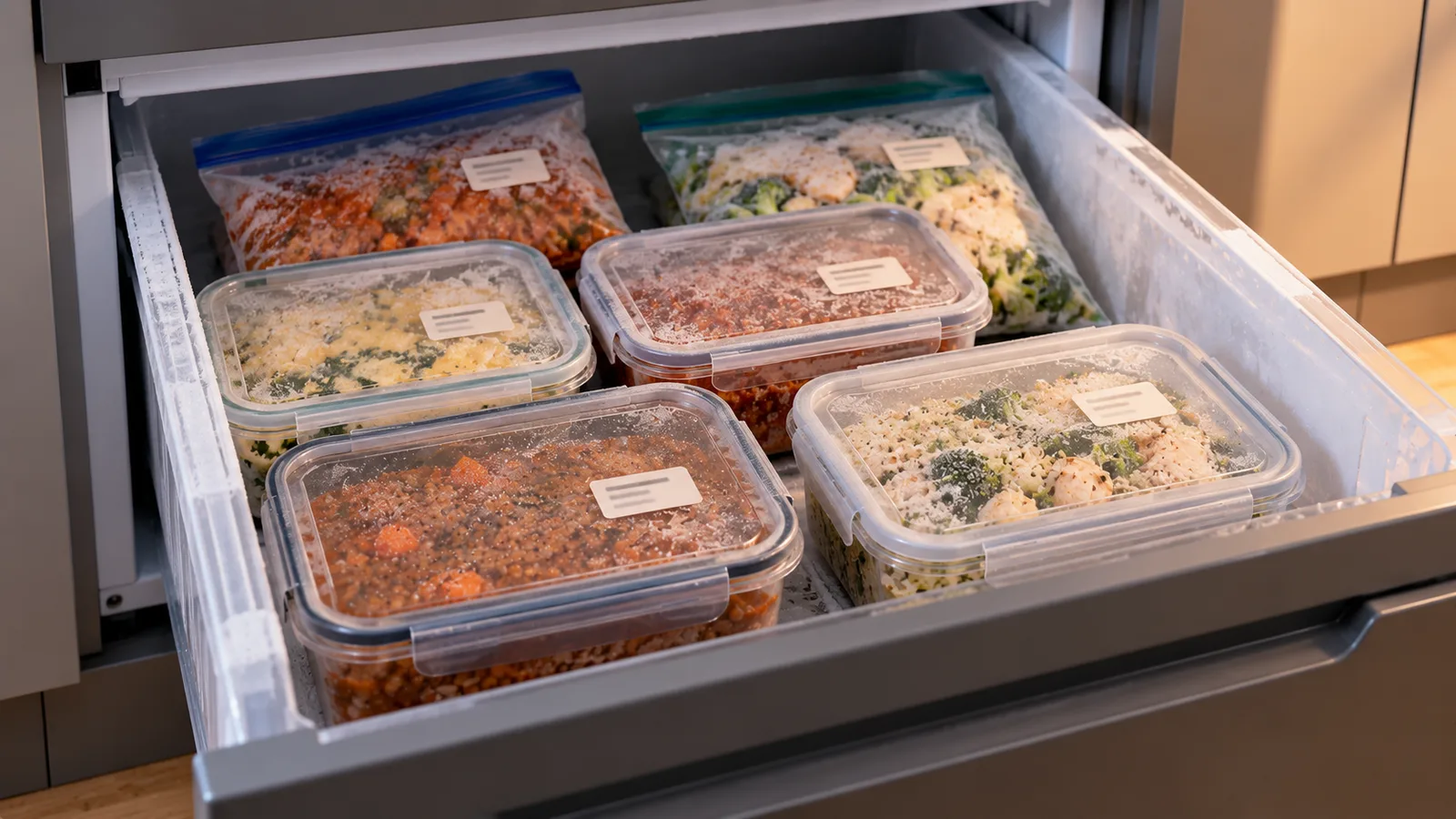
A freezer can make meal planning easier, but only if you know what is inside it.
Without a simple inventory, frozen food gradually disappears behind newer packages. You may buy ingredients you already have, forget cooked meals, or discover several portions only after they have been stored far longer than intended.
A freezer inventory solves a different problem from a fridge inventory.
The fridge is mainly about what needs attention soon. The freezer is about knowing what is available, how much you have and which items should move through the rotation first.
What should a freezer inventory tell you?
For meal planning, four pieces of information are usually enough:
- what the food is;
- how many useful portions are available;
- when it was frozen;
- which items should be used first.
For example:
| Food | Portions | Frozen | Rotation |
|---|---|---|---|
| Lentil soup | 3 | 12 Sep | Use first |
| Chicken curry | 2 | 20 Sep | Use soon |
| Cooked rice | 2 | 28 Sep | Normal |
| Tomato sauce | 4 | 2 Oct | Normal |
This is much more useful than simply writing “soup, curry, rice, sauce.”
Track portions, not just containers
A container is not always a useful meal-planning unit.
One large box of chili might contain four meals. Three small containers of soup might contain three individual lunches.
Instead of recording:
1 box chili
record:
Chili — 4 portions
This makes it easier to answer practical questions such as:
- Do I have enough for two people?
- Can this cover two lunches?
- How many dinners are already prepared?
- Do I need to cook another batch this week?
Define what a portion means for your household
“1 portion” does not have to be a universal serving size.
It only needs to be meaningful for your planning.
For example:
- 1 lunch portion;
- 1 adult dinner portion;
- 2-person dinner;
- 250 g cooked rice;
- 500 ml soup;
- 1 pizza base;
- 1 serving of sauce.
If two people in the household normally eat different amounts, grams or container size may be clearer than simply writing “2 portions.”
Record the freezing date
The freezing date helps you rotate food.
It does not automatically tell you whether a food is safe or unsafe. Storage recommendations vary by food, packaging, freezer conditions and guidance.
The date mainly answers:
Which equivalent item has been in the freezer longer?
If you have two containers of the same soup:
- one frozen on 5 September;
- one frozen on 2 October;
the September container is normally the logical one to plan first.
This is the basic idea behind first-in, first-out rotation.
Use FIFO: first in, first out
FIFO means:
first in → first out
For a home freezer, the principle is simple.
When several equivalent foods are available, use the older suitable batch before the newer one.
Suppose your inventory contains:
| Item | Frozen |
|---|---|
| Bolognese sauce A | 10 Aug |
| Bolognese sauce B | 4 Sep |
| Bolognese sauce C | 1 Oct |
When planning pasta night, start with batch A rather than automatically taking the newest container.
This keeps the freezer moving instead of accumulating old food indefinitely.
Rotation is not the same as an expiration date
Do not turn the freezing date into an invented universal deadline.
Food-safety and quality guidance depends on factors including:
- the type of food;
- whether it was handled safely before freezing;
- freezer temperature;
- packaging;
- interruptions in freezing;
- thawing method.
Follow appropriate official food-safety guidance for storage and thawing.
The inventory is a planning and rotation system, not a replacement for food-safety instructions.
Divide large batches before freezing
Meal planning becomes easier when food is frozen in useful amounts.
Imagine making eight portions of lentil soup.
Freezing all eight portions in one container means you may need to thaw the whole batch even when you only need two meals.
Instead, you could freeze:
- 2 portions;
- 2 portions;
- 2 portions;
- 2 portions.
Or use single portions if that better matches your routine.
The ideal size is the amount you are likely to thaw at one time.
Portion size should match future use
Before freezing, ask:
How will I probably use this?
Examples:
Cooked rice
Freeze in individual or two-person portions rather than one very large block.
Pasta sauce
Freeze in amounts that match your normal pasta meal.
Soup
Use lunch-sized or dinner-sized portions.
Cooked meat
Consider whether it will be used as a complete meal or as an ingredient in wraps, bowls or pasta.
Bread
Freezing slices or smaller sections may be more practical than freezing one large block.
Meal planning begins at the moment food enters the freezer.
Label the physical food as well as the inventory
A digital list is not enough if the actual container cannot be identified.
Useful freezer labels can include:
- food name;
- freezing date;
- portion quantity.
For example:
Chicken curry — 2 portions — 03 Oct
You do not need a long description.
The goal is to connect the physical package with the inventory entry.
Avoid vague labels
A container labeled:
Dinner
may be obvious today and mysterious six weeks later.
Likewise:
Sauce
does not tell you whether it contains tomato, meat, cream or something else.
Prefer specific names:
- lentil soup;
- chicken curry;
- tomato pasta sauce;
- cooked brown rice;
- roasted vegetables.
Specific labels make the inventory useful even after you have forgotten the original cooking day.
Create useful freezer categories
If your freezer contains many items, categories make planning faster.
A simple system could be:
Complete meals
- chili;
- curry;
- soup;
- lasagna portions.
Meal components
- cooked rice;
- sauces;
- cooked beans;
- roasted vegetables;
- cooked meat.
Protein ingredients
- fish;
- chicken;
- tofu;
- other suitable frozen protein foods.
Bread and grains
- bread;
- wraps;
- cooked grains.
Fruit and vegetables
- berries;
- frozen vegetables;
- chopped fruit.
The categories should reflect how you actually build meals.
Complete meals and components solve different problems
A frozen complete meal is useful when you have little time.
A frozen component gives more flexibility.
For example, frozen tomato sauce can become:
- pasta sauce;
- a base for beans;
- part of a casserole;
- sauce for another grain-based meal.
Cooked rice can support:
- curry;
- a bowl;
- a side dish.
A useful freezer can contain both complete meals and flexible components.
Build one meal from several freezer components
Suppose the inventory contains:
- 2 portions cooked rice;
- 1 portion chicken curry;
- frozen peas;
- frozen spinach.
You can create a meal without cooking everything from scratch.
Or suppose you have:
- tomato sauce;
- cooked lentils;
- frozen vegetables;
- bread.
Those ingredients can become a different meal with relatively little preparation.
Inventory turns frozen components into visible meal options.
Add frozen food to the weekly plan before shopping
Before writing a grocery list, check the freezer.
Ask:
- Which complete meals could cover a busy day?
- Which older items should be rotated?
- Which components can reduce the amount I need to buy?
- Which frozen vegetables or proteins can support planned recipes?
Then assign specific freezer items to meals.
For example:
Tuesday lunch: frozen lentil soup
Thursday dinner: chicken curry + frozen rice
Saturday: tomato sauce from freezer for pasta
Now the freezer is actively reducing cooking and shopping requirements.
Example: planning from a freezer inventory
Suppose you have:
| Food | Amount | Priority |
|---|---|---|
| Lentil soup | 2 portions | High |
| Chicken curry | 2 portions | High |
| Cooked rice | 3 portions | Medium |
| Tomato sauce | 2 portions | Medium |
| Frozen broccoli | 500 g | Normal |
| Bread | 6 slices | Normal |
A weekly plan might use:
Monday lunch
Lentil soup + bread.
Wednesday dinner
Chicken curry + cooked rice + broccoli.
Friday dinner
Pasta with frozen tomato sauce and vegetables.
Instead of starting the week with an empty menu, three meals already have a foundation.
Subtract portions when you plan them
If the inventory shows:
Lentil soup — 3 portions
and you assign two portions to Tuesday lunch, you can temporarily think of the available balance as:
1 unassigned portion
This prevents the same frozen meal from being assigned twice.
After the food is removed from the freezer, update the inventory.
Remove items when they leave the freezer
An inventory that still lists food already eaten quickly becomes unreliable.
Update the list when:
- food is removed for thawing;
- a complete frozen portion is used;
- part of a frozen batch is removed;
- food is discarded;
- a new batch is added.
You do not need real-time warehouse management.
A quick update during weekly planning and whenever a meaningful quantity changes is usually enough.
Use an “oldest first” view
A long freezer list is easier to use when sorted by freezing date.
For example:
- vegetable soup — 4 Aug;
- chili — 19 Aug;
- tomato sauce — 2 Sep;
- chicken curry — 18 Sep;
- rice — 30 Sep.
The top of the list becomes a source of ideas for the next meal plan.
This is often more useful than browsing the freezer physically every time.
A simple monthly freezer reset
Even with a working inventory, it is useful to periodically compare the list with the actual freezer.
For example, once a month:
- open the freezer;
- compare visible items with the inventory;
- remove entries that no longer exist;
- add forgotten items;
- identify older suitable foods;
- plan several of them into upcoming meals.
This corrects small tracking mistakes before they accumulate.
Use the freezer for planned surplus, not only accidental leftovers
Freezer planning can be intentional.
Suppose a recipe makes six portions but your household needs two tonight.
You can plan:
- 2 portions for dinner;
- 2 portions for tomorrow;
- 2 portions for the freezer.
The frozen portion is not an accidental leftover. It is a future meal.
Record it immediately:
Bean chili — 2 portions — frozen 05 Oct
Now a future busy evening already has a meal option.
Batch cooking without filling the freezer with one recipe
Batch cooking does not have to mean freezing ten identical dinners.
You can create flexible components:
- several portions of cooked grains;
- tomato sauce;
- cooked beans;
- soup;
- cooked protein;
- chopped or cooked vegetables.
Different combinations create different meals.
This can reduce repetition while retaining the time-saving benefits of batch preparation.
Keep enough space for rotation
A freezer packed so tightly that old food cannot be seen or accessed makes FIFO harder.
The exact organization depends on freezer size, but the principle is useful:
new food should not permanently bury old food.
If possible, place newly frozen versions behind or below older equivalent items so the older ones remain easier to reach.
Small freezer? Track capacity as well as food
When freezer space is limited, inventory helps answer another question:
Can I actually freeze the batch I am planning to cook?
Before batch cooking, check whether there is space for:
- two containers of soup;
- four portions of sauce;
- a loaf of bread;
- several frozen meals.
Using older inventory before a large cooking session can free space for new portions.
Do not buy frozen food you already have
Freezer duplicates can be difficult to notice.
Common examples include:
- frozen peas;
- berries;
- bread;
- fish;
- pizza bases;
- cooked sauces;
- frozen vegetables.
Before shopping, check the inventory rather than assuming you are out.
If you already have 750 g of frozen broccoli, another bag may not be necessary this week.
Connect freezer inventory with fridge inventory
The two systems work best together.
Fridge inventory
Focuses on:
- opened foods;
- leftovers;
- perishables;
- foods to use soon.
Freezer inventory
Focuses on:
- frozen portions;
- stored batches;
- rotation;
- longer-term meal capacity.
When suitable food moves from the fridge to the freezer, remove it from one inventory and add it to the other.
That prevents duplicate records.
Plan thawing as part of the meal plan
A frozen meal is only useful if you remember it in time.
When assigning a frozen item to a future meal, also consider the appropriate thawing or reheating process.
Follow safe thawing guidance for the specific food.
Depending on the food and preparation method, safe approaches may include refrigerator thawing or other methods recommended by official food-safety guidance.
Do not rely on leaving perishable frozen food at room temperature for extended periods.
Example weekly freezer workflow
Sunday
Review the freezer inventory.
Select:
- older lentil soup for Monday;
- chicken curry for Wednesday;
- tomato sauce for Friday.
Add the necessary complementary ingredients to the grocery list.
Monday
Use two portions of soup.
Update:
Lentil soup: 3 → 1 portion
Wednesday
Use the chicken curry and one portion of rice.
Update both entries.
Friday
Use the tomato sauce.
Weekend
Cook a large stew and freeze two portions.
Add:
Beef and vegetable stew — 2 portions — frozen Saturday
The freezer remains part of an active rotation rather than a passive storage space.
A compact freezer inventory template
A useful template is:
| Item | Portion/unit | Quantity | Frozen date | Priority |
|---|---|---|---|---|
Optional fields can include:
- location or drawer;
- planned meal;
- notes.
Do not add fields that make the system too cumbersome to maintain.
If you use a spreadsheet or app
Useful sorting options include:
- oldest first;
- category;
- number of portions;
- foods marked “use soon.”
A simple inventory is usually better than an elaborate system that is abandoned after a week.
The best format is the one you can update quickly when food enters or leaves the freezer.
A practical rotation rule
When planning meals:
1. Look at the oldest suitable items.
Start there for meal ideas.
2. Check complete meals.
Assign them to busy days.
3. Check components.
Use them to reduce cooking and grocery needs.
4. Reserve the portions.
Do not assign the same food to two meals.
5. Update the inventory after use.
This makes freezer rotation part of ordinary meal planning.
The main idea
A freezer becomes more useful when it is treated as a collection of future meals rather than a place where leftovers disappear.
Track:
what it is → how much is available → when it was frozen → what should be used first
Then use the inventory before making the grocery list.
With portion-based tracking, visible freezing dates and first-in, first-out rotation, frozen food can become a predictable part of the weekly meal plan instead of an unknown stockpile.
Sources
- U.S. Department of Agriculture Food Safety and Inspection Service, freezing and food-safety guidance.
- U.S. Food and Drug Administration, safe food storage guidance.
- European Food Safety Authority (EFSA), consumer food-safety guidance.
- European Commission, guidance and information related to food storage, date marking and food waste prevention.