
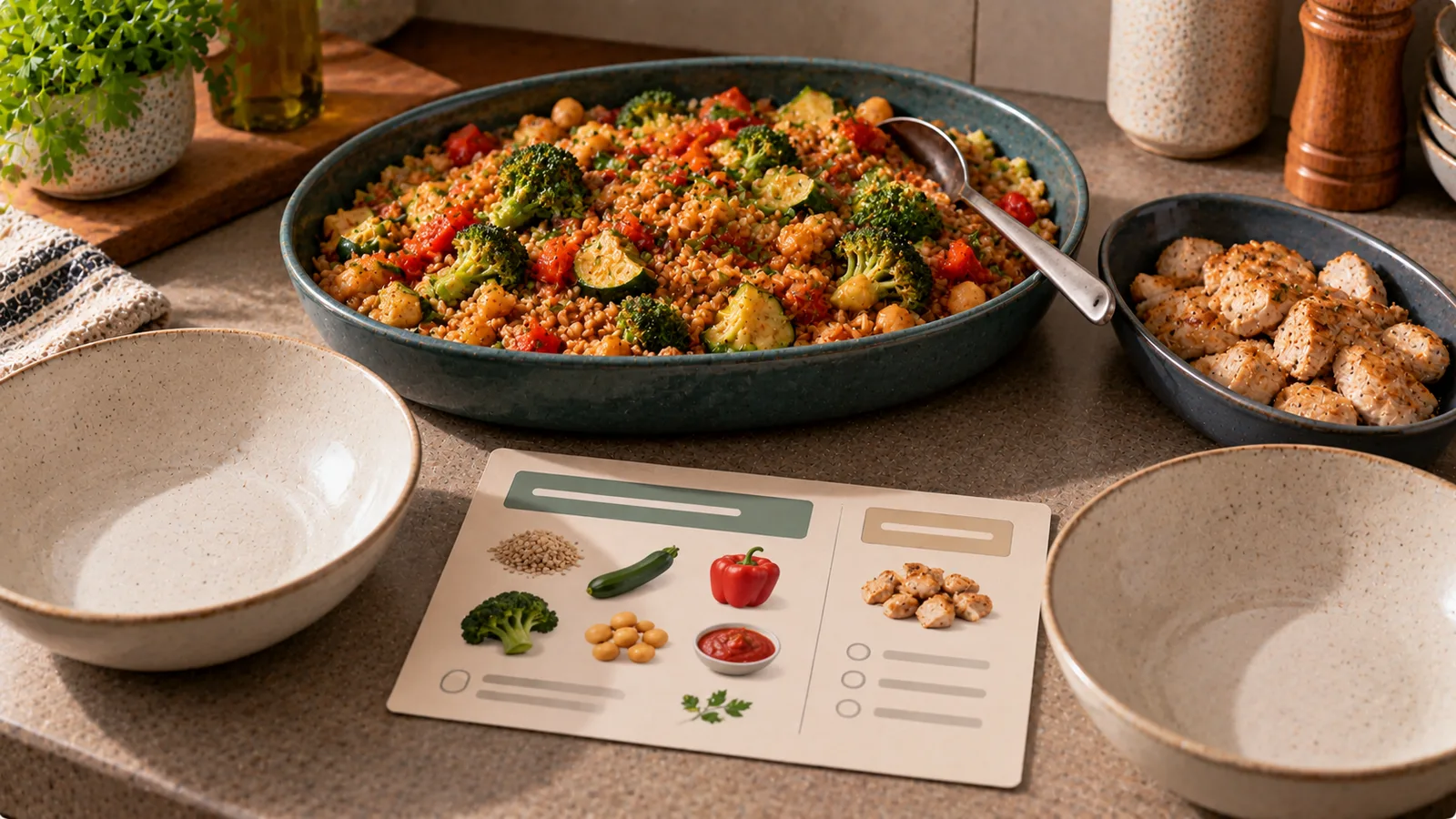
Cooking for a vegetarian and an omnivore does not have to mean preparing two completely separate meals every evening.
A more efficient approach is to build most meals around a shared vegetarian base, then add different protein components where needed.
For example, both people can eat the same rice, vegetables and sauce while one adds chickpeas or tofu and the other adds chicken.
This keeps most of the shopping, preparation and cooking shared without forcing either person to eat a diet they did not choose.
The shared-base method
A useful meal can be divided into four parts:
- a shared carbohydrate or grain;
- shared vegetables;
- a shared sauce or seasoning;
- separate protein additions when necessary.
A rice bowl might therefore use:
Shared
- rice;
- roasted peppers;
- broccoli;
- carrots;
- soy-ginger sauce.
Vegetarian
- tofu.
Omnivore
- chicken.
Instead of cooking two dinners, most of the meal remains identical.
A practical 5-day plan for two people
This example assumes one vegetarian and one omnivore.
| Day | Shared meal | Vegetarian component | Omnivore component |
|---|---|---|---|
| Monday | Rice bowls with roasted vegetables | Tofu | Chicken |
| Tuesday | Tomato pasta with spinach | Lentils | Chicken from Monday |
| Wednesday | Tacos with beans, vegetables and salsa | Black beans + cheese | Black beans + optional minced meat |
| Thursday | Potato and vegetable tray bake | Chickpeas + yogurt sauce | Salmon or chicken |
| Friday | Vegetable curry with rice | Chickpeas | Chickpeas + optional chicken |
The important feature is not the exact recipes.
It is the structure: the couple shares most ingredients while only a limited part of each meal changes.
Monday: rice bowls
For two people:
Shared base
- 150 g dry rice;
- 200 g broccoli;
- 150 g bell pepper;
- 150 g carrots;
- 100 g onion;
- approximately 15 g cooking oil;
- soy sauce, garlic and ginger.
Vegetarian portion
- 180–200 g firm tofu.
Omnivore portion
- 180–200 g raw boneless chicken.
Cook the rice once.
The vegetables can be roasted or pan-cooked together.
Cook tofu and chicken separately so that the vegetarian portion does not come into contact with meat if that matters to the household.
The same sauce can usually be used for both proteins if its ingredients are suitable for both people.
Tuesday: tomato pasta
Use:
- 180–200 g dry pasta;
- 400 g canned tomatoes;
- 150 g spinach;
- onion;
- garlic;
- herbs.
For the vegetarian portion, add approximately:
120–150 g cooked lentils
For the omnivore portion, use leftover cooked chicken from Monday if enough was prepared.
This creates a second meal without requiring another completely separate protein preparation.
Wednesday: tacos
A shared taco filling can contain:
- 1 can black beans, approximately 240 g drained;
- 150 g bell pepper;
- 100 g onion;
- tomatoes or salsa;
- lettuce;
- tortillas;
- spices.
The vegetarian can use beans plus cheese or yogurt.
The omnivore can eat the same bean mixture and optionally add a small portion of cooked minced meat.
The meat is an addition rather than the foundation of the entire meal.
Thursday: potato and vegetable tray bake
Prepare a shared tray with approximately:
- 500 g potatoes;
- 200 g zucchini;
- 150 g carrots;
- 150 g peppers;
- 100 g onion;
- 15–20 g olive oil;
- herbs and spices.
For the vegetarian serving, add:
150–180 g drained chickpeas
These can be roasted on one section of the tray or in a separate small baking dish.
For the omnivore serving, add:
150–180 g salmon or chicken
If avoiding contact between vegetarian food and meat is important, use separate dishes or clearly separated cooking equipment rather than relying on opposite sides of one tray.
Friday: vegetable curry
Prepare one shared curry base using:
- 200 g vegetables such as peppers;
- 200 g zucchini;
- 150 g carrots;
- 100 g onion;
- garlic;
- curry spices;
- 400 g canned tomatoes;
- approximately 200 ml light coconut milk or another suitable sauce base.
Add chickpeas to the shared curry.
Serve with approximately:
150 g dry rice for two people
The omnivore can eat the chickpea curry as it is or add leftover chicken.
This is useful because an omnivore does not need meat in every meal for the planning system to work.
Grocery list for five dinners
A realistic starting list for these meals is:
Grains and starches
- rice: approximately 300 g dry;
- pasta: 200 g dry;
- tortillas: 1 small pack;
- potatoes: 500–600 g.
Vegetarian proteins
- firm tofu: 200 g;
- cooked or canned lentils: about 150 g drained/cooked;
- black beans: 1 can, around 240 g drained;
- chickpeas: 2 cans, around 480 g drained;
- cheese or yogurt for tacos and sauces if desired.
Omnivore additions
- chicken: approximately 400–500 g raw;
- salmon or additional chicken: approximately 150–180 g;
- optional minced meat for tacos: 100–150 g.
The omnivore quantities are intentionally smaller than they would be in a plan where meat forms the center of every dinner.
Vegetables
Approximately:
- broccoli: 200 g;
- bell peppers: 600–700 g;
- carrots: 450–500 g;
- onions: 400–500 g;
- spinach: 150 g;
- zucchini: 350–400 g;
- lettuce: 1 small head or bag;
- tomatoes or salsa as needed.
Pantry and sauce ingredients
Useful items include:
- canned tomatoes;
- coconut milk;
- olive or cooking oil;
- soy sauce;
- garlic;
- ginger;
- curry spices;
- taco seasoning or individual spices;
- dried herbs.
Quantities should be adjusted to appetite and calorie needs.
Why shared bases save time
Imagine preparing two fully separate dinners.
One person gets tofu curry and rice.
The other gets chicken with potatoes and vegetables.
You may need separate:
- ingredient preparation;
- pans;
- cooking times;
- sauces;
- leftovers;
- storage containers.
With a shared-base system, the meal could instead be vegetable curry and rice for both, with chickpeas in the shared base and optional chicken added to one serving.
The amount of duplicate work becomes much smaller.
Start with meals that are naturally flexible
Some meals are particularly easy to adapt:
- grain bowls;
- tacos and wraps;
- pasta;
- curries;
- stir-fries;
- baked potatoes;
- tray bakes;
- soups where protein can be added separately;
- salads with separate toppings.
Meals where meat is structurally central can require more adaptation.
For example, making one beef lasagna and one vegetarian lasagna may involve nearly two full recipes.
A pasta bowl with one shared tomato sauce and separate toppings is much easier.
Do not make the vegetarian meal an afterthought
A common planning mistake is to create a complete omnivore meal and simply remove the meat.
Chicken, rice and vegetables becoming only rice and vegetables does not necessarily create an equivalent meal.
The vegetarian version should have its own meaningful protein component when appropriate.
Options can include:
- beans;
- lentils;
- chickpeas;
- tofu;
- tempeh;
- eggs;
- dairy foods;
- suitable meat alternatives.
The exact choice depends on the type of vegetarian diet and personal preferences.
The omnivore can eat vegetarian meals too
A shared plan becomes much easier if every dinner does not require an animal-protein alternative.
For example:
Monday:
tofu for one, chicken for the other.
Tuesday:
lentils for one, leftover chicken for the other.
Wednesday:
both eat bean tacos, with optional meat for one.
Thursday:
chickpeas for one, salmon for the other.
Friday:
both can eat chickpea curry, with chicken optional.
This reduces the number of separate ingredients and cooking tasks.
Use one protein preparation more than once
If the omnivore needs chicken for several meals, cook enough during one session.
For example:
Monday:
cook 400 g chicken.
Use approximately 200 g for Monday's bowl.
Store the remaining cooked chicken safely and use it for Tuesday's pasta or Friday's curry.
The vegetarian component can follow the same principle.
A larger batch of lentils or roasted chickpeas can appear in more than one meal without repeating the complete dish.
Reuse ingredients, not identical meals
Ingredient overlap saves money and reduces waste.
The same peppers can appear in:
- Monday's rice bowl;
- Wednesday's tacos;
- Friday's curry.
The same rice can support:
- Monday's bowl;
- Friday's curry.
The goal is not to eat the same meal repeatedly.
It is to buy ingredients that can move through several different meals.
Separate components before combining the meal
When cooking, keep flexible components separate until serving.
Instead of mixing chicken directly into an entire pan of pasta sauce, keep the sauce vegetarian.
Then add:
- lentils to one plate;
- chicken to the other.
This preserves leftovers that either person can use later.
It also avoids turning an otherwise shared dish into an omnivore-only dish.
One sauce is often enough
Separate protein does not necessarily require separate seasoning.
A lemon-herb marinade, curry sauce, tomato sauce or soy-ginger sauce may work with both tofu and chicken.
For example:
prepare one soy-ginger sauce.
Use part with tofu.
Use part with chicken.
Keep the raw-meat portion separate and do not reuse marinade or utensils contaminated by raw meat on ready-to-eat vegetarian food.
Cross-contact preferences matter
Vegetarians differ in how they feel about food being cooked:
- in the same pan;
- on the same tray;
- with the same utensils;
- on the same grill.
There is no single household rule that fits everyone.
Agree in advance on what is acceptable.
If strict separation is preferred, practical solutions include:
- separate pans;
- separate sections of cookware only when truly isolated;
- dedicated utensils;
- cooking vegetarian food first;
- clearly labeled containers.
Planning around the household's actual preference prevents friction later.
Food safety still applies
Raw meat should be kept separate from foods that are ready to eat.
Use separate or properly cleaned:
- cutting boards;
- knives;
- plates;
- utensils.
Do not place cooked food back onto a plate that previously held raw meat unless it has been thoroughly washed.
Refrigerate perishable leftovers promptly and keep the refrigerator around 4°C / 40°F or below.
Cook animal proteins to appropriate safe internal temperatures.
Plan leftovers intentionally
Do not let leftovers happen by accident.
Before cooking, decide what extra food has a purpose.
For example:
Monday:
extra chicken becomes Tuesday's omnivore protein.
Wednesday:
extra black beans become a lunch filling.
Thursday:
extra roasted vegetables can become Friday lunch.
This makes the plan more efficient without forcing both people to eat exactly the same leftovers.
Label containers when needed
A refrigerator containing multiple similar meals can become confusing.
Simple labels such as:
- vegetarian;
- chicken;
- tofu;
- Thursday;
- use first
can help.
This is especially useful when one person wants to avoid accidentally eating meat-containing food.
Breakfast and lunch can stay more independent
Couples do not need to share every meal.
It can be more efficient to coordinate dinners while keeping breakfast and lunch individually flexible.
For example, one person may prefer yogurt and fruit while the other eats eggs.
One may take lentil leftovers for lunch while the other uses chicken.
A shared meal plan does not have to mean identical diets.
Adjust quantities separately
A vegetarian and an omnivore may also have different calorie needs, appetites or activity levels.
Do not solve this by designing entirely separate meals.
Adjust scalable components such as:
- rice;
- pasta;
- potatoes;
- bread;
- cooking oil;
- sauces;
- protein portions;
- toppings.
For example, both people can eat the same curry while one has 150 g cooked rice and the other 250 g.
The meal remains shared even though the portions differ.
Example of one shared bowl with different portions
Shared ingredients:
- rice;
- vegetables;
- sauce.
Person A:
- 150 g cooked rice;
- 200 g vegetables;
- 180 g tofu.
Person B:
- 220 g cooked rice;
- 250 g vegetables;
- 180 g chicken.
The structure remains the same.
Only quantities and the protein component change.
Keep the grocery list integrated
Avoid writing one full vegetarian shopping list and another full omnivore shopping list.
Instead use:
Shared
- grains;
- vegetables;
- fruit;
- sauces;
- herbs;
- common dairy or alternatives.
Vegetarian-only
- tofu;
- tempeh;
- specific meat substitutes if used.
Omnivore-only
- chicken;
- fish;
- meat.
This makes duplicate purchases easier to spot.
When both people share grocery costs
Meal planning and grocery-cost splitting are related but separate problems.
If one person buys relatively expensive meat or fish that the other does not eat, the household may choose to treat those items separately.
The same can apply to specialty vegetarian products used by only one person.
The important point for meal planning is simply to identify which groceries are shared and which are individual.
The method for dividing the grocery bill can then follow whatever arrangement the household has chosen.
A simple weekly planning routine
Before shopping:
Step 1: Choose three to five shared meal bases.
Step 2: Decide which meals can be fully vegetarian for both people.
Step 3: Mark the meals that need separate protein components.
Step 4: Reuse each special protein in more than one meal where practical.
Step 5: Build one integrated grocery list.
Step 6: Check what is already in the refrigerator, freezer and pantry.
Step 7: Decide which leftovers have a planned destination.
This usually takes less effort than independently planning two complete menus.
When the system becomes too complicated
If every meal requires:
- two sauces;
- two starches;
- two sets of vegetables;
- two completely different proteins;
- separate cooking methods,
you are effectively preparing two meals.
Simplify the base.
For example, instead of:
vegetarian curry versus meat lasagna,
choose:
one curry base with chickpeas for one person and optional chicken for the other.
The shared component should represent most of the meal.
A useful planning ratio
There is no required percentage, but a practical target is for roughly 70–90% of the meal components to be shared.
That could mean:
- same rice;
- same vegetables;
- same sauce;
- different protein.
The percentage is not a nutrition rule. It is simply a planning principle that keeps the workload manageable.
What to do when preferences differ beyond meat
Sometimes the real problem is not vegetarian versus omnivore.
One person may dislike spicy food, mushrooms or beans.
The other may want more vegetables or different sauces.
In that case, use modular meals.
Bowls, tacos, wraps and baked potatoes allow each person to assemble a different final plate from the same group of prepared ingredients.
A flexible fallback meal
Keep one meal available that requires little adaptation.
For example:
- tortillas;
- canned beans;
- cheese;
- chopped vegetables;
- salsa;
- leftover chicken if available.
The vegetarian makes a bean-and-cheese wrap.
The omnivore can eat the same wrap or add chicken.
A fallback like this is useful when the planned dinner becomes impractical.
The goal is one meal system, not two menus
The most efficient vegetarian-and-omnivore meal plan does not try to make every plate identical.
Instead it separates what genuinely needs to be different while keeping everything else shared.
A practical pattern is:
shared starch + shared vegetables + shared sauce + flexible protein
Use vegetarian meals for both people when convenient, prepare meat as an optional component rather than the foundation of every dish, and buy overlapping ingredients that can be reused across the week.
That keeps the plan flexible without turning dinner into two separate cooking projects.