
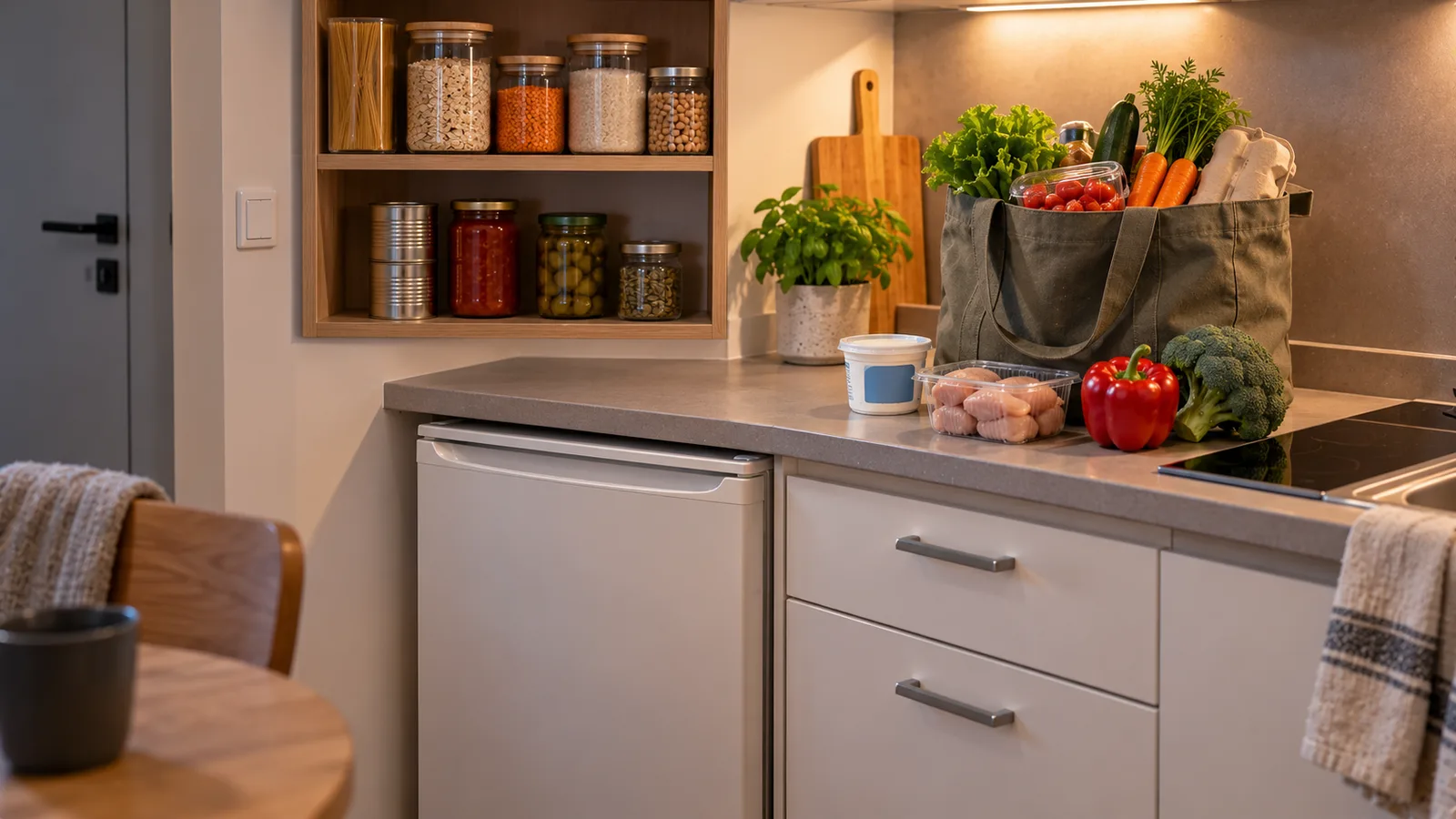
A small refrigerator changes meal planning.
The problem is not simply that you can buy less food. Limited refrigerated space affects how often you shop, which ingredients you keep at home, how many leftovers you can store and whether traditional seven-day meal prep is practical at all.
Instead of trying to fit a large weekly grocery shop into a tiny fridge, build the plan around the storage you actually have.
Start with fridge capacity, not recipes
Before planning meals, look at what normally occupies your refrigerator.
Separate the space into four practical groups:
- everyday staples;
- fresh ingredients for upcoming meals;
- opened products;
- leftovers.
If the fridge is already nearly full with milk, yogurt, sauces and opened products, a meal plan that requires containers for seven prepared dinners is unrealistic.
Your usable capacity matters more than the refrigerator's advertised volume.
The basic strategy: pantry base + smaller fresh shops
A useful small-fridge system is:
keep shelf-stable staples at home + buy refrigerated perishables in shorter cycles.
Shelf-stable staples can include:
- oats;
- rice;
- pasta;
- couscous;
- lentils;
- canned beans;
- canned tomatoes;
- canned fish;
- crispbread;
- unopened shelf-stable foods;
- nuts and seeds;
- oils;
- herbs and spices.
Then refrigerated space can be reserved for foods that actually need it.
This reduces the amount of cold storage required for each meal.
Shop more frequently, but with a plan
A large refrigerator makes a once-a-week shop easier.
With a tiny fridge, two or three smaller shops can be more practical.
For example:
Sunday
Buy ingredients for Sunday through Tuesday.
Wednesday
Restock fresh ingredients for Wednesday through Friday.
Saturday
Buy only what is needed for the weekend and the next transition.
This does not mean visiting a supermarket every day.
The goal is to shorten the period for which you need to store bulky perishables.
Plan in blocks instead of seven individual days
A seven-day meal plan can still work, but divide it into shorter purchasing blocks.
For example:
| Block | Meals planned | Fresh food purchased |
|---|---|---|
| Days 1–3 | 3 dinners + lunches | First set of vegetables, dairy and protein |
| Days 4–5 | 2 dinners + lunches | Second small fresh-food shop |
| Days 6–7 | Flexible meals | Small top-up or pantry-based meals |
The complete week is planned, but not every fresh ingredient has to enter the refrigerator on day one.
Measure the space once
You do not need a complicated inventory system.
For one normal week, notice:
- how many meal containers fit;
- how many large dairy containers fit;
- whether vegetables have a dedicated drawer;
- which bottles permanently occupy door space;
- how much room remains after normal staples are inside.
This gives you a realistic storage budget.
If only two prepared meal containers fit comfortably, do not plan five refrigerated meal-prep portions at once.
Give every refrigerated item a reason to be there
When space is limited, avoid using the refrigerator as long-term storage for products that do not require refrigeration before opening.
Depending on the product and label instructions, some unopened foods can stay in a cupboard until needed.
Always follow the manufacturer's storage instructions.
Do not move foods out of refrigeration if their label requires them to remain chilled.
Use shelf-stable ingredients to complete fresh meals
A small amount of refrigerated food can support many meals when combined with pantry staples.
For example:
Meal 1
Rice + canned beans + fresh peppers + yogurt-based sauce.
Meal 2
Pasta + canned tomatoes + fresh spinach + cheese.
Meal 3
Couscous + canned chickpeas + cucumber + tomato.
Meal 4
Lentils + rice + onions + a small amount of refrigerated vegetables.
The refrigerator stores only the ingredients that genuinely benefit from cold storage.
Choose compact ingredients
Two foods can provide similar meal functions while using very different amounts of refrigerator space.
Compact options can include:
- concentrated sauces instead of large ready-made dishes;
- a block of cheese rather than several individually packaged portions;
- smaller containers when a large one would remain open too long;
- vegetables with good storage characteristics;
- ingredients that can be used in several meals.
The objective is not maximum food density at any cost. It is to avoid filling valuable cold space with products that are unlikely to be used.
Plan ingredient overlap deliberately
Ingredient overlap is particularly valuable with a small fridge.
Suppose you buy:
- one cucumber;
- three peppers;
- a bag of spinach;
- yogurt;
- chicken or tofu.
Those ingredients can appear in several different meals without making every meal identical.
For example:
- rice bowl with chicken, pepper and yogurt sauce;
- couscous salad with cucumber and pepper;
- pasta with spinach;
- wrap with chicken or tofu, cucumber and yogurt sauce.
The same refrigerated ingredients are used quickly while pantry ingredients create variety.
Use-first dates are more useful than perfect inventories
You do not need to record every gram of food in the refrigerator.
A simple "use first" list can be enough.
For example:
Use first
- opened yogurt — Monday;
- spinach — Monday or Tuesday;
- half cucumber — Tuesday;
- cooked chicken — follow safe refrigerated storage guidance.
This directs the next meals toward foods that are already open or more perishable.
Opened food consumes future space
When planning a shopping trip, do not count only unopened groceries.
An opened jar, half an onion, leftover cooked rice and half a container of yogurt all occupy space.
Before shopping, check:
- what is already open;
- what needs to be eaten soon;
- what leftovers exist;
- how many empty containers are actually available.
Then build the next shopping list.
Avoid creating too many leftovers
Traditional batch cooking often recommends preparing many portions at once.
That can fail in a tiny fridge.
Instead, cook enough for:
- dinner plus one lunch;
- two dinners;
- one meal plus a freezer portion if freezer capacity exists.
Smaller batches reduce the number of containers competing for refrigerator space.
Use the freezer separately
A tiny refrigerator sometimes has a small freezer compartment.
Treat freezer capacity as a separate resource.
Do not assume every leftover can simply be frozen.
If freezer space is limited, reserve it for foods where freezing provides the most value, such as:
- individual cooked portions;
- bread;
- selected frozen vegetables;
- protein foods bought in useful portions.
Keep an inventory so the freezer does not become permanent storage for forgotten food.
Build one pantry meal into the week
A pantry-based meal gives the plan flexibility.
Examples include:
- lentil and tomato pasta;
- rice with beans and canned tomatoes;
- couscous with chickpeas;
- tuna pasta using canned ingredients;
- lentil soup using shelf-stable ingredients.
A pantry meal is useful when:
- fresh ingredients were used faster than expected;
- shopping is delayed;
- the fridge is too full for another purchase;
- plans change.
It acts as a buffer without requiring additional refrigerated storage.
Buy vegetables according to storage pressure
Not every vegetable needs to be purchased for the entire week at once.
Buy more perishable or bulky vegetables for the first part of the cycle and restock later.
Your exact choices depend on the product, local storage guidance and your refrigerator conditions.
The important principle is simple: do not buy seven days of bulky refrigerated produce merely because the meal plan covers seven days.
Dairy needs a space plan too
Large yogurt tubs, milk cartons, cheese, quark and other refrigerated products can consume a surprising amount of space.
Before buying several varieties, consider:
- which ones will actually be used;
- whether one product can serve several meals;
- how quickly it will be consumed after opening;
- whether the package size matches available space.
A cheaper large package is not necessarily useful if it creates storage problems or food waste.
Example: seven days with two fresh-food shops
Here is one possible structure.
Pantry base already at home
- oats;
- rice;
- pasta;
- couscous;
- red lentils;
- canned beans;
- canned tomatoes;
- canned tuna;
- nuts;
- oil;
- spices.
Fresh shop 1 — days 1 to 3
- yogurt;
- chicken or tofu;
- peppers;
- cucumber;
- spinach;
- bananas;
- small amount of cheese.
Day 1
Breakfast: oats, yogurt and banana.
Lunch: couscous with chickpeas, cucumber and pepper.
Dinner: chicken or tofu with rice, spinach and pepper.
Day 2
Breakfast: oats with yogurt and nuts.
Lunch: leftover rice bowl.
Dinner: pasta with tomato, spinach and cheese.
Day 3
Breakfast: oats and banana.
Lunch: couscous with tuna, cucumber and pepper.
Dinner: lentil and tomato dish with rice.
By the end of day three, most of the first fresh-food batch has been used.
Fresh shop 2 — days 4 to 7
Buy a second compact set such as:
- eggs or another suitable protein;
- yogurt or quark;
- carrots;
- tomatoes;
- another green vegetable;
- apples;
- bread.
Day 4
Breakfast: eggs with bread and tomato.
Lunch: lentils and rice.
Dinner: bean and vegetable pasta.
Day 5
Breakfast: yogurt, oats and apple.
Lunch: leftovers from dinner.
Dinner: couscous with chickpeas, carrots and tomato.
Day 6
Breakfast: oats and yogurt.
Lunch: bread with a protein-rich topping and vegetables.
Dinner: rice with beans and vegetables.
Day 7
Use remaining fresh foods plus pantry ingredients.
This structure provides a complete weekly plan without storing the whole week's refrigerated food at once.
Shopping lists should follow storage capacity
Instead of asking only, "What do I need for seven days?" ask:
- What do I need before my next shop?
- Which ingredients already exist?
- Which foods must be refrigerated?
- How much cold space is currently free?
- Which opened foods need to be used first?
This changes grocery planning from a recipe list into a storage-aware system.
Small-fridge shopping example
For a three-day block, a compact list might look like:
Refrigerated or fresh
- one protein source for two meals;
- one yogurt or dairy product;
- three or four vegetables;
- one or two fruits;
- one small cheese or other refrigerated ingredient.
Pantry
Restock only when needed:
- rice;
- pasta;
- oats;
- couscous;
- canned beans;
- canned tomatoes;
- lentils;
- oil.
This prevents every shopping trip from filling both the fridge and pantry unnecessarily.
Check the fridge before ordering groceries online
Online shopping can make overbuying especially easy because you cannot see your refrigerator while adding products to the basket.
Before ordering:
- open the fridge;
- identify use-first foods;
- estimate free space;
- check upcoming meals;
- then place the order.
Do not assume a normal weekly basket will fit simply because the products are individually small.
Do not confuse organization with extra capacity
Containers and organizers can make a refrigerator easier to use, but they do not create additional cold-storage volume.
Too many organizers can actually consume space.
Use containers when they:
- prevent leaks;
- keep leftovers safe;
- make opened foods visible;
- allow practical stacking.
Avoid transferring every product into another container solely for appearance.
Keep frequently used items visible
Food hidden behind other products is easier to forget.
A simple arrangement can be:
- use-first foods at the front;
- unopened or longer-lasting foods behind them;
- leftovers in a consistent area;
- frequently used ingredients in predictable places.
Visibility reduces duplicate purchases and forgotten leftovers.
Avoid overcrowding
A refrigerator needs appropriate air circulation to maintain safe temperatures.
Do not pack food so tightly that airflow is obstructed.
Follow the refrigerator manufacturer's instructions regarding loading, temperature settings and placement of foods.
A small fridge that is completely crammed with food is not necessarily being used efficiently or safely.
Check the refrigerator temperature
Safe refrigeration depends on temperature, not merely on placing food inside the appliance.
Follow official local food-safety guidance and the refrigerator manufacturer's recommendations.
A refrigerator thermometer can help confirm whether the appliance is maintaining an appropriate temperature, particularly if it is small, frequently opened or heavily loaded.
Keep raw and ready-to-eat foods appropriately separated
Limited space does not remove the need for safe food handling.
Store raw foods that could contaminate other products in a way that prevents drips or contact with ready-to-eat foods.
Use suitable containers and follow local food-safety guidance.
Small refrigerators require more deliberate organization because foods are physically closer together.
Meal prep does not have to mean seven containers
Meal prep can mean preparing components rather than complete meals.
For example:
- cook two portions of rice;
- wash vegetables;
- prepare a sauce;
- cook a protein for the next one or two meals;
- portion a snack.
This saves time without filling the refrigerator with a row of containers.
When a smaller package is worth it
Unit price is useful, but it is not the only consideration.
A larger package may be cheaper per kilogram but more expensive in practice if:
- it does not fit comfortably;
- it remains open too long;
- part of it spoils;
- it forces you to overbuy other ingredients less often used.
For a tiny fridge, package size can be part of the purchasing decision.
Use restaurants and takeaway deliberately, not as storage failure
A small fridge does not require cooking every meal.
If eating out or ordering food is already part of your budget and routine, include it intentionally in the meal plan.
For example, if Friday dinner will be eaten outside the home, do not buy refrigerated ingredients for a Friday dinner that will probably not be cooked.
Planning around real life reduces unnecessary storage and waste.
If you share a small fridge
Shared refrigerators require an additional constraint: not all available space belongs to you.
Agree on:
- approximate shelf allocation;
- how leftovers are labeled;
- whether shared foods exist;
- how long abandoned food is kept;
- where raw foods are stored.
Meal planning should use your realistic share of the fridge rather than its total capacity.
A five-minute planning routine
Before each small grocery shop:
1. Look
Check what is in the refrigerator.
2. Prioritize
Identify foods that should be used first.
3. Count
Decide how many meals you need before the next shop.
4. Build
Create those meals around existing ingredients and pantry staples.
5. Buy
Purchase only the fresh foods required to complete the block.
This process can be faster than constructing an entirely new seven-day menu every time.
What to track in Mealisa or another meal planner
If you use a meal-planning app, the most useful information is not only the recipes.
Track or note:
- planned meals;
- ingredients already available;
- opened perishables;
- use-first foods;
- leftovers;
- freezer portions;
- next shopping day.
The next shopping date is especially important in a small-fridge system because it determines how much fresh food you actually need to store.
The core rule
With a tiny fridge, do not ask:
How can I fit a full week of groceries inside?
Ask:
How little refrigerated food do I need before the next planned shop?
That shift changes the entire system.
Keep a shelf-stable base, buy fresh foods in shorter cycles, deliberately reuse refrigerated ingredients, prepare smaller batches and leave enough space for leftovers and safe airflow.
A small refrigerator does not prevent structured meal planning. It simply makes storage capacity one of the constraints the plan needs to respect.
Sources
- Bundeszentrum für Ernährung (BZfE), practical guidance on food storage, shopping and reducing food waste.
- Bundesinstitut für Risikobewertung (BfR), consumer information on food hygiene and safe refrigerated storage.
- European Food Safety Authority (EFSA), consumer food-safety information.
- U.S. Food and Drug Administration (FDA), refrigerator and food-storage safety guidance.
- USDA Food Safety and Inspection Service (FSIS), refrigeration and safe food-handling guidance.