
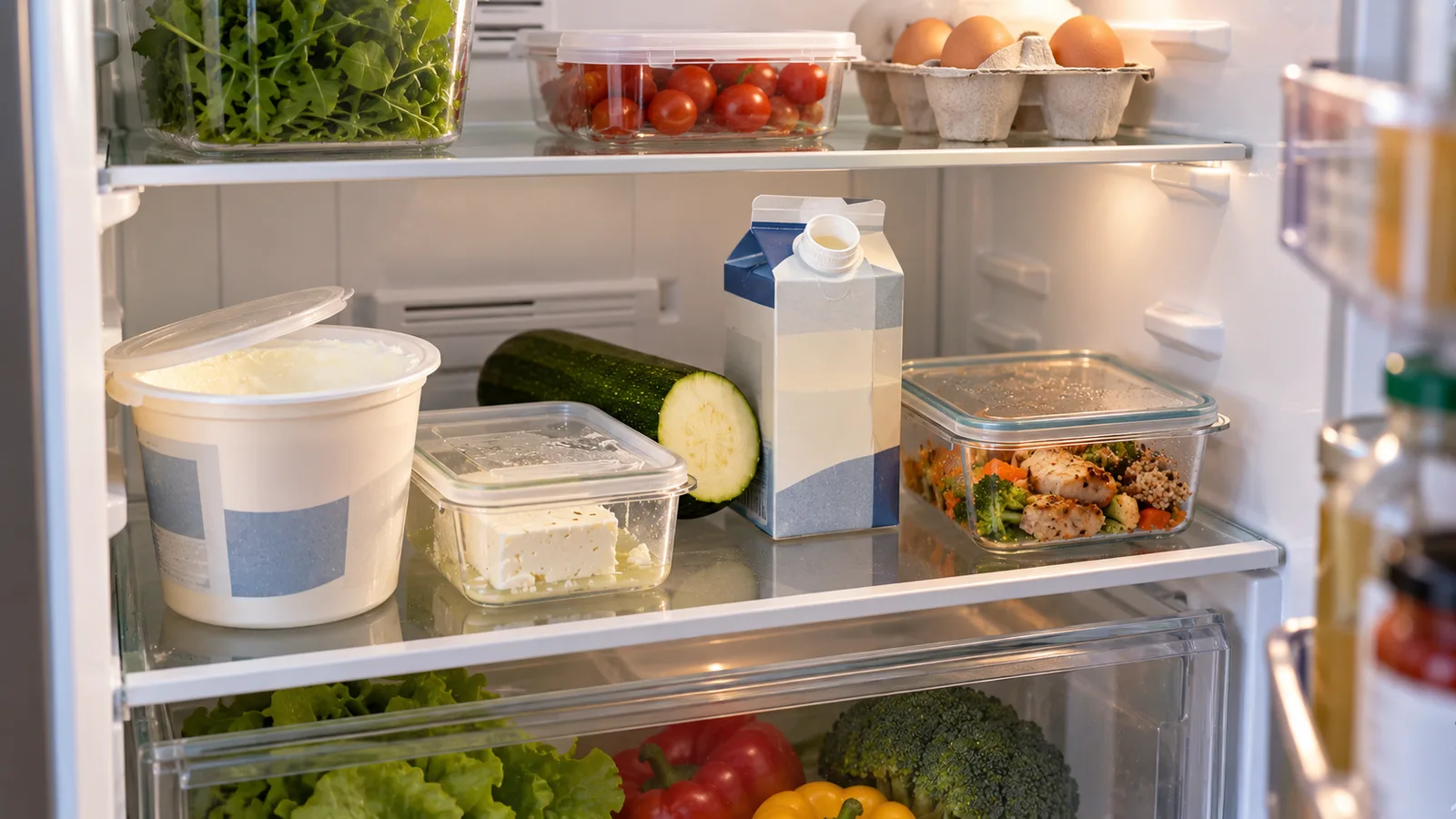
Meal planning often starts with a list of meals you want to cook.
A more efficient approach starts one step earlier:
What is already in the fridge, and what should be used first?
A fridge inventory is a short working list of opened foods, leftovers and perishable ingredients that are likely to influence the next few meals.
It does not need to record every jar and bottle in the refrigerator. Its purpose is to make the foods most likely to be forgotten visible before you plan or shop.
What belongs in a useful fridge inventory?
Prioritize foods that are:
- already opened;
- cooked and left over;
- highly perishable;
- partially used;
- approaching a relevant date;
- easy to forget at the back of the fridge.
Examples include:
- half a container of yogurt;
- opened cream;
- cooked rice;
- leftover chicken;
- half an onion;
- opened tofu;
- spinach;
- mushrooms;
- grated cheese;
- cooked lentils;
- an opened jar of sauce.
You usually do not need to record a sealed product with a long shelf life unless you specifically want it included in the next meal plan.
Inventory is different from a shopping list
A shopping list answers:
What do I need to buy?
A fridge inventory answers:
What do I already have that should influence what I cook next?
The most useful workflow connects the two:
check fridge → identify use-first foods → choose meals → calculate missing ingredients → shop
This prevents buying ingredients for a plan while existing food is forgotten.
Use a simple four-column system
A practical inventory can be very small.
| Food | Amount left | Status | Use first |
|---|---|---|---|
| Cooked chicken | ~180 g | Cooked leftover | Monday |
| Spinach | ~120 g | Opened | Monday |
| Greek yogurt | ~250 g | Opened | Tuesday |
| Mushrooms | ~200 g | Opened | Tuesday |
| Cheddar | ~100 g | Opened | Later |
The “use first” field is not necessarily a new food-safety expiration date.
It is a planning priority that tells you which ingredients should be considered first when choosing upcoming meals.
Do not invent your own safety date
A use-first date is a planning tool, not permission to override storage instructions, a use-by date or signs that food is no longer suitable to eat.
Follow:
- the manufacturer's storage instructions;
- use-by dates where applicable;
- instructions such as “use within X days after opening”;
- appropriate refrigeration;
- established food-safety guidance.
If a food should no longer be eaten safely, meal planning should not be used to rescue it.
The inventory helps you use suitable food before that point.
Step 1: scan the fridge before planning meals
Open the refrigerator and look specifically for:
- cooked leftovers;
- opened packages;
- cut produce;
- fresh vegetables and herbs;
- dairy and alternatives already opened;
- meat, fish or tofu that needs attention;
- sauces or ingredients opened for a previous recipe.
You do not need to create a perfect database.
The goal is to capture foods that can change your meal choices.
Step 2: record the amount in a useful way
Exact grams are useful when you already know them, but precision is not always necessary.
You can record:
- 180 g cooked chicken;
- half a cucumber;
- about 1/3 jar pesto;
- 2 portions cooked rice;
- 4 eggs;
- half a block of tofu.
Use the level of precision needed to decide whether the ingredient can support a meal.
For calorie or recipe calculations, you can weigh the actual amount later.
Step 3: mark opened and cooked foods clearly
Two identical products can have very different planning priorities.
For example:
- sealed yogurt;
- yogurt opened yesterday.
Or:
- dry uncooked rice;
- cooked rice stored in the refrigerator.
A useful inventory records the state of the food, not just its name.
Useful status labels include:
- unopened;
- opened;
- cooked;
- leftover;
- cut;
- thawed.
This is particularly useful when more than one person uses the refrigerator.
Step 4: create a use-first order
Instead of treating every fridge item equally, create a short priority sequence.
For example:
Use first
- cooked chicken;
- opened spinach;
- leftover rice.
Use next
- mushrooms;
- opened yogurt;
- half a pepper.
Flexible
- eggs;
- unopened cheese;
- carrots.
Now meal planning has a clear starting point.
Step 5: build meals around combinations, not individual ingredients
An inventory becomes useful when ingredients are combined.
Suppose the fridge contains:
- cooked chicken;
- spinach;
- mushrooms;
- yogurt;
- half an onion.
Instead of creating five unrelated tasks, ask:
Which meal can use several of these at once?
Possible meal:
Chicken and mushroom skillet with spinach, served with rice and a yogurt-based sauce.
One meal can reduce several open items simultaneously.
Example: turning an inventory into three meals
Imagine the refrigerator contains:
- 200 g cooked chicken;
- 150 g spinach;
- 250 g mushrooms;
- 300 g yogurt;
- half a cucumber;
- cooked potatoes;
- grated cheese.
A three-meal sequence could be:
Meal 1
Chicken, mushroom and spinach pan with potatoes.
Uses:
- chicken;
- mushrooms;
- spinach;
- potatoes.
Meal 2
Potato and cheese omelet with cucumber-yogurt side.
Uses:
- remaining potatoes;
- cheese;
- cucumber;
- yogurt.
Meal 3
Yogurt breakfast bowl or savory yogurt sauce with another planned meal.
Uses:
- remaining yogurt.
The inventory shapes the plan before new groceries are added.
Track remaining amounts after cooking
The inventory becomes inaccurate if you never update it.
Suppose you have:
300 g mushrooms
and use:
220 g
Do not leave “300 g mushrooms” in the inventory.
Update it to approximately:
80 g mushrooms
or remove it if the remainder is too small to matter for your planning.
This is especially important for ingredients used across several meals.
You do not need to update the inventory after every bite
A fridge inventory should save time, not create another demanding tracking system.
Update it when something meaningful happens:
- a package is opened;
- a meal creates leftovers;
- a substantial amount is used;
- food is discarded;
- food is moved to the freezer;
- the remaining quantity materially changes what you can cook.
A spoonful of mustard does not need constant inventory updates unless mustard is relevant to your planning.
Use a “leftovers” section
Prepared food is often easier to forget than raw ingredients.
Keep leftovers visible as a separate group.
For example:
| Leftover | Amount | Planned use |
|---|---|---|
| Lentil soup | 2 portions | Tuesday lunch |
| Cooked rice | 1 portion | Monday dinner |
| Roasted vegetables | ~250 g | Tuesday bowl |
Assigning a planned use immediately can be more effective than simply recording that the food exists.
Give leftovers a destination
When dinner creates extra food, decide what it is for.
Instead of:
Leftover pasta
record:
Leftover pasta — tomorrow's lunch
Instead of:
Cooked chicken — 250 g
record:
Cooked chicken — Wednesday wrap
This converts inventory into a meal-planning tool rather than a passive list.
Plan the first days more precisely than the last days
Perishable foods create the most constraints early in the planning period.
If you plan seven days, the first two or three days may be strongly influenced by what is already open.
Later days can rely more on:
- unopened ingredients;
- frozen foods;
- shelf-stable foods;
- a second small grocery trip.
This makes the plan more flexible and reduces the chance that today's leftovers are assigned to a meal six days away.
Example seven-day planning logic
Suppose Sunday evening's inventory shows:
High priority
- cooked salmon;
- opened spinach;
- half an avocado.
Medium priority
- mushrooms;
- yogurt;
- opened feta.
Flexible
- eggs;
- carrots;
- sealed tofu.
A sensible plan might begin:
Monday lunch: salmon and spinach bowl
Monday dinner: mushroom and feta omelet
Tuesday breakfast: yogurt with oats and fruit
Tuesday lunch: meal using remaining spinach or feta
The second half of the week can then use ingredients with more flexibility.
Connect the inventory to your grocery list
After selecting meals, calculate only what is missing.
Suppose a recipe needs:
- 300 g mushrooms;
- 1 onion;
- 200 g spinach;
- rice.
Your inventory already contains:
- 120 g mushrooms;
- half an onion;
- 80 g spinach;
- enough rice.
Your shopping list should reflect the gap rather than the full recipe:
- about 180 g additional mushrooms;
- onion if the remaining half is insufficient;
- about 120 g additional spinach.
This reduces duplicate buying.
Avoid buying another package because you forgot the open one
Duplicate purchases commonly happen with foods such as:
- yogurt;
- cheese;
- sauces;
- herbs;
- vegetables;
- milk or alternatives;
- opened deli products.
A quick fridge check before shopping can prevent buying a second package while the first is still open.
A physical “use first” zone can help
If your refrigerator allows it, dedicate one visible shelf or container to foods that should be considered first.
This can include:
- opened products;
- leftovers;
- cut vegetables;
- ingredients reserved for the next meal.
The physical zone and the inventory list serve the same purpose: making priority foods difficult to forget.
Do not reorganize food in a way that conflicts with safe refrigerator storage requirements.
Meal planning when several people share the fridge
A shared refrigerator creates an extra question:
Is this food available for the plan?
An inventory can mark items as:
- shared;
- mine;
- partner's;
- reserved for a specific meal.
For example:
| Food | Amount | Owner/status |
|---|---|---|
| Cooked rice | 2 portions | Shared |
| Yogurt | 1 container | Reserved |
| Tofu | 200 g | Shared |
| Leftover pasta | 1 portion | Partner's lunch |
This prevents a meal plan from assuming that every visible ingredient is available.
Fridge inventory and recipe planning
When choosing recipes, prioritize combinations that consume the highest-priority foods.
A simple ranking method is:
Priority 1: meal uses two or more use-first ingredients
Priority 2: meal uses one use-first ingredient
Priority 3: meal uses only long-lasting ingredients
If two recipes are equally appealing, the one using more perishable open ingredients may be the more efficient choice.
Do not force incompatible leftovers into one recipe
Reducing waste does not mean every open ingredient must appear in the same meal.
If you have:
- leftover curry;
- strawberries;
- feta;
- half a cucumber;
you do not need a recipe containing all four.
Instead:
- curry becomes lunch;
- strawberries go into breakfast;
- feta and cucumber become part of dinner.
The inventory should improve meal choices, not create strange combinations.
Use the freezer when plans change
Sometimes you planned to eat leftovers tomorrow but your schedule changes.
If the food is suitable for freezing and can be frozen safely, moving it to the freezer can preserve flexibility.
When you do this:
- remove it from the fridge inventory;
- add it to the freezer inventory;
- record a useful portion description;
- record the freezing date if helpful.
Fridge and freezer inventories should not both claim the same food.
Inventory before shopping: a five-minute routine
Before making the grocery list:
1. Check leftovers.
What cooked food is already available?
2. Check opened products.
What packages have been started?
3. Check produce.
Which vegetables, fruit and herbs should be prioritized?
4. Choose the next meals.
Use the highest-priority foods first.
5. Buy only the missing components.
This small routine can make meal planning more responsive to the food actually in the kitchen.
Example of a complete planning cycle
Friday evening, the refrigerator contains:
- 2 portions cooked rice;
- 180 g cooked chicken;
- 120 g spinach;
- 150 g mushrooms;
- half a cucumber;
- 200 g yogurt;
- 4 eggs.
Step 1: prioritize
Use first:
- chicken;
- spinach;
- mushrooms;
- cooked rice.
Use next:
- cucumber;
- yogurt.
Flexible:
- eggs.
Step 2: create meals
Saturday lunch:
Chicken, mushroom and spinach rice bowl.
Saturday dinner:
Eggs with cucumber-yogurt salad.
Sunday:
Use remaining yogurt at breakfast or as a sauce.
Step 3: identify gaps
The rice bowl may need:
- onion;
- additional vegetables;
- seasoning.
The egg meal may need:
- bread;
- tomatoes.
Step 4: shop for gaps
The grocery list now supplements existing food rather than replacing it.
A simple fridge-inventory template
You can use this structure in a note, spreadsheet or meal-planning app:
| Item | Remaining amount | State | Use-first priority | Planned meal |
|---|---|---|---|---|
Keep it short enough that you will actually maintain it.
A 10-item current list is often more useful than a 70-item database that is never updated.
The practical rule
A useful fridge inventory answers three questions:
What is open?
How much is left?
What should influence the next meals first?
Meal planning then becomes a sequence:
inventory → priorities → meals → missing ingredients → grocery list
Instead of planning meals independently from the food already at home, the refrigerator becomes the starting point.
That can make the plan more practical, reduce duplicate purchases and give opened food and leftovers a clear place in upcoming meals.
Sources
- European Commission, information on food date marking and food waste prevention.
- European Food Safety Authority (EFSA), consumer guidance on food date marking and safe food handling.
- U.S. Food and Drug Administration (FDA), refrigerator and food-storage safety guidance.
- USDA Food Safety and Inspection Service, refrigeration and leftovers guidance.