
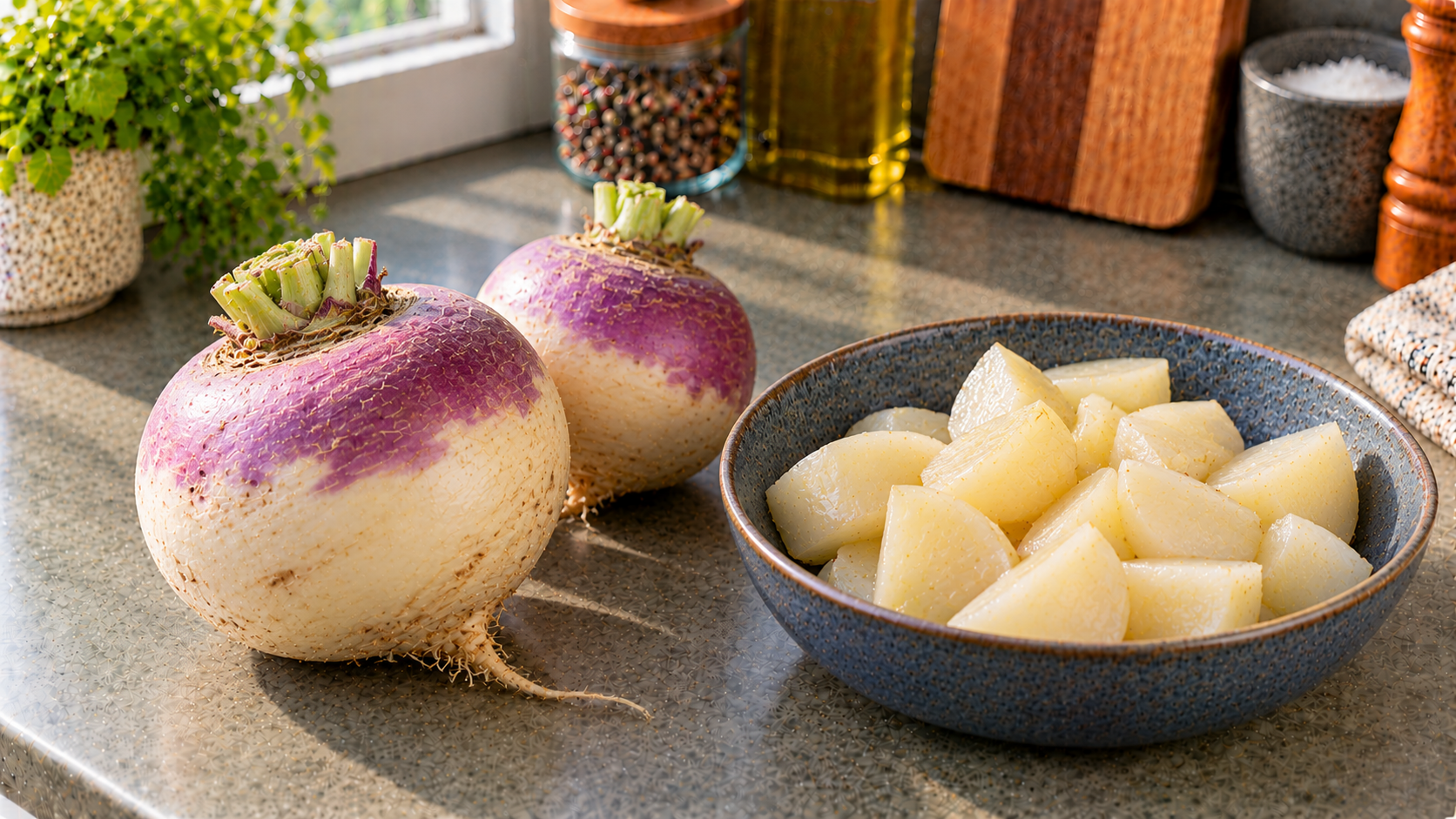
Turnips contain approximately 28 calories per 100 g raw and 22 calories per 100 g boiled, drained and prepared without salt, according to USDA FoodData Central. These figures describe the edible root, not turnip greens, rutabaga or a finished dish containing butter or oil.
Turnips are relatively low in calories and supply water, carbohydrates, fibre and vitamin C. The actual calories in a meal depend on the weight eaten and how the vegetable is prepared.
Turnip nutrition: raw versus boiled
The following values come from USDA SR Legacy entries for raw turnips (FDC 170465) and turnips cooked, boiled, drained, without salt (FDC 170058).
| Nutrient per 100 g | Raw turnips | Boiled turnips |
|---|---|---|
| Calories | 28 kcal | 22 kcal |
| Protein | 0.90 g | 0.71 g |
| Carbohydrates | 6.43 g | 5.06 g |
| Fibre | 1.80 g | 2.00 g |
| Fat | 0.10 g | 0.08 g |
| Total sugars | 3.80 g | 2.99 g |
| Water | 91.90 g | 93.60 g |
| Potassium | 191 mg | 177 mg |
| Vitamin C | 21.0 mg | 11.6 mg |
Sources: USDA raw turnips and USDA boiled turnips.
These values refer to two food-composition records, not measurements of the same batch before and after cooking. Differences in moisture and soluble nutrients can affect the figures per 100 g.
The lower calorie value for boiled turnips does not establish how much energy every individual turnip loses during boiling.
Calories by serving size
For boiled and drained turnips, the reference value is 22 kcal per 100 g.
| Cooked edible portion | Calories | Protein | Fibre |
|---|---|---|---|
| 50 g | 11 kcal | 0.4 g | 1.0 g |
| 100 g | 22 kcal | 0.7 g | 2.0 g |
| 150 g | 33 kcal | 1.1 g | 3.0 g |
| 200 g | 44 kcal | 1.4 g | 4.0 g |
| 250 g | 55 kcal | 1.8 g | 5.0 g |
| 300 g | 66 kcal | 2.1 g | 6.0 g |
The portion figures are calculated from the USDA reference and rounded.
Calories = cooked edible weight in grams × 22 ÷ 100.
For example, a 180 g serving of boiled turnips contains approximately 40 kcal before any sauce or oil.
If the turnip is weighed raw, use the raw reference of 28 kcal per 100 g instead.
How many calories are in one turnip?
There is no reliable calorie value for every turnip because roots vary considerably in size.
A raw turnip with 100 g of edible root contains approximately 28 kcal. A larger one providing 200 g of edible root contains approximately 56 kcal.
These are examples based on edible weight, not universal definitions of small and large turnips.
Remove any peel, damaged pieces or stem ends that will not be eaten before weighing. If the peel is eaten, include it in the edible weight.
One medium turnip may supply considerably more or less than the amount assumed in a recipe. Weighing is more accurate than counting individual vegetables.
Raw, steamed and boiled turnips
Raw turnips can be sliced thinly for salads, grated into slaws or eaten as a crunchy vegetable.
Boiling and steaming soften the flesh and mellow its peppery flavour.
When a turnip is boiled, water and some water-soluble nutrients can move between the vegetable and the cooking liquid. This affects nutritional values per 100 g.
For calorie tracking, use an entry matching the preparation and the weight at which you measured the food.
If you weigh turnips raw and then cook them without additions, you can calculate the recipe's starting energy from the raw weight. If you weigh the finished vegetable, a cooked-food entry is usually more convenient.
Do not apply nutritional values for 100 g dry or raw material to 100 g cooked material without checking the difference in weight.
Roasted turnips and cooking oil
Roasted turnips can taste sweeter and develop browned edges. They may lose water, changing the calorie concentration per 100 g of finished food.
The largest practical difference often comes from added oil or butter.
For example, 300 g raw turnips provide approximately 84 kcal. Add 15 g olive oil, contributing about 135 kcal, and the complete recipe totals approximately 219 kcal before other ingredients.
If three people eat equal portions and all the oil is consumed, each serving contains approximately 73 kcal.
This is a recipe calculation, not a generic nutrition value for roasted turnips.
If some oil remains on the baking tray, the quantity actually consumed may be smaller. Additional ingredients such as honey, cheese or cream must be counted separately.
Turnip mash, soups and prepared dishes
Turnip mash can be made from boiled turnips alone or combined with potatoes, butter, milk or cream.
Plain mashed turnip is not equivalent to mashed turnip enriched with dairy and fat.
Similarly, a turnip soup may include vegetable stock, potatoes, lentils, meat or cream. The energy content depends on the complete recipe.
For homemade meals, calculate the calorie contribution of every ingredient before dividing the cooked dish into portions.
If the final dish has an uneven distribution of ingredients, weighing each serving provides a better estimate than assuming every bowl is identical.
For commercially prepared dishes, use the manufacturer's nutrition label when available.
Turnips versus potatoes and rutabaga
Turnips, potatoes and rutabaga are different vegetables. Their typical nutrient compositions and culinary uses overlap, but their calorie values should not be treated as identical.
Turnips and potatoes should not share the same nutrition entry; use the potato calories and serving guide for a direct comparison.
Plain turnips can replace some potatoes in soups, stews or mash when a lighter-textured dish is desired. That substitution changes flavour and texture as well as nutrient composition.
Rutabaga, also known as swede, is a different root vegetable. It may be sold near turnips and sometimes shares similar-looking packaging.
Choose the correct product entry for the vegetable you actually use.
Turnip greens are also different from the root. They have their own nutrient profile and should not automatically inherit the root's calorie value.
Carbohydrates, fibre and natural sugars
Raw turnips contain approximately 6.43 g total carbohydrates, 1.80 g fibre and 3.80 g sugars per 100 g in the USDA reference.
These are sugars naturally present in the root. They are not the same as sugar added to a glaze or sweetened pickle.
The USDA total-carbohydrate value includes dietary fibre under the American reporting convention. European food labels generally report available carbohydrate separately from fibre.
Turnips provide some fibre, but the total contribution depends on portion size.
For example, 200 g boiled turnips contains approximately 4 g fibre in the reference used here.
People who experience digestive discomfort after larger portions of vegetables may prefer smaller servings and gradual increases.
Vitamin C, potassium and other nutrients
The raw USDA reference reports approximately 21 mg vitamin C and 191 mg potassium per 100 g.
The boiled reference reports approximately 11.6 mg vitamin C and 177 mg potassium.
Cooking and draining can affect water-soluble nutrients, although the exact changes vary with time, temperature and preparation.
Vitamin C supports normal collagen formation and immune function. Potassium has roles in normal muscle and nerve function.
Turnips are not a concentrated protein source. For a balanced meal, combine them with beans, eggs, tofu, fish or another suitable protein source.
Are turnips useful for weight management?
Plain turnips have a relatively low energy density and can contribute volume to meals.
They do not independently cause weight loss. Overall energy intake and dietary habits remain more important.
A turnip-based soup, roasted turnip side dish or mixed vegetable mash can fit into a balanced diet.
However, oil, butter, cream, cheese and other ingredients may account for more calories than the turnips themselves.
For accurate tracking, measure those additions separately.
How to record turnips correctly
For raw turnips, use the matching USDA value of 28 kcal per 100 g. For boiled and drained turnips without salt, use 22 kcal per 100 g.
Record only the edible amount actually consumed.
For recipes, calculate all ingredients and divide by the finished servings. For packaged foods, use the product's own label when available.
Sources and calculation notes
- USDA FoodData Central — Turnips, raw, FDC 170465.
- USDA FoodData Central — Turnips, cooked, boiled, drained, without salt, FDC 170058.
All portion and recipe values are calculated estimates based on the stated references. Actual values vary with variety, preparation and edible yield.