
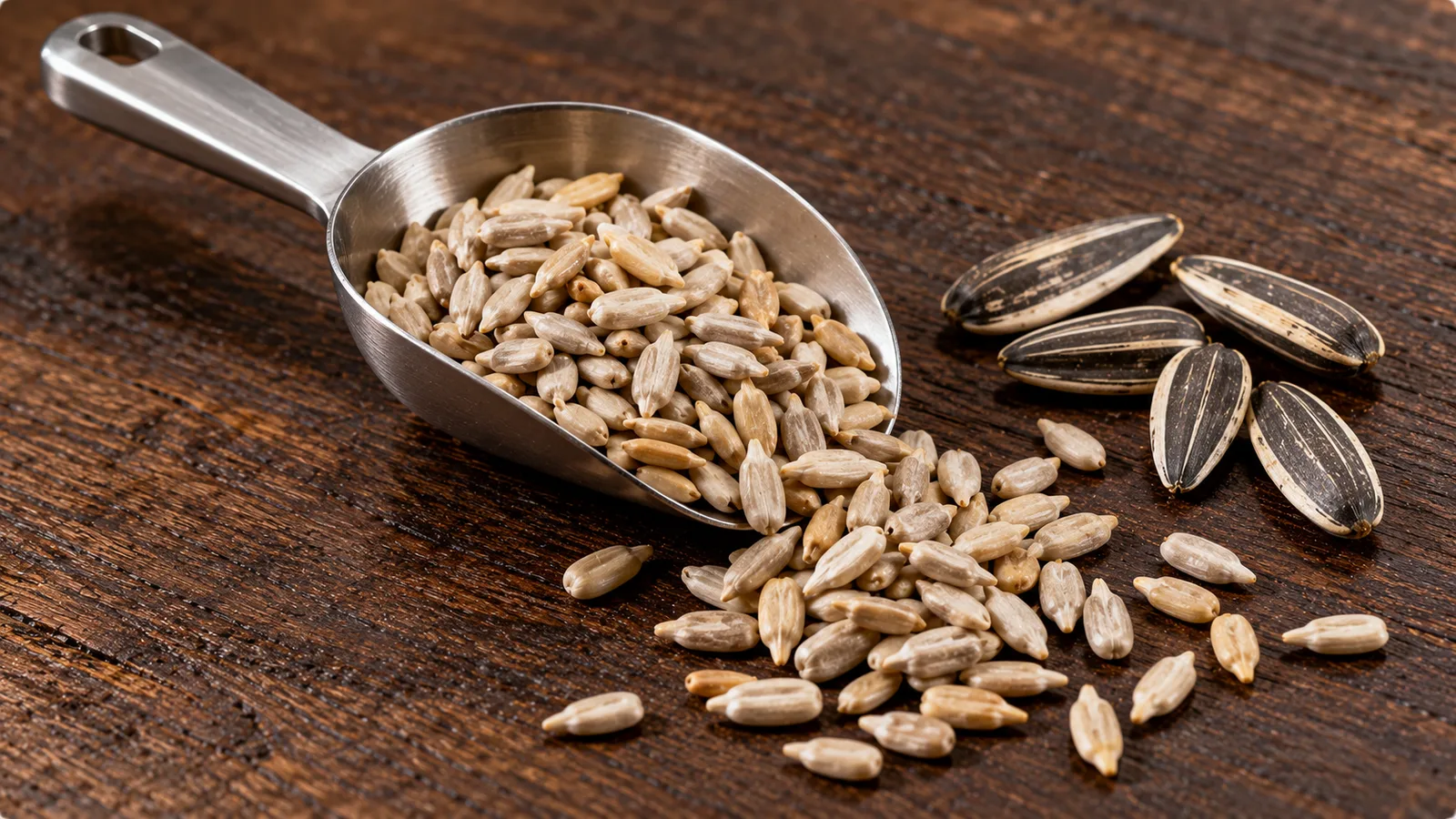
Sunflower seeds are small, but they contain a substantial amount of energy. A few spoonfuls can add texture to a salad, porridge or yogurt, while a large handful can contribute considerably more calories than its size suggests.
The key distinction is between the edible sunflower seed kernel and the whole seed with its inedible outer shell.
For raw, hulled sunflower seed kernels, a commonly used USDA reference value is approximately 584 calories per 100 grams.
That means a 30 g portion provides approximately 175 calories.
These values are a useful starting point, but the actual calories depend on whether the kernels are raw, dry-roasted, oil-roasted, salted, coated or included in a prepared product.
Sunflower seed calories by portion
The following calculations use 584 kcal per 100 g of raw, edible sunflower seed kernels.
| Edible portion | Approximate calories |
|---|---|
| 5 g | 29 kcal |
| 10 g | 58 kcal |
| 15 g | 88 kcal |
| 20 g | 117 kcal |
| 25 g | 146 kcal |
| 30 g | 175 kcal |
| 40 g | 234 kcal |
| 50 g | 292 kcal |
| 75 g | 438 kcal |
| 100 g | 584 kcal |
These are calculated estimates, not measurements of every commercial sunflower seed product.
The formula is straightforward:
Calories in your portion = edible weight in grams × 5.84.
For example:
35 g × 5.84 = approximately 204 kcal.
If the package provides a different calorie value, use the package information for that specific product.
Nutrition facts for sunflower seed kernels
Sunflower seed kernels contain mostly fat by weight, together with protein, carbohydrates and fiber.
Typical USDA reference values for raw kernels are approximately:
| Nutrient | Per 100 g | Per 30 g |
|---|---|---|
| Energy | 584 kcal | 175 kcal |
| Protein | 20.8 g | 6.2 g |
| Total fat | 51.5 g | 15.4 g |
| Carbohydrates, USDA by difference | 20.0 g | 6.0 g |
| Dietary fiber | 8.6 g | 2.6 g |
| Saturated fat | 4.5 g | 1.3 g |
Source: USDA FoodData Central, reference entry for sunflower seed kernels, dried.
Values are rounded.
An important labeling detail: the USDA carbohydrate-by-difference figure includes fiber, whereas EU nutrition labels generally list available carbohydrate separately from fiber.
For this reason, the carbohydrate value in a European product label may be lower than the USDA figure without indicating that the product is fundamentally different.
Do not add fiber to the USDA carbohydrate figure and treat the result as total carbohydrate.
Why are sunflower seeds high in calories?
Most of the energy in sunflower seeds comes from fat.
Fat provides approximately 9 kcal per gram, compared with approximately 4 kcal per gram for protein and digestible carbohydrate.
Sunflower seed kernels contain more than 50 g of fat per 100 g in the raw reference data.
This explains why relatively small portions have considerable energy.
However, calorie density does not mean that sunflower seeds are automatically a poor food choice.
They provide unsaturated fats, protein, fiber and several micronutrients.
The practical question is how much you eat and how that amount fits into the rest of your meals.
Are sunflower seeds a good source of protein?
Sunflower seed kernels provide approximately 20.8 g of protein per 100 g.
That sounds high, but 100 g is also a large, energy-dense portion.
A more typical 30 g serving supplies approximately:
- 175 kcal.
- 6.2 g protein.
- 15.4 g fat.
- 2.6 g fiber.
Sunflower seeds can contribute to daily protein intake, but they are not necessarily the most efficient option if your main goal is obtaining large amounts of protein for relatively few calories.
Foods such as lentils, skyr, tofu, fish or eggs have different protein-to-calorie ratios.
Sunflower seeds are often more useful as a nutrient-containing topping or snack than as the main protein component of a meal.
What types of fat do sunflower seeds contain?
Most of the fat in conventional sunflower seed kernels is unsaturated.
Many standard varieties contain substantial amounts of linoleic acid, an omega-6 polyunsaturated fatty acid.
However, the fatty acid composition can differ by cultivar.
High-oleic sunflower seeds contain more monounsaturated oleic acid and less linoleic acid than conventional varieties.
Both types can appear in commercial food products.
This is one reason why the nutrition of sunflower seed oil or prepared sunflower seed snacks should not be assumed to be identical across all brands.
For general dietary context, see the WHO healthy diet guidance.
The overall dietary pattern matters more than treating a single food as inherently healthy or unhealthy.
Vitamin E in sunflower seeds
Sunflower seed kernels are notable for their vitamin E content.
USDA reference data for dried sunflower seed kernels reports approximately 35 mg of alpha-tocopherol per 100 g.
A 30 g portion therefore provides roughly 10.5 mg.
Vitamin E is a fat-soluble nutrient with antioxidant functions.
The amount in a specific product can vary with the variety, processing and storage conditions.
For an explanation of vitamin E and its dietary sources, consult the NIH Office of Dietary Supplements.
Vitamin E content does not remove the need to consider portion size or total calorie intake.
Other nutrients in sunflower seeds
Sunflower seed kernels also contribute several minerals and B vitamins.
Depending on the reference data and product, these can include:
- Magnesium.
- Phosphorus.
- Copper.
- Selenium.
- Thiamin.
- Vitamin B6.
- Folate.
A food can contribute meaningful nutrients without supplying every nutrient a person needs.
Sunflower seeds do not replace vegetables, fruit, legumes, whole grains or other varied protein sources.
Their nutritional value is best considered as part of the overall diet.
Raw versus roasted sunflower seeds
Roasting changes flavor, aroma, moisture content and sometimes the amount of added fat.
Raw kernels have a mild taste.
Dry-roasted kernels develop a more pronounced toasted flavor.
Oil-roasted kernels may contain additional fat from the cooking process.
A product that loses water during roasting can also show more calories per 100 g because its weight becomes more concentrated.
This does not mean that roasting creates energy from nothing.
It means the relationship between water, edible solids and total weight changes.
For accurate tracking, use the nutrition label of the product you actually eat.
Do not automatically assign raw-kernel values to roasted products.
Does salt increase calories?
Salt itself does not contribute meaningful calories.
Adding salt to otherwise identical sunflower seeds does not directly increase their energy content.
However, salted commercial products may differ in other ways.
They may be roasted in oil, coated or processed differently.
Salt also changes sodium intake.
For a meaningful comparison, check both calories and salt or sodium on the package.
In EU nutrition labels, salt is generally declared as salt rather than sodium.
The label values should be compared on the same weight basis, preferably per 100 g.
Sunflower seeds with shells versus kernels
This distinction can cause large tracking errors.
The hard outer shell is normally discarded.
If you weigh 50 g of whole sunflower seeds in shells, you have not necessarily eaten 50 g of kernels.
The edible amount depends on the shell-to-kernel ratio, which varies by variety and product.
Do not use a universal conversion percentage unless it has been verified for the specific product.
For the most accurate measurement:
- Weigh the whole seeds before eating.
- Collect and weigh the discarded shells.
- Subtract shell weight from the original weight.
- Use the edible kernel weight for calorie calculations.
For example, if 50 g of whole seeds produce 22 g of discarded shells, the estimated edible amount is 28 g.
At 584 kcal per 100 g:
28 × 5.84 = approximately 164 kcal.
This example is illustrative. It is not a claim that every 50 g portion contains 28 g of edible kernels.
How many calories are in a tablespoon?
Tablespoons measure volume, not mass.
A level tablespoon of hulled sunflower seeds may weigh approximately 8–10 g, depending on kernel size and how tightly it is filled.
Using the raw reference value:
- 8 g: approximately 47 kcal.
- 10 g: approximately 58 kcal.
- 20 g: approximately 117 kcal.
A heaped tablespoon may contain more.
For occasional meal planning, a tablespoon estimate can be convenient.
For consistent calorie tracking, weighing the seeds is more reliable.
What does a 30 g serving look like?
A 30 g serving of hulled sunflower seeds is a relatively small handful.
The exact appearance depends on the size of the kernels and the container.
It can be used as:
- A topping for oatmeal.
- An addition to a salad.
- A garnish for vegetable soup.
- A component of homemade granola.
- A small snack.
Thirty grams is not a mandatory serving size.
It is simply a convenient reference for comparing products and portions.
Sunflower seeds and weight management
Sunflower seeds can fit into a diet intended for weight maintenance, weight loss or weight gain.
The relevant factors include total energy intake, overall diet quality and portion size.
If you are trying to reduce calorie intake, measuring a topping can be more useful than avoiding sunflower seeds completely.
Consider a salad with 15 g of sunflower seeds.
The seeds add approximately 88 kcal.
If you use 45 g instead, they contribute approximately 263 kcal.
The difference is approximately 175 kcal, even though the rest of the salad is unchanged.
Neither amount is automatically right or wrong.
The useful point is to recognize the energy contribution.
Can sunflower seeds help you feel full?
Sunflower seeds contain fat, protein and fiber, all of which can influence the eating experience and satisfaction of a meal.
However, they are calorie-dense.
Eating more seeds does not guarantee better appetite control or weight loss.
A practical approach is to combine a measured amount with foods that provide greater volume, such as vegetables, fruit or yogurt.
For example, 15 g of sunflower seeds can add crunch to a bowl of yogurt and fruit without turning the seeds into the largest source of calories.
Individual responses to foods vary.
Sunflower seeds compared with pumpkin seeds
Both sunflower seeds and pumpkin seeds are energy-dense.
Their precise nutrition depends on whether they are hulled, raw, roasted or seasoned.
For a useful comparison, choose equivalent products and the same edible weight.
Comparing 30 g of sunflower kernels with 30 g of pumpkin seed kernels is more meaningful than comparing one handful of shelled seeds with one handful of seeds in shells.
Check the labels when comparing protein, calories, fat and salt.
Small differences between database entries may reflect product varieties or analytical methods rather than a meaningful difference in your everyday diet.
Sunflower seeds in bread and baked products
Sunflower seeds are frequently added to bread, crackers and savory pastries.
In these products, the calories come from all ingredients, not just the seeds.
For example, sunflower seed bread may also contain flour, oil, sugar or other grains.
You cannot calculate the calories of a finished slice simply by adding a standard seed value.
Use the nutrition label for packaged bread.
For homemade bread, calculate the complete recipe and divide by the finished number of servings or final edible weight.
Sunflower seed butter
Sunflower seed butter is made by grinding sunflower kernels into a paste.
Some products contain only seeds.
Others include added oil, sugar or salt.
Because it is concentrated and easy to spread, portion size matters.
A tablespoon of sunflower seed butter does not necessarily weigh the same as a tablespoon of whole kernels.
Use the actual product label and the measured amount.
Do not assume sunflower seed butter has exactly the same calories per 100 g as raw kernels.
How to read a sunflower seed nutrition label
Start with the product description.
Determine whether the package contains:
- Hulled kernels.
- Whole seeds in shells.
- Dry-roasted kernels.
- Oil-roasted kernels.
- Salted or flavored seeds.
- A seed mixture.
Then check the nutrition table.
Look for energy per 100 g and, if provided, per serving.
A hypothetical label might show:
| Label information | Example |
|---|---|
| Energy per 100 g | 610 kcal |
| Declared serving | 25 g |
| Calculated energy per serving | 153 kcal |
The calculation is:
610 × 25 ÷ 100 = 152.5 kcal.
The label's serving size is a reference chosen for the product. It is not necessarily the amount you eat.
For packaged foods in the European Union, nutrition declaration requirements are established under Regulation (EU) No 1169/2011.
Three common calorie-tracking mistakes
Counting the shells as edible food
A weight that includes discarded shells should not automatically be entered as kernel weight.
Using raw nutrition data for every roasted product
Processing and added oil can change calories per 100 g.
Estimating a large handful as one tablespoon
A handful can contain substantially more seeds than a level tablespoon.
These mistakes can create a larger error than the small differences between reputable nutrition databases.
Practical ways to use sunflower seeds
Sunflower seeds work especially well when they provide texture rather than dominate the meal.
Try:
- 10 g over a vegetable soup.
- 15 g stirred into oatmeal.
- 20 g in a grain-and-vegetable salad.
- A small amount sprinkled over roasted vegetables.
- A measured portion mixed with dried fruit and other nuts or seeds.
If you toast kernels at home, use a dry pan over moderate heat and stir frequently.
Watch closely because small seeds can brown quickly.
Let them cool before storing.
If you add oil during toasting, include that oil in the recipe's calorie calculation.
Storage and freshness
Sunflower seeds contain substantial amounts of fat, so their flavor can deteriorate with prolonged exposure to heat, light and air.
Keep them in a sealed container in a cool, dry place.
For longer storage, refrigeration or freezing may help preserve quality, particularly after opening.
Follow the manufacturer's instructions where available.
Discard seeds that develop an unpleasant rancid smell or taste, visible mold or other signs of deterioration.
Do not rely on a date alone to judge the condition of improperly stored food.
Allergies and cross-contact
Sunflower seeds can cause allergic reactions in some people.
They are not automatically safe for everyone who has a peanut or tree-nut allergy.
Individual allergies and cross-contact risks differ.
If you have a diagnosed food allergy, read the product label and follow your clinician's advice.
Do not use a general nutrition article to determine whether a particular food is safe for an allergic person.
Frequently useful portion calculations
If you use sunflower seeds regularly, the following approximate calculations can save time:
| Portion | Calories | Protein |
|---|---|---|
| 10 g | 58 kcal | 2.1 g |
| 15 g | 88 kcal | 3.1 g |
| 20 g | 117 kcal | 4.2 g |
| 30 g | 175 kcal | 6.2 g |
| 40 g | 234 kcal | 8.3 g |
| 50 g | 292 kcal | 10.4 g |
These figures use the raw kernel reference values of 584 kcal and 20.8 g protein per 100 g.
For a branded product, replace the reference figures with its own label values.
Sources
- USDA FoodData Central — food composition reference for dried sunflower seed kernels.
- NIH Office of Dietary Supplements: Vitamin E — vitamin E functions and dietary sources.
- World Health Organization: Healthy diet — dietary context for fats and overall eating patterns.
- Regulation (EU) No 1169/2011 — European food information and nutrition labeling.
The practical takeaway
Raw, hulled sunflower seed kernels provide approximately 584 kcal per 100 g.
A 30 g portion contains about 175 kcal, alongside protein, predominantly unsaturated fat, fiber and vitamin E.
The most useful habit is to measure the edible kernels, distinguish raw from prepared products and use the nutrition label whenever one is available.
Sunflower seeds do not need to be avoided because they are calorie-dense. Their contribution is easier to manage when the portion is deliberate and the rest of the meal is considered.