
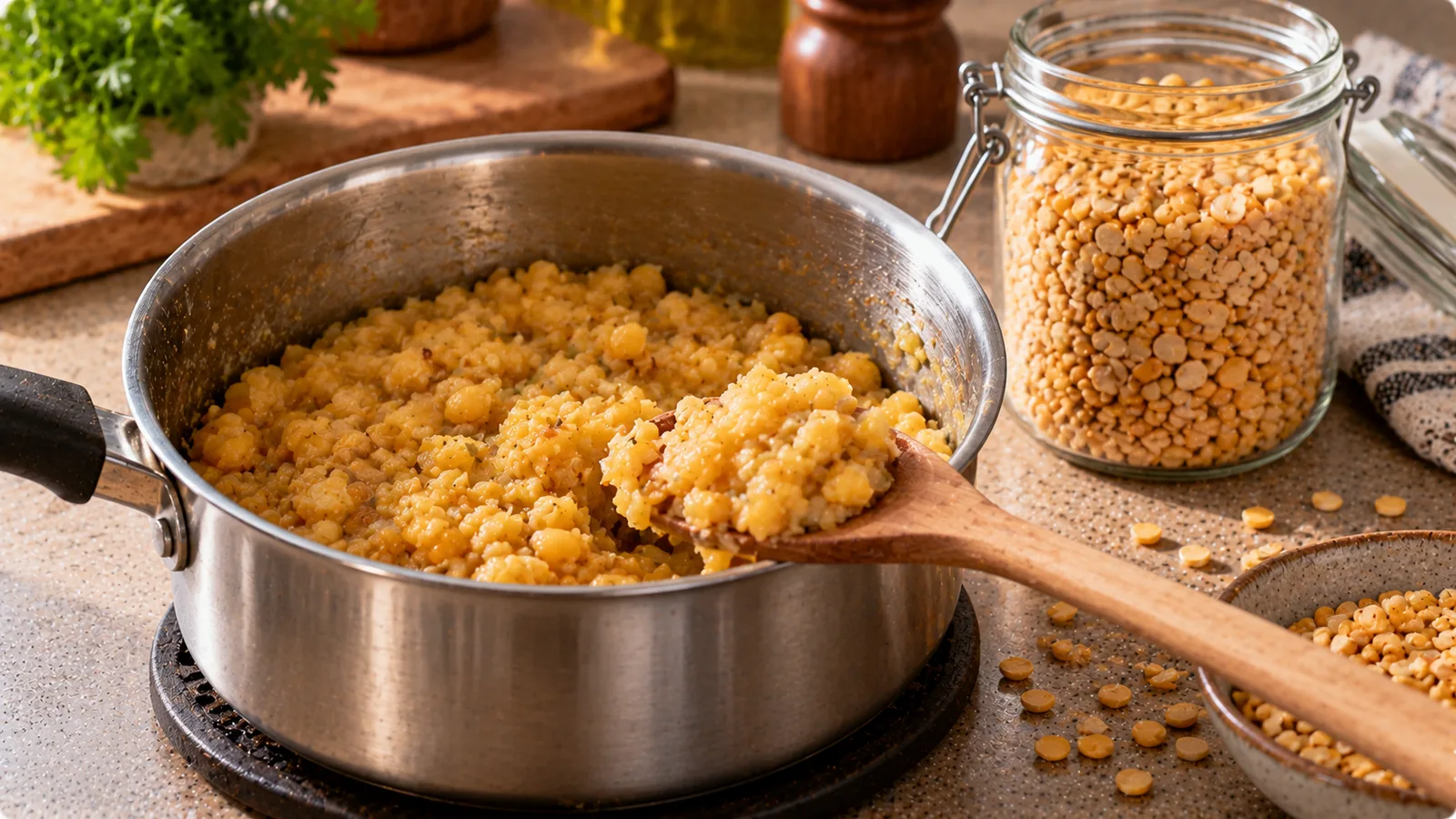
Split peas are dried peas that have been peeled and divided into two halves. They are commonly used in thick soups, purées and simple legume dishes.
The most important detail when counting their calories is whether you are weighing them dry or after cooking.
Plain boiled split peas provide approximately 118 kcal per 100 g, while dry split peas provide approximately 341 kcal per 100 g.
The difference is mainly caused by water absorbed during cooking. It does not mean that most of the original calories disappear.
Split pea nutrition per 100 g
These are rounded reference values for mature split peas, without added oil or other ingredients.
| Nutrient | Dry split peas | Boiled split peas |
|---|---|---|
| Calories | 341 kcal | 118 kcal |
| Protein | 24.6 g | 8.3 g |
| Carbohydrates, US total | 60.4 g | 21.1 g |
| Fat | 1.2 g | 0.4 g |
| Fiber | 25.5 g | 8.3 g |
Values are approximate and depend on the food composition record, variety, cooking method and retained water.
The carbohydrate values above follow the US convention, which includes dietary fiber in total carbohydrate. European nutrition labels normally report carbohydrate and fiber separately. Check the definition before comparing the two.
Calories in common cooked portions
The following table uses 118 kcal, 8.3 g protein and 21.1 g total carbohydrate per 100 g of plain boiled split peas.
| Cooked weight | Calories | Protein | Total carbohydrates |
|---|---|---|---|
| 50 g | 59 kcal | 4.2 g | 10.6 g |
| 100 g | 118 kcal | 8.3 g | 21.1 g |
| 150 g | 177 kcal | 12.5 g | 31.7 g |
| 200 g | 236 kcal | 16.6 g | 42.2 g |
| 250 g | 295 kcal | 20.8 g | 52.8 g |
| 300 g | 354 kcal | 24.9 g | 63.3 g |
These are calculations based on a single reference, not separate measurements of each portion.
A bowl or cup does not have one universal weight. For better accuracy, weigh the cooked food rather than relying on container size.
Why dry split peas have more calories per 100 g
Dry split peas contain relatively little water.
During boiling, they absorb water, soften and often begin to break down. This increases the total weight of the food.
For example, imagine that 100 g of dry split peas are cooked and the finished drained preparation weighs 280 g.
The dry starting amount contains approximately 341 kcal.
If all of that energy were retained, the calculation would be:
341 ÷ 280 × 100 = approximately 122 kcal per 100 g cooked.
This example illustrates dilution through hydration. It is not a guaranteed cooked yield or an exact retention calculation: some nutrients may move into discarded cooking water.
The actual finished weight depends on cooking time, water quantity and whether the cooking liquid is retained.
Dry-to-cooked portion example
Suppose you use 200 g dry split peas for a batch.
Based on the dry reference, the peas contribute approximately:
200 × 341 ÷ 100 = 682 kcal.
After cooking, the complete batch weighs 600 g.
If the batch contains only peas and water, and the simplified calculation assumes no energy loss, then:
682 ÷ 600 × 100 = approximately 114 kcal per 100 g finished food.
A 150 g serving represents one-quarter of the batch, or approximately 171 kcal under the same assumptions.
For homemade preparations, using your actual dry ingredient weights and measured final yield is often more consistent than assuming every cooked batch has identical water content.
Green versus yellow split peas
Both green and yellow split peas are forms of dried peas.
Their appearance and flavor differ somewhat, but they generally have broadly similar nutritional profiles.
Exact calories and macronutrients can vary between varieties and commercial products.
For packaged split peas, use the nutrition declaration of the product you actually purchased when available.
Do not assume that color alone establishes a meaningful calorie difference.
Split peas versus fresh green peas
Split peas are not nutritionally interchangeable by weight with fresh garden peas.
Fresh green peas contain much more water and are usually eaten without the drying and splitting process.
A database entry for fresh peas is therefore not suitable for calculating a portion of dry split peas.
Likewise, a cooked split-pea entry should not be used for the weight of uncooked dried peas.
Protein and fiber in split peas
Split peas supply plant protein and dietary fiber.
A 200 g portion of plain boiled split peas provides approximately 16.6 g protein and 16.6 g fiber using the reference values above.
They can contribute to daily protein intake, although they should not automatically be treated as nutritionally equivalent to fish, eggs or dairy products.
A varied diet helps provide a broader range of essential amino acids and other nutrients.
The fiber content can make split peas a useful component of filling meals.
However, large portions may cause bloating or digestive discomfort in some people, particularly when legume intake increases suddenly.
Increasing portions gradually and cooking the peas thoroughly may improve tolerance.
Are split peas suitable for weight loss?
Split peas can fit into a calorie-controlled diet.
Their protein and fiber content can help make a meal satisfying, but no individual food guarantees weight loss.
The complete recipe and serving size matter.
Plain split peas cooked in water are different from split-pea soup made with oil, cream, sausage or other energy-containing ingredients.
For a complete food diary entry, include everything added during cooking.
How to track split peas correctly
Choose a database entry matching the food at the time it was weighed.
| What you weighed | Appropriate entry |
|---|---|
| Uncooked split peas | Split peas, dry |
| Plain boiled split peas | Split peas, cooked |
| Thick split-pea purée | Recipe or cooked split peas plus additions |
| Split-pea soup | Complete soup recipe |
| Packaged prepared split peas | Exact product label |
If the dish contains additional vegetables, fat or other ingredients, the calories of plain cooked split peas alone will not describe the full dish.
Tracking a batch without confusion
For a homemade batch:
- Weigh the dry split peas before cooking.
- Record any oil, butter or other calorie-containing ingredients.
- Cook the dish as usual.
- Weigh the final edible preparation.
- Divide the recipe's total calories by its final weight.
- Multiply by the weight of the portion eaten.
This method accounts for your particular water absorption and evaporation.
It is especially useful when split peas cook down into a thick, partially broken-down texture.
Common errors when logging split peas
Using dry calories for cooked weight
Applying approximately 341 kcal to 100 g of plain cooked split peas can greatly overestimate the portion's energy.
Using cooked calories for dry weight
Applying 118 kcal to 100 g of dry split peas can substantially underestimate the energy in the starting ingredient.
Assuming every cooked batch has the same yield
Different cooking methods produce different final water contents.
Treating split-pea soup as plain peas
Soup may contain more water and additional ingredients, changing its calories per 100 g.
Mixing carbohydrate definitions
US total carbohydrates and European declared carbohydrates are not necessarily identical because dietary fiber is handled differently.
Sources and reference notes
- USDA FoodData Central — food composition references for mature split peas in dry and boiled forms.
- EU Regulation No 1169/2011 — European food nutrition labeling conventions.
- USDA MyPlate: Beans, Peas and Lentils — dietary context for legumes.
The nutrition figures are rounded reference estimates, not measurements of a particular package or homemade batch.
Key takeaway
For plain split peas, use approximately 341 kcal per 100 g dry or 118 kcal per 100 g boiled.
The major difference comes from water absorption.
When tracking homemade split peas, match the database entry to the weighed form or calculate the recipe from its dry ingredients and actual cooked yield.