
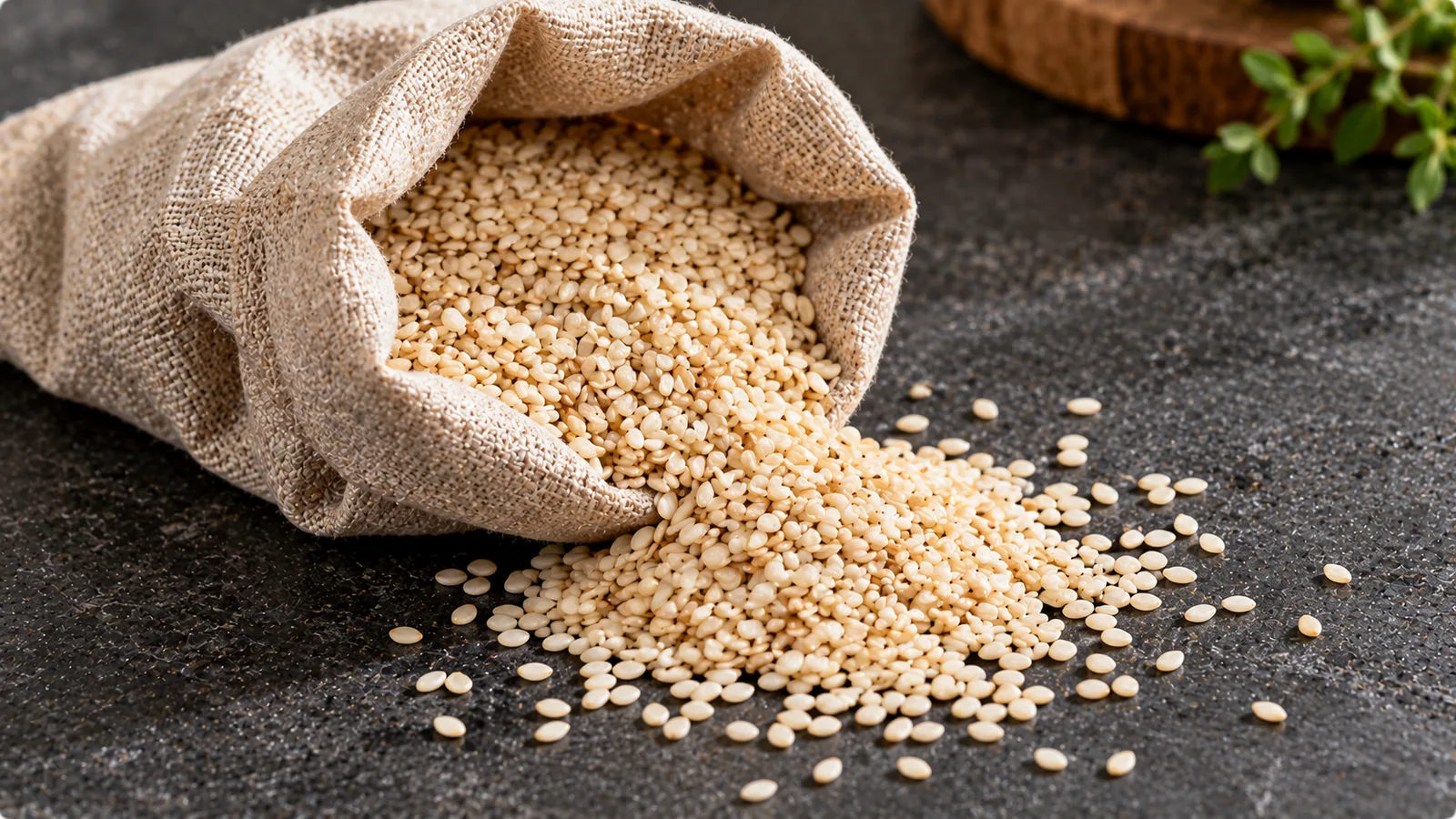
Sesame seeds are small, but they contain a substantial amount of energy. Their relatively high fat content makes them calorie-dense, even when they are used only as a topping.
A sprinkle on bread, a spoonful in a salad or a larger quantity in a homemade sauce can contribute different amounts of calories.
The most reliable way to estimate that contribution is to measure the weight of the seeds and use nutrition information that matches the product.
How many calories are in sesame seeds?
A commonly used reference for whole, dried sesame seeds is approximately 573 kcal per 100 g.
That is equivalent to about 5.73 kcal per gram.
The following table shows calculated portions:
| Sesame seeds | Estimated calories |
|---|---|
| 5 g | 29 kcal |
| 10 g | 57 kcal |
| 15 g | 86 kcal |
| 20 g | 115 kcal |
| 25 g | 143 kcal |
| 30 g | 172 kcal |
| 40 g | 229 kcal |
| 50 g | 287 kcal |
| 100 g | 573 kcal |
These figures are estimates derived from a single reference profile, not guaranteed values for every variety or brand.
Hulled, unhulled, toasted and processed sesame products can have different nutritional values. Product labels should take priority when available.
Calories in a tablespoon of sesame seeds
A tablespoon is a volume measurement rather than a fixed weight.
Depending on how the spoon is filled and the type of sesame seeds, a tablespoon may contain roughly 9 g of seeds.
At 573 kcal per 100 g, 9 g provides approximately 52 kcal.
If your tablespoon contains 12 g, the estimated contribution rises to approximately 69 kcal.
The difference illustrates why spoon measurements are less accurate than weighing.
A teaspoon may contain approximately one-third of the volume of a tablespoon, but its exact weight still depends on the seeds and how the spoon is filled.
For occasional cooking, a spoon estimate can be practical. For detailed calorie tracking, grams are preferable.
Sesame seed nutrition per 100 g and 15 g
The following table uses a reference profile for whole dried sesame seeds.
| Nutrient | 100 g | 15 g |
|---|---|---|
| Energy | 573 kcal | 86 kcal |
| Protein | 17.7 g | 2.7 g |
| Total fat | 49.7 g | 7.5 g |
| Total carbohydrate, including fiber | 23.5 g | 3.5 g |
| Dietary fiber | 11.8 g | 1.8 g |
| Calcium | 975 mg | 146 mg |
| Iron | 14.6 mg | 2.2 mg |
| Magnesium | 351 mg | 53 mg |
The values are rounded estimates based on USDA food composition data.
Carbohydrate labeling note: The carbohydrate figure in this reference includes dietary fiber. Many European nutrition labels list carbohydrate separately from fiber. These different conventions should not be compared directly without adjustment.
The mineral figures describe the amount present in the food, not necessarily the amount absorbed by the body.
Source: USDA FoodData Central.
Why are sesame seeds high in calories?
Sesame seeds contain close to half their weight as fat in the reference profile.
Fat provides more energy per gram than protein or digestible carbohydrate, making fat-rich seeds particularly energy-dense.
This does not make sesame seeds inherently unhealthy.
They contain predominantly unsaturated fats, alongside protein, fiber and minerals.
However, a food can provide useful nutrients and still contribute a meaningful number of calories.
For example, adding 20 g of sesame seeds to a meal adds approximately 115 kcal, before accounting for any oil, dressing or other ingredients.
Whether that amount fits your eating plan depends on your total food intake and individual goals.
Hulled versus unhulled sesame seeds
Sesame seeds may be sold with their outer hull intact or with the hull removed.
Unhulled seeds retain the outer covering.
Hulled seeds have had that covering removed, changing their texture and some aspects of their nutrient composition.
The distinction is especially relevant when comparing minerals such as calcium.
Some food composition references show much higher total calcium in whole, unhulled sesame seeds than in hulled seeds.
However, total calcium content does not equal calcium absorbed.
Sesame seeds contain compounds such as oxalates and phytates that can affect mineral availability.
The precise amount and bioavailability depend on the variety and processing.
Do not assume that every sesame product provides the same calcium amount as the whole-seed reference table.
If the product specifies hulled or unhulled seeds, choose the matching nutrition entry.
White sesame versus black sesame
White and black sesame seeds are commonly used in different dishes.
Their color does not establish an exact calorie value.
Variety, hull status, moisture and processing all affect the composition of a product.
Black sesame seeds are sometimes sold with their hulls, while white sesame seeds may be hulled, but this is not a universal rule.
A black sesame product is not automatically higher in calcium, and a white sesame product is not automatically lower in calories.
For reliable comparisons, check the actual product description and nutrition label.
Raw versus toasted sesame seeds
Toasting sesame seeds develops a stronger aroma and a more pronounced nutty flavor.
During dry toasting, moisture can be lost, which may change nutrient concentrations when expressed per 100 g.
The original seeds do not gain calories simply because they are heated.
If you toast 15 g of sesame seeds in a dry pan without adding other ingredients, the starting seeds contain approximately 86 kcal according to the reference profile.
However, the final weight may be slightly lower because of moisture loss.
If oil is added, the oil contributes additional calories.
For example, 5 g of olive oil adds approximately 44 kcal to the entire preparation.
Record both the seeds and the added oil.
Sesame seeds versus tahini
Tahini is a paste made from ground sesame seeds.
It is related to sesame seeds but is not always nutritionally identical to the whole-seed reference.
Tahini can be produced from hulled or unhulled seeds, and products differ in their composition and processing.
Its texture also makes volume measurements unreliable.
A tablespoon of tahini can weigh substantially more than a tablespoon of loose sesame seeds.
When logging tahini, select a tahini entry or use its product label rather than recording the same spoonful as whole sesame seeds.
This distinction matters especially in dressings, hummus and sauces, where several tablespoons may be used.
Practical portions in everyday meals
Sesame seeds are often used as an ingredient rather than eaten as a large standalone serving.
| Use | Example quantity | Estimated calories |
|---|---|---|
| Light topping on vegetables | 5 g | 29 kcal |
| Garnish for a rice bowl | 10 g | 57 kcal |
| Added to homemade bread | 15 g | 86 kcal |
| Sesame coating for a dish | 20 g | 115 kcal |
| Larger recipe ingredient | 30 g | 172 kcal |
These are culinary examples, not prescribed daily serving sizes.
The best amount depends on the recipe, your preferences and the other ingredients.
How to calculate sesame calories in a recipe
Calculate the calories from the weight of sesame seeds used.
For example, suppose a recipe includes 40 g sesame seeds.
Using the reference value:
40 × 5.73 = 229 kcal, rounded.
If the finished recipe makes four equal servings, sesame contributes approximately:
229 ÷ 4 = 57 kcal per serving.
This calculation covers only the sesame seeds.
Oil, flour, meat, vegetables, sauces and other ingredients must be counted separately.
If portions are not equal, divide the complete recipe's nutrition according to the actual serving weights.
Example: homemade sesame dressing
Suppose a dressing contains:
- 15 g sesame seeds.
- 10 g olive oil.
- Lemon juice.
- Water.
- Garlic and seasoning.
The sesame seeds contribute approximately 86 kcal.
The olive oil contributes approximately 88 kcal.
Together, those two ingredients contribute approximately 174 kcal before the smaller contributions from other ingredients.
If the dressing is divided into two equal portions, each contains about 87 kcal from the sesame and oil combined.
A dressing made with tahini instead of whole seeds must be calculated using the tahini's nutrition information.
Sesame seeds and protein
Sesame seeds provide approximately 17.7 g protein per 100 g in the reference profile.
A 15 g portion supplies about 2.7 g.
That is a useful contribution, but sesame seeds are not usually an efficient primary protein source when compared with foods that provide more protein relative to their calorie content.
For example, obtaining 15 g protein from sesame seeds alone would require a comparatively large quantity and several hundred calories.
Sesame seeds are better viewed as one component of a varied meal.
Their protein contribution can complement other foods such as beans, lentils, yogurt or eggs.
Sesame seeds and dietary fiber
The reference profile contains approximately 11.8 g dietary fiber per 100 g.
That corresponds to:
- About 0.6 g fiber in 5 g.
- About 1.2 g in 10 g.
- About 1.8 g in 15 g.
- About 3.5 g in 30 g.
The amounts may vary between hulled and unhulled products.
Although sesame seeds contain fiber, the relatively small quantities commonly used as toppings do not necessarily provide a large share of daily fiber intake.
Whole grains, legumes, vegetables and fruit can help provide additional dietary fiber.
Sesame seeds and minerals
Sesame seeds contain minerals including calcium, iron and magnesium.
However, mineral content can vary considerably by product.
Hulling is particularly relevant to calcium measurements.
Food composition data can describe total mineral content, but that is not the same as the quantity absorbed.
It is therefore misleading to claim that every 15 g sesame portion provides a fixed percentage of someone's calcium needs.
Use product-specific data where available and consider the broader diet rather than relying on one ingredient.
Sesame allergy: an important consideration
Sesame is a recognized food allergen.
For people with sesame allergy, even small amounts can cause reactions, and avoidance may be medically necessary.
Sesame can appear in bread toppings, crackers, sauces, tahini, hummus and mixed spice products.
In the European Union, sesame seeds and products made from them are among the allergens that must be declared when used as ingredients under applicable food information rules.
In the United States, sesame is also recognized as a major food allergen.
Always check the full ingredient list and allergen information if sesame allergy is relevant.
Sources: EU Regulation 1169/2011 and FDA — Food Allergies.
Storage and freshness
Sesame seeds contain substantial amounts of fat, so storage conditions matter.
Keep them in a tightly closed container away from heat, moisture and direct sunlight.
Follow the storage instructions on the packaging.
For longer storage, refrigeration may help maintain quality, especially for opened products.
Discard seeds that develop an unpleasant rancid smell or taste.
Toasted seeds may lose their fresh aroma over time, so toasting small amounts shortly before use can be useful.
Common calorie-tracking mistakes
Counting a tablespoon as an exact weight. The amount varies with seed size and spoon filling.
Using whole-seed nutrition for tahini. Tahini products have their own composition and serving weight.
Ignoring added oil during toasting. The oil adds calories even when the seeds are the main ingredient.
Treating all sesame products as nutritionally identical. Hull removal and processing can affect the nutrient profile.
Using a large 100 g reference as though it were a normal topping. Most toppings are much smaller, so calculate the actual portion.
Forgetting sesame in sauces or baked goods. Small amounts used repeatedly can add up.
Assuming the mineral content shown in a database is fully absorbed. Bioavailability can differ.
The most reliable way to track sesame seeds
For everyday nutrition tracking:
- Identify whether the product is whole, hulled, unhulled, toasted or tahini.
- Use the specific product's nutrition label when available.
- Weigh the amount in grams.
- Include any oil or other ingredients used in preparation.
- Calculate nutrition for the complete recipe.
- Divide by actual serving size rather than assuming all portions are equal.
Key takeaway
Whole dried sesame seeds contain approximately 573 kcal per 100 g in a common reference profile.
A 15 g portion provides about 86 kcal, while a 30 g portion provides about 172 kcal.
Sesame seeds also contribute unsaturated fats, protein, fiber and minerals, although exact nutrient amounts differ between products.
For accurate tracking, distinguish whole seeds from tahini, check whether the seeds are hulled or unhulled, and weigh the quantity you actually use.