
The useful number and its limits
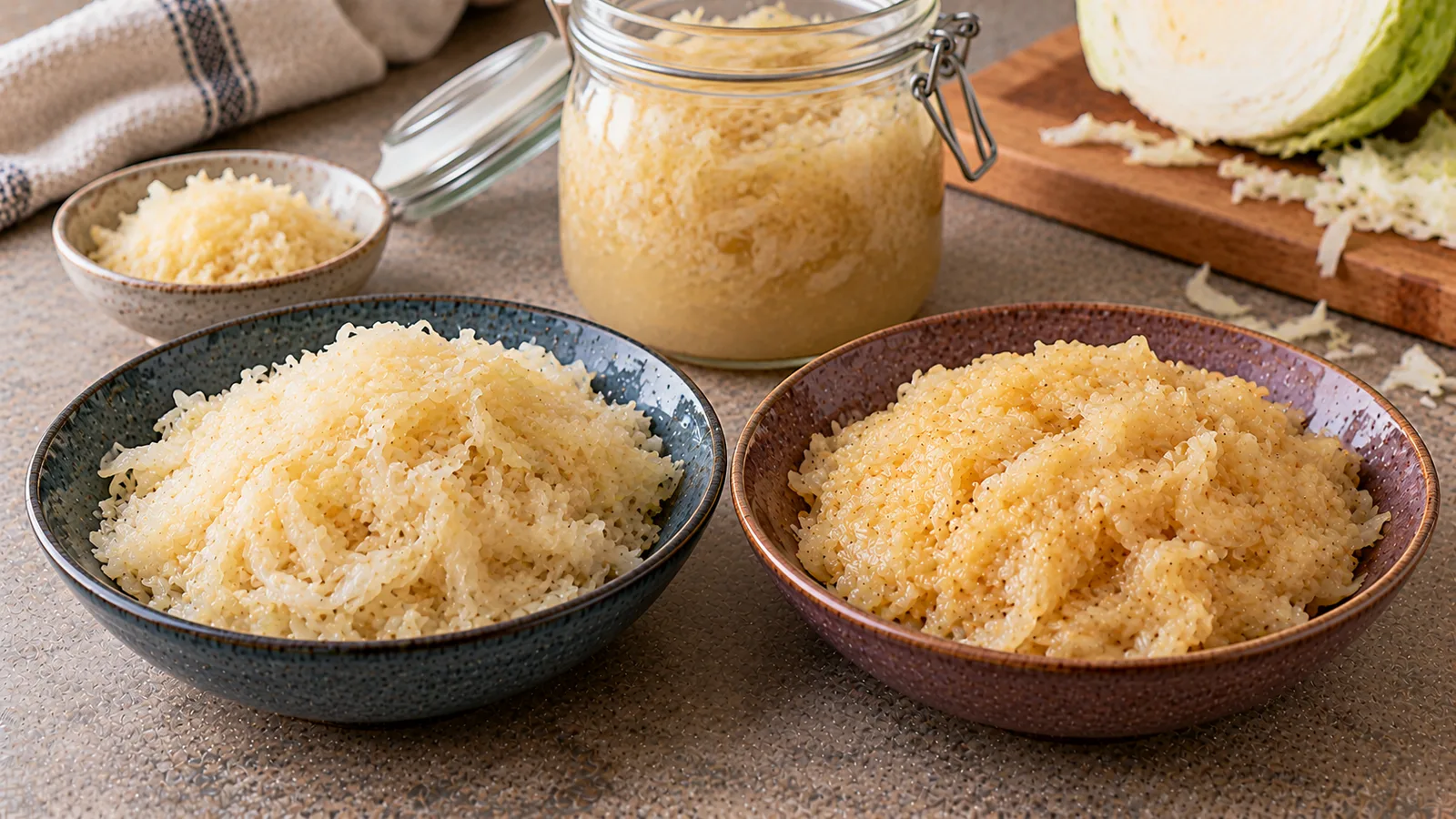
For plain sauerkraut, an established USDA SR Legacy reference reports 19 kcal per 100 g, together with 0.91 g protein, 0.14 g fat and 4.28 g carbohydrate. Its exact description is “sauerkraut, canned, solids and liquids”, FoodData Central 169279. This is a reference point, not a universal value for every homemade batch, rinsed jar, restaurant side or buttery cooked dish. A weighed portion and the product label usually answer the practical question more reliably than a volume estimate. The familiar sharp flavour comes from fermentation and added salt; neither sourness nor an image of the food proves how many calories or how much salt it contains. USDA source.
Calories by portion of the reference product
The following simple multiplications apply only to the same reference product in the same state, including its liquid. They are useful as a starting point when a plain jar lists similar nutrition. A smaller serving does not need a different calorie density: multiply the grams you actually eat by 19 and divide by 100. If you serve cabbage without its brine, switch to the drained-weight and label procedure below rather than pretending that this table describes the drained solids. The distinction matters when comparing a wet scoop from the jar with a squeezed mound on a plate.
| Portion weight | Energy (rounded) |
|---|---|
| 50 g | 10 kcal |
| 100 g | 19 kcal |
| 150 g | 29 kcal |
| 200 g | 38 kcal |
Food calories come from the amount actually eaten, not from the weight of discarded packaging or brine.
What happens when you drain or squeeze it?
A jar may state net weight and a separate drained weight. Net weight includes liquid; drained weight describes the material left after the declared drainage procedure. For example, a hypothetical 500 g jar might supply 350 g drained cabbage. The 350 g is a demonstration, not a typical yield. If you eat 150 g of that drained cabbage, you can be certain of the weight but not its exact calories from a record for solids plus liquid. The brine and solids do not have identical composition, and squeezing removes variable amounts. Prefer the pack's nutrition declaration for the edible form you consume, or a database entry explicitly matching the drained form. Record discarded brine separately if it matters to a recipe.
Does heating change the calories?
Heating plain sauerkraut does not introduce energy by itself. Yet its calories per 100 g can change if water evaporates, cooking liquid is discarded or extra broth is added. Imagine 300 g of cabbage initially contributing 57 kcal on the reference assumption. If cooking removes 50 g of water and the other ingredients add no energy, the entire batch is still about 57 kcal, now spread across roughly 250 g. That works out to about 23 kcal per 100 g of the hypothetical cooked batch; this is a mass-balance example, not a measured USDA value for cooked sauerkraut. Weigh the finished batch whenever a per-100-g figure for your own recipe is needed.
Oil, butter, bacon and apple: what actually adds energy
The highest-impact change in many cooked versions is the ingredients added. 5 g of oil contributes approximately 45 kcal and 10 g about 90 kcal; count only what stays in the food. If the dish begins with 150 g of the referenced sauerkraut, its approximate 29 kcal plus 5 g oil gives about 74 kcal, before any other ingredients. Bacon, sausage, butter, sugar, apple and potatoes can all alter the finished dish; their amounts cannot be inferred from the word “sauerkraut.” If frying fat is partly left in the pan, a weighed recipe or a justified retention estimate is better than automatically counting a large unmeasured splash.
Sodium and salt on different labels
The USDA reference reports 661 mg sodium per 100 g, equivalent to about 1.65 g salt using the European declaration conversion of sodium × 2.5. A 150 g portion of that reference gives about 992 mg sodium, or 2.48 g salt equivalent. These are sodium and calculated salt, not two quantities of salt to add together. Some brands are lower or higher; a rinse may remove part of the surface brine but does not justify an invented percentage reduction. The EU uses salt equivalent on nutrition labels, while US panels commonly emphasise sodium. Compare like with like: per 100 g on the package and then multiply by the amount eaten. EU salt explanation.
Cold, warm, homemade and packaged versions
Refrigerated fermented sauerkraut, pasteurised jarred cabbage and homemade batches can have different water, sugar, salt and acid profiles. Heating changes texture and may affect living microorganisms, so a cooked side should not be advertised as a guaranteed live-culture product. A traditional cabbage fermentation uses salt and controlled conditions; do not extrapolate safe fermentation practices from a calorie reference. Packages can also contain wine, sugar, onion or spices. Those additions may or may not materially change calories, but only ingredients and a reliable label can establish their contribution. No single USDA number authenticates every commercial recipe or home preparation.
Two realistic plate calculations
Cold side: weigh 100 g of plain product matching the cited wet reference. That corresponds to approximately 19 kcal, before dressing. Warm side: weigh 150 g of the reference product before heating and add 5 g oil, assuming no food or fat is discarded. The ingredient sum is approximately 29 + 45 = 74 kcal. A splash of water during cooking affects final weight but not the ingredient sum. If that mixture finishes at 125 g, the 74 kcal are concentrated into a smaller total mass. Neither example is an estimate for a restaurant portion with unspecified meat, potatoes or cream.
For related calculations, see how drained weight works · how raw and cooked weight affects tracking.
A quick method to log the serving
First identify whether the product is plain, seasoned or part of a complete dish. Next read the nutrition information per 100 g and check whether the stated weight is net, drained or prepared. Then weigh the quantity that goes onto the plate; if you cook a batch, record all additions and the final cooked weight. Divide total ingredient calories between actual servings, not an assumed count. For salt, use the value expressed on your local label and convert only if needed. When a label is available, it generally takes priority over a generic reference for that brand and preparation.
The separate intent from kimchi
Sauerkraut is most often described as fermented cabbage with a comparatively simple seasoning profile; kimchi is a separate group of fermented vegetables with its own ingredients and salt profile. Do not copy the values of a kimchi article into a sauerkraut calculation, or the reverse. For sauerkraut, the decision is whether the portion is plain, drained or cooked with added ingredients. This distinction makes the page useful even if you already know the generic calories in cabbage. If precise medical sodium limits apply to you, use the labelled product and seek appropriate professional guidance rather than relying on a generic database entry.